How to break bad news: SPIKES, step by step

To break bad news, use SPIKES, the six steps from Baile and colleagues (2000): set up, ask what they know, ask how much they want, warn then tell, respond to emotion, agree a plan.
Key takeaways
- Ask, "What have you been told about your medical situation so far?"
- Warn first, then give small chunks in nontechnical words, checking understanding.
- Name the emotion, the step 52% expected hardest (Baile 2000).
Before you say a word: set up the room
Before you speak, make the room fit the task. Protect privacy, invite whoever the patient wants, sit at eye level, and prevent interruptions. If there's no room, draw curtains, hand your bleep to a colleague or set it silent, and rehearse your opening lines.
Check with your senior and local policy who should lead and attend; involving your senior early is the default. The GMC decision making guidance warns serious harm can result if patients are not listened to, so build rapport before hard news.
Before the real thing, practise asking about ideas and concerns with an AI patient; it's for history practice only. It does not run a bad-news conversation.
The six SPIKES steps, in order
SPIKES sets out six steps for structuring a bad-news conversation, developed by Baile and colleagues in The Oncologist, 2000. Six practical steps help you organise what you say, how you check understanding, and when to pause.
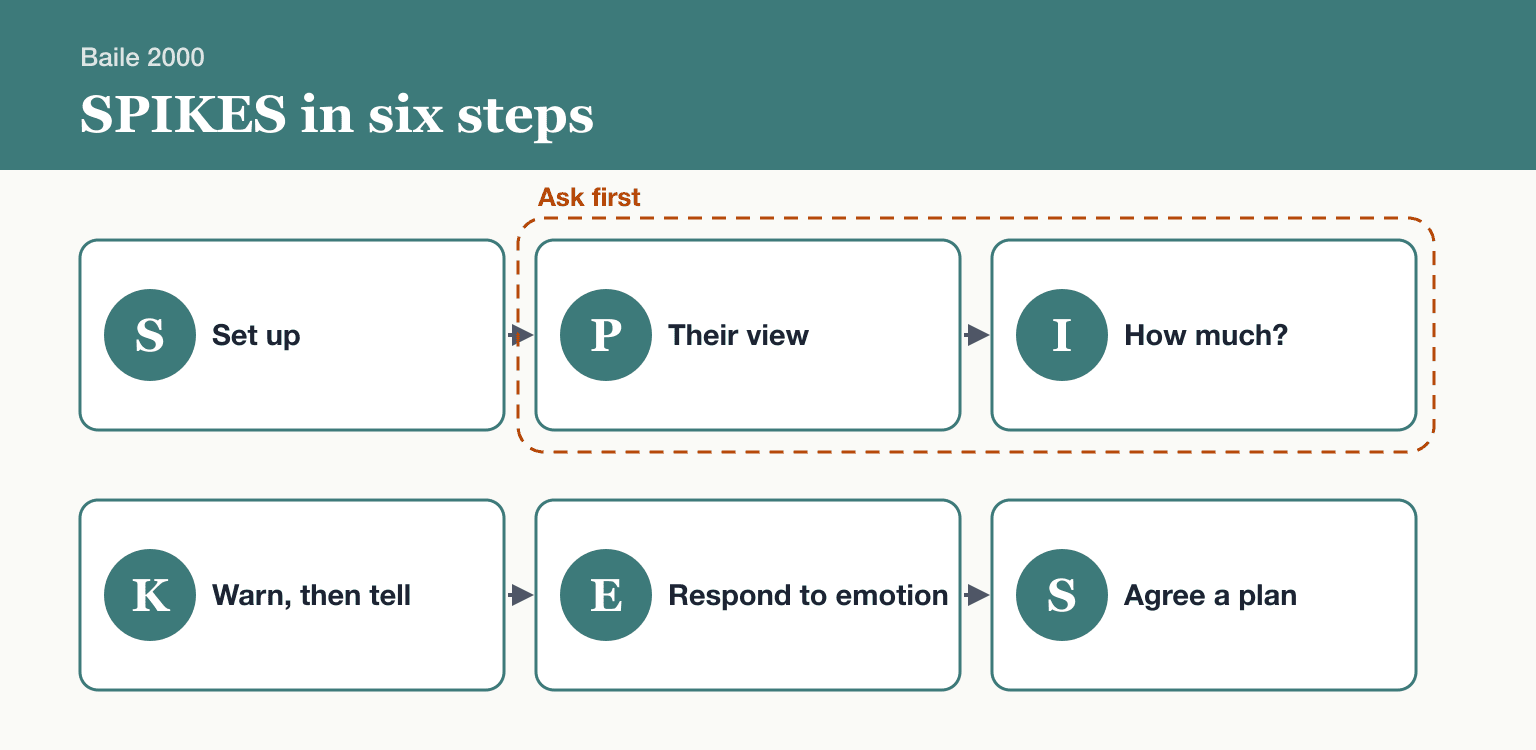
SPIKES in order, from setting up to strategy and summary, for difficult conversations.
The six steps in the original SPIKES paper are practical and reusable across settings:
- Setting up: Make privacy and comfort deliberate, involve chosen others, sit down, and manage interruptions. "Arrange for some privacy"
- Perception: Before you tell, ask what they already understand and how worried they feel. "What have you been told about your medical situation so far?"
- Invitation: Ask how much they want to know. If they don't, offer to return or speak to a relative or friend.
- Knowledge: Give a warning shot. Use plain words like spread, not metastasised, in small chunks, and check understanding. "Unfortunately I've got some bad news to tell you"
- Emotions: Pause, observe and name the emotion, identify the reason, then make a short empathic connecting statement before moving on.
- Strategy and summary: Ask if they feel ready to discuss a plan. Summarise what was said and check for misunderstanding or questions.
Steps 2 and 3 are the "before you tell, ask" part.
What to say when they go quiet, cry or get angry
Expect anything from silence to disbelief, crying, denial or anger. An empathic response is your move: observe the emotion, name it, find the reason, then offer a short connecting statement.
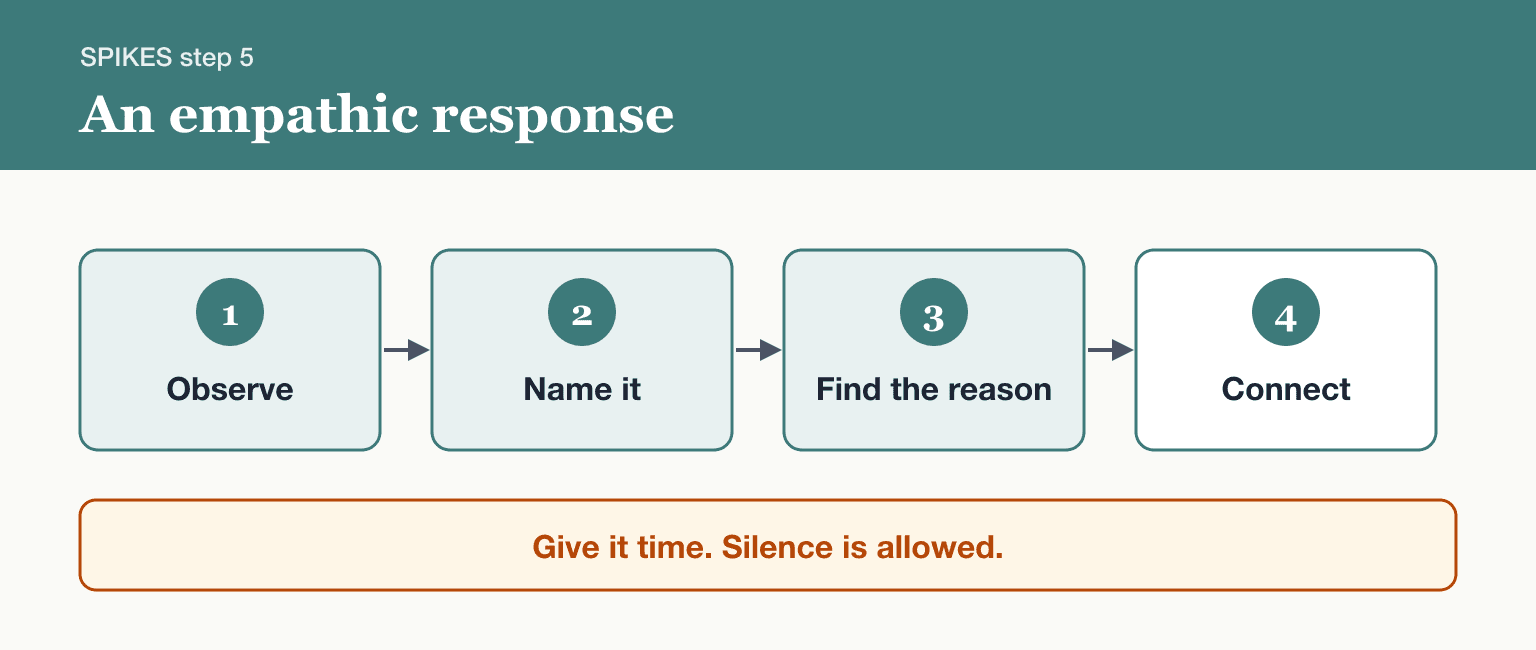
Four moves that fit silence, tears or anger. You won't fix feelings, you meet them.
Observe what you see or hear, name the emotion to yourself, identify the likely reason, then connect with a brief statement after a pause. The SPIKES paper sets out those four moves. A nurse practitioner guide reports responses may range from silence to dramatic sobbing, so leave space for silence.
Use these lines, each serving a different purpose, from the SPIKES paper's Table 2:
Type | What it does | Example line |
|---|---|---|
Empathic | Names and joins the feeling | "I can see how upsetting this is to you." |
Exploratory | Invites the concern into the open | "Could you tell me what you're worried about?" |
Validating | Affirms the reaction as understandable | "I can understand how you felt that way." |
In the ASCO survey reported in the SPIKES paper, 99% found SPIKES practical and easy to understand. 52% said responding to emotions would be the greatest challenge.
If the anger comes from family, see handling angry relatives.
SPIKES on a real case file: Brian, 70 (simulated)
The information SPIKES needs, what the patient thinks, fears and wants, is usually gathered earlier in the history as ideas, concerns and expectations. You'll use it to set the tone, decide who's present, and pitch the level of detail.
Brian Whitaker, 70, a simulated patient from the Diagnosica library, retired accountant, comes in with yellow eyes and skin. The case file's diagnosis is pancreatic cancer, so whoever gives that news later will need what he said during taking a jaundice history. His biggest fear only comes out if you ask directly.
Brian, 70 (simulated): what he said, and the SPIKES step it feeds
Chip | Question | Answer | Why it mattered |
|---|---|---|---|
Volunteered | What brings you in today? | Skin and eyes have gone yellow over weeks. | Perception: his own words for the problem. |
Asked | Who is at home with you? | Married 40-plus years; wife noticed yellow first. | Setting up: who he may want in the room. |
Asked | What do you think is going on? | Maybe gallbladder, or jaundice that would clear up. | Perception: shows the gap between his theory and the news. |
Only if asked specifically | What worries you most? | Afraid it's something serious, like cancer. | Emotions: you already know the fear to acknowledge. |
Only if asked specifically | What are you hoping for? | An explanation, relief from the itch, and to know what happens next. | Invitation and Strategy: he wants clear information and a next step. |
His fear and his hopes, two of the five, only came out because someone asked directly.
Simulated patient. Case file panc-ca-70m. Questions written by us as a model, not a learner session.
Which SPIKES step each answer feeds
Use the history to gather what each SPIKES step needs, and ask ICE early so fears and hopes surface before anyone has news to give or decisions to defend.
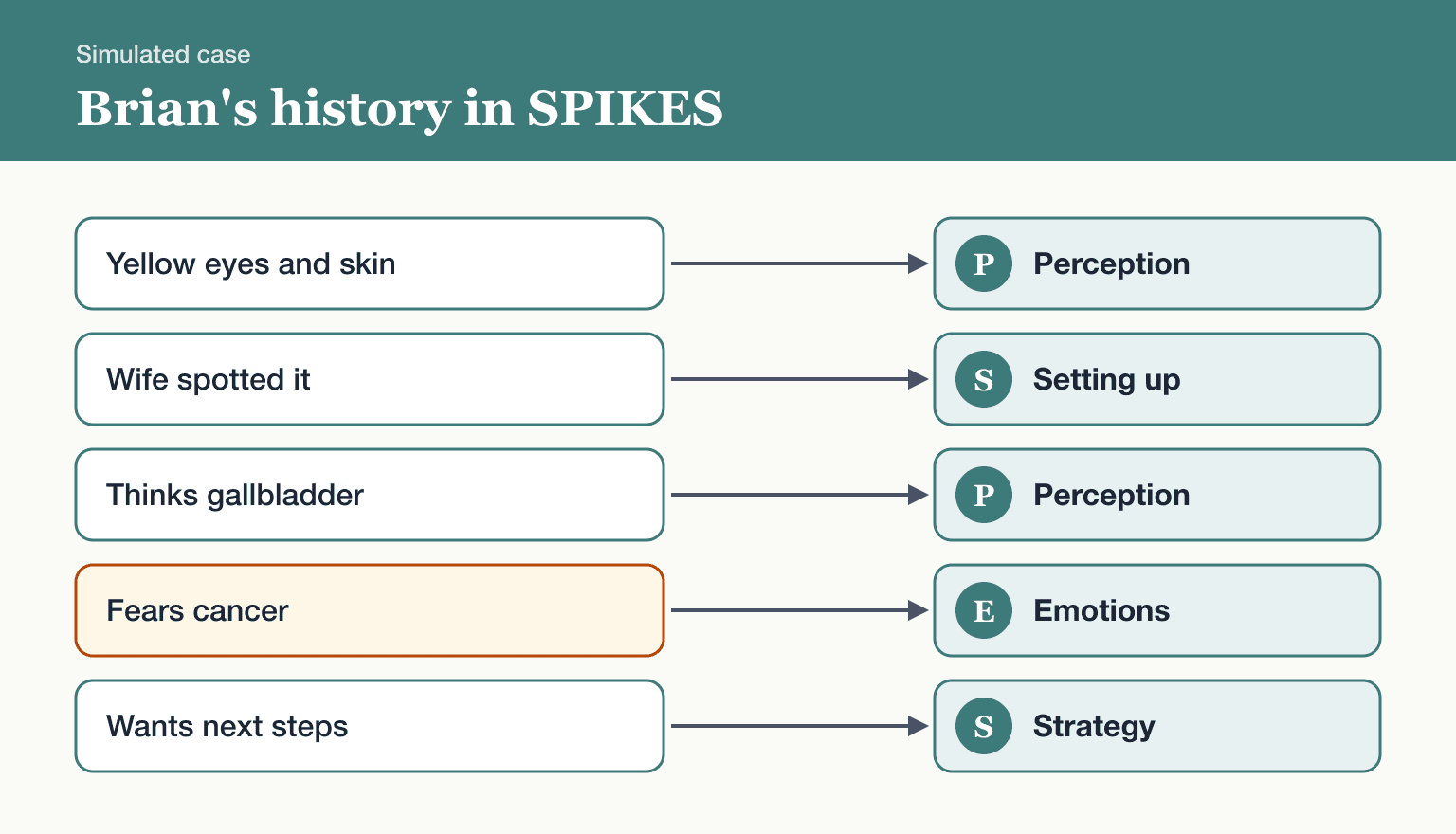
Diagram mapping Brian's history to SPIKES steps for planning a difficult conversation.
Practise eliciting ICE properly; the case scorecard rubric gives communication points for exploring his fear of cancer.
How Diagnosica helps with this
Practise history and elicit ideas, concerns and expectations from an AI patient.
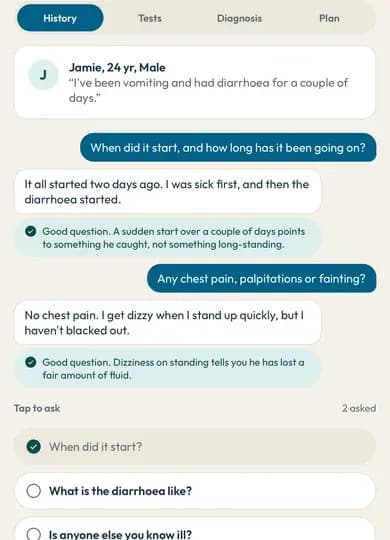
Diagnosica app, history screen in a guided case, as of October 2026.
- History tab with your questions and replies.
- Each reply shows a Good question note.
- In cases ask anything by voice or typing.
Simulated patient. Screenshot from Diagnosica, October 2026.
Take a history from an AI patient, free
Common mistakes that cost marks
How to break bad news in OSCEs often fails for five reasons. They're fixable errors.
Baile et al and the South Tees tips flag these OSCE mark traps:
- No warning shot: give a warning: "Unfortunately I've got some bad news to tell you".
- Jargon over clarity: use plain words, say "spread" instead of "metastasized".
- False finality: avoid saying "There is nothing more we can do for you".
- Canned empathy: never say "I know how you feel".
- Premature reassurance: avoid it, and respect denial without arguing.
Watch out. Do not guess about prognosis or offer answers you do not know; say you will find out the specifics, or bring your senior to discuss next steps together.
See how examiners score communication and South Tees top tips, South Tees Hospitals NHS Foundation Trust tips hosted by NHS North Yorkshire CCG.
How to practise before your OSCE or first shift
Before your OSCE or first shift, practise out loud with a partner playing the patient. Run all six steps. Get them to react with silence, tears or anger. Time it, swap roles, then repeat until the words feel natural.
The history is where you learn what the patient fears, hopes and expects. Drill eliciting ideas, concerns and expectations. Practise the exact phrases you'll use under pressure. Fold that into your wider OSCE preparation.
Diagnosica does not run a breaking-bad-news conversation. It lets you take a history from an AI patient by voice or text, with a video avatar, draw out ideas, concerns and expectations, and see a scorecard. For reps, take a full history from an AI patient.