How to prepare for an OSCE
To prepare for an OSCE, start eight weeks out, learn station structure, practise out loud with a timer, then taper in the final two weeks. In the UK, medical schools set and deliver the CPSA.
Key takeaways
- Check school timings, marks, decide plan.
- Practise histories aloud with a timer, choose partner runs or solo drills, commit daily.
- After every run, fix one thing before the next.
- In the final two weeks, prioritise sleep and read each station brief twice, no cramming.
What your OSCE tests and who sets it
For UK students, the OSCE that counts towards licensing is the Clinical and Professional Skills Assessment. It sits within the Medical Licensing Assessment alongside the applied knowledge test, and is set by your school. The CPSA is your OSCE within the MLA.
On the GMC's CPSA page, it’s described as a performance-based assessment of clinical and professional skills. The GMC will quality assure each school's exam against requirements. UK medical schools set and deliver the CPSA. The Medical Schools Council says the MLA is administered by your medical school. Format varies by school, including station length and scoring, per Pastest's OSCE guide.
Find out these from your school this week:
- Exact station timings and any reading or reset time.
- The mark scheme or domains your school uses.
- Which station types appear, and any paired or examiner-led formats.
If you want a quick run, practise one history station with an AI patient.
The eight-week OSCE plan at a glance
Eight weeks is enough to cover every station type twice if you split it into phases. This is a suggested structure, not an official timetable.
Work through these five phases and keep the weeks visible on your wall:
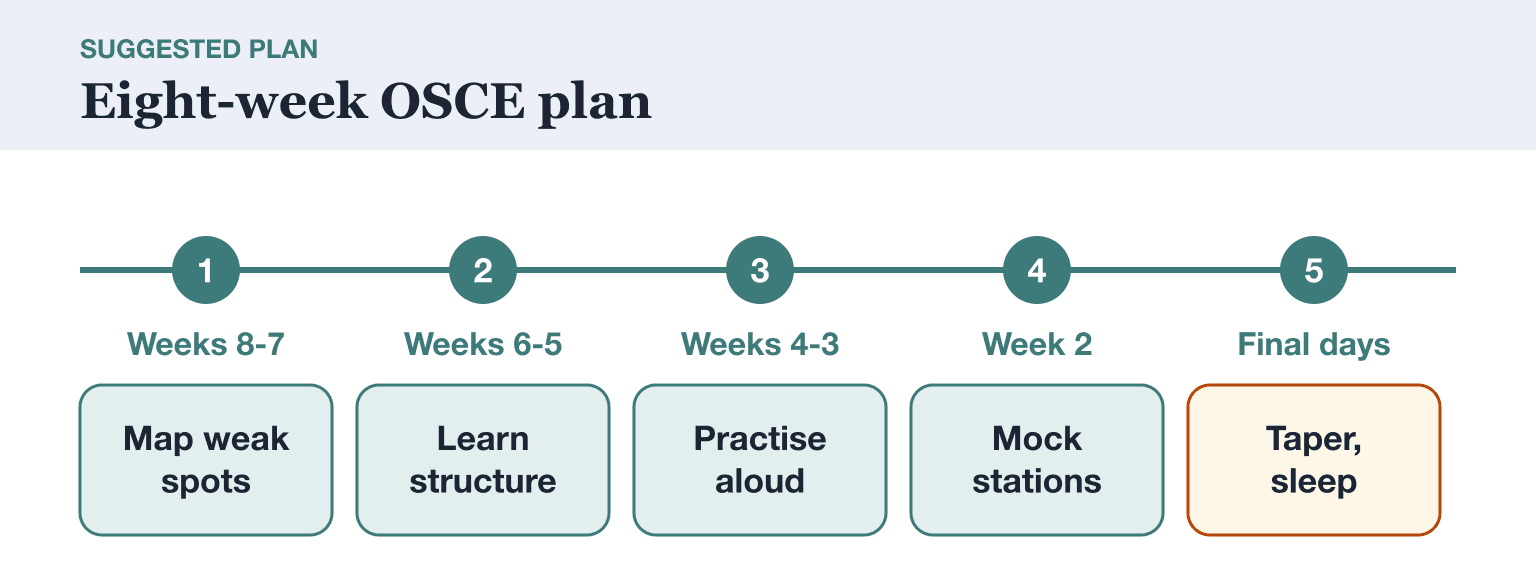
Suggested eight-week plan: weeks 8 to 7 map weak spots; 6 to 5 structure; 4 to 3 practise aloud; week 2 mocks; days taper, sleep.
- Find weak station types and map them, Weeks 8 to 7, then target them per the BMA's OSCE tips.
- Learn station structures, Weeks 6 to 5, for every type you expect to meet.
- Practise stations out loud, Weeks 4 to 3, against a timer, with a partner or solo.
- Run mock stations under exam conditions, Week 2, then review feedback the same day.
- Protect sleep and taper, Final days, and read every station brief carefully on entry.
Cross check each week against the MLA content map. It’s underpinned by readiness for safe practice, managing uncertainty, and person-centred care. Per Geeky Medics' OSCE tips, check your university's exact timings and mark schemes. Practise with a timer.
Weeks 8 to 5: learn the shape of each station
Use a predictable history order, build station muscle memory, and keep listening while you sequence. Weeks 8 to 5 are for structure, not polish. A history station rewards a set order you can run while still adapting to the patient.
Start by nailing the default history structure taught by Geeky Medics. Flex per case and tailor depth. The backbone keeps you fluent under time pressure in any specialty. Learn the headings cold, then move smoothly between them without losing the thread. Use this compact version as your checklist:
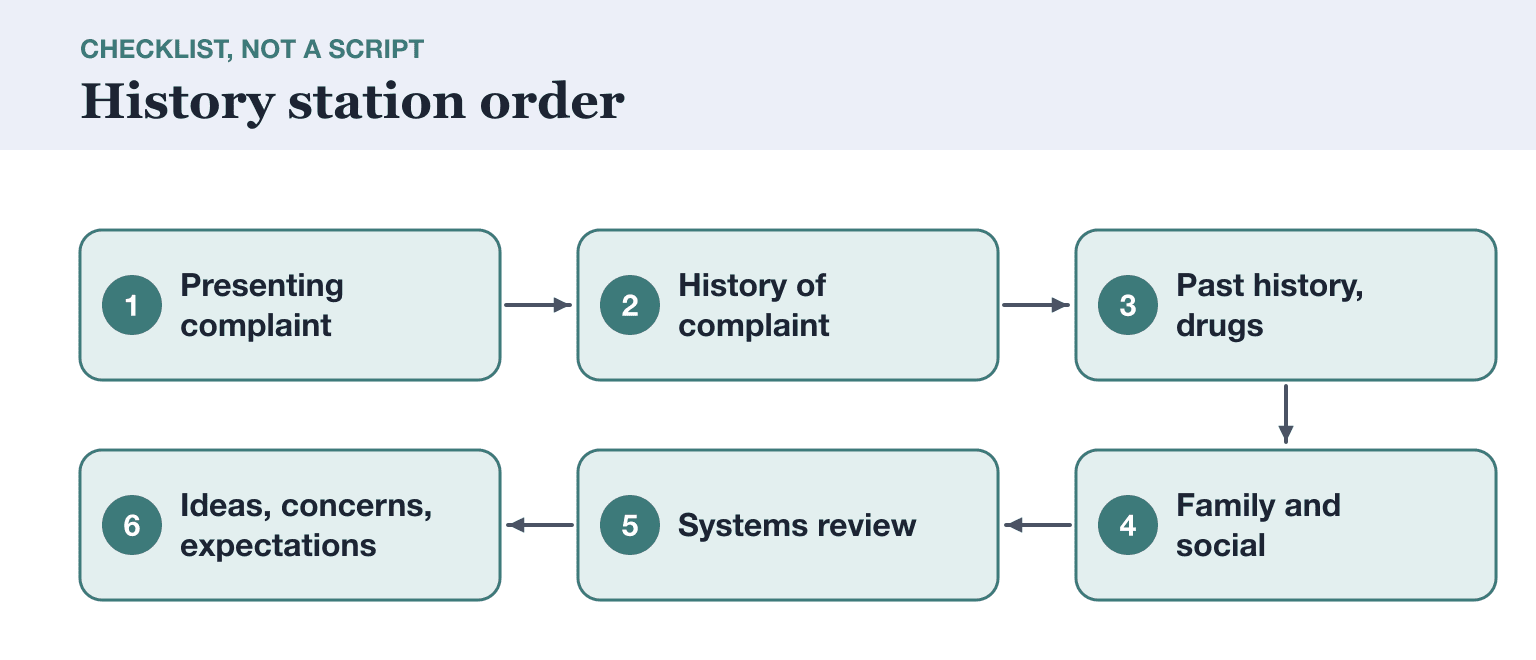
Presenting complaint, history of presenting complaint, past and drug history, family and social history, systemic enquiry, ideas concerns and expectations.
- Presenting complaint
- History of presenting complaint
- Past and drug history
- Family and social history
- Systemic enquiry
- Ideas, concerns, expectations
Geeky Medics also reminds you that "patients do not adhere to our structure", so treat this as a checklist, not a script. To get moving, a UCL student guide says to "practise history taking stations initially" before explaining stations. The GMC's Outcomes for graduates "sets out the knowledge, skills and behaviours that new UK medical graduates" must show. Check what your school expects at your stage.
Weeks 4 to 3: practise out loud, with or without a partner
Stations are performed, so practise out loud now. Reading silently won’t simulate time pressure or train concise delivery. Set short, spoken reps that copy station flow. Use a timer, and treat each rep as live.
BMA advice is practical: family members, friends and flatmates make great patients. The UCL student guide suggests meeting an OSCE group weekly, either in person or remotely. Keep the brief tight, keep timing strict, and keep repeats frequent.
A Medical Teacher study of a near-peer mock OSCE reported "significantly improved student confidence for OSCEs". That’s confidence, not marks. Another Medical Teacher paper offers twelve tips for mock OSCEs and notes "Mock OSCEs can be set up by undergraduate students or junior trainees". No partner this week? Use a solo practice plan.
Run a quick feedback loop using Pendleton's rules as Geeky Medics describes them:
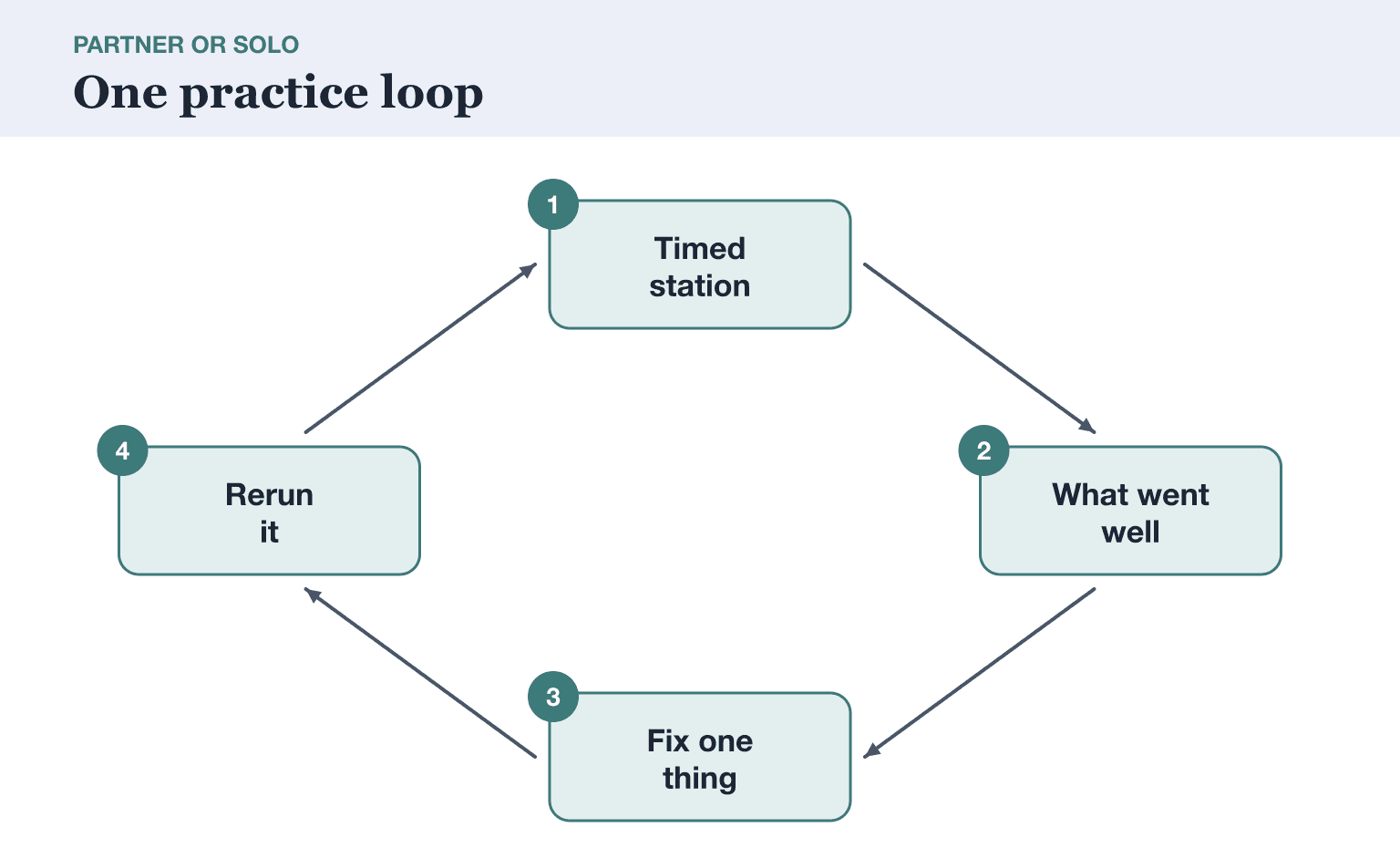
Solo or partner loop: time a station, get what went well first, pick one fix, rerun to confirm.
- Say what went well before anything else.
- Name one behaviour to change on the next attempt.
- Repeat the station now and test the tweak under time.
How Diagnosica helps with this
Ask by voice or text, the AI patient answers, free to start, no card needed.
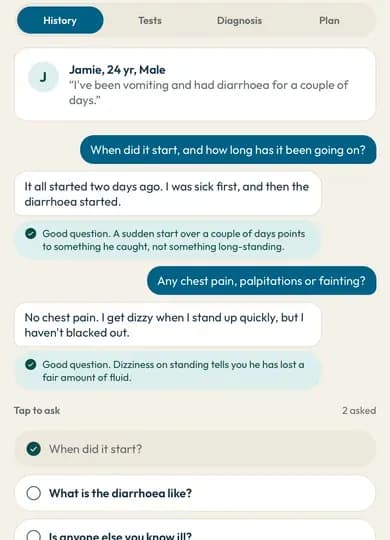
Diagnosica app, history chat screen, as of October 2026.
- You ask a history question.
- The simulated patient answers.
- Scorecard with teaching points after each case.
Simulated patient. Screenshot from Diagnosica, October 2026.
Practise a history station, free
A worked history station: Martin Cole's hot knee
This worked case shows how much of a history surfaces when you ask key things. Many share headlines then stall. Targeted prompts pull red flags and background.
Martin Cole, 55-year-old bus driver, type-2 diabetes, AI-simulated patient from our case library: "My right knee's come up hot and swollen and I can't stand on it."
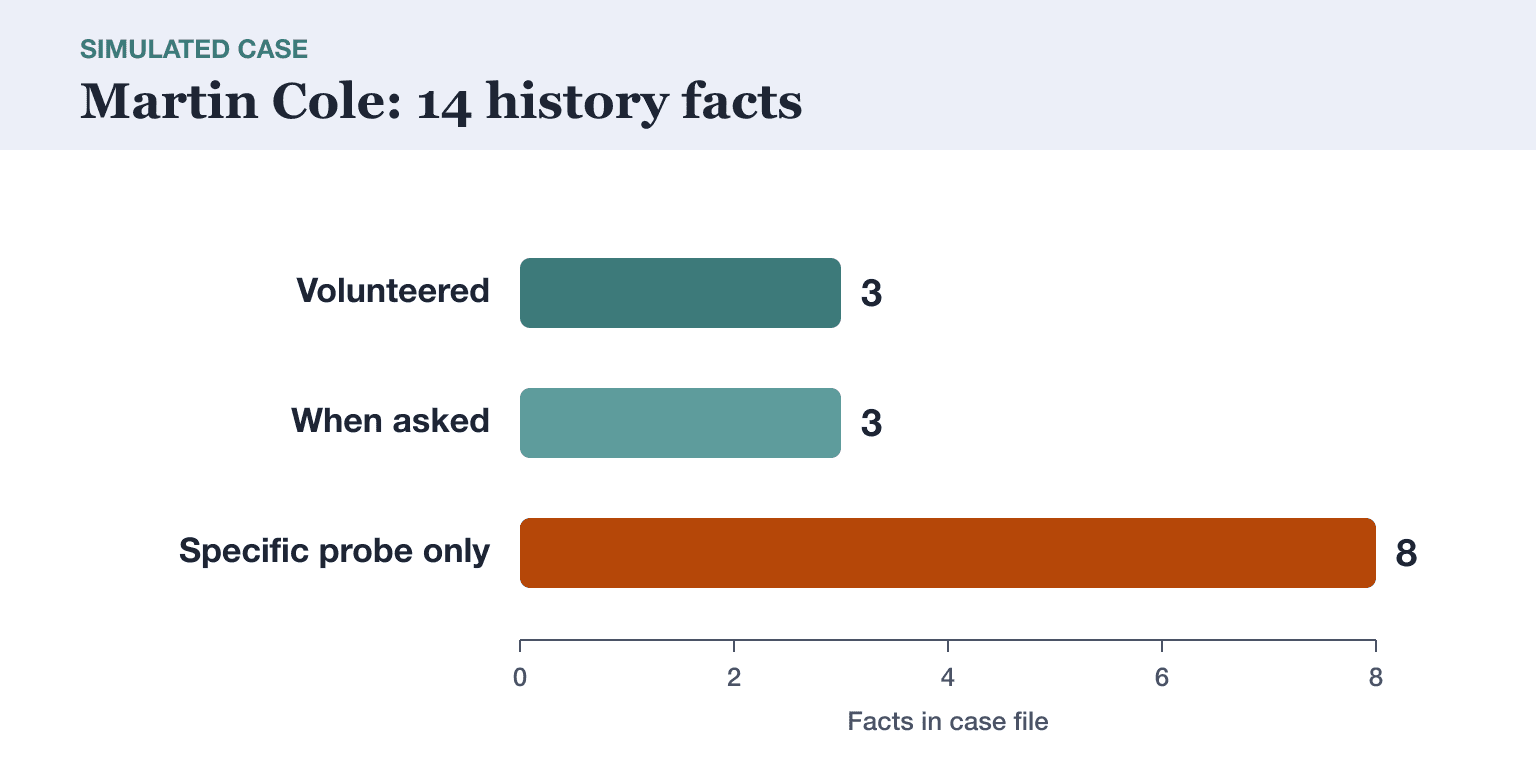
Martin Cole, septic-arthritis-55m: 14 facts total, 3 volunteered, 3 on question, 8 on specific probe, from the Diagnosica case file.
The case file holds 14 history facts: 3 volunteered, 3 given on a question, 8 only on a specific probe.
Martin Cole, 55 (simulated): what he said, and what had to be asked
Chip | Question | Answer | Why it mattered |
|---|---|---|---|
Volunteered | What has happened to your knee? | hot, red, swollen, very painful right knee over one to two days | rapid-onset single hot joint is treated as infection until proven otherwise |
Volunteered | Anything else bothering you? | feels feverish, sweaty and shivery | systemic upset with a hot joint raises the probability of infection over crystals |
Asked | Are any other joints affected? | only that one knee is affected | monoarthritis narrows the differential to infection, crystals or a bleed into the joint |
Only if asked specifically | Any cuts or grazes on that knee? | grazed the skin over that knee kneeling in the garden a week ago | a portal of entry gives a route for infection into the joint |
Only if asked specifically | Any medical conditions like diabetes? | has type 2 diabetes | diabetes is a major host risk factor for joint infection |
The look-alikes in the case file are gout, pseudogout and reactive arthritis, and he has had no recent gout attack (only on a specific probe); the diagnosis is septic arthritis. Good first, then the next step, the learner should ask about skin and past illness every time.
Simulated patient. Case file septic-arthritis-55m. Questions written by us as a model, not a learner session.
Watch out. In this case, 8 of 14 history facts surfaced only with a specific probe. A station that stops at volunteered information misses most of the history. Habit: ask about risk factors and past illness every time.
OSCE station guides to work through next
Use this page as your map: this plan is the hub. Each guide below goes one station or one skill deep. In the final six weeks, work history stations in weeks 6 to 3, and run the skills guides alongside.
History stations to work through
Start here:
Guide | The question it answers | Level |
|---|---|---|
Chest pain history steps? | Intermediate | |
How should I assess adult jaundice systematically in an OSCE? | Intermediate | |
Syncope history key questions? | Beginner | |
What structure works best for haematuria history in exams? | Intermediate | |
Breaking bad news structure? | Beginner |
Skills guides and the exam itself
Then add the pieces for OSCE preparation and recovery, station to station:
Guide | The question it answers | Level |
|---|---|---|
What happens in OSCEs? | Beginner | |
Which history mnemonic works best for different clinical scenarios? | Beginner | |
Run a systems review? | Beginner | |
How do I deliver a crisp accurate history summary? | Beginner | |
How do examiners score? | Intermediate | |
What practical steps turn OSCE feedback into targeted improvements? | Intermediate | |
How to manage OSCE nerves? | Beginner | |
What should I do after an OSCE station goes wrong? | Intermediate |
The last two weeks and the night before
Your final fortnight is for rehearsal under exam conditions, not new content. Nail timings, station brief reading and steady starts, and you’ll prioritise protecting sleep. Practise what will be scored, park the rest, and keep nerves down with predictable routines.
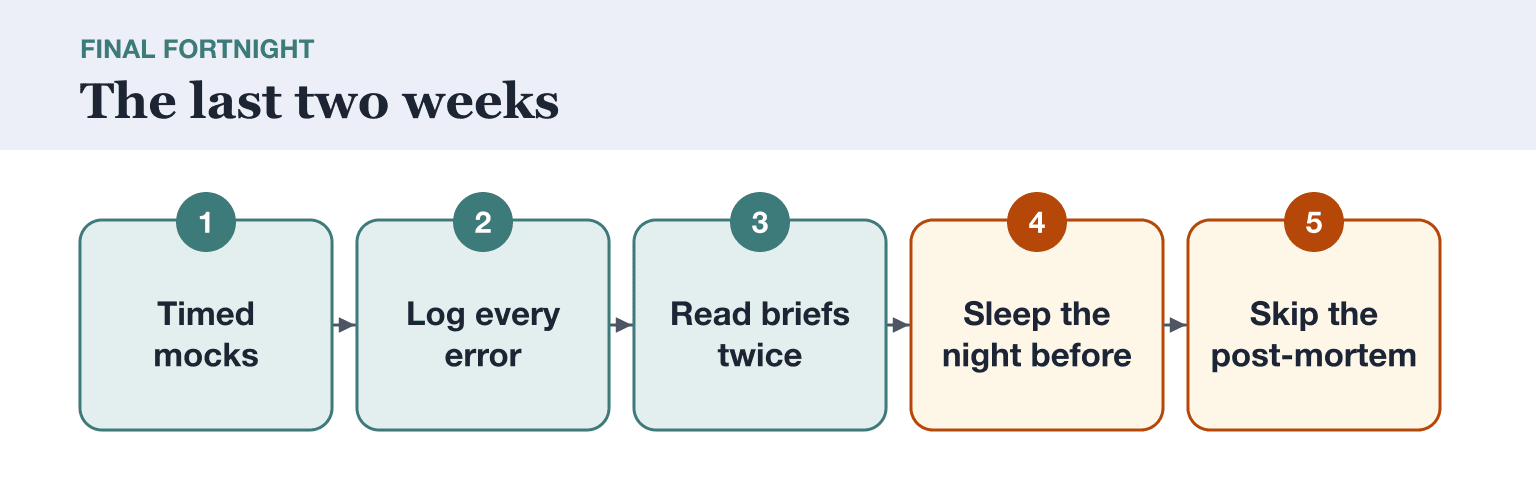
The last two weeks: timed mocks, our suggestion; log every error, via Geeky Medics; read briefs twice, sleep, and skip the post-mortem, via the BMA.
- Run timed mock stations back to back, using strict reading and station timings, and practise steady opens and closes.
- Write down every error, Geeky Medics says, so you can review them before the next exam and avoid repeats.
- Read the station instructions 2 or 3 times, BMA says, or you'll examine the wrong limb and score nothing.
- Sleep a full night before; the BMA says cramming the night before leaves you stressed.
- Skip the post-mortem with friends afterwards, the BMA says, and move on to food, water and a reset.
Nerves are normal, and it's not a bad sign. If they spike, use a brief grounding routine, control your breathing, and accept imperfect runs. See the anxiety guide on managing exam nerves for practical ways to settle before you read the brief and when you exit.
What this plan can't rehearse for you
Examination and procedure stations need hands, kit and a real person in front of you, and no app replaces that; book with your group and your school's skills lab, get lab time, and practise on manikins and peers, not screens.
Geeky Medics suggests, if your school allows it, "practice with its equipment and anatomical models". Diagnosica covers the history-taking conversation only with an AI patient by voice or text shown as a video avatar. You get a scorecard after every case, including on the free tier. It does not do physical examination practice. It doesn't give advice about real patients, and it's not a diagnostic system. Treat every output as educational.
Start week 8 with one history station, then run a station with a scorecard. It's free to start, no card needed, and it sets a baseline before your group session.