Haematuria history OSCE station: one case, worked

Your haematuria history OSCE station lives or dies on four facts: visible or not, painful or painless, then smoking and occupation. NICE NG12 suggests a suspected cancer pathway referral for unexplained visible haematuria at age 45 and over.
If you have blood in pee, see NHS advice on blood in pee, ask for an urgent GP appointment or get help from NHS 111. This post is exam practice.
Key takeaways
- Eleven of fifteen history facts surfaced only with specific probes in this simulated case.
- Ask about past jobs; he worked thirty years mixing dyes in a textile dye works.
- Escalate if 60+ with unexplained non-visible haematuria plus dysuria or raised white cell count.
The case: Gordon, 68, blood in the urine (simulated)
This is a simulated library case in Diagnosica. The station asks you to take a focused haematuria history from a 68-year-old man with blood in his urine, then summarise and show safe escalation thinking. Examination is out of scope.
Case summary
Item | From the case file |
|---|---|
Patient | Gordon Reeve, 68, male |
Opening line | "I've had blood in my urine on and off for a few weeks." |
Background | Retired textile dye worker, about 30 years; smoked 20/day for 45 years |
His idea (ICE) | Was told it was a water infection; expected antibiotics would fix it |
Difficulty | Intermediate |
Before reading on, meet Gordon as a live video AI patient and take Gordon's history yourself.
The history, question by question
In this haematuria history OSCE station, Gordon volunteers only two facts: visible blood and that it’s painless. Nearly everything else that decides the case comes from targeted specific probes, asked cleanly and in the right order.
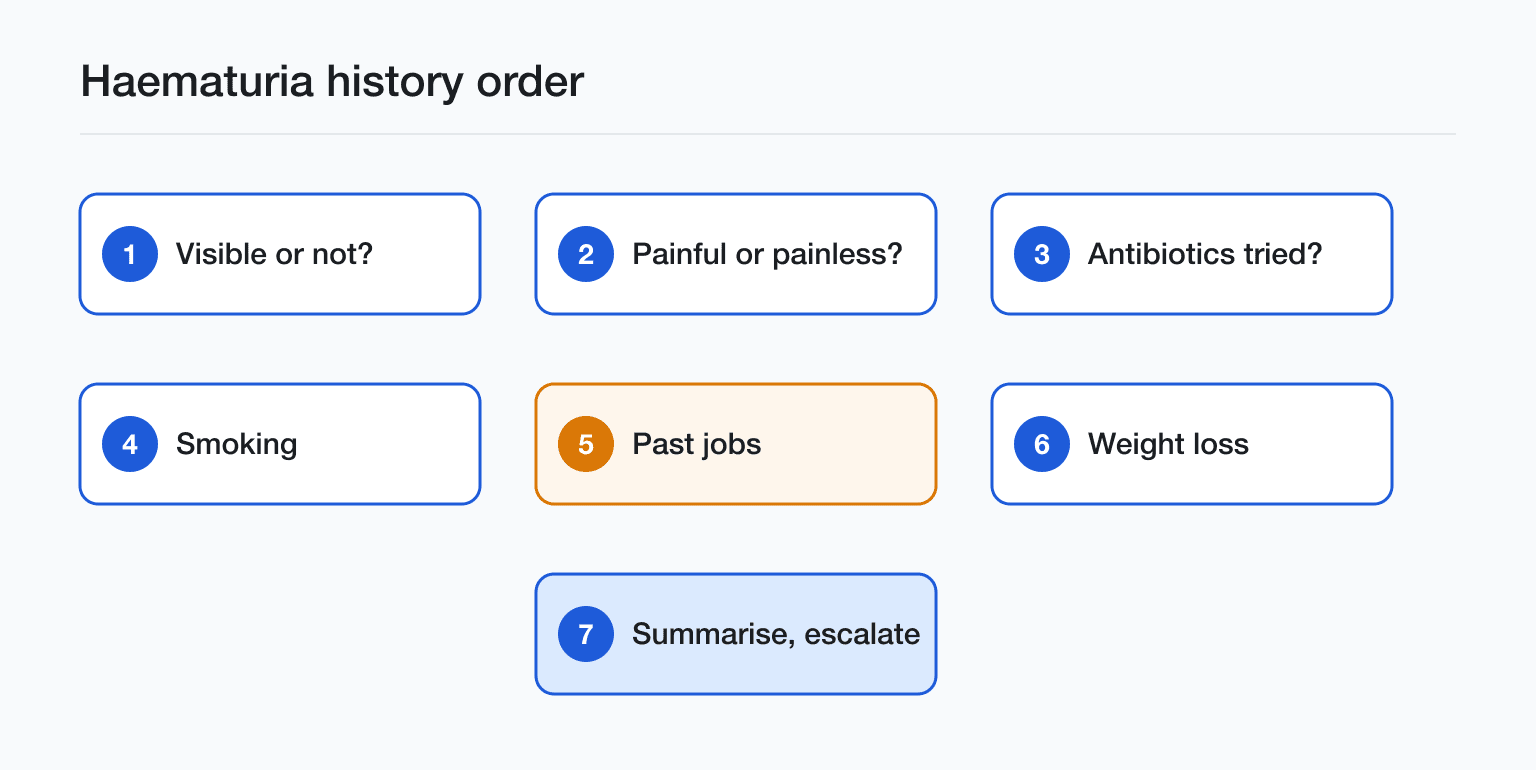
A seven-step order for a haematuria history that flags occupational risk early and finishes with a concise summary and escalation.
Use this seven-step haematuria history order, highlighting past jobs, then end with a clear summary and escalation plan.
Gordon, 68 (simulated): what he said, and what we had to ask
Chip | Question | Answer | Why it mattered |
|---|---|---|---|
Volunteered | What brought you to clinic today? | I’ve seen red or pink blood in my urine, sometimes clots. | Confirms visible haematuria, frames the differential. |
Volunteered | Any pain when you pass urine or with the blood? | No pain at all with the blood. | Painless bleeding narrows likely causes. |
Only if asked specifically | Has your GP treated this or checked your urine? | GP gave antibiotics twice, no benefit, and urine tests showed no infection. | No response and negative tests make infection less likely. |
Only if asked specifically | Do you smoke, how much and for how long? | About twenty a day for around forty five years. | Major exposure history relevant to haematuria risk. |
Only if asked specifically | What work have you done, any chemical exposures? | Worked about thirty years in a textile dye works mixing dyes and chemicals. | Occupational chemical exposure relevant to urinary tract causes. |
Only if asked specifically | Any recent weight loss without trying? | A little weight loss recently without trying. | Constitutional symptom that raises concern. |
11 of the case's 15 history facts come out only when asked specifically, so the next step is to plan your specific questions.
Simulated patient. Case file bladder-cancer-68m. Questions written by us as a model, not a learner session.
Two quick negatives also earn marks: no fever, no burning or loin pain, and no blood thinners. Those are negatives that steer the differential. He’d been told it was a water infection, which sits under his ideas and worries.
The occupational question, asked properly
Gordon will only mention his thirty years in a textile dye works if you ask about his work. The NHS lists textile industry chemicals among bladder cancer risks, so the occupational link is easy to miss unless you surface it.
Ask about past jobs, not only the current role: asking about past jobs. Gordon retired three years ago after mixing dyes and chemicals for about thirty years. The case file notes dye-work chemicals can present decades later, and the NHS list of bladder cancer risks names textile industry exposure.
Watch out. Ask ‘are you retired?’ or ‘what do you do?’ and you’ll stall. Instead, open with, "What did you do for most of your working life?" That phrasing surfaces long exposures from earlier careers.
How Diagnosica helps with this
Take a haematuria history from a video AI patient, by voice or typing.
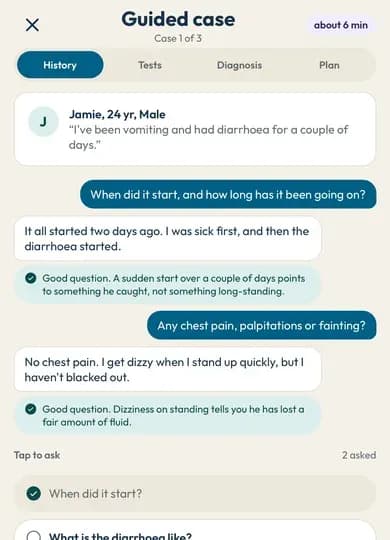
Diagnosica app, history screen, as of October 2026.
- Your question and the reply appear in chat.
- Brief feedback appears under a well phrased question.
- Suggested next questions to tap if you're stuck.
Simulated patient. Screenshot from Diagnosica, October 2026.
Red flags and the NICE referral thresholds
Gordon meets NICE NG12 suspected cancer pathway criteria: 68 with visible haematuria, no infection found and no response to treatment. That triggers urgent suspected bladder cancer referral based on visible haematuria in adults aged 45 and over.
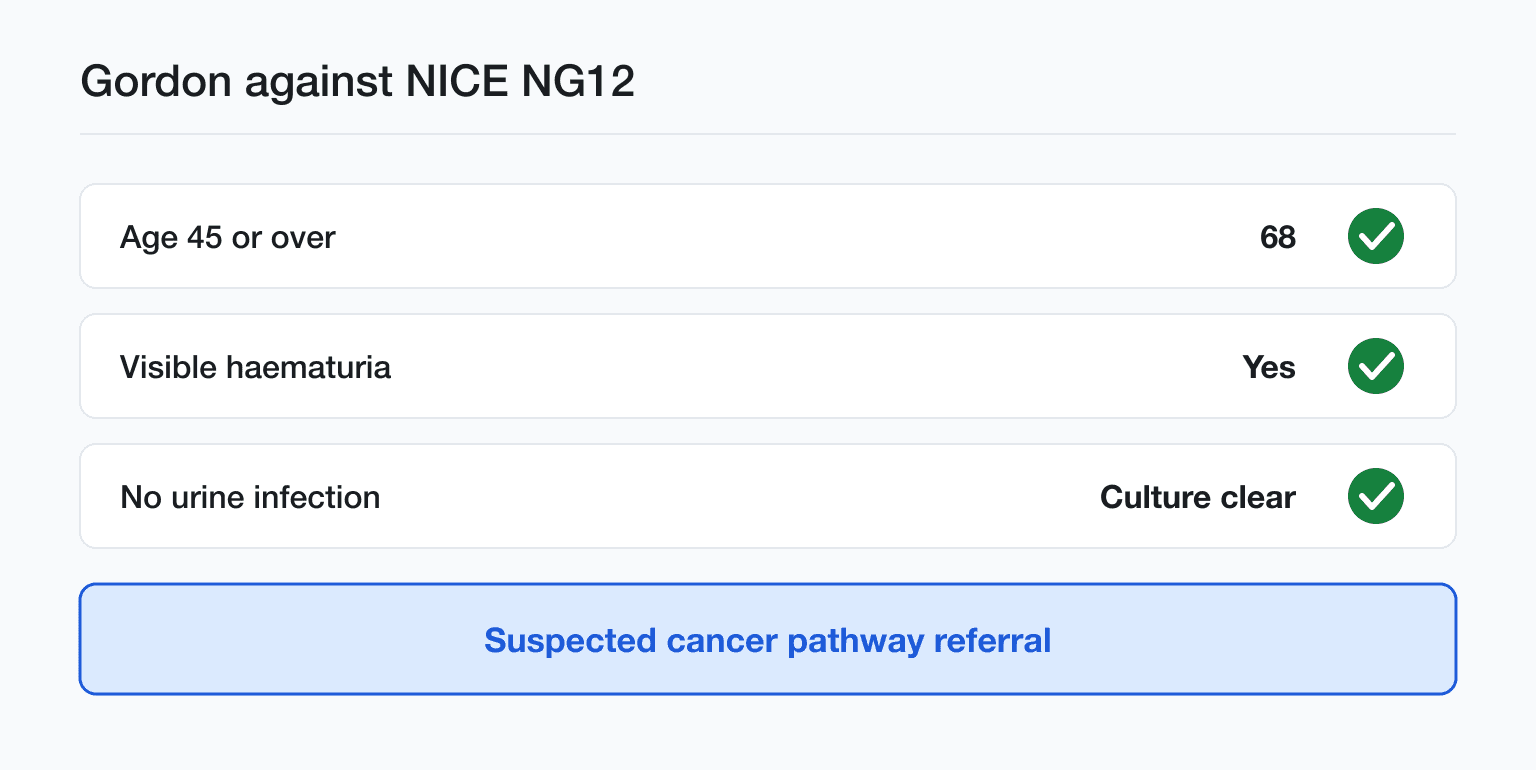
Against NICE NG12, Gordon meets age 45+, visible haematuria, and culture-clear urine, so suspected cancer pathway referral is indicated.
Per NICE NG12 1.6.4, age 45+, visible haematuria, and culture-clear urine indicate a suspected cancer pathway referral, and local trust or practice guidance applies.
Finding | Age | NG12 says |
|---|---|---|
Unexplained visible haematuria without urinary tract infection, or visible haematuria that persists or recurs after successful treatment of urinary tract infection | 45 and over | Suspected cancer pathway referral for bladder cancer |
Unexplained non-visible haematuria and either dysuria or a raised white cell count on a blood test | 60 and over | Suspected cancer pathway referral for bladder cancer |
Recurrent or persistent and unexplained urinary tract infection | 60 and over | Consider non-urgent referral for bladder cancer |
NG12 defines this pathway as a diagnosis or ruling out of cancer within 28 days of urgent GP referral. See NG12 defines the pathway and the bladder and renal entries within NICE NG12 urological recommendations.
In the station, say you'd escalate and refer in line with NG12 and local guidance. The same visible haematuria criteria in NG12 also cover renal cancer.
The case file marks painless bleeding and weight loss as red flags you must elicit.
What the case file checks, and the trap diagnosis
In this haematuria history OSCE station, the case file lists seven key findings and marks two must-elicit red flags, painless bleeding and weight loss. Diagnosica gives a scorecard after every case, free and paid alike.
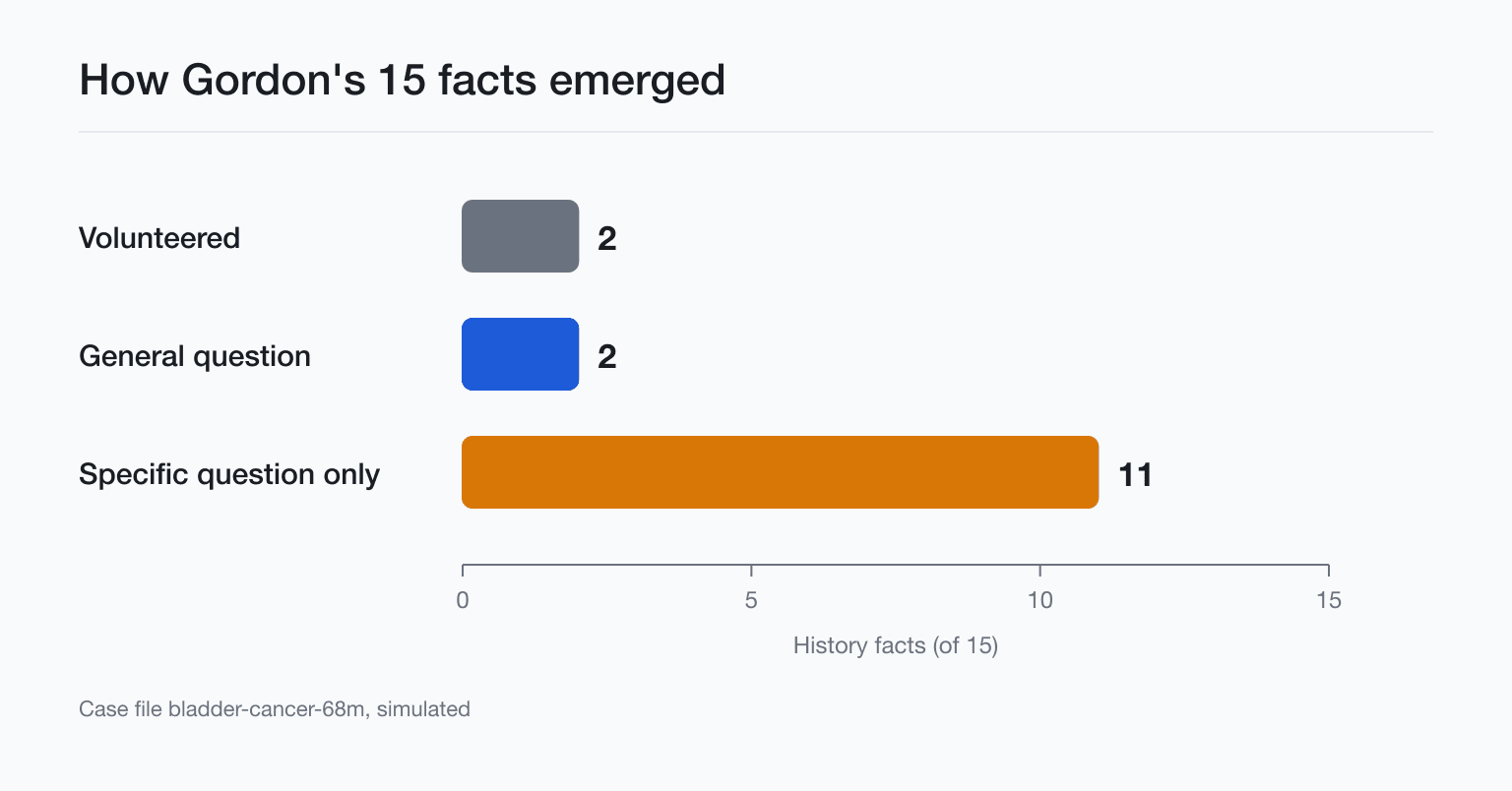
Gordon's 15 facts: 2 volunteered, 2 on a general question, 11 on specific probes. Source: bladder-cancer-68m, simulated.
In the simulated bladder-cancer-68m case, Gordon volunteered 2 facts, gave 2 on a general question, and 11 appeared only with specific probes.
The urine dipstick shows blood with no nitrites and few leucocytes, and the culture reports no significant growth. That doesn't support the "water infection" label. The decisive diagnosis in this case is bladder cancer, and the trap diagnosis is recurrent urinary tract infection.
To finish, give a crisp summary that names the risk factors you elicited, then your working diagnosis. That summary helps the examiner hear your structure, see closing summary for the examiner and cross check against how examiners mark histories.
What to take into your next station
For a haematuria history OSCE station, go in with a three-line opener and one safety trigger: visible versus painless first, occupational and smoking probes, and the NG12 threshold you'll state you would escalate.
Use these lines and make the safety trigger explicit:
- Start with visible blood and pain: ask if the haematuria was visible and painless.
- Ask past jobs and smoking specifically, including chemical exposures and pack-years.
- NG12: 45+ with unexplained visible haematuria without urinary tract infection, I'd escalate.
Build depth with a full OSCE preparation plan, then switch to the syncope history station. Ready to try Gordon Reeve? Open Diagnosica and run the full case with the video AI patient.