How to Escalate to a Senior Doctor (SBAR Phone Script)

How do you escalate to a senior doctor?
Escalating to a senior doctor means calling your SHO or registrar early when a patient hits a trigger or you’re worried, then giving a 30 second SBAR that ends with a clear ask to review. Follow local escalation policy on who to call.
The blocker isn’t knowledge, it’s fear. In a Croydon survey of FY1s sent to 41 doctors with 21 responses, the top reason was “they are too busy and I don’t want to disturb them,” and 19% never contacted the registrar on weekday shifts, a single trust signal, not a census.
This post gives you triggers, the script, a worked call, the likely questions back, and what to do if a call goes badly. For context, see staying afloat in FY1.
When should an FY1 call the registrar?
When an FY1 should call the registrar comes down to three things: the NEWS2 score, dangerous new data, and concern from you or nursing staff. NEWS2 from the Royal College of Physicians guides thresholds, but it supplements judgement. If the score crosses a trigger, or a result looks high risk, escalate within your own team.
NEWS2 scores six measurements: respiration rate, oxygen saturation, systolic blood pressure, pulse rate, level of consciousness or new confusion, and temperature. If you’re unsure what deterioration looks like before you score it, read spotting deterioration early.
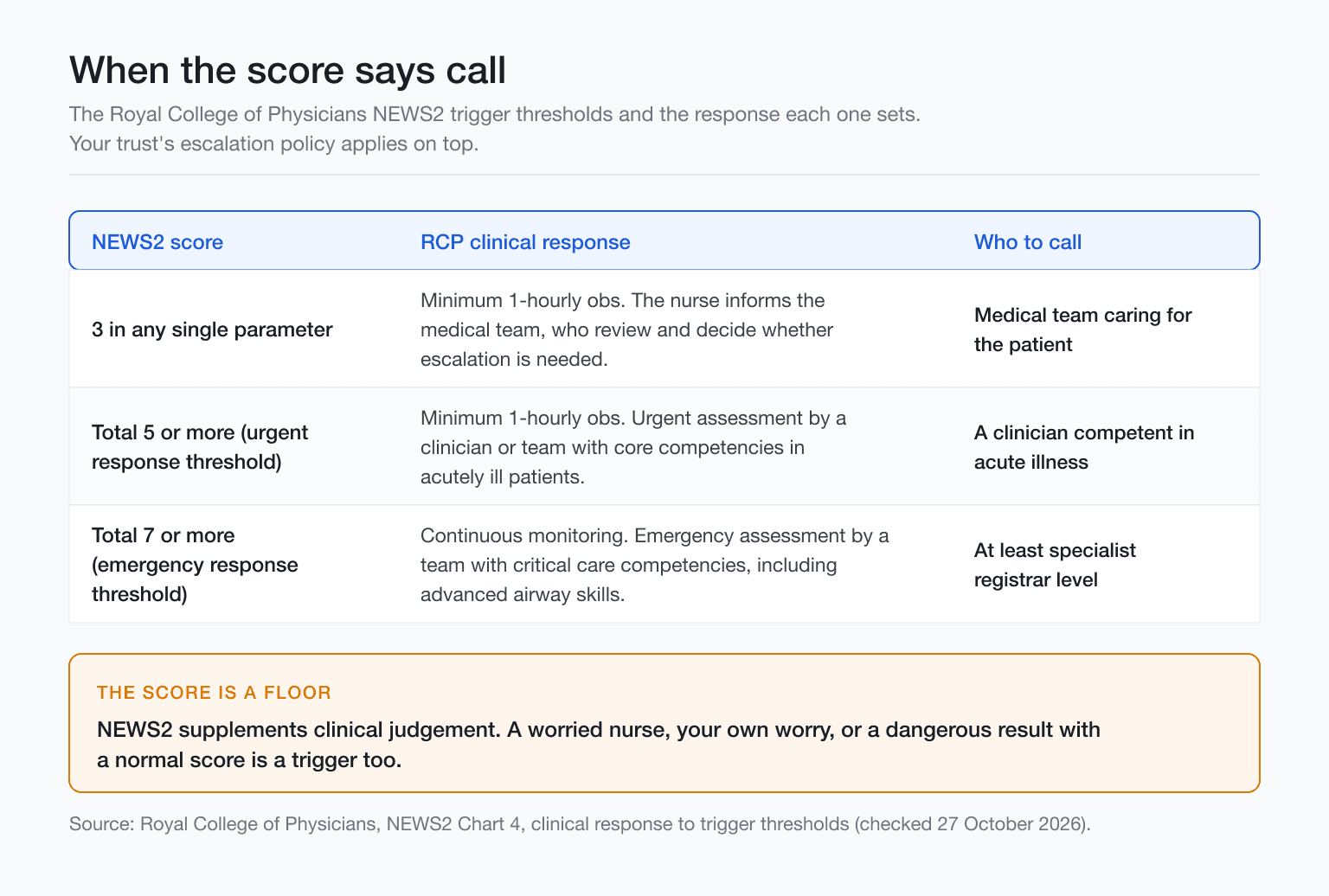
Per the RCP NEWS2 response chart, thresholds are:
- Score of 3 in a single parameter, minimum 1-hourly observations; the nurse informs the medical team, which reviews and decides on escalation.
- Aggregate 5 or more, urgent response threshold; minimum 1-hourly; urgent assessment by a clinician or team with core competencies for acutely ill patients.
- Aggregate 7 or more, emergency response threshold; continuous monitoring; medical team informed at specialist registrar level or above; emergency assessment by a team with critical care competencies.
The score is a floor, not a ceiling. A worried nurse, your own worry, or a dangerous result with a normal score are triggers too.
Local trust escalation policy applies and may set its own rules on who you call and when.
If multiple bleeps hit together, start by triaging the bleep first, then call the right senior using SBAR.
The 30-second SBAR script, line by line
SBAR, which stands for Situation, Background, Assessment, Recommendation, is set out in NHS England and NHS Improvement’s QSIR tool to stop hinting and hoping, especially when you’re speaking to someone more senior. Use it exactly as written. One clear headline, then your ask. You can be unsure and still be safe and specific.
- “Hello, it’s Dr [Your Name], FY1 on [Ward/Extension]. I’m calling about [Patient Name, Bed X, Hospital Number if needed]. I’m concerned because [headline problem], with [observations or NEWS2 score] right now.”
- “Background, they were admitted on [date] with [reason]. In the last [timeframe], [what changed]. Last set of obs are [read them], and their normal is [if known].”
- “Assessment, I think the problem is [your working diagnosis]. If I’m not sure, ‘I’m not sure what the problem is but they’re deteriorating.’ If I’m very worried, ‘I don’t know what’s wrong but I am really worried.’ That exact wording is in NHS England's SBAR prompts.”
- “Recommendation, I need you to come and see them in the next [X] minutes.”
- “Is there anything you want me to do in the meantime? I’ll read back what we’ve agreed now.”
Write it down before dialling. If they pick up sounding slammed, lead with line 1’s headline and line 4’s ask, then fill in lines 2 and 3 when invited.
One fact, one ask. Same muscle you use in presenting in thirty seconds.
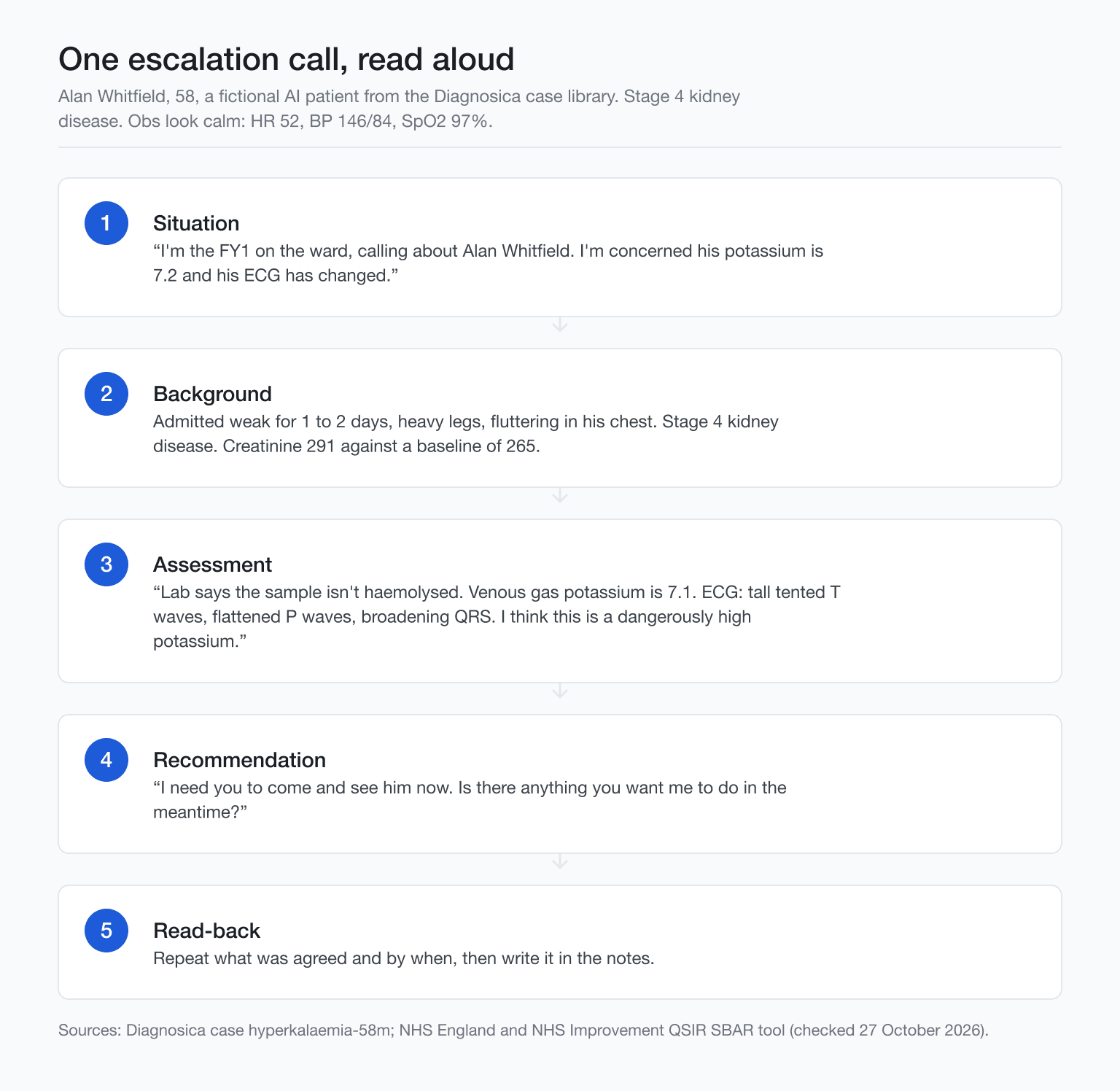
A worked call: Alan Whitfield's potassium of 7.2
Alan Whitfield is a fictional AI patient from the Diagnosica case library. He’s 58 with stage 4 chronic kidney disease and he opens with, “I’ve just felt weak and off colour the last day or two, I probably shouldn’t have come.” You’re the FY1, within your team, and you’re calling for a senior review about a high potassium.
S: I’m calling about Alan Whitfield, 58, with stage 4 kidney disease. I’m concerned because his potassium is 7.2 mmol/L and the ECG shows tall tented T waves with flattened P waves and a broadening QRS. His heart rate is 52, BP 146 over 84, SpO2 97, temperature 36.7.
B: He’s felt weak and heavy-legged for 1 to 2 days with tingling round his lips and brief chest fluttering. Creatinine is 291 micromol per litre, baseline 265 a month ago. The lab says the sample isn’t haemolysed, venous gas potassium is 7.1 with bicarbonate 17. He had a medicine change from his GP three weeks ago, has taken over-the-counter painkillers, and started a low-salt substitute six weeks ago.
A: I think this is a dangerously high potassium with ECG changes.
R: I need you to come and see him now. Is there anything you want me to do in the meantime?
This works because it leads with the number and the ECG, which sets urgency in one breath. You’re not hinting, you’re saying what the problem is. It also answers the next question before it’s asked, that the sample isn’t haemolysed, and it makes a clear ask with a time.
If you want to practise the history that leads to this call, you can take Alan's history yourself as a history-taking case with labs and an ECG in Diagnosica, not a phone-call simulator.
What will the registrar ask you back?
On an escalation call within your team, the registrar will ask questions that decide urgency: latest full observations with the NEWS2 score, what has changed and since when, key results and whether any sample could be spurious, the patient’s baseline and any documented ceiling of care, and what you think is going on.
If you don’t have a piece of information to hand, “I don’t know, I’ll check and call you back in five minutes” is an acceptable answer. NEWS2 guides response, but your trust’s escalation policy applies.
- Latest full observations and NEWS2 with times, plus trend.
- What’s changed, and over what time frame.
- Results so far, and whether any could be spurious.
- Baseline figures, and how today differs.
- Your SBAR Assessment, for example “I think this is X” or “I’m not sure, but he is deteriorating and I’m worried”.
- Any documented ceiling of care, or that you’ll check.
Calls to another team are different: cross-specialty referral calls follow a separate pattern and purpose.
When the call goes badly
A call to a senior goes badly when you get a curt reply, “why are you calling me”, or there’s no clear plan or timeframe. Restate your concern and ask in SBAR, say you’re worried, confirm what’s agreed and by when, read it back, and if they don’t come or the patient worsens, call again and escalate per local policy. Then document.
“I am calling about [patient]. I am calling because I am concerned that [EWS, obs, rhythm]. I think the problem is [X], or I am not sure what the problem is but the patient is deteriorating. I need you to come to see the patient in the next [XX minutes]. I am really worried.”
Write a contemporaneous note. Who you called, when, what you said, their response, what was agreed, and the timeframe. If you escalated, list the sequence and times.
One blocker is not knowing who to call. A Croydon survey found 9.5 percent of FY1s never knew who the medical registrar was on weekdays, 14.2 percent at weekends. Get this at handover with contact details, and check who covers weekend ward cover.
Practising the call before you need it
Practising an escalation call to a senior doctor makes the real call shorter and calmer. After any review of a sick patient, run an SBAR out loud, then write your one line Assessment. Keep five prompts on a card by the phone. Reps beat nerves, and format beats panic.
Diagnosica is an AI clinical simulator for medical students and junior doctors: you take a history from an AI patient by voice or text, order labs and imaging, commit to a diagnosis and management plan, and get a competency scorecard. The patient appears as a video avatar, it’s free to start with no card needed, and there are apps on iPhone and Android. It’s built for doctors in the UK and beyond rather than one country’s exam. It doesn’t simulate the phone call to the registrar, it trains the Assessment line, deciding what you think is going on from history and results, which you then say out loud as SBAR. It doesn't give advice about real patients, and it's not a diagnostic system. Treat every output as educational.
Start a free case and say the Assessment line out loud when you finish.
Common questions
Common questions about how to escalate to a senior doctor come up on every first set of nights. The short answers: SBAR is the shared format, you usually go up the ladder unless NEWS2 demands registrar-level involvement, worry without a label is valid, and your notes should record who you called, what you said, and what was agreed. Local policy sits over all of this.
What does SBAR stand for?
SBAR stands for Situation, Background, Assessment, Recommendation. It is an NHS England and NHS Improvement communication tool, originally developed by the US military for nuclear submarines. It prevents hinting and hoping by forcing a headline, then context, then what you think, then a clear ask. Typical openers are, I am calling about Mr X, and I am concerned that his Early Warning Score has risen.
Should I call the SHO or the registrar first?
Default to the ladder, SHO first, registrar if needed, unless your trust policy or the NEWS2 threshold points straight to a registrar. A Croydon survey in 2022 found FY1s contacted SHOs more and felt more comfortable doing so, and often hesitated to disturb registrars. If NEWS2 is 7 or more, the Royal College of Physicians chart expects the team informed to include at least a specialist registrar. Local policy applies.
Is it OK to call a senior when I'm not sure what's wrong?
Yes. The NHS SBAR guide explicitly offers, I don’t know what’s wrong but I am really worried, and, I am not sure what the problem is but the patient is deteriorating. That language is there for exactly this moment. Your job is to spot deterioration, state your concern plainly, and ask for a review. Certainty can wait. Escalation cannot.
What should I write in the notes after escalating?
Document the time, who you called, their role, and that it was a phone escalation. Write a brief SBAR summary, the concern you raised, and what was agreed, for example senior to review and the timeframe for that review. Add any pending results you flagged and who will follow them up. Record if you asked, Is there anything you want me to do in the meantime? Follow local record-keeping and handover policy.