How to write a discharge summary as an FY1

How to write a discharge summary: write it for the GP, lead with the diagnosis and what happened, list every medicine change with its reason, and finish with clear actions stating who does what and when.
End of shift, three patients are going home, and the TTO is the only thing stopping them. Nobody taught you the format, only that it has to be sent within 24 hours. See surviving FY1, step by step.
This post gives you the section order GPs read, a worked example from a case-library AI patient, recording medicine changes, and what to cut. It won't teach prescribing or tell you what to do with any medicine.
How do you write a good discharge summary?
A good discharge summary is accurate, brief, and written for the GP. It states the diagnosis, what happened in hospital, medicine changes with reasons, and the actions after discharge with a named owner and timescale. It avoids note dumps, uses plain language, and puts the things the GP needs first.
In a 2014 survey at one UK hospital, 13 of 36 responding junior doctors reported inadequate training in discharge summary writing. The same paper says its samples were small and local, and it concluded many discharge summaries may not currently fulfil GP requirements for managing continuity of care. It cites a 2009 UK study saying 90% of discharge summary items were written by foundation doctors.
This is not a knowledge test, it is a format problem you can learn and reuse.
Who reads a discharge summary, and what do they need?
The discharge summary is written for the GP, who wasn't there, has only a few minutes, and needs to act on it. They want the diagnosis, what happened, what changed with medicines and why, and what needs doing next, by whom and when.
Discharge summaries must be sent to the GP within 24 hours, the BMA says.
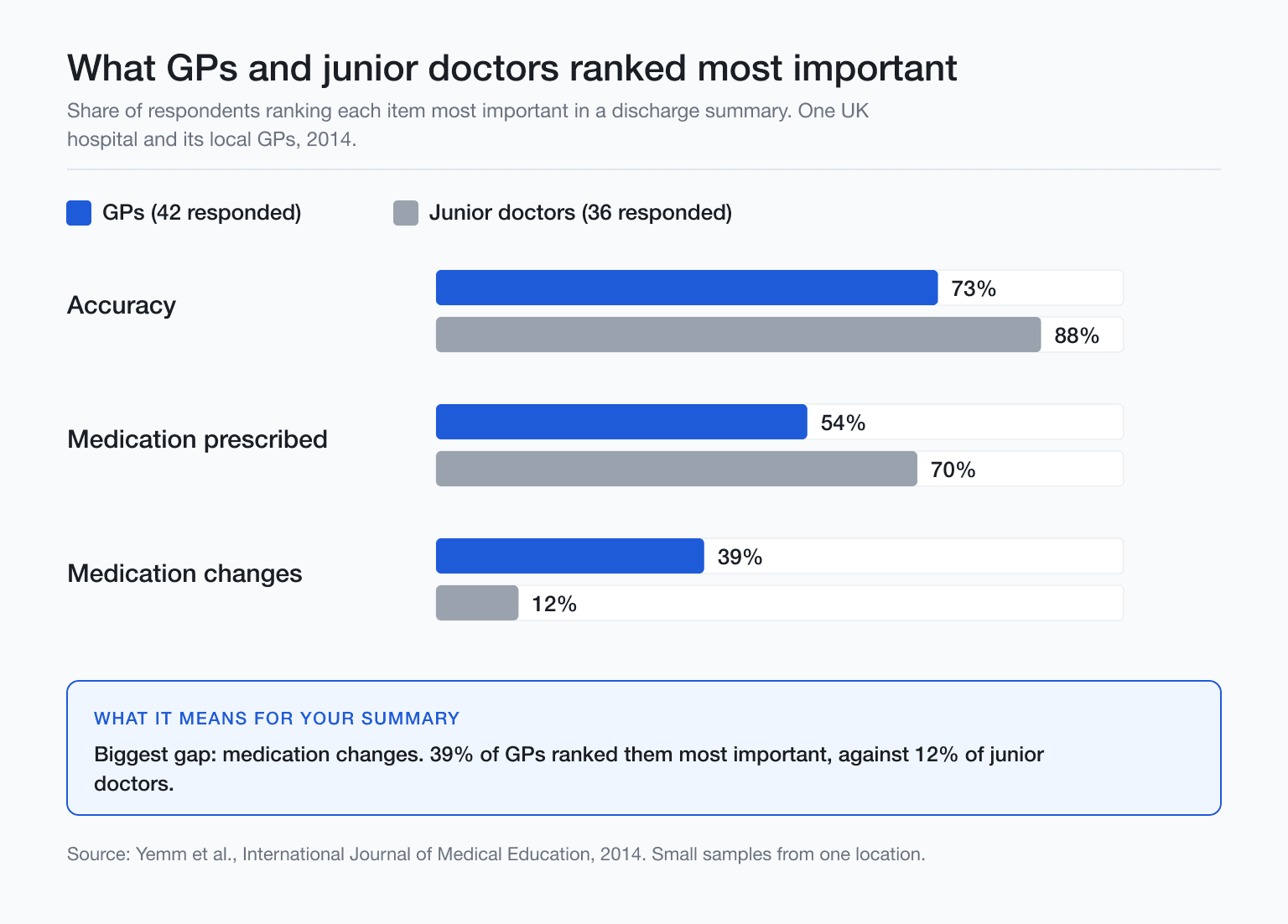
A small single-hospital survey compared what GPs and junior doctors rated as most important.
- Accuracy, 73% of GPs vs 88% of junior doctors.
- Medication prescribed, 54% of GPs vs 70% of junior doctors.
- Medication changes, 39% of GPs vs 12% of junior doctors.
The biggest gap is medication changes. GPs care about them far more than juniors expect.
Think of it like presenting on a ward round, same discipline, different listener. See your ward-round presentation for the headline-first habit you can repurpose.
What goes in a discharge summary, in order?
A discharge summary follows the national PRSB eDischarge Summary standard, version 2.1, owned by NHS England from 1 January 2026. It has 22 sections. Trust templates vary, but the order below is what a GP reads first. For detail, see the PRSB discharge standard. Write for actions, not completeness, and make medicine changes explicit.
- Diagnosis (primary, then secondary): State the final primary diagnosis, then significant secondary diagnoses.
- Presenting complaint and clinical summary: State the complaint and a two to four line summary.
- Key investigation results: Only include results that changed decisions, with baseline where relevant.
- Medicines and medicine changes: List current medicines, then started, stopped or changed, with reasons.
- Allergies and adverse reactions: Record allergen, reaction type, severity, and confirmation date if known.
- Plan and requested actions: Write each action with owner, deadline, and escalation or result handling.
- Information and advice given to the patient: Summarise safety netting, self care advice, and contact routes.
- Person completing the record: Sign with full name, role, contact number, date and time.
Items 1, 4 and 6 are what a GP scans first. Don't copy your admission clerking into it, write the handover the GP needs to act on.
A worked discharge summary from a real case
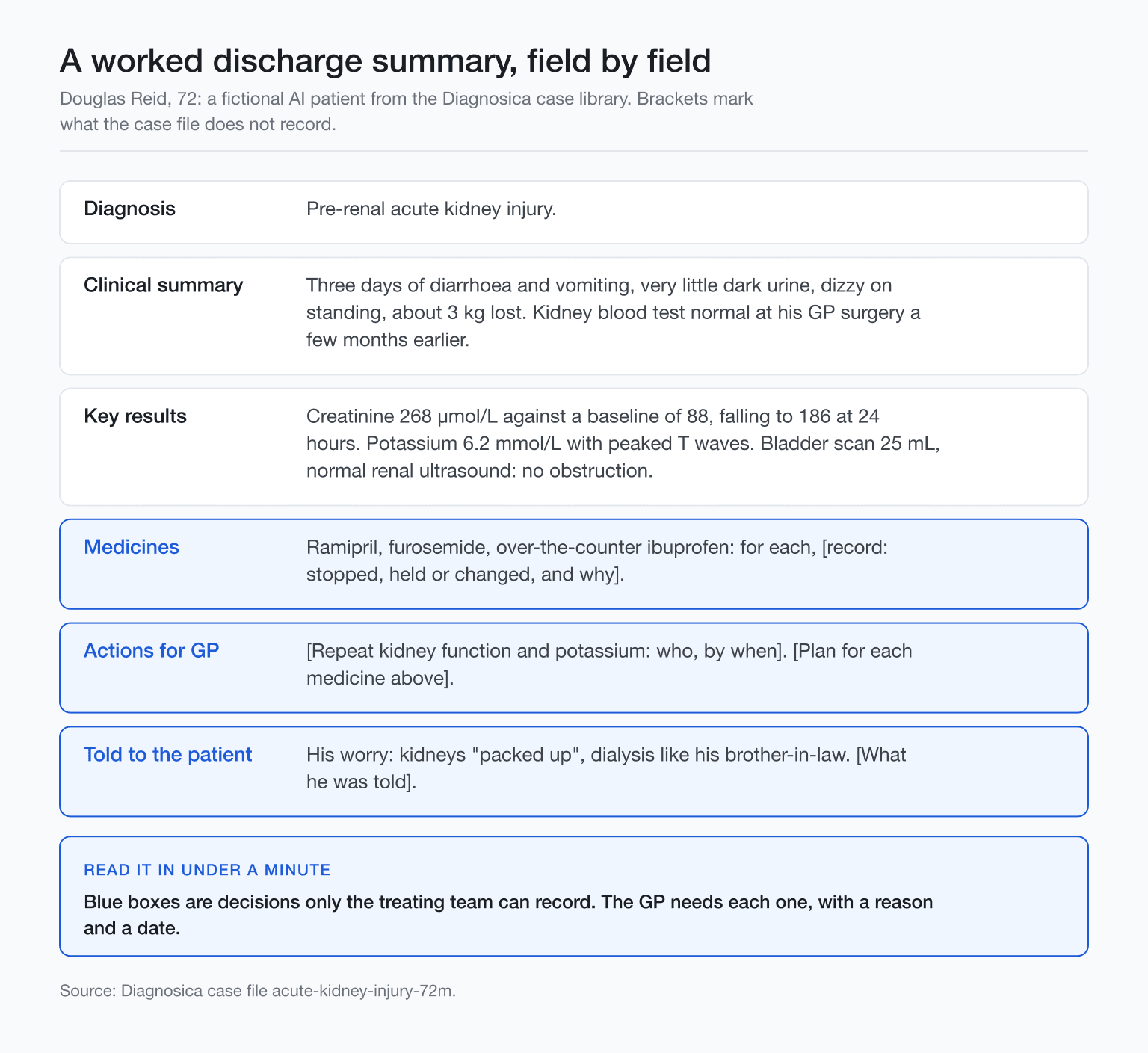
This worked discharge summary uses a fictional AI patient from the Diagnosica case library, Douglas Reid, 72, so the facts are fixed and checkable, and anything the case file doesn't record appears as a bracketed placeholder. It models the format a GP can scan fast: diagnosis, what happened, key results with baselines and trend, named medicine changes with reasons, and clear actions with owners and dates.
- Diagnosis: Pre-renal acute kidney injury.
- Clinical summary: Three days of diarrhoea and vomiting with very low dark urine output, dizziness on standing, and about 3 kg weight loss. He kept taking ramipril and furosemide, and added over-the-counter ibuprofen for back pain. A kidney blood test at his GP surgery a few months earlier was normal.
- Key results: Creatinine 268 µmol/L against a baseline 88 µmol/L, falling to 186 µmol/L at 24 hours. Potassium 6.2 mmol/L with peaked T waves on ECG. Bladder scan residual 25 mL and renal ultrasound normal, so no obstruction.
- Medicines: Ramipril [record: stopped, held or changed, and why]; Furosemide [record: stopped, held or changed, and why]; Over-the-counter ibuprofen [record: stopped, held or changed, and why].
- Actions for GP: [repeat kidney function and potassium: who, by when]; [plan for each medicine above].
- Told to the patient: He worried his kidneys had "packed up" and he'd end up on dialysis like his brother-in-law. [what he was told].
The GP can see the baseline, the trajectory, and three named medicines that need a decision, in under a minute.
If you want to see how the details land in conversation, take Douglas Reid's history yourself (he's an AI patient you can talk to, free to start).
The case file lists chronic kidney disease as a distractor, so writing the baseline creatinine stops the next doctor mislabelling this admission.
How do you write medicine changes and actions for the GP?
Medicine changes need to be explicit. For every medicine started, stopped, held or changed, write the drug, what changed, why, and what the GP should do next with a date. In a small single hospital survey, 39% of GPs ranked medicine changes most important versus 12% of junior doctors, which is a gap you can close by writing them cleanly.
- Medicine: [name, and who started it if relevant]
- Change: [stopped, held, started, or changed]
- Reason: [why, in one line]
- GP action and when: [what the GP should do, and by what date]
Worked example shape using Alan Whitfield's case:
- Amiloride, started by GP three weeks before admission: [record: stopped, held or changed, and why]. GP action: [what, by when].
- Low salt substitute, patient switched six weeks before admission: [record: continued or stopped, and why]. GP action: [what, by when].
- Ibuprofen bought over the counter for two weeks: [record: advice given or change, and why]. GP action: [what, by when].
Actions only count if they have an owner and a timescale. "GP to follow up" on its own is not an action. If a task remains with the hospital, say that it remains with the hospital and name the team or person who owns it, plus when they will do it. See writing a clear plan for phrasing owners and dates.
What to leave out of a discharge summary
A discharge summary is a letter to the GP. Cut anything the GP can't act on. Keep the diagnosis, the few events that changed decisions, medicine changes with reasons, and clear actions with owners and dates. Fewer lines, clearer jobs.
- The full day-by-day ward story, it hides the point. Keep the 1 or 2 events that changed management, nothing more.
- Every normal blood result, it drowns the signal. Keep abnormal results that changed decisions and the baseline for comparison, and drop investigations that changed nothing.
- Long lists of negatives, they add noise. Say the key ruled-out diagnoses if they frame the plan, otherwise omit.
- Unexplained abbreviations, they slow the GP down. Expand once or write it plainly.
- Vague actions like "GP to review", they create risk. State the action, who owns it, and by when. If you need a specialist to do something, that's a separate request, see writing a referral.
Practise the history your summary depends on
A discharge summary is only as accurate as the history behind it, so ask directly about medicines, timing, and red flags. In Douglas Reid's acute kidney injury case, the triple whammy surfaces only if you ask about over-the-counter painkillers, and he volunteers two weeks of ibuprofen only when pressed.
Diagnosica is an AI clinical simulator for medical students and junior doctors: you take a history from an AI patient by voice or text, order labs and imaging, commit to a diagnosis and management plan, and get a competency scorecard. Patients appear as video avatars, it's free to start, no card needed, with apps on iPhone and Android as well as the web. Used in the UK and elsewhere. It doesn't give advice about real patients, and it's not a diagnostic system. Treat every output as educational. It doesn't write or mark discharge summaries for you.
Common questions
How long should a discharge summary be?
A discharge summary should be as short as it can be while staying accurate and decision focused for the GP. In a small single-hospital survey, accuracy ranked first for 73% of GPs and 88% of junior doctors, and medication prescribed ranked highly for both. Lead with diagnosis, what happened, medicine changes with reasons, and clear follow up actions.
What is a TTO?
A TTO is the To Take Out medication list, the medicines a patient leaves hospital with. East and North Hertfordshire NHS Trust explains TTOs in a trust's TTO leaflet, but naming varies between trusts, so check your own trust's process and terminology. The TTO records the medicines supplied on discharge, while the discharge summary explains the admission, decisions made, and any requested actions.
How quickly does a discharge summary need to reach the GP?
Discharge summaries need to reach the GP within 24 hours of discharge, according to the BMA guidance on primary and secondary care working together. A short, accurate handover with medicine changes and clear actions beats a late, long letter, from what we can tell.
Should a discharge summary include normal results?
Discharge summaries should include normal results only when a normal finding answers a question the GP will ask. In an acute kidney injury worked example, the renal ultrasound was normal sized kidneys with no hydronephrosis, so no obstruction was seen. That single normal result matters. Routine normal bloods that do not change follow up plans can usually be left out.
Practise taking the history that every discharge summary depends on with a video AI patient. Speak or type, order investigations, commit to a diagnosis and plan, then get a competency scorecard. It's free to start, no card needed. Available on the web, iPhone and Android. Run a free case