Medical simulation games: which teach, which just entertain

Medical simulation games split into two groups: learning simulators like Full Code and Body Interact, built for trainees, and consumer games like Medical Diagnostic Simulator and browser doctor games, built to entertain. Pick based on whether you want to learn or play, and how serious you want feedback to be.
We make Diagnosica, which sits in the learning group, so weigh us accordingly. All facts come from each product’s own page checked 4 November 2026, and none of these vendors was tried by us.
Key takeaways
- Use a three-question test: who wrote it, how it scores, who it's for.
- Full Code’s free tier has 4 cases, as of November 2026.
- Evidence shows short-term learning gains, low certainty, from 2019 review and 2026 meta-analysis.
What is a medical simulation game?
A medical simulation game is interactive software where you act as a clinician, take histories, order tests, and make management decisions for simulated patients. Formats span training simulators used in education and services to pure entertainment titles. The common thread is decision making under constraints, with feedback ranging from light to structured scoring.
HealthySimulation defines a serious game as "a computer-based program that is designed for both entertainment and learning purposes, by simulating real-world scenarios".
That’s different from guess-the-diagnosis clue ladders; for those, see medical diagnosis games.
Medical simulation games compared
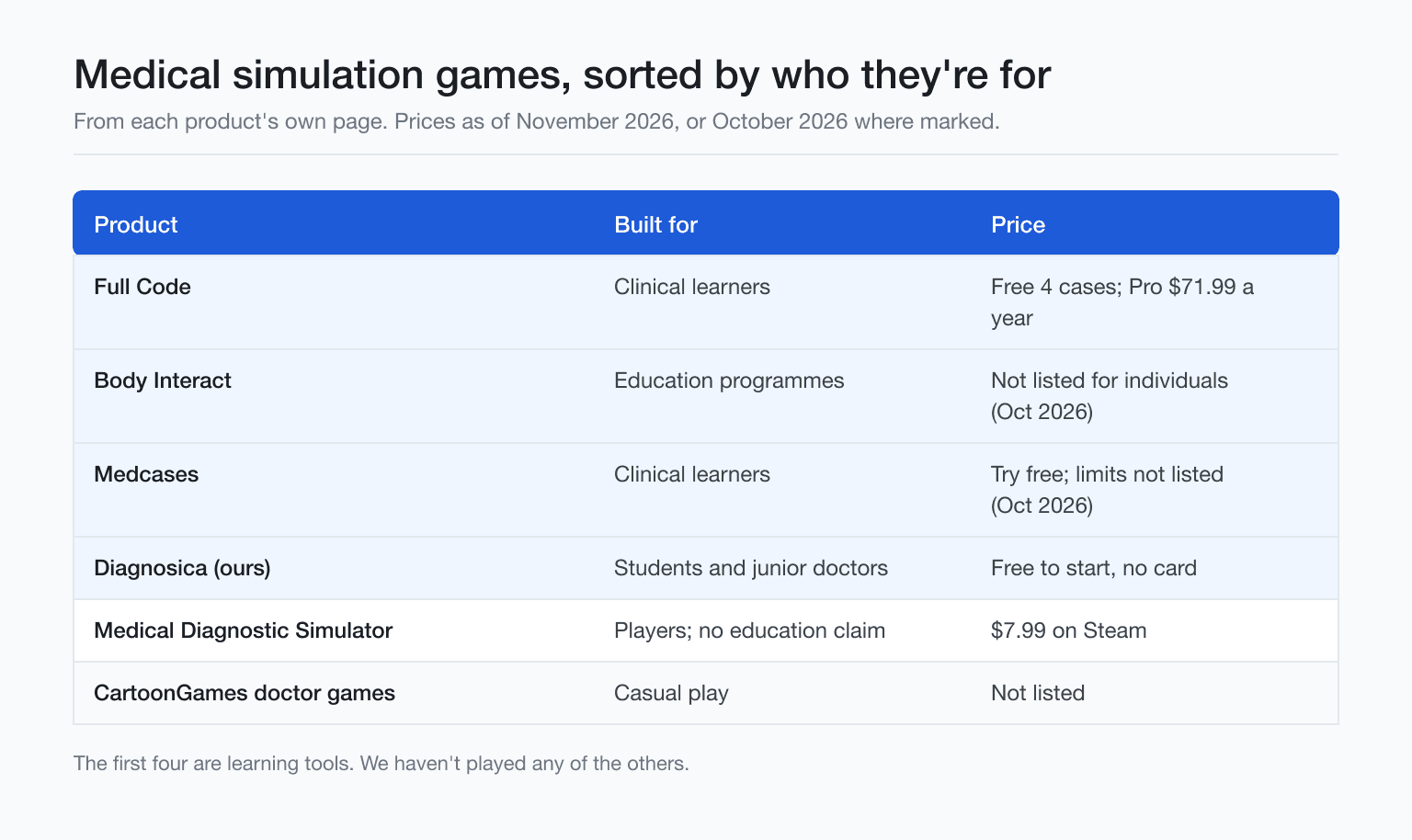
Medical simulation games compared, with who they’re for, what you do, and price checks as of November 2026. We sort education first simulators from entertainment titles so you pick the right practice tool or time-filler.
Game | Built for | You do | Price, as of November 2026 | Where |
|---|---|---|---|---|
Full Code | clinicians and trainees | work through peer-reviewed cases | Free 4 cases; Pro $11.99/m or $71.99/y; CME $99.99/y | iOS, Android, web |
Body Interact | education programmes | talk to reactive virtual patients | Individual price not listed, Oct 2026 | Web, iOS, Android, Windows |
Medcases | clinical learners | interview, exam, tests, treatment | Try free; paid limits not listed, Oct 2026 | web, iOS, Android |
VRpatients | skills training | simulate skills in VR scenarios | No price stated on page | Meta Quest headset |
Diagnosica | students and clinicians | take histories, order tests, diagnose, scorecard | Free to start, no card | iPhone, Android, web |
Medical Diagnostic Simulator | entertainment | consult as a GP, diagnose | $7.99 | Steam on PC |
itch.io medical games | indie players | varies by title | free | itch.io, mixed platforms |
CartoonGames doctor games | kids and casual players | arcade doctor mini games | not listed | web browser |
Order is learning tools first, not a ranking of quality.
The ones built for learning
Full Code, Body Interact and Medcases are medical simulation games whose own pages speak directly to clinical learners and education programmes. They state audiences, case types and objectives upfront, signalling built for curricula rather than casual play, with declared outcomes throughout.
Full Code lists 300+ peer reviewed, CME accredited cases across 31 specialties on the homepage, with 4 free cases and Pro at $11.99 a month or $71.99 a year on pricing, as of November 2026. See Full Code alternatives.
Body Interact offers virtual patients that breathe, speak and react in real time, with AI driven conversations, sold to medicine, nursing, health science and EMS programmes on Body Interact. Demo-led, with no individual price listed, as of October 2026.
Medcases covers interview, physical exam, test interpretation and treatment on Medcases. Voice-only tools skip that exam step. The site self-reports 1,500 case scenarios and invites individuals to try free.
VRpatients is described on the Meta store as a simulation game that helps reinforce core skills, and it needs a Meta Quest headset on VRpatients. No price is listed. For no hardware options, see free virtual patient simulators.
The ones built for fun
Consumer medical simulation games are built for fun, not study. Medical Diagnostic Simulator is a text-based GP sim whose store page says cases are created with AI, and doesn't claim education. Itch.io's medical tag is mixed, and CartoonGames hosts doctor games. Fine for fun, don't revise from them, because the pages don't say where the medicine comes from.
Medical Diagnostic Simulator is consumer-first, $7.99 as of November 2026, developer Arktos Cat, released 10 June 2024, 15 user reviews. The page discloses, "All cases have been created with IA.", and it doesn't present itself as medical education.
itch.io's medical tag collects free indie sims, from Trauma lab, "an anatomy and physics sandbox", to Poliklinika, "You're an underpaid physician in a district clinic. Try not to get fired before lunch." Emergency Code pitches "build clinical confidence before you ever step foot in the room", so the tag is mixed. Doctor games on CartoonGames are framed as entertainment.
How to tell if a game will teach you anything
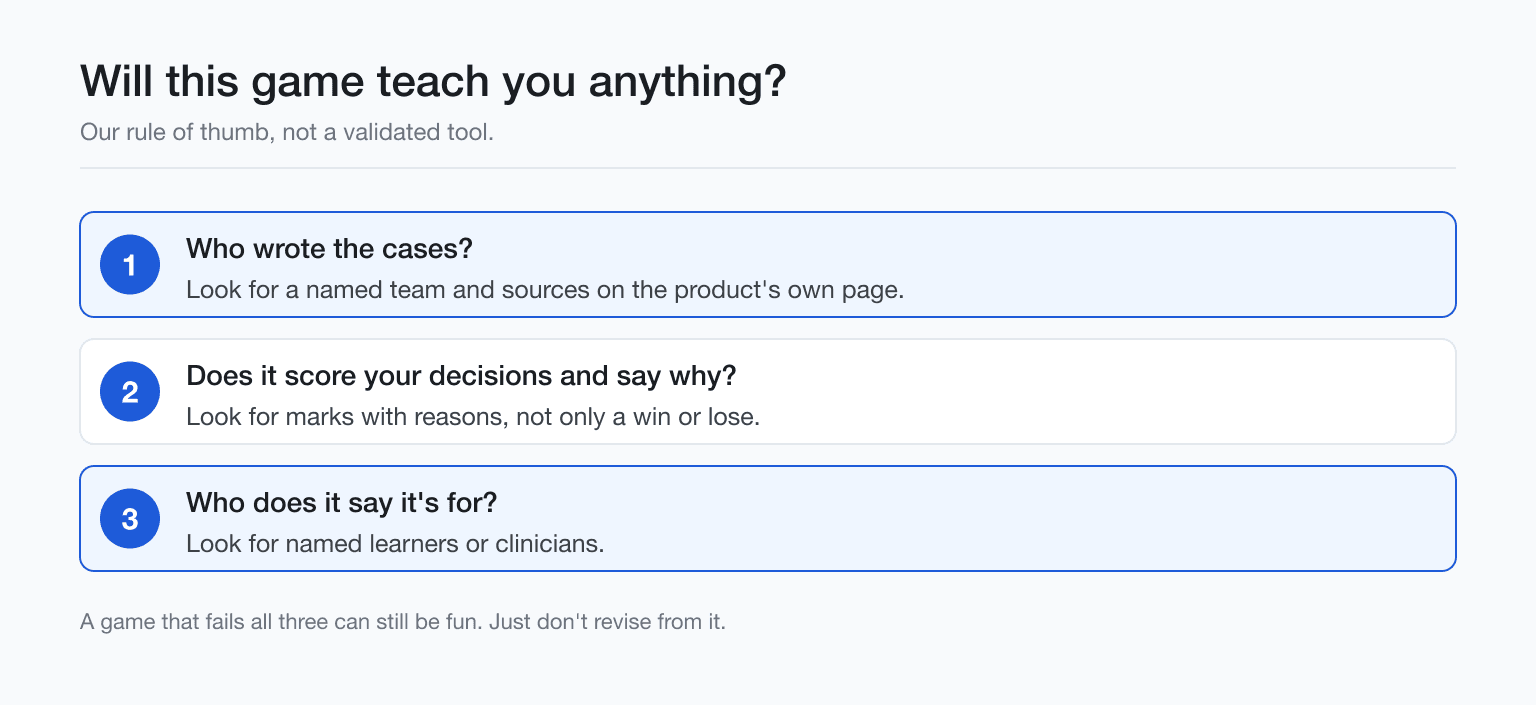
To sort medical simulation games that teach from ones that only entertain, ask three questions: who wrote the cases and from what source, how your decisions are scored and why, and who it’s for. This is our rule of thumb, not a validated tool. A game failing all three can still be fun. It checks transparency and declared pedagogy.
- Who wrote the cases and from what source: a named team with cited references, visible.
- Does it score your decisions and say why: point-by-point scoring with clear rationales shown.
- Does it say who it's for: defined learners or clinicians, not undefined 'everyone' or 'users'.
Example. The Full Code pricing and Full Code homepage state peer-reviewed, CME-accredited cases; the Steam page for Medical Diagnostic Simulator discloses AI-created cases, describes a text-based GP sim, and doesn’t claim education.
Do medical simulation games actually help?
Medical simulation games probably help with short-term learning when they are built as serious games, but the certainty is low. Most products haven’t been measured. Expect short-term gains, low-certainty evidence, and most products untested. For any single title, claims outpace trials. That gap matters if you're choosing what to use.
A 2019 review of serious games in health professions education covered 25 studies; among 18 controlled experiments, 14 favoured serious games on post-test scores, and it concluded short-term learning seems efficacious while research remains emergent.
A 2026 meta-analysis on gamified clinical reasoning learning pooled 10 of 26 studies and reported a standardised mean difference of 1.11, adjusted to 0.75 for publication bias, with low certainty and a cautious interpretation. SMD is a standard measure of effect size across studies.
These studies don't test any game named here, including ours.
Where Diagnosica fits
Diagnosica is an AI clinical simulator where you play the patient encounter with a video AI patient, order tests, decide a diagnosis and plan, and get a scorecard. It adds a two-minute quick case, streaks and weekly leagues. No physical exam practice, it’s early, and there’s no learning-effect trial. See Duolingo for medical students.
Play a case Talk to a video AI patient, order tests, commit to a diagnosis, then see your score. Start a case free
Common questions
Are there free medical simulation games?
Yes. Full Code has a free tier with 4 cases as of November 2026, see Full Code's pricing. itch.io's medical tag lists free indie titles. Medcases says you can try free. Diagnosica is free to start, no card.
Is there a realistic doctor simulator on PC?
On PC, Medical Diagnostic Simulator on Steam is a text-based GP sim, $7.99 as of November 2026, and its store page says all cases are AI created. Whether it feels realistic is something we can't judge. Full Code also runs on the web in a browser.
Can a simulation game replace ward time?
No. A 2019 review of serious games found short term learning gains, and a 2026 meta-analysis reported low-certainty effects, and neither compared against ward time. Useful for extra repetitions and feedback, but not a substitute for patients. No physical exam practice on Diagnosica.
Are medical simulation games good for OSCE practice?
Depends on the station. For data gathering, investigations, differential and a plan, simulators can help you practise decisions and timing. Diagnosica covers history, investigations, reasoning and a plan, no physical exam. For station-focused tools, see AI OSCE simulators.
Diagnosica is an independent educational platform and is not affiliated with, endorsed by, or sponsored by any third-party product or trademark named in this article. All trademarks remain the property of their respective owners. Product comparisons are for educational purposes and reflect publicly available information at the time of writing, November 2026.
If you're after learning over entertainment, try an AI patient with scored decisions and teaching points, free to start, no card: Play a practice case