Problem representation: the one-line summary, with examples

A problem representation is a one-sentence summary of a patient that names who they are, the time course, and the key features of the syndrome. Students often call it the one-liner. It shapes which diagnoses you consider.
Key takeaways
- Build from 3 parts: who, when, what, in a single one-liner.
- Swap raw story for paired qualifiers, like acute or chronic, cut irrelevant details.
- Next step: rewrite one recent case as a single sentence tonight.
Try it now: take a history from a live simulated AI patient by voice or text, then write your one-liner.
Write a one-liner for a live case
What is a problem representation?
A problem representation is the patient summed up in one short line, in clinical terms. You compare it with diseases you know to test your early hunch. It keeps the key signs that matter for diagnosis. It orders them by time and by what matters most. It points your differential toward the likeliest groups, fast.
Clinical Problem Solvers calls it an evolving summary. It should change as you gather new information. WikiMSK notes it also translates lay language to medical terms, so your summary activates scripts instead of copying phrasing.
You then compare that distilled description to what you know by matching it to illness scripts. That deliberate match keeps the differential organized and makes revising the sentence feel natural as data arrive.
How to write a problem representation in three parts
Write a problem representation by answering who, when and what, then sharpen and cut. The three-part frame is patient context, time course, and clinical syndrome, clarified in a 2026 coaching guide that emphasizes clarity, relevant findings, and precise terminology.
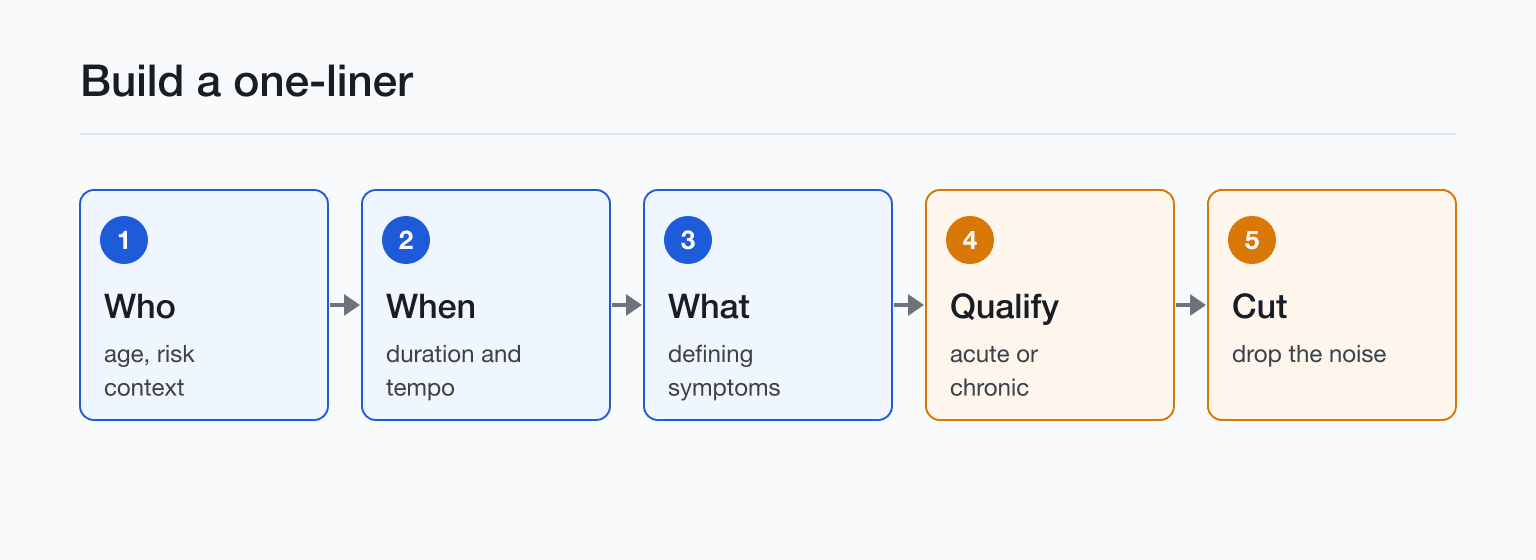
Three core parts first, then two sharpening steps. Frame from Clary 2026 and Clinical Problem Solvers.
Build it in this order, using one line you can revise fast:
- State who: age, sex, and the risk context that matters diagnostically.
- Pin down when: duration and tempo, acute, subacute or chronic, stable or progressive.
- Name what: the key symptoms that define the syndrome and exclude mimics.
- Swap story details for semantic qualifiers, using paired terms such as constant or recurrent to compress meaning.
- Cut anything that wouldn't change your list: fatigue rarely narrows differential; ask "What can be omitted without losing clarity?"
Clinical Problem Solvers also use a who, when, what frame for problem representation. It keeps the one-liner organized and quick to update.
A problem representation example, before and after
One simulated library case shows how raw complaints become a one-liner that links organs and time. Compare the initial list with the rewrite and see how qualifiers, acuity labels, and organ grouping turn it into a teachable line.
Peter Halloran is a simulated patient from the Diagnosica case library. Different doctors had looked at his nose and kidneys separately.
Peter, 48 (simulated): what he said, and what we had to ask
Chip | Question | Answer | Why it mattered |
|---|---|---|---|
Volunteered | What brought you in today? | Six months of blocked, crusty nose with recurring nosebleeds, not improved with three antibiotic courses or steroid spray. | Chronic ENT symptoms, refractory, sets tempo and site. |
Volunteered | Any cough or blood when coughing? | Four weeks coughing up blood, from streaks to a teaspoonful, and getting more breathless. | New respiratory bleeding and dyspnea, escalates tempo, second organ system. |
Asked | Has anyone checked your urine or kidney function recently? | GP urine test this week found blood and protein, kidney bloods worse than three months ago. | Urinary blood and protein with worsening kidney function, confirms renal system. |
Volunteered | Have different doctors seen you for each problem? | Different doctors looked at nose and kidney problems as separate things, nobody said they are connected. | Signals the link between ENT and kidney problems across teams. |
Asked | Any weight loss, sweats, or fevers at home? | Drenching night sweats, lost about six kilograms, feeling hot and feverish. | Constitutional symptoms support a systemic process. |
Only if asked specifically | Has your nose shape changed at the bridge? | The bridge of my nose has begun to flatten and sink in, I can see it. | Structural nasal change, severe ENT involvement, adds specificity to one-liner. |
Three of six facts surfaced only because you asked, and the one-liner needs all six.
Simulated patient. Case file gpa-48m. Questions written by us as a model, not a learner session.
Rewrite the case as one sentence
The after version is a linked problem representation where the same facts become one sentence of qualifiers that spans nose, lungs, and kidneys. It makes your reasoning explicit, compressible, and easy to test fast.
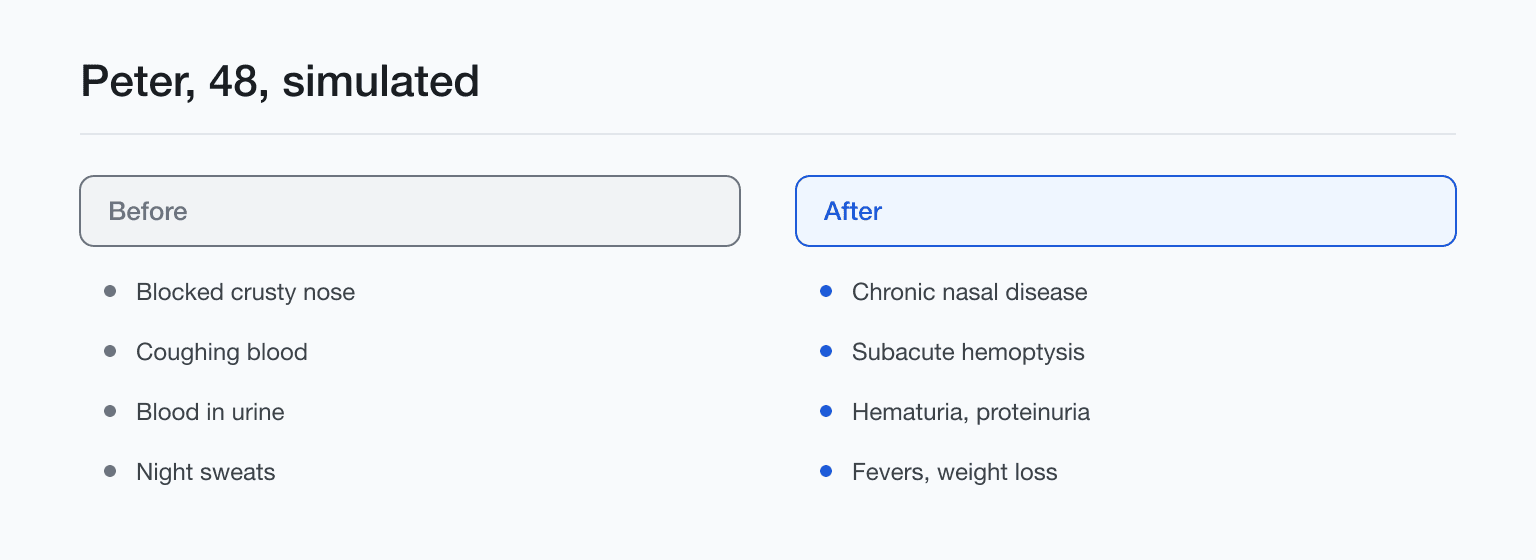
Same facts, rewritten in clinical terms. Simulated patient from a Diagnosica library case.
After. 48-year-old man, chronic six-month crusting nasal disease with recurrent nosebleeds unresponsive to three antibiotic courses, subacute four-week hemoptysis with progressive breathlessness, new hematuria and proteinuria with worsening kidney function over three months, plus feverishness, drenching night sweats and 6 kg weight loss.
The after version links nose, lungs and kidneys in one sentence, so the question becomes which single process could affect all three or whether to split them. That's one cause or several, then you build the differential it unlocks from those qualifiers.
The diagnosis is left off on purpose so you can work it out in the case.
How Diagnosica helps with this
In Diagnosica, you take the history, then the guided diagnosis tests your linked findings.
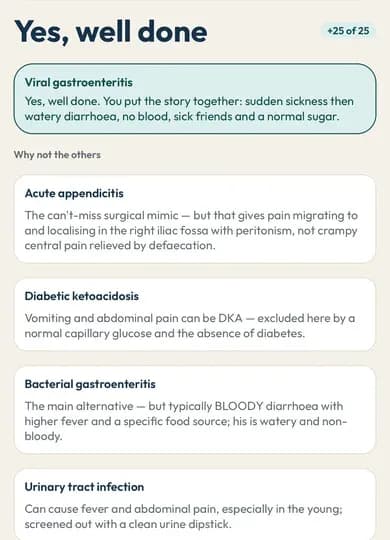
Diagnosica app, guided case diagnosis step, as of October 2026.
- Feedback names the story you put together from your findings.
- 'Why not the others' explains each wrong option against the story.
- Full cases: take Peter's history by voice or text.
Simulated patient. Screenshot from Diagnosica, October 2026.
Problem representation vs one-liner vs summary statement
On most wards, problem representation, one-liner, and summary statement are used interchangeably. Clary 2026 says the problem representation is often called a one-liner. Some teachers split mental model vs sentence. The problem representation is your inner model during the visit. The summary statement is what you say after the encounter.
McQuade and Bonifacino, in a 2023 JGIM letter, say the problem representation is the mental model. They add the summary statement is said after the initial evaluation. They also give this example: calling “foot pain” “acute monoarticular arthritis” is a problem representation.
In practice, the one-liner is also the opening line of the assessment that follows, so it sets up your argument and what comes next.
Common problem representation mistakes
Common mistakes are too long and too literal one-liners that miss abstraction. Clary 2026 described this novice pattern, while experts favor shorter, more abstract summaries, and misframing adds noise that buries signal.
Fix these traps today:
- Chronology recap: You narrate events, not features that discriminate diagnoses.
- Vague descriptors: You keep vague terms; fatigue rarely helps per WikiMSK's worked example.
- Irrelevant history: You include chronic knee osteoarthritis in a fever and cough case.
- Frozen one-liner: You never revise it.
Watch out. Splitting a patient into unrelated problems can hide the linking thread. The 2026 guide warns misrepresenting the problem can lead to misdiagnosis and patient harm.
How to practice problem representation
How to practice problem representation: write one-liners on purpose after real or simulated cases, say them out loud before you check any answer, then compare. Keep a running notebook, and title each line with the presenting problem and setting.
Do this routine tomorrow: after each patient or case, write the who-when-what one-liner, then list diagnoses it brings to mind. A study of 36 pediatric interns found many struggled to turn data into problem representations, so repetition matters.
Tie your problem representation to your clinical reasoning on the wards. Say a one-liner fast, then slow down and test it against fast and slow thinking, revising words so the sentence points at likely diseases.
Try that now on your next patient or a simulated one, then compare with a peer or supervisor. Try your one-liner on a new patient.