What is an OSCE?

An OSCE is an objective structured clinical examination, a series of timed, task-based stations. Every candidate sits the same stations for the same time, while an examiner marks against a standardised mark sheet. Several examiners mark across stations.
Key takeaways
- At Glasgow all stations are 10 minutes, per University of Glasgow OSCE guidance.
- PLAB 2 has 16 scenarios, each 8 minutes, per GMC PLAB 2 guide.
- Next step: check your school's OSCE guide for timings, marking model and station types.
Curious about OSCE history practice? Try one history station with a video AI patient that answers by voice or text, history only, free to start, no card needed.
What is an OSCE?
An OSCE is a practical exam where you rotate through a circuit of timed stations, each a short clinical task with a simulated or real patient. Examiners mark you using the same structured mark sheet. Everyone sits the identical station set with fixed timing, and several examiners assess across stations.
The Medical Schools Council examiner guide calls it the commonest form of clinical assessment at medical school. It says Harden and Gleeson described the first OSCE in 1979.
Some schools write Observed Structured Clinical Examination, per the University of Washington's OSCE page. The GMC says PLAB 2 uses the same style. Schools often use a mix of simulated and real patients, per the Medical Schools Council examiner guide.
The parts of an OSCE at a glance
Every OSCE shares the same few parts, but each school or exam body sets the specifics. Expect different station mixes, timings, examiner roles and how results are reported across programmes.
These are the core parts you’ll see named in official guides:
Part | What it is | One published example | Read more |
|---|---|---|---|
Stations | Consultation, examination, procedural skill types. | Liverpool names three main types. | |
Simulated patient | Actor follows script as patient, sometimes a real patient. | Liverpool uses actors, MSC says mix used. | Same Liverpool page |
Examiner | Examiner watches, usually stays passive and marks performance. | Liverpool examiner passive, Glasgow adds global judgement. | |
Timing | Station length and scenario count per station. | Glasgow 10 minutes, PLAB 2 16 x 8 minutes, UW 25 minutes. | |
Who sets it | Who designs and quality assures the assessment. | UK schools set CPSA, GMC quality assures. |
Formats vary by school and exam body, so your own school’s guide wins for timing, station types and marking rules.
How an OSCE station works, step by step
An OSCE station follows the same basic rhythm almost everywhere, and the timings below are the ones Glasgow publishes in its examiner instructions. Expect a short brief outside, timed entry, uninterrupted work, a warning horn, and then a changeover.
Here’s the typical station flow you’ll see in practice:
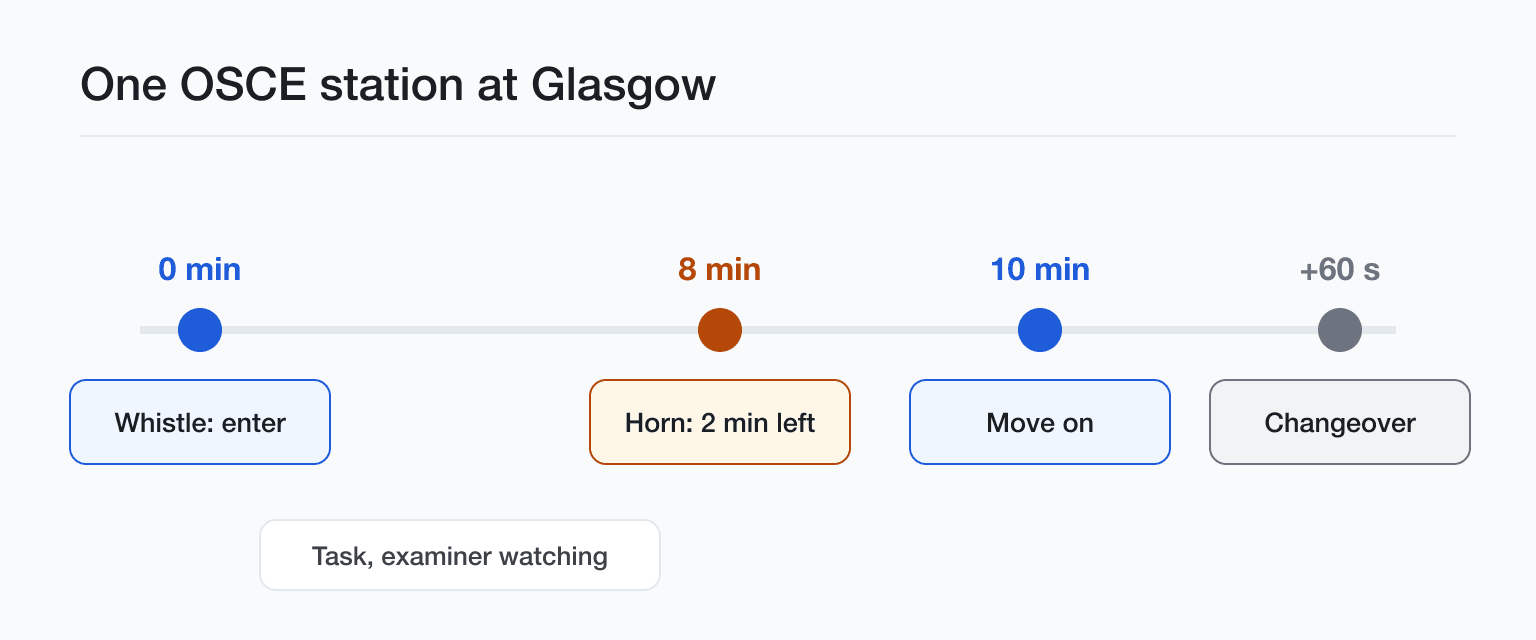
Glasgow station timing with 8 minute horn and 60 second changeover. Source: University of Glasgow OSCE examiner instructions
- Read the task instructions outside the station.
- Enter at the whistle and start the task.
- Work through the task while the examiner watches and marks, no feedback.
- Wrap up when the horn sounds at eight minutes, two minutes left.
- Move on at ten minutes, with a 60 second changeover.
These timings and the no feedback rule come from Glasgow's OSCE examiner instructions. Other schools and exam bodies use different station lengths and signals, so always check your local format.
Simulated history-taking station worked example
Gareth, 52 (simulated): what he said, and what you had to ask
Many history stations look like this, and the patient volunteers a few facts while others need targeted questions.
Chip | Question | Answer | Why it mattered |
|---|---|---|---|
Volunteered | What brings you in today? | Woke overnight with a painful, swollen big toe; came on suddenly, worst within hours. | Sudden onset in one joint shapes the whole history. |
Volunteered | Can you describe what the joint looks and feels like? | Joint red, hot, shiny, swollen, cannot bear a bedsheet on it. | Pins down local symptoms and severity to guide your next questions. |
Asked | Has this happened before? | Third attack in two years, each settling over about a week. | Recurrent self-limiting attacks favour crystal disease over joint infection. |
Only if asked specifically | Any medicines? | Takes a water tablet for blood pressure. | Medication history is routine and often skipped, yet can explain acute joint flares. |
Only if asked specifically | Fever or feeling unwell? | Feels a bit feverish with this attack. | Must-ask red flag; fever here does not rule septic arthritis out. |
In this case file, 2 of 16 history facts are volunteered, and 10 appear only if you ask very specifically.
Simulated patient. Case file gout-52m. Questions written by us as a model, not a learner session.
How Diagnosica helps with this
Ask by voice or text, AI patient answers, a scorecard follows.
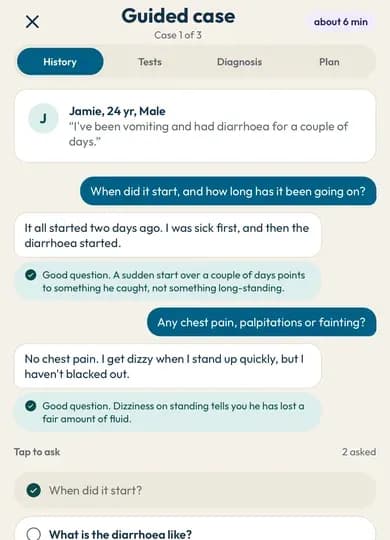
Diagnosica app, guided case history screen, as of October 2026.
Simulated patient. Screenshot from Diagnosica, October 2026.
Take a patient's history, free
How is an OSCE marked?
Examiners mark each station against a structured mark sheet. At the University of Glasgow, examiners also record a separate global judgement, and that judgement sets the station pass mark using a method called borderline regression. OSCEs use multiple examiners and standardised mark sheets.
Borderline regression means the pass mark comes from how candidates judged borderline actually scored. The global judgement is used to set that station’s pass line from observed performance.
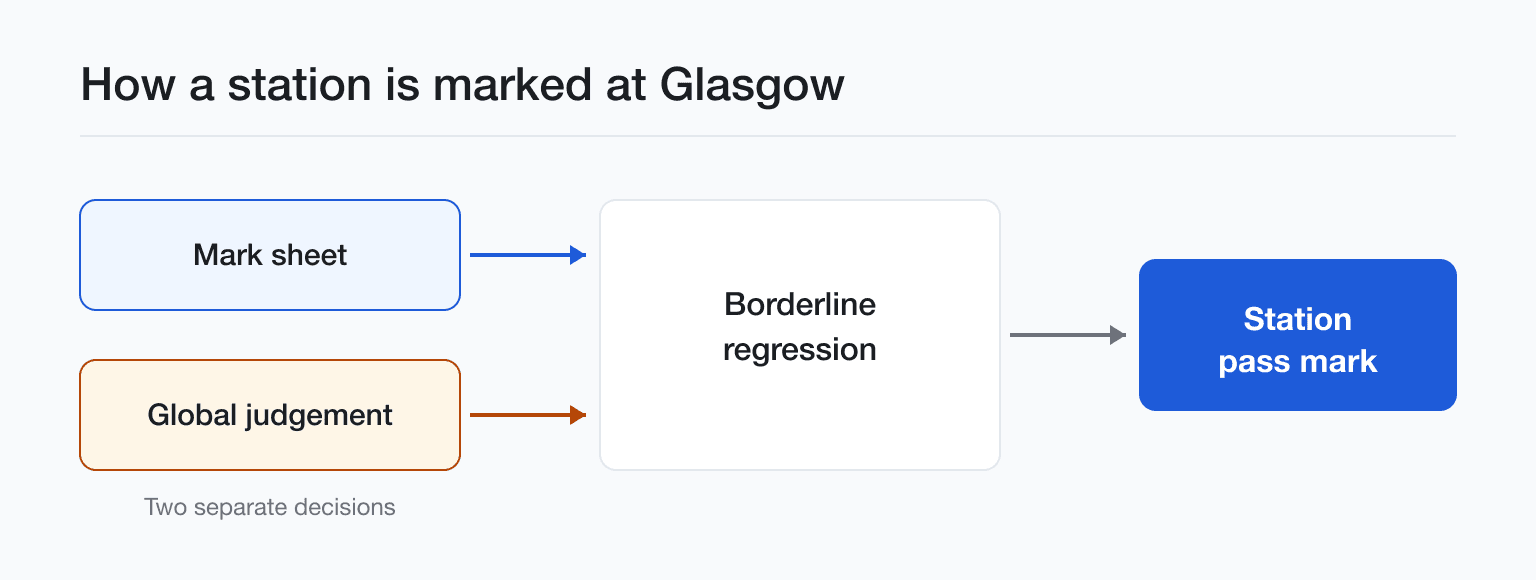
How global judgement sets a station pass mark via borderline regression. Source: University of Glasgow OSCE examiner instructions
Marking varies. At Glasgow, since 2023-24, examiners award 1 to 5 for Core Consultation Skills; the simulated patient awards 1 to 3. University of Washington scores stations Meets Expectations or Needs Development. For UK finals, schools set the CPSA and the GMC quality assures it, see CPSA marking in detail.
Mistakes and myths beginners make
You can fix early OSCE mistakes if you know the rules schools use, the timings bodies publish, and why asking targeted questions beats waiting for patients to volunteer everything.
Watch for these common traps:
- No killer stations, says the Medical Schools Council guide.
- Station timings vary, 8 to 25 minutes, per GMC PLAB 2 and UW.
- 10 of 16 history facts in the gout case file need a specific probe.
- Glasgow examiners must not give feedback during stations.
Watch out. History station tip: in the gout case file (Gareth, 52, simulated), feeling feverish is a must ask red flag he reveals only if asked specifically, so ask about fever yourself.
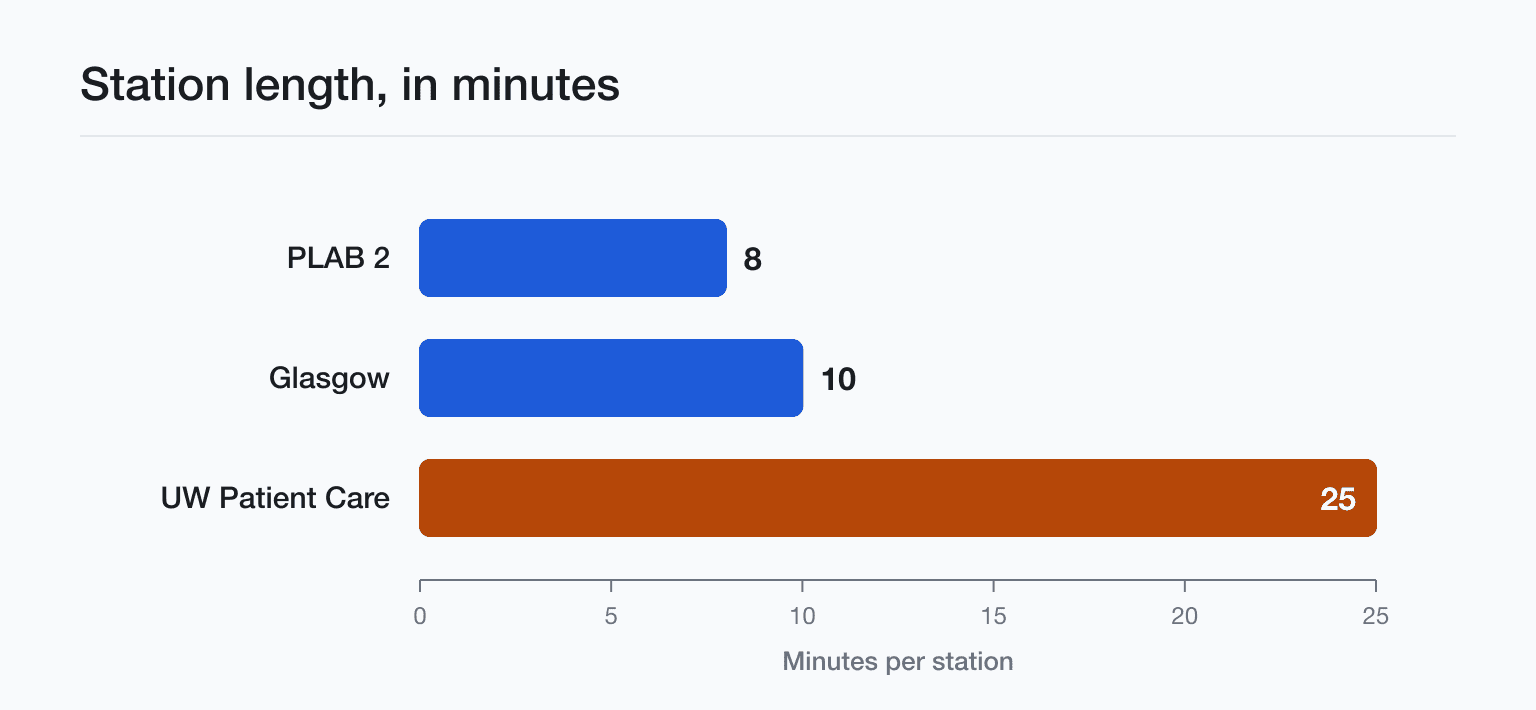
Station length across exams. Sources: GMC, University of Glasgow, University of Washington
If your hands shake, read nerves on OSCE day. If you don’t pass, see what happens after a fail. Some schools use sequential testing, a second circuit combined with the first, as the Medical Schools Council guide describes.
Where to go next
If you're brand new to OSCEs, begin with a clear starter guide and your school's official OSCE handbook. Get the big picture first, then match it to your exam body's rules.
Start with how to prepare for an OSCE if you want the full preparation path as a beginner.
Practise with a solo practice plan if you're rehearsing history stations with no partner. Use self-guided PLAB 2 preparation if you're an international graduate sitting PLAB 2.
Practise a history station tonight with Diagnosica's AI patient: practise a history station. You talk by voice or text, it answers, you get a scorecard; it covers history-taking only, no physical examination.