How to use Anki in medical school: a practical guide

Knowing how to use Anki for medical school starts with Anki's defaults: cap new cards, review every day, and expect roughly 200 reviews daily from 20 new cards. Anki desktop is free on all major platforms.
Key takeaways
- Keep desired retention at 90%, above 97% can be overwhelming.
- Press Again when you forget, not Hard, to record a real lapse.
- Add one patient-history practice daily, since cards hold facts, not questioning.
Start on the defaults and cap new cards
If you're deciding how to use Anki for medical school, begin a few weeks on the defaults, then adjust. Then prioritize New cards/day, which sets new-card count and drives review load; see the Anki deck options guide.
Start with these Anki deck options and what they actually control:
Setting | What it controls | What the manual says |
|---|---|---|
New cards/day | New cards shown each day | Missed days don't stack up |
Maximum reviews/day | Cap on review cards daily | Upper limit on reviews shown |
Desired retention, FSRS | Target long term recall rate | Default 90%; above 90% load rises quickly |
Answer buttons | How your response trains FSRS | Use Again when you forget |
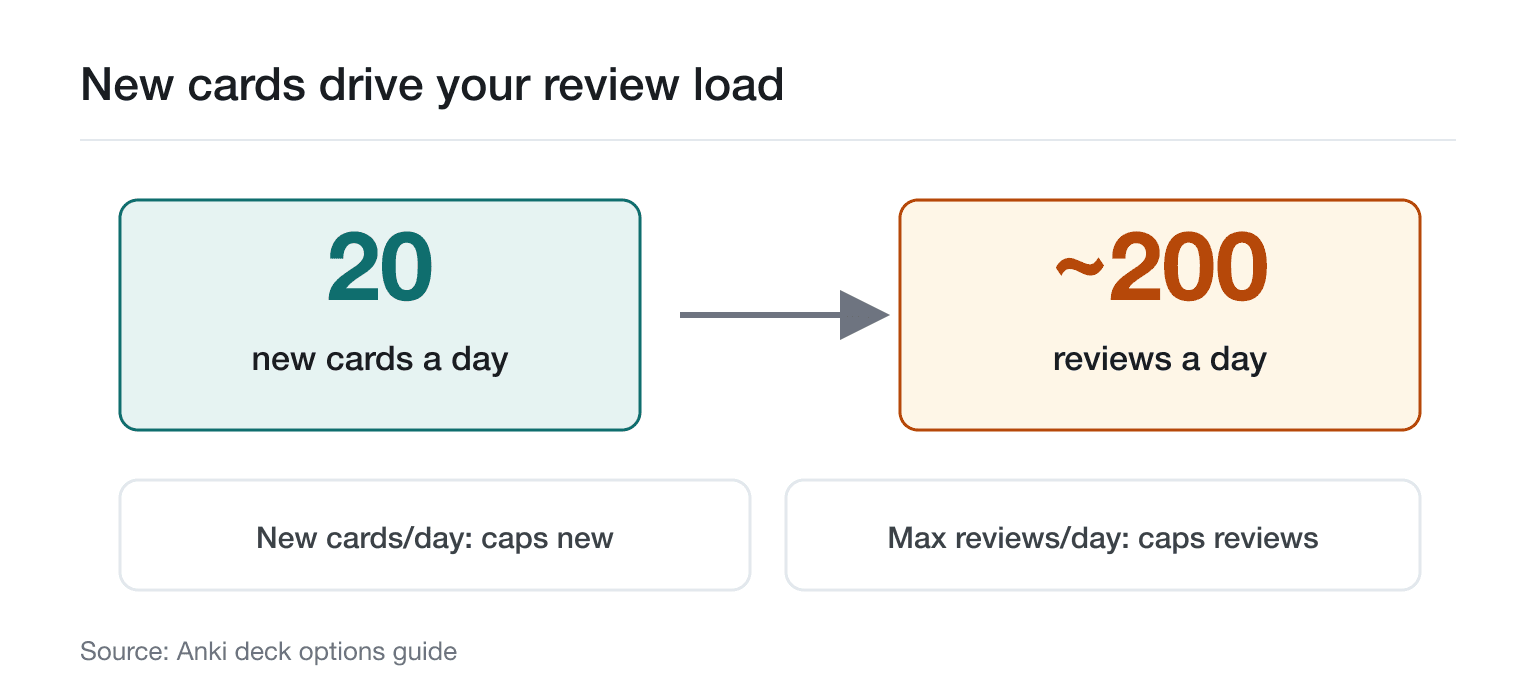
Anki's manual: 20 new cards a day means roughly 200 reviews a day.
The same guide says that 20 new cards a day leads to roughly 200 reviews a day. For downloads and mobile apps, see the Anki download page: Anki desktop is free, AnkiDroid is free, and AnkiMobile for iPhone is paid. For where Anki fits across a week, see a full study system.
To feel where questions start, try a two-minute quick case, free and no sign-up.
How many Anki cards a day in med school?
There is no official number. Anki’s manual gives the math: about 20 new cards a day grows to roughly 200 reviews a day. Set your new card limit to match the daily review time you can actually protect, so reviews stay sustainable during classes, wards, and exams.
Use Maximum reviews/day to cap how many review cards you see and to smooth peaks after a break. New cards/day is a daily cap, and missed days do not stack. For practical recovery tactics after gaps, see restarting after missed days.
A 2006 review of spacing studies across 317 experiments in 184 articles found the best gap grows as the needed retention interval increases. That’s the spacing effect Anki’s manual traces to Ebbinghaus in 1885. Plan that cadence when fitting reviews into the week.
A daily Anki routine in five steps
An Anki daily routine for medical school is simple: do your reviews first, add new cards only after that, and grade honestly so the scheduler works. Stop when the counts hit zero, then come back again tomorrow.
Do it the same way every day, in this order:
- Clear due reviews first.
- Study new cards up to your cap. Anki won't exceed your New cards/day limit.
- Say the answer out loud or in your head before flipping the card.
- Press Again when you forgot, even if it was close.
- Sync and stop when the counts reach zero.
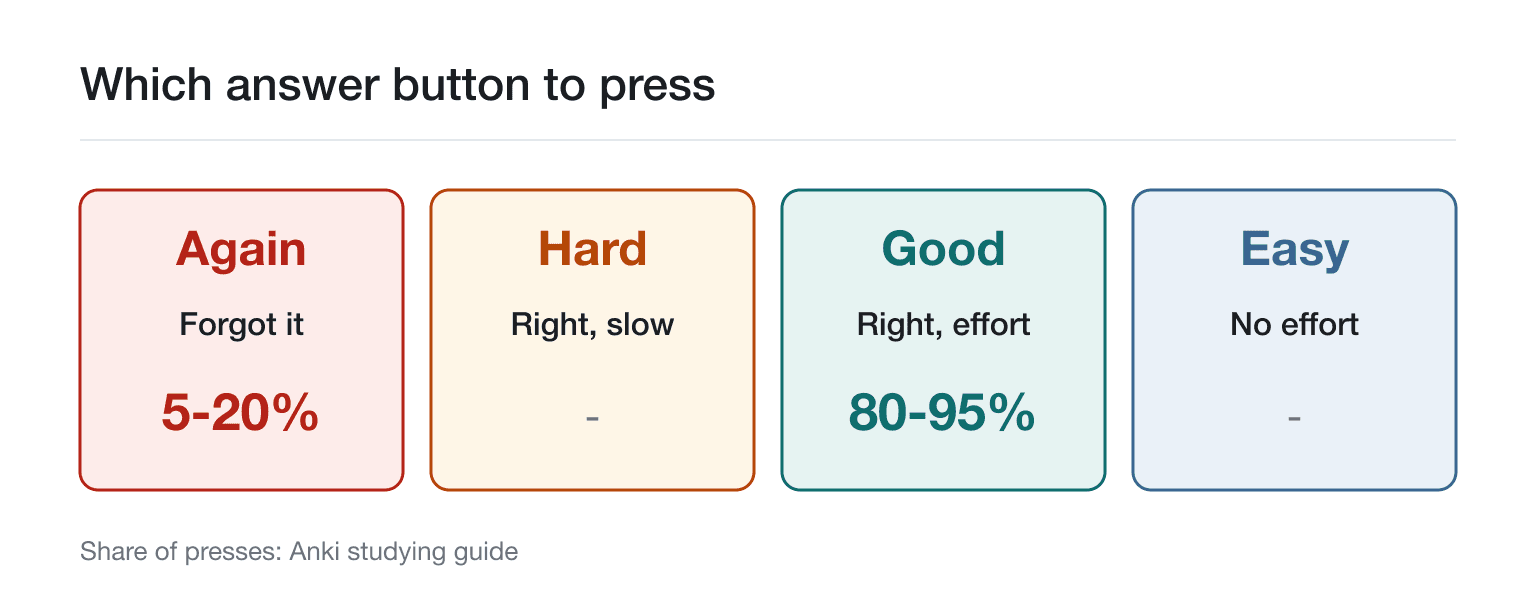
Anki's studying guide: Good about 80 to 95% of the time, Again about 5 to 20%.
Per Anki's studying guide, Good is used about 80 to 95 percent, and Again about 5 to 20 percent. If you forgot, press Again, since Hard tells FSRS you recalled it and can make intervals too long.
For the deeper why, see testing yourself on purpose.
Premade decks or your own cards?
For medical school, both work because the goal is recall, not authorship. A premade deck saves card-writing time, while making your own aligns with lectures and how you think. The choice depends on time and how closely a deck matches your lectures.
One premade example is the AnKing Step Deck, which, per its own page, is organized according to the main study platforms.
A Deng 2015 study of 72 students at one school reported Anki users were 31% of respondents. Each additional 1,700 unique Anki cards, or 445 practice questions, was associated with one more Step 1 point. Association at one school, not proof that cards cause the score.
If cards stop fitting how you study, see when Anki isn't enough.
Where cards stop helping: one patient
At the bedside, a card hands you the question, a patient doesn't, so key facts stay hidden until you ask, probe, and follow up in sequence.
Meet Stephen Marsh, 42, a simulated patient from the Diagnosica case library with Addison's disease. A card on this topic might list tiredness, about 6 kg weight loss, dizziness on standing, salt craving, and darker skin, as in his file.
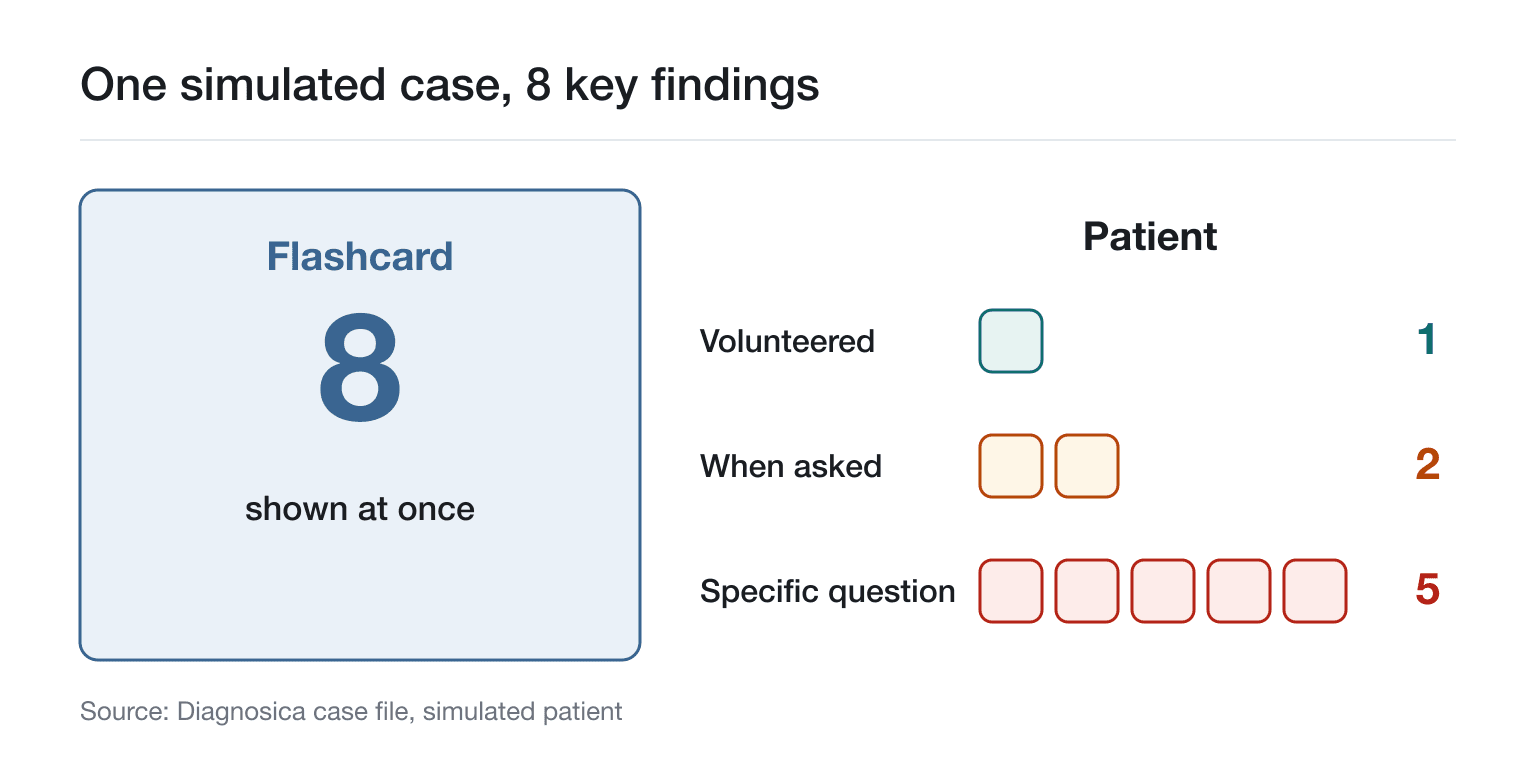
Simulated case file: of 8 key findings, 1 volunteered, 2 when asked, 5 only on a specific question.
Of 8 key findings in the simulated case file, 1 is volunteered, 2 come out when asked, and 5 only on a specific question.
Example. Simulated: He volunteers about four months of tiredness and around 6 kg weight loss. Dizziness on standing appears when asked. Salt craving and the darker skin appear only when asked a specific question. Across his 16 history facts, 10 require a specific probe.
Turning clues into a differential starts from recall's list, then questioning turns it into a diagnosis.
How Diagnosica helps with this
Practice recall with five clues, each wrong guess unlocks the next.
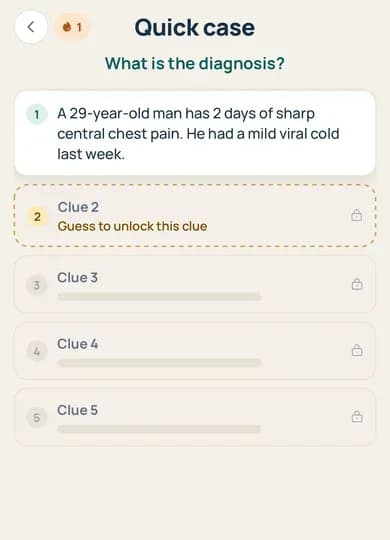
Diagnosica app, quick case, as of October 2026.
- Read first clue, type a diagnosis
- Wrong guess unlocks the next clue
- Fifth guess is your final one
Simulated patient. Screenshot from Diagnosica, October 2026.
Common Anki mistakes in medical school
The predictable ones are adding too many new cards, pushing intervals with the wrong buttons, chasing an extreme retention target, and rereading instead of recalling. They inflate workload and confidence without learning gains.
When figuring out how to use Anki for medical school, watch for these patterns:
- Hundreds of new cards early create overwhelming review loads, per the manual.
- On forgotten cards, press Again; Hard tells FSRS you recalled.
- Above 90 percent retention, workload climbs fast; 97 percent can be overwhelming.
- Rereading boosts confidence, but recall tests beat it later; see the study below.
In a 2006 testing study, prior testing beat restudying on tests 2 days and 1 week later, though restudying raised confidence. See why spacing beats cramming for context and planning.
Watch out. A full review count feels like progress, but flipping a card without trying first is passive study. Anki's own manual says active recall testing beats passive study, and means trying to remember before you see the answer.
Practice using what your cards hold
Use Anki to lock down facts, then spend a few minutes where you must ask the questions and commit to a diagnosis. Keep Anki for facts, and practice the step where you commit to a diagnosis.
Diagnosica’s quick case asks you to name the diagnosis from up to 5 clues in about 2 minutes. A full case lets you take a history from a video AI patient by voice or text. It’s free to start with no card, so use your cards on a patient.