Medical student study schedule: templates for each year

A medical student study schedule should change by year, with one weekly template each for pre-clinical, rotation and final-year weeks. Each template keeps a fixed daily floor, a two-minute case, for bad days.
To make that daily floor stick, you'll want tools that reward repetition: a daily diagnosis game habit compares terminology apps and daily case apps by their daily unit, streaks and leaderboards.
Key takeaways
- Post-call, only the quick case.
- Test yourself and space reviews; a 2013 review rated rereading low utility.
- Switch templates as you move from lectures to rotations to final year.
Do this first: three blocks and a floor
A medical student study schedule works best as three daily blocks, review, new content, and question practice, plus a floor for bad days. Map fixed commitments first, fit the blocks, then grab the year template below.
Do these four moves to set it up:
- List fixed weekly commitments: lectures, ward hours, clinic, labs, commuting.
- Place a review block, a new-content block, and a questions block around them.
- Set the floor as one quick case, a two-minute clue-by-clue diagnosis.
- Pick your year template below and copy it into your calendar.
That three-block shape lines up with Sketchy's M1 study guide, which suggests morning review, afternoon new content, and evening practice questions.
This post is the templates; keeping the habit going lives in its own guide. Go small and add one two-minute case to today.
Why the templates lean on self-testing and spacing
These templates lean on self-testing with spacing because retrieval outperforms rereading long term. Each plan builds a questions block and a two-minute quick case into your week to keep recall warm.
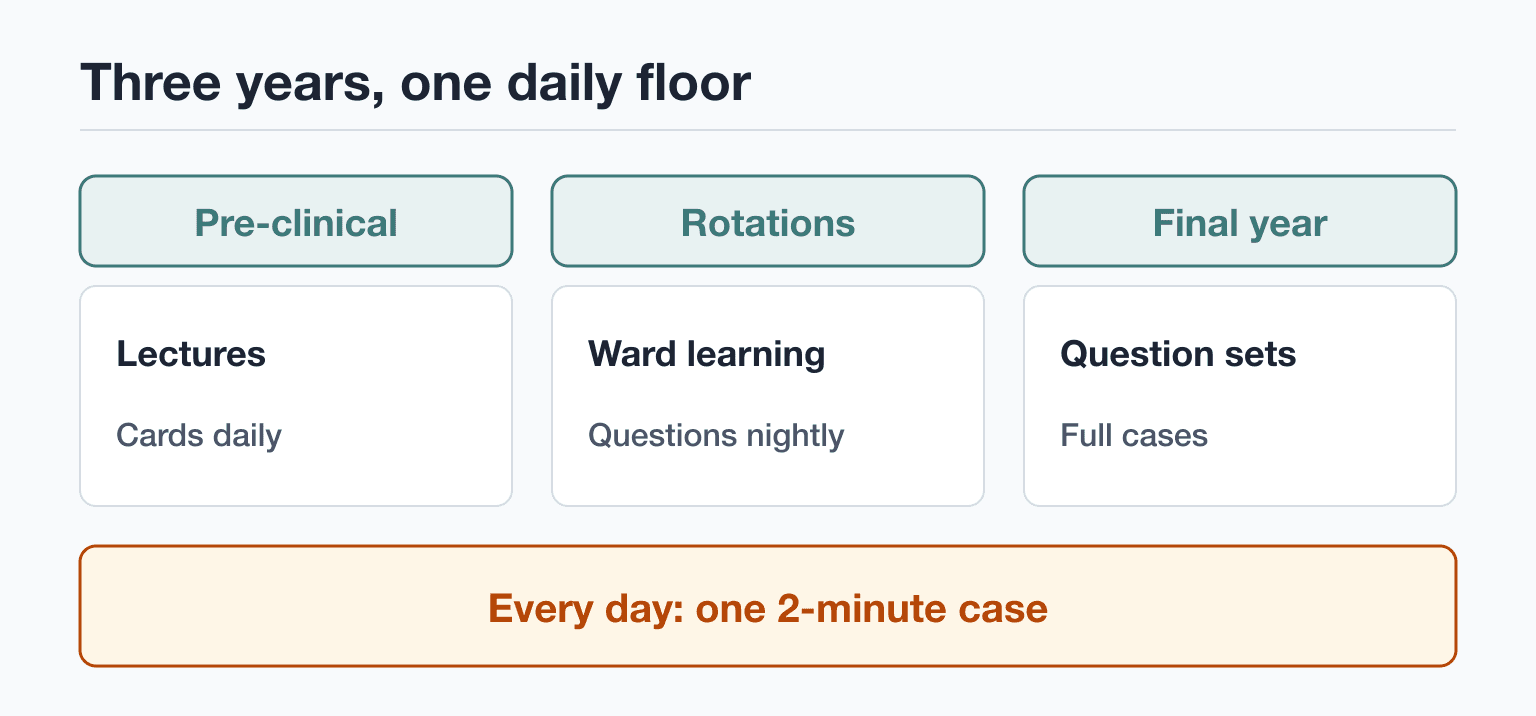
One tiny test daily is the floor. The two-minute quick case makes it doable.
In a randomized trial with residents, material was tested after teaching and twice more about two weeks apart, with feedback. About 6 months later, tested items scored 39% versus 26% for restudied material; 40 residents completed the trial.
A 2013 review of 10 techniques rated practice testing and distributed practice high utility, while rereading and highlighting were low. Build schedules around recall and spacing, not passive rereads.
A 2015 study of 72 students found boards-style questions completed and unique Anki flashcards seen predicted Step 1 score. Association, not cause. Each template reserves a review block and a questions block, and the quick case is a small daily self-test. See self-testing done properly. No study tested Diagnosica.
Pre-clinical week template
The pre-clinical week template assumes lectures set the week, so new content is the big block and review sits in front. You warm up with spaced cards, convert today’s lectures to cards, and always protect a two-minute quick case.
In the AMA's first-year tips, a Sketchy strategist says, "Block exams reward depth, while Step 1 and other board exams reward breadth". Learn for the block exam, and tag board-relevant material for review.
Make the week flow like this:
Day | Review block | New content | Floor |
|---|---|---|---|
Lecture days (Mon to Thu) | Yesterday's cards, self-tested | Today's lectures, made into cards | One quick case |
Small-group or lab day | Weak cards from the week | Pre-read for the session | One quick case |
Saturday | A week's question set | Catch up one lecture | One quick case |
Sunday | Light card review only | Rest | One quick case |
If Anki isn't working for you, see flashcard tools besides Anki.
Example. Monday, you open with yesterday’s card pile until recall feels clean. In lecture, you flag high-yield diagrams and convert key ideas to atomic cards before you leave. Later, you tag board-relevant items for breadth review. To close, run a two-minute quick case, naming the diagnosis from up to 5 clues, then read the one-line teaching point.
Clinical rotation week template
On clinical rotations, your study plan accepts that the ward sets the day. Review before rounds, read on patients; questions move to the evening, quick case as the floor on bad days.
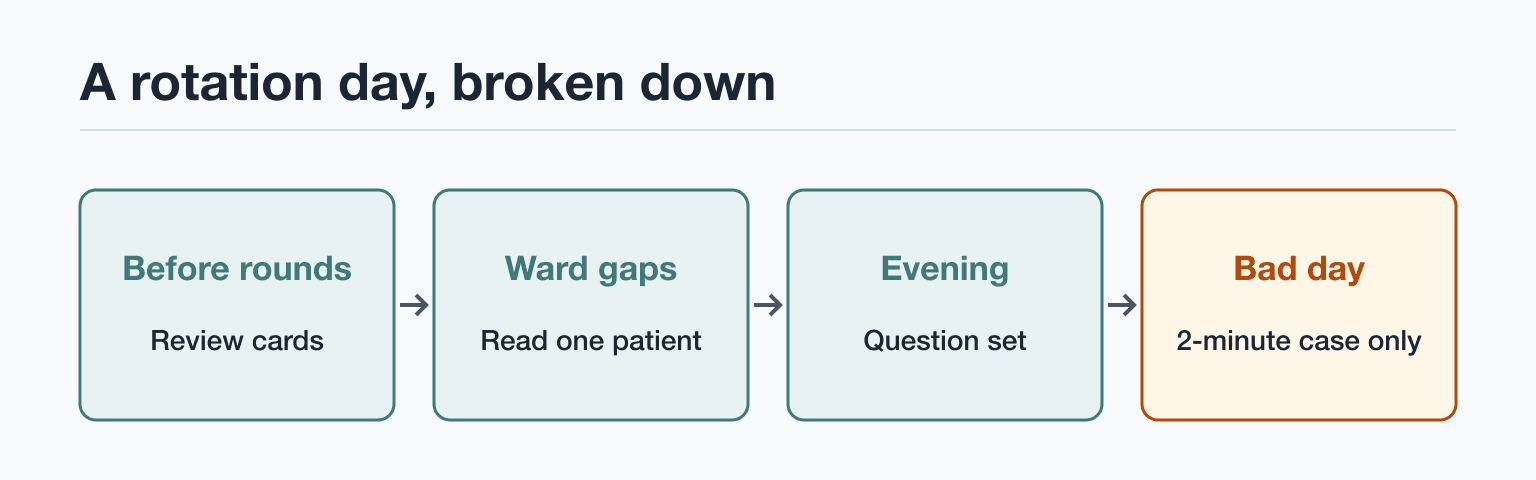
On rotation days, review early, read on patients in gaps, and run questions at night. The quick case is the floor.
Review before rounds, read on a patient in gaps, questions at night, quick case on bad days:
Day type | Before or between | Evening | Floor |
|---|---|---|---|
Ward day | Review cards before rounds | Read up on one patient, then questions | One quick case |
Clinic day | Pre-read the clinic's common presentations | Question set for that specialty | One quick case |
Post-call or late day | Nothing | Nothing | One quick case only |
Weekend day | Shelf-style question block | Review missed questions | One quick case |
For tactics behind this template, see preparing for clinical rotations and studying around ward work.
Watch out. Long ward days happen. Don't delete the review block, shrink it to the floor instead.
How Diagnosica helps with this
Quick case: name the diagnosis from up to 5 clues, about 2 minutes.
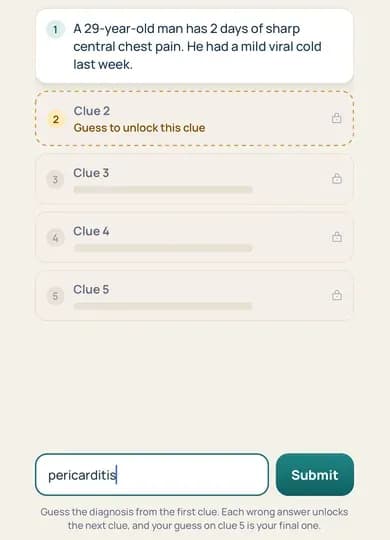
Diagnosica app, quick case screen, as of November 2026.
- Read the first clue and type a guess.
- Each wrong guess unlocks the next clue, up to five.
- It keeps your daily streak going on bad days.
Simulated patient. Screenshot from Diagnosica, November 2026.
Final-year and dedicated study week template
In final year or a dedicated board-study period, question sets become the main block and whole cases test how it fits together. Anchor the week on timed questions, add full practice cases, and keep a daily quick case as floor.
Use this template as your default, then tweak what you'll review for shelves or Step timing:
Day | Main block | Review block | Floor |
|---|---|---|---|
Question days | Timed question set | Every missed question, written up | One quick case |
Case day | Full practice cases, start to finish | Gaps the cases exposed | One quick case |
Practice test day | One full practice exam | Review it the next day | One quick case |
Rest day | Nothing | Nothing | One quick case |
UK readers revising for finals can see a full finals revision timetable, and there's more final-year advice for the rest of the year.
Common study schedule mistakes
Common study-plan mistakes are predictable: avoid rereading as your main review, stop counting hours like a target, keep a rest day, and switch templates as your year and clerkships change.
These are the common traps and the better move for each:
- Rereading as review rated low utility in the 2013 review; test yourself.
- Counting hours lacks a sourced right daily number; track blocks done instead.
- No rest day ignores AMA advice to leave time for other activities.
- One template forever fails; switch when years change or weeks stop fitting.
Start this week
Copy the weekly template for your year into your calendar this week, then change one thing at a time, so your plan survives busy days without rethinking it.
On better days, Diagnosica's full cases let you take a history from an AI patient on video, by voice or text. Then order investigations, commit to a diagnosis, and see a scorecard. There are over 130 cases across 18 specialties. There's a free tier, no card needed, so keep the daily quick case going.