How to study in medical school: a guide by year

Wondering how to study in medical school? Test yourself often and space reviews out. A 2013 review of 10 study techniques rated practice testing and spaced practice highest, and rereading and highlighting low.
Try a quick rep you can do today. Try a two-minute quick case, five clues one at a time, keep your daily streak. About two minutes, you name the diagnosis from up to five clues, free to start, no card needed.
Key takeaways
- Decide: replace rereading with active recall, quizzing yourself from memory.
- First year: start daily recall; two thirds to three quarters is retained after one year.
- On clerkships: use cases with key-feature questions; one sample scored 56.0% versus 48.8%.
- Mix topics when practicing; one ECG sample reached 46% accuracy versus 30% with blocked practice.
What works best for studying medicine?
Practice testing and spaced practice built into each week work best. They make you retrieve and revisit, which strengthens memory and slows forgetting. If you're weighing how to study in medical school, keep questions central and treat rereading and highlighter use as support, not the main act.
In Dunlosky et al., 2013, Psychological Science in the Public Interest, a review of 10 learning techniques, practice testing and distributed practice received high utility ratings. The review is general educational psychology, not a medical-school study, but medical-education trials below point the same way. The same review suggests using practice testing instead of rereading.
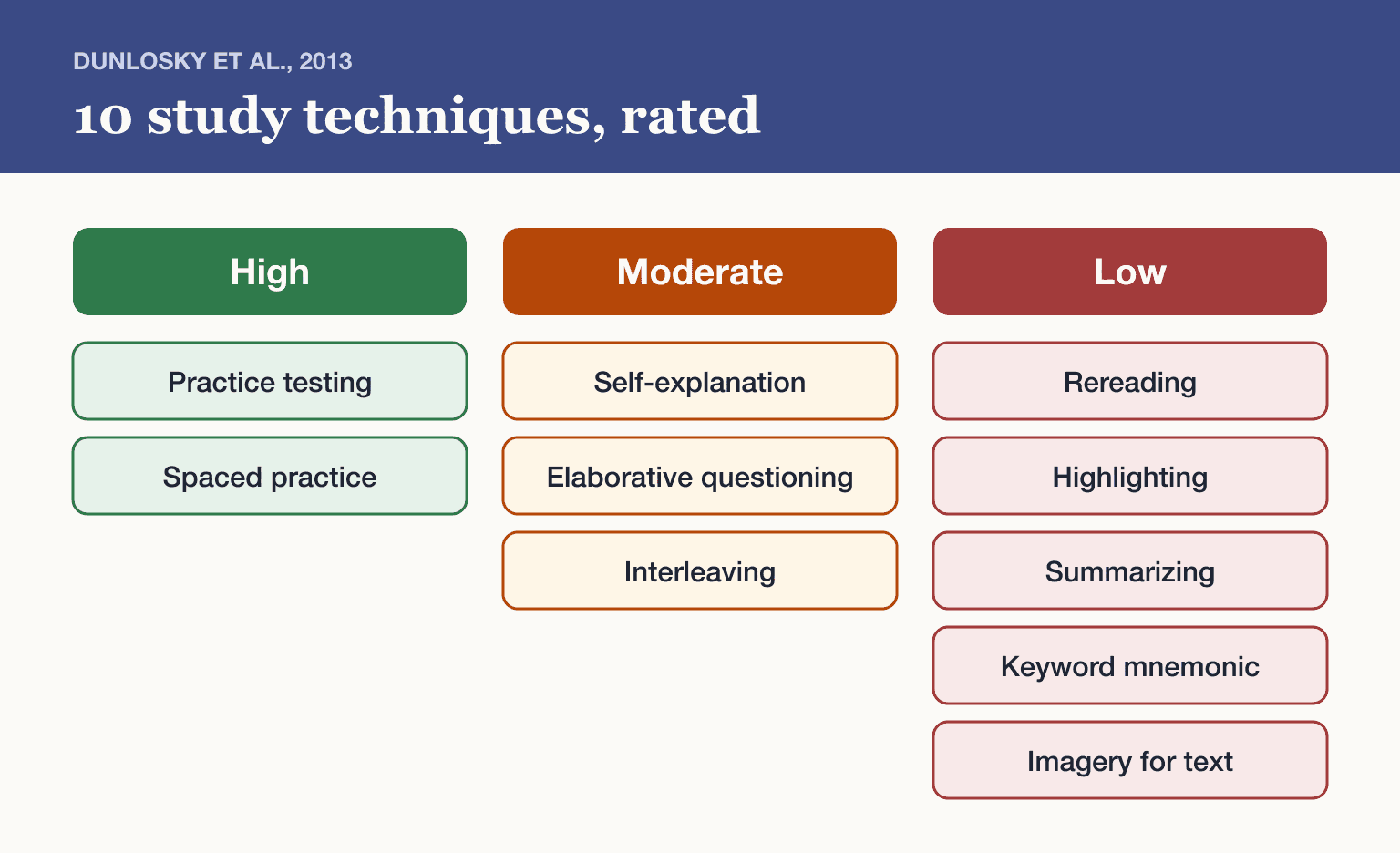
High, moderate, and low utility ratings for ten techniques; practice testing and spaced practice rated highest. Source: Dunlosky et al., 2013.
From that review, the utility tiers to guide your next session:
- High utility: practice testing, distributed practice.
- Moderate utility: elaborative interrogation, self-explanation, interleaved practice.
- Low utility: summarization, highlighting, keyword mnemonic, imagery for text, rereading.
The study methods map: every guide in one place
If you want an overview of study methods you can act on tomorrow, use this map, and each method's deeper guide sits below, tagged by the year it matters most.
Pick a starting point below:
Guide | Question it answers | Year it matters most |
|---|---|---|
what active recall is and how to do it | First year on | |
why medical knowledge fades and how spacing keeps it | Every year | |
weekly study schedules for preclinical, clerkship and final-year weeks | Preclinical years | |
staying consistent on bad weeks | Every year | |
setting up and running Anki for medical school | First year on | |
what to add beside flashcards | Step 1 prep | |
how to learn from patients on clinical rotations | Clerkships | |
game-style daily apps for medicine | Every year |
Bookmark this and work row by row.
Why rereading feels productive but fades
Rereading feels productive because familiar text reads smoothly. That fluency can fool you. Testing yourself makes you retrieve, which strengthens memory and exposes gaps you can fix before they set.
In experiments, students who took recall tests remembered more on final tests 2 days or 1 week later than those who restudied (Roediger and Karpicke, 2006). Restudying only won on a 5 minute test. Repeated studying raised confidence, even as delayed retention fell in the same samples.
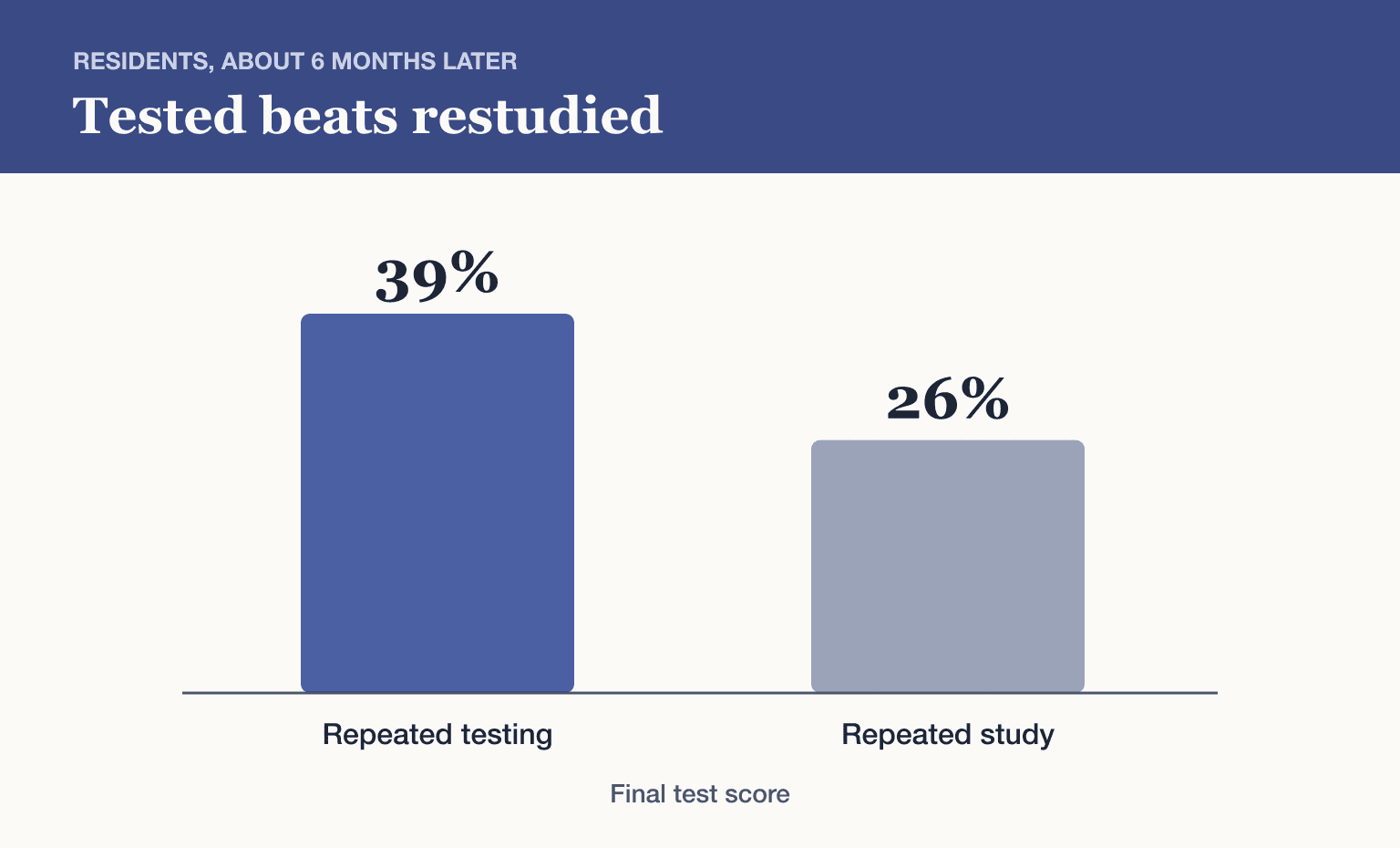
Delayed recall favored tested material 39% vs 26% on restudied content in residents. Source: Larsen et al., 2009.
In a randomized trial in pediatric and emergency medicine residents, tested material scored 39% versus 26% for restudied material about 6 months later, in a 2009 randomized trial in residents. Those tests included feedback.
Testing tends to work best when frequent and spaced, with short-answer recall outperforming recognition, and with feedback as a core ingredient, per a 2008 review. A meta-analysis found recall formats produced larger testing benefits than recognition formats across samples in a 2014 meta-analysis. In practice, that means short answers plus feedback, spaced over time.
First year of medical school: set up these habits early
First year of medical school is where habits are cheapest to build, and knowledge fades without review. Use brief retrieval, spaced practice, and floors to keep momentum steady, make cognitive load lighter, and leave time for anatomy, physio, and life.
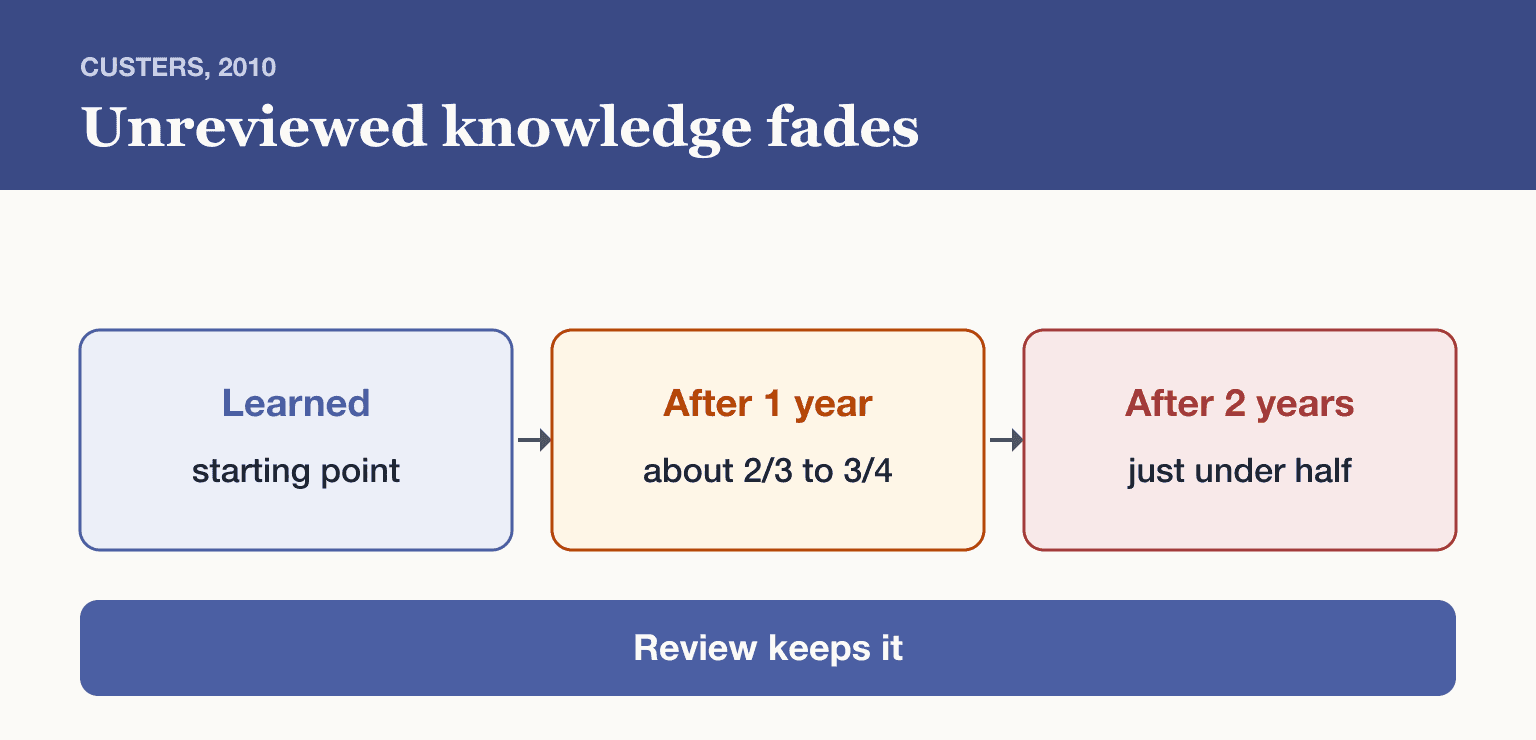
Typical decay: two-thirds to three-quarters at one year, under half the next. Source: Custers, 2010.
A 2010 review of forgetting found roughly two-thirds to three-quarters of learned knowledge are retained after one year, falling to slightly below half the year after a 2010 review of forgetting. That’s why review belongs on the calendar, not only before exams.
Run this first-year loop every study day, even the thin ones, and you’ll keep recall active as workload grows without ballooning your hours, stress, or anxiety:
- Close notes completely and write, from memory, what you remember after each lecture.
- Turn each lecture into a few questions you can answer in short form, not recognition.
- Review yesterday's and the previous week's questions before new material, then add today’s set daily.
- Check answers and fix errors right away for feedback, while the trace is fresh.
- Keep a short daily floor on bad days, then stop without negotiating further.
Spaced repetition without drowning in cards
Spaced repetition in med school is a high-utility technique, and many students run it with flashcards or question banks. The win comes from finishing small daily reviews and using prompts that force recall, not recognition.
At one US medical school, a 2015 study of 72 students found every student used practice multiple-choice questions, 31% used Anki, and self-directed retrieval practice was associated with higher USMLE Step 1 scores. It is one school and an association, not proof that cards cause higher scores. A 2014 meta-analysis (Rowland) reported recall tests gave larger testing benefits than recognition tests.
The deck is a tool, not the goal. Keep daily reviews small enough to finish, then add slowly. Prompts that make you produce an answer beat cards you only recognize, which matches what recall over recognition tends to deliver.
Watch out. Adding cards faster than you can review them snowballs the queue. The daily pile balloons, you miss days, then you stop altogether.
Space reviews you can finish and favor retrieval-heavy prompts, so the habit survives your heaviest weeks.
How Diagnosica helps with this
Practice naming diagnoses with one-at-a-time clues and a daily streak.
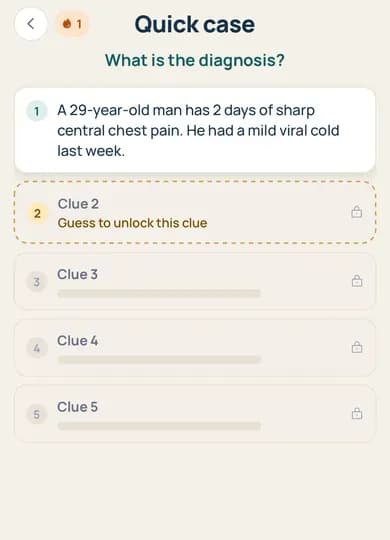
Diagnosica app, quick case screen, as of November 2026.
- The patient opens, and that first line counts as clue one.
- Type a diagnosis, and a wrong guess unlocks the next clue.
- Work through up to five clues, then see the answer.
Simulated patient. Screenshot from Diagnosica, November 2026.
Mix topics instead of studying them in blocks
Interleaving, mixing similar topics in one session, gets a moderate utility rating in the same evidence review that rated elaborative interrogation and self-explanation, and, in medicine, trains you to tell lookalikes apart. Use it once you know the basics so each new question forces a choice.
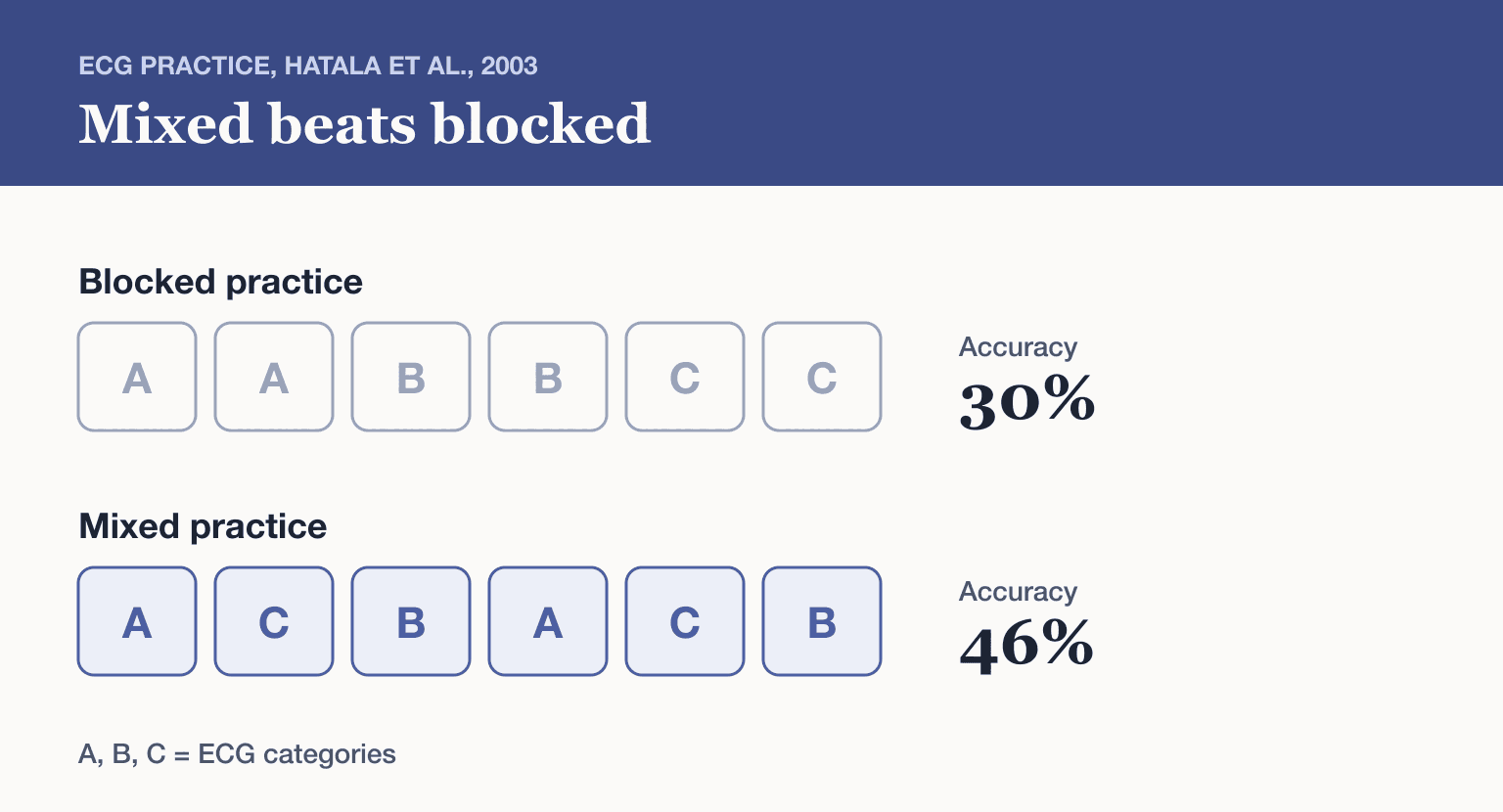
Diagnostic accuracy improved with mixed categories over blocked practice in ECG learning. Source: Hatala et al., 2003.
In a small set of experiments in ECG interpretation with medical students, mixed-category practice beat blocked practice. Learners reached 46% versus 30% diagnostic accuracy with mixed categories compared with one-category blocks in a 2003 ECG study by Hatala and colleagues. That sample and setting are limited, but the signal points to comparing patterns, not memorizing a template.
Example. Instead of an evening of only heart failure questions, mix several causes of breathlessness. Alternate heart failure, asthma, pulmonary embolism, pneumonia, and anemia. For each stem, commit to a diagnosis and one reason. Then reveal the answer, contrast features, and move on.
Use interleaving to practice telling lookalikes apart, not to cram one label.
How studying changes in clerkships
In clerkships the unit of study moves from isolated facts to patients and cases, so shift from facts to patients and test yourself with cases that pose questions. US med schools call these clerkships, UK readers call them placements.
In a Year 4 sample, cases embedded with key-feature questions outlasted plain narratives on delayed testing. At 9 months the question-embedded cases scored 56.0% vs 48.8% for the same cases read as plain narratives in a 2016 trial in Year 4 students. Format can change long-term recall. Reading alone lags.
A randomized urology rotation follow-up found spaced case questions can stick. Third-year students who got weekly emailed case scenarios with questions after their rotation retained more on an end-of-year test in a 2007 randomized trial. One specialty and one cohort, but the takeaway is short, spaced, case-based questions.
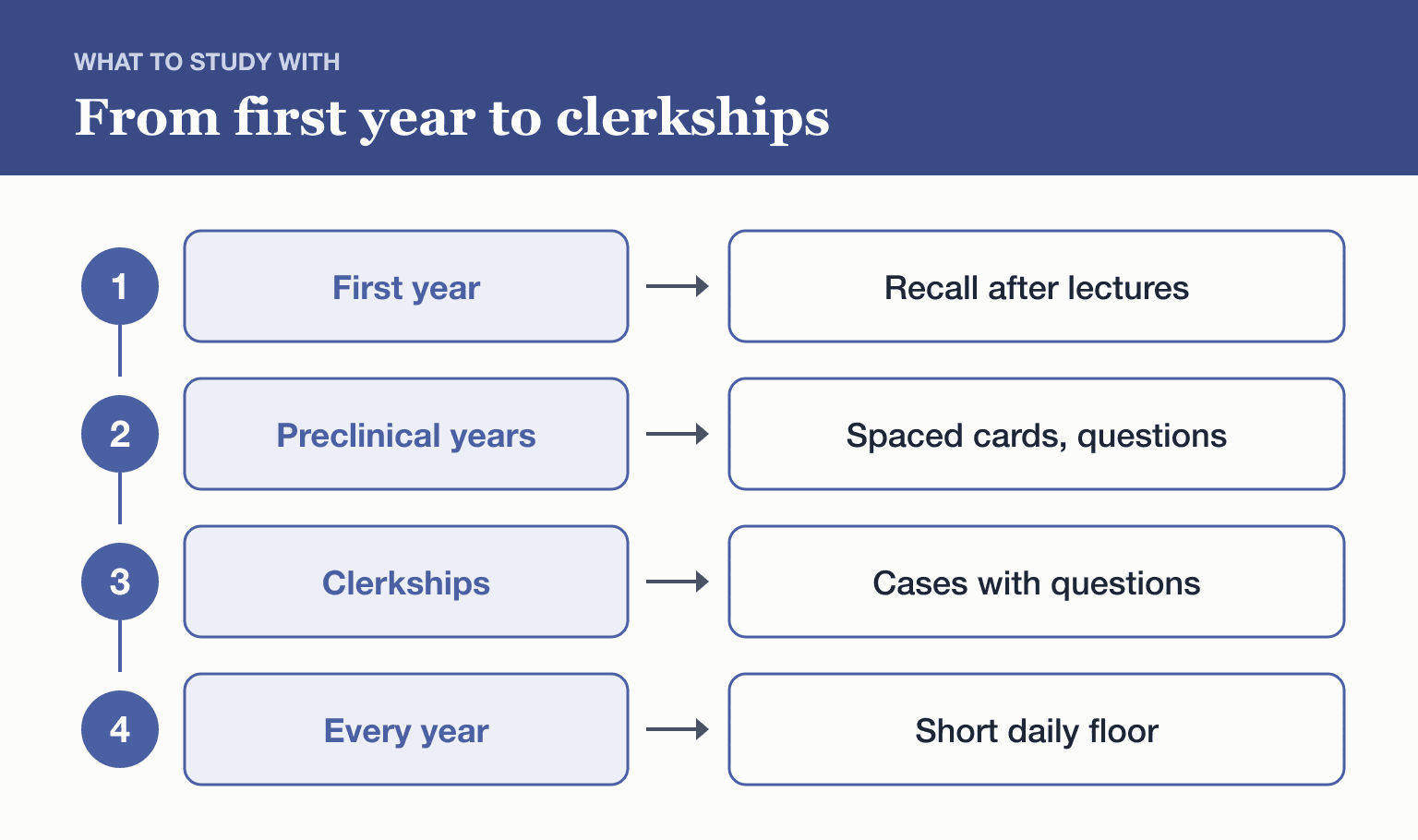
Summary of study approaches by year, drawn from the studies cited on this page.
Think of how to study in medical school shifting by stage, then make tomorrow a bit smaller:
- First year: recall after lectures and daily questions
- Preclinical years: spaced cards and question banks
- Clerkships: cases with built-in questions
- Every year: a short daily floor
Keep a daily habit when the week falls apart
Keeping a daily habit when the week falls apart means accepting that spacing only works if you keep showing up. Set a minimum daily floor small enough for a bad day, then hit it to keep your recall spacing intact.
A short retrieval session keeps the spacing chain alive on days you can’t make a full session. The spaced-practice rating you saw earlier depends on repeated exposures over time, not marathon blocks. Skip the day, and the intervals stretch.
Your floor can be tiny and still count: ten old questions, a handful of due cards, or one short case. Hit it, then stop. Good days will take care of themselves.
If you want to keep a case-a-day rhythm, use the quick case, which takes about two minutes. You name the diagnosis from up to five clues, one at a time, and it keeps a daily streak going. Try it to keep a daily case going. Free to start, no card needed.