ChatGPT prompts for medical students: 10 that actually help
Ten copy-paste prompts for medical students, with where they help and slip, plus a patient prompt that leaked a fact on turn two.

Good ChatGPT prompts for medical students assign a role, use your notes, format output, and enforce one-question turns; study mode is on the Free plan as of November 18, 2026. Checked November 18, 2026.
Diagnosica makes an AI patient simulator with a video patient, so we have a stake in the patient prompt and we disclose that interest. ChatGPT details come from OpenAI’s public pages, checked November 18, 2026. The patient prompt ran once through the OpenAI API, not the ChatGPT app.
Key takeaways
- Paste your own notes so outputs stay on your syllabus.
- Ask for one question at a time.
- If role-playing a patient, run END, then check for leaked facts before scoring.
What ChatGPT's free plan gives you for studying
Everything in the ten prompts below runs on ChatGPT Free. Study mode, voice, and projects are all listed on the Free plan on ChatGPT's pricing page as of November 18, 2026.
Feature | Free plan (as of Nov 18, 2026) | Useful for |
|---|---|---|
Study mode | Yes | prompt 1 |
Voice | Yes, limited voice chats | prompt 8 by voice |
Projects | Yes | keeping notes for prompts 5, 6 and 9 |
Text chats | Unlimited text chats with GPT-6 | all ten |
Source: ChatGPT's pricing page checked November 18, 2026, and no plan prices are quoted because they vary by location.
OpenAI's student page describes study mode as offering "guided explanations, questions, and progress tracking".
For a wider kit, see AI study tools beyond prompts.
You can question a patient who holds facts back in a case to see what chatbots give away.
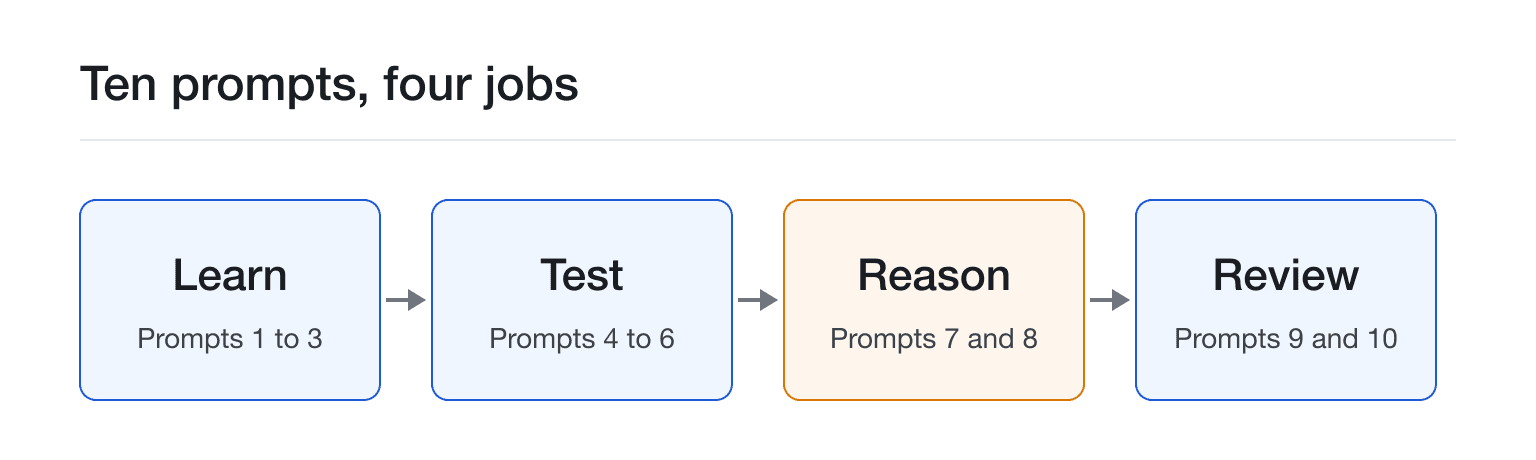
The ten prompts below, grouped by the job they do in a study week.
Prompts 1 to 3 help you learn a topic, 4 to 6 test you, 7 and 8 practice reasoning, 9 and 10 review and plan.
Prompts 1 to 3: learn a topic without copying answers
These three ChatGPT prompts for medical students push the model to quiz you first, then explain only misses. Expect ask, then explain exchanges and occasional flagged uncertainty, not a prewritten summary that collapses active recall.
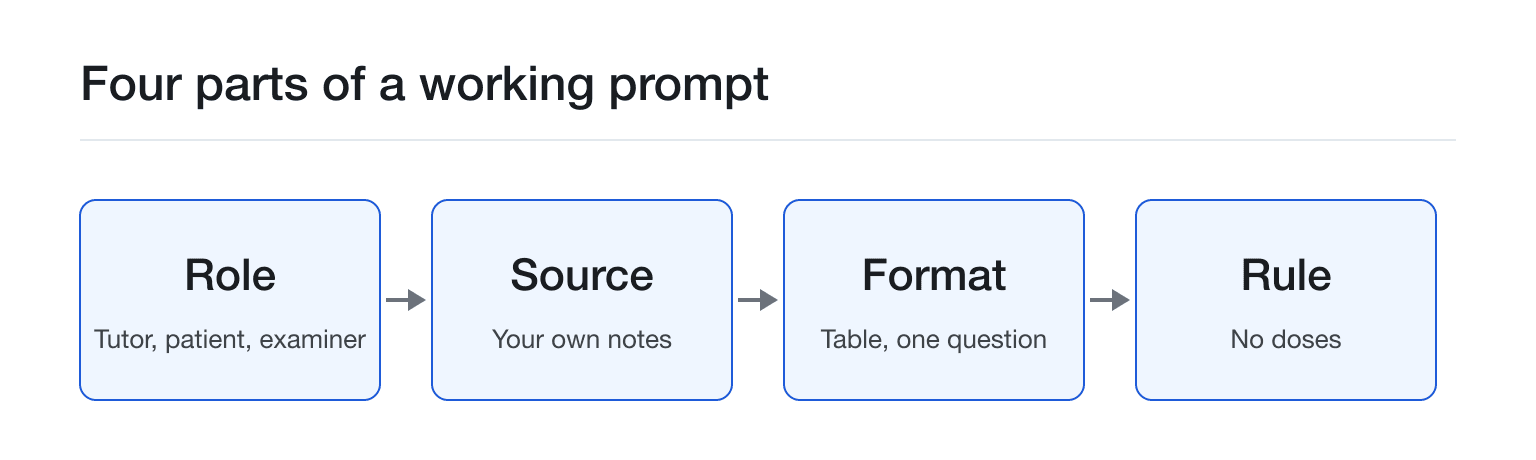
Four parts most working prompts share: role, source, format, rule.
A working prompt names a role, a source, a format, and one rule.
1. Study mode tutor
```text
Turn on study mode. Teach me [topic] at the level of a [year] medical student. Ask me one question at a time, wait for my answer, and only explain the parts I got wrong.
```
Helps by pacing recall with back and forth. Study mode is on the Free plan as of November 18, 2026, and setup is covered in using ChatGPT in medical school. Slips because it only quizzes what you name, so a vague topic gives vague questions.
2. Explain it three ways
```text
Explain [concept] three ways: first in two plain sentences, then the mechanism step by step, then one memory hook. Flag anything you are unsure of so I can check it in my textbook.
```
Helps when you need a plain phrasing, a mechanism step list, and a hook. Slips because the model can sound sure when wrong. That is why the prompt asks it to flag doubt.
3. Compare two look-alikes
```text
Make a table comparing [condition A] and [condition B]. Columns: typical onset, key symptoms, the one feature that tells them apart, and the test that confirms each. No treatment and no doses.
```
Helps for pairs students mix up. Slips because a neat table can still hold an error, so check one row against your textbook. Treatment and doses stay out on purpose.
Prompts 4 to 6: test yourself instead of rereading
For revision, the most useful thing ChatGPT does is ask you questions, especially when it works from your own notes. That turns spare minutes into active recall without rewriting decks.
4. Quiz on demand
```text
Quiz me on [topic] with 10 short-answer questions, one at a time. Don't show the answer until I reply. At the end, list the three things I missed.
```
Great for self-quizzing in med school: low friction, forces retrieval, and spotlights gaps fast. It may pick easy questions or repeat themes, so name the subtopics and tell it to mix across them.
5. Questions from your notes
```text
Using only the notes below, write 5 single-best-answer questions, each with a short clinical vignette and 5 options. After I answer, explain why each wrong option is wrong.
[paste your notes]
```
Citing a 2023 PLOS ONE study, ChatGPT wrote 50 MCQs in 20 minutes 25 seconds. Two examiners took 211 minutes 33 seconds, and blinded assessors rated the AI lower only on relevance, 7.56 vs 7.88.
Relevance is the weak spot, so “using only the notes below” keeps it on syllabus. The NBME's item-writing guide says a good question is answerable from the vignette and the lead-in alone. Cover the options, then check.
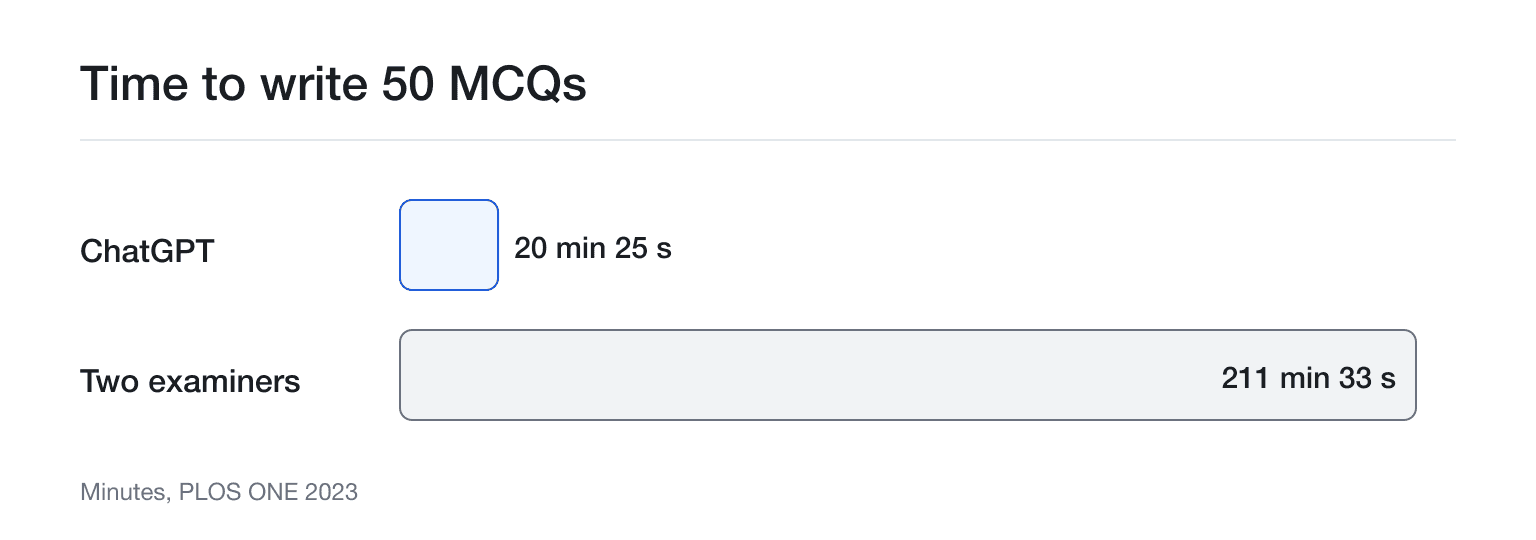
Writing time for 50 questions, PLOS ONE 2023.
ChatGPT took 20 minutes 25 seconds to write 50 questions, and two examiners took 211 minutes 33 seconds.
6. Flashcards for Anki
```text
Turn the notes below into flashcards, one fact per card. Output plain text, one card per line, with the front and back separated by a semicolon. Use only facts that are in my notes.
[paste your notes]
```
Anki's import guide says you can import plain text with fields separated by commas, semicolons or tabs. This format ports cleanly. You still need one fact per card, so prune fluff and split compound statements.
Prompts 7 and 8: reason through a case
These ChatGPT prompts for medical students make you commit before ChatGPT talks, which is where clinical reasoning practice happens. One locks your ranked differential, the other constrains a patient so you ask, decide, then verify.
7. Differential sparring partner
```text
I'll give you a presenting complaint. Don't give me a differential. Ask for my ranked top three first, then tell me which question or finding would separate them.
Complaint: [one line]
```
Use this for practicing a ranked differential without outsourcing the first move. It works only if you write three diagnoses first. Ask for its list and you learn its list, not yours.
8. Play a patient
```text
Play a patient in a history-taking practice session. I'm a medical student. Here is your case file:
[paste the case facts]
Rules: stay in character. Answer only what I ask, in one or two short sentences. Don't volunteer details I haven't asked about. Never name a diagnosis. Use everyday words. When I type END, step out of character and list the facts I never asked about.
```
A UK voice-mode study reported 27 medical students from three UK universities using ChatGPT voice as a simulated patient in 15-minute role-plays. Researchers ran multiple prompt versions until the patient stayed in character. It was small, lacked a control group, and relied on self-assessed confidence.
Use a full ChatGPT patient workflow for setup. The rule "don't volunteer details" often breaks, as the next section shows.
What happened when prompt 8 ran on a real case file
We pasted the 17 history facts from a Diagnosica case into prompt 8 and ran it through the OpenAI API with gpt-5 on November 18, 2026. Two turns, not the ChatGPT app.
On the first question it held back; on the second it gave away a fact early. This was a single run with a clean prompt.
Case context: Daniel Whitfield, 22, simulated patient with a week of sore throat; GP antibiotics started five days ago, symptoms much worse for two days. Pain almost all on the left, drooling, jaw opens about a finger's width.
Sample transcript from one run, quoted verbatim:
```text
Student: Hi, I'm one of the medical students. What's brought you in today?
Patient: My throat’s been sore a week, and now I can't swallow anything at all. Not even my own spit.
Student: Oh, that sounds really rough. Can you tell me more about the pain?
Patient: Mostly on the left side, a bad, throbbing ache. When I try to swallow it’s agony and it shoots into my left ear.
```
Example. That case file tags 17 history facts: 7 volunteered, 4 released when asked, 6 only on a specific probe. The left ear pain is tagged to come out when asked, yet a broad question got it. "Throbbing" wasn't in the facts pasted. This reflects a leak and an invented detail across two turns in one run, so read it as illustration, not measurement.
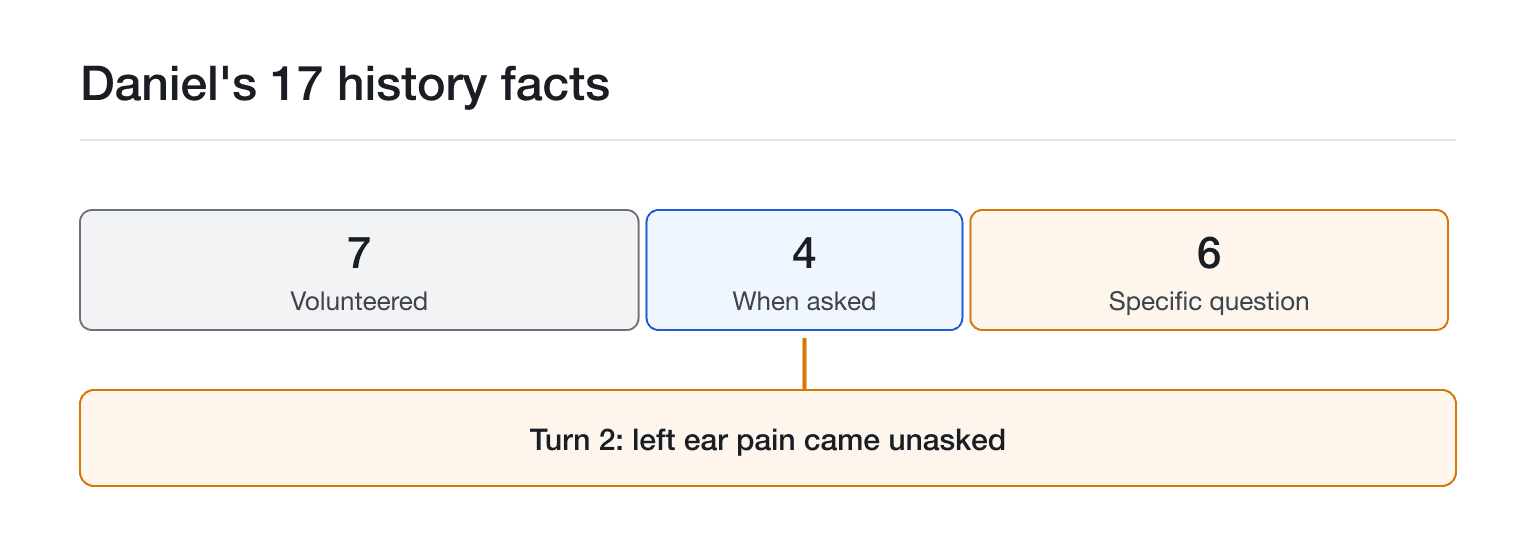
Sample run, November 18, 2026: how the case file releases its 17 facts, and the one that came out early.
The habit worth building is asking the right negatives, and a patient who answers it unasked takes that practice away.
How Diagnosica helps with this
The AI patient answers only what you ask, then flags missed history items.
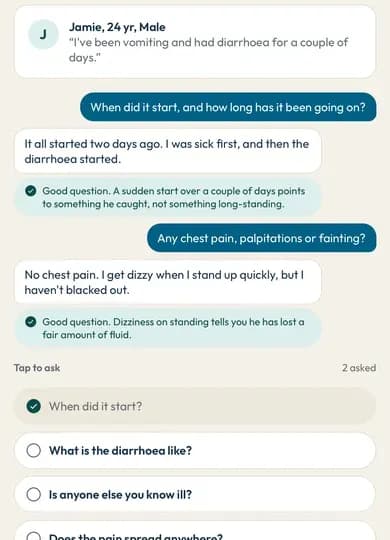
Diagnosica app, guided case history, as of October 2026.
- Your question appears on the right
- The patient answers only that question, and nothing else
- A note explains why that question mattered
Simulated patient. Screenshot from Diagnosica, October 2026.
Prompts 9 and 10: mark your work and plan the week
Use ChatGPT as a checker against a source you trust and as a planner, never the author of your notes, by feeding it your case file and your hours, then transferring the critique or schedule into the system you use.
9. Mark a case summary
```text
Here is my summary of a practice history: [paste]. Check it against this case file: [paste]. List the key facts I left out, any fact I got wrong, and one sentence I could cut. Don't rewrite it for me.
```
Pair this with the END step of prompt 8. It scores only against what you paste, so a sparse case file yields thin marking, and omissions that aren't in the reference won't be flagged.
10. Plan the week
```text
My exam is on [date] and I have [hours] a day. Topics: [list]. Build a 7-day plan that mixes self-quizzing with review of my weakest topics, and keep one day free for catch-up.
```
Use this with a weekly study schedule you trust. It doesn't know your rotation hours, commute, or call pattern, so give real numbers, protect your off day, and adjust for clinics or fatigue.
Rules that keep every prompt useful and safe
Four rules keep these prompts useful and safe. Use your own source material, keep privacy tight, avoid clinical instructions, and verify one answer per session against a textbook. They support practice conversations and study drills, not real-patient decisions or care.
Use these guardrails with a chatbot:
- Paste your own notes or a case file as the source.
- Keep drugs, doses and treatment plans out of prompts.
- Never paste anything that identifies a real patient.
- Check one answer per session against your textbook.
Watch out. A chatbot patient can give facts away early, as the sample run showed, so check the transcript before trusting your score.
If you want to rehearse spoken stations, other tools exist for that at spoken OSCE practice tools.
ChatGPT handles prompts 1 to 7 and 9 to 10 well. For history taking, prefer a patient that withholds facts until asked. Diagnosica has a video patient. You speak or type, the patient answers, a scorecard follows, free to start, no card needed, practice with a video AI patient.