Syncope OSCE station: a worked history with a scorecard
A syncope OSCE station tests whether you get the before, during and after story, then catch the cardiac red flags NICE says need review within 24 hours. A simulated 72-year-old's blackouts, walked through a scorecard.
If you’re with someone now, per the NHS fainting page, call 999 if they fainted while exercising, have chest pain, or can’t be woken within 1 minute. This post is exam practice, not guidance for real patients.
Key takeaways
- Elicit 3 phases, before, during and after, from the patient and any witness.
- Exertional blackout, new breathlessness or a murmur, means cardiac review within 24 hours.
- In Brian’s case file, not exploring exertional blackout costs 5 communication marks.
Brian, 72: the case in one line
Brian Watts, 72, a retired bank manager who lives alone, is a syncope OSCE station that opens on breathlessness before revealing blackouts while active. Stop at dyspnoea and you miss it, so ask about exertional episodes and warning.
His opening line is, "I've been getting out of breath on hills and stairs for the last few months." He then volunteers two blackouts when physically active, once on the stairs, with no warning. Stations often open on another symptom. Compare with a breathlessness history walkthrough.
You can take Brian's history yourself (voice or text, the AI patient appears on screen as a video avatar).
What to ask about the blackout
In a syncope OSCE station, structure the history around before, during and after the blackout. NICE guideline CG109 asks for accounts from the person and any witness, and to record posture, prodrome, observed movements, injuries, duration and confusion.
Use these prompts in order:
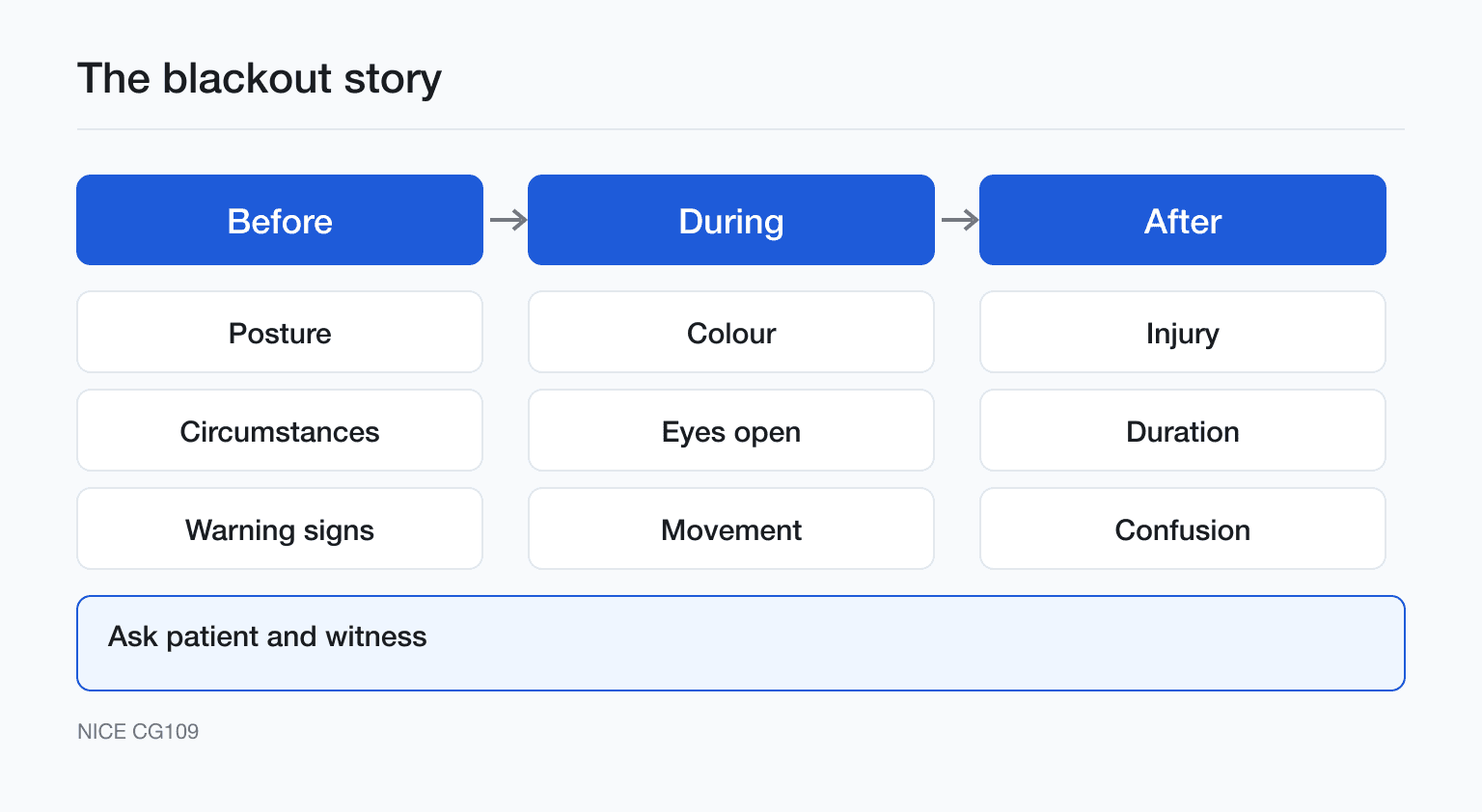
NICE CG109 frames syncope history as before, during and after, and includes witness input.
- Before and posture: Ask where and what they were doing, and the posture immediately before.
- Warning symptoms: Record sweating, feeling hot or other prodromal symptoms.
- Observed during: Colour, eyes open or shut, any limb movements seen by a witness.
- Tongue and injury: Ask about tongue-biting, head injury, or other trauma sustained.
- After the event: Duration of loss of consciousness and confusion afterwards, including recovery time.
- History and risks: Previous episodes, family history of sudden cardiac death, medicines that may contribute.
See NICE guideline CG109 for the exact wording and sequence of questions. It also says to phone witnesses who are not present; Brian Watts, 72, lives alone, so there is no witness. His account carries the station. For technique, see a witness history by phone.
To separate a faint from a seizure, NICE lists a bitten tongue, head-turning to one side, unusual posturing, prolonged limb-jerking and confusion afterwards as signs that strongly suggest seizure. It also notes brief jerking can happen during an uncomplicated faint.
Worked example: what Brian says and what you must ask
Brian volunteers three things unprompted: breathlessness, chest tightness and blackouts. In this syncope OSCE station, the facts that settle it only surface when you ask targeted questions. Ask for red flags and link symptoms explicitly.
Brian, 72 (simulated): what he said, and what you had to ask
Chip | Question | Answer | Why it mattered |
|---|---|---|---|
Volunteered | What brought you in today? | I’ve blacked out twice while active, once on the stairs, without warning. | Exertional syncope is the most ominous symptom here |
Volunteered | Tell me about the chest tightness. | Tight central feeling walking uphill, which eases when I rest. | Scoring rewards drawing out exertional angina features |
Asked | What happened on the stairs episode? | I came round sitting on the steps with a bruised elbow. | NICE asks you to record any injury |
Only if asked specifically | Any racing or fluttering before you black out? | No, no racing or fluttering before I pass out. | Argues against a primary rhythm cause |
Only if asked specifically | Ever told you have a heart murmur? | Yes, years ago at a check-up, they said I had a murmur. | Linking murmur to symptoms is scored, and a NICE red flag |
Only if asked specifically | Has your breathlessness been getting worse? | Yes, it’s worse now and limits me more than before. | One of two must elicit red flags in this case |
Two of the six came unprompted; four needed questions, three of those needed a specific prompt.
Simulated patient. Case file aortic-stenosis-72m. Questions written by us as a model, not a learner session.
Negative answers steer the differential as much as positives. Practise naming negatives that change the picture. Then cross-check chest tightness against the chest pain OSCE walkthrough to avoid anchoring on the wrong cause.
How Diagnosica helps with this
You ask, AI patient answers, each answer can teach a step.
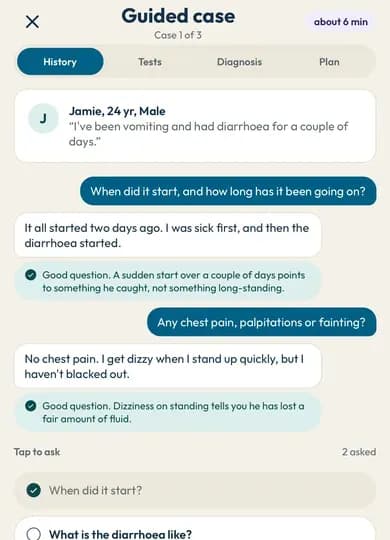
Diagnosica app, history screen of the guided first case, as of November 2026.
- History, Tests, Diagnosis, Plan tabs.
- Reply appears under your typed question.
- Note explains dizziness when standing.
Simulated patient. Screenshot from Diagnosica, November 2026.
The red flags in a syncope history
NICE CG109 says anyone with a blackout plus red flag features needs urgent cardiovascular assessment, with the referral reviewed within 24 hours by a specialist. These flags are weighted toward cardiac causes and should trigger same-day escalation in a station.
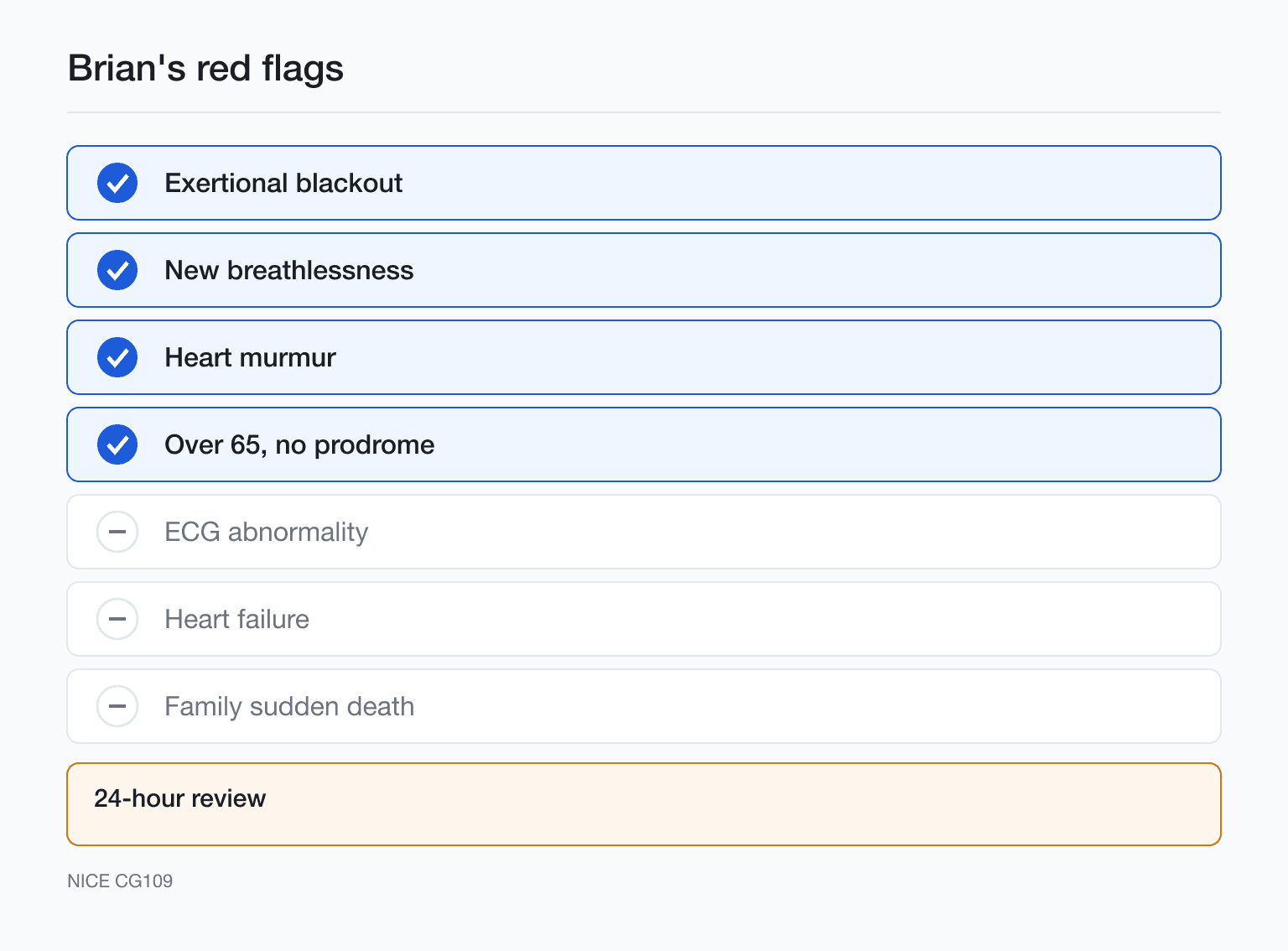
NICE CG109 lists red flags needing cardiac review within 24 hours.
Red flags include an ECG abnormality, heart failure, and blackout during exertion. Family history of sudden cardiac death under 40 or an inherited cardiac condition, new or unexplained breathlessness, and a heart murmur also count. Consider the same 24-hour referral for anyone older than 65 with a blackout without prodromal symptoms, per the NICE guideline CG109.
Brian’s history hits four: exertional episodes, breathlessness that’s new to him, a murmur told to him years ago, and age over 65 with no warning. In a station, say out loud that this needs same-day senior review, and state you’ll follow local trust guidance. NICE also says people with a blackout must not drive while waiting for specialist assessment.
Watch out. The postural hypotension trap. Postural hypotension is common in older people, but Brian’s blackouts happen on exertion, not on standing. His case file deducts 10 marks for attributing exertional syncope to a benign cause such as postural hypotension.
Investigations and the diagnosis
The syncope OSCE station investigations for Brian Watts, 72, start with a 12-lead ECG for suspected blackout and a transthoracic echocardiogram. Baseline bloods: NT-proBNP, full blood count, urea and electrolytes. The decisive diagnosis to commit to is aortic stenosis.
NICE CG109 says record a 12-lead ECG using automated interpretation in anyone with a suspected blackout. See the NICE guideline overview, published 25 August 2010 and updated 21 November 2023. Local guidance applies to real patients.
Distractors include postural hypotension, hypertrophic cardiomyopathy, stable angina and stroke. Naming only heart failure earns partial credit, but the call is aortic stenosis.
What the scorecard rewards
Brian's case file scores four domains, each out of 25: communication, clinical workup, clinical thinking and approach to treatment. The history station marks reward focused risk capture, and workup and thinking subtract points for skipped essentials and missed urgency.
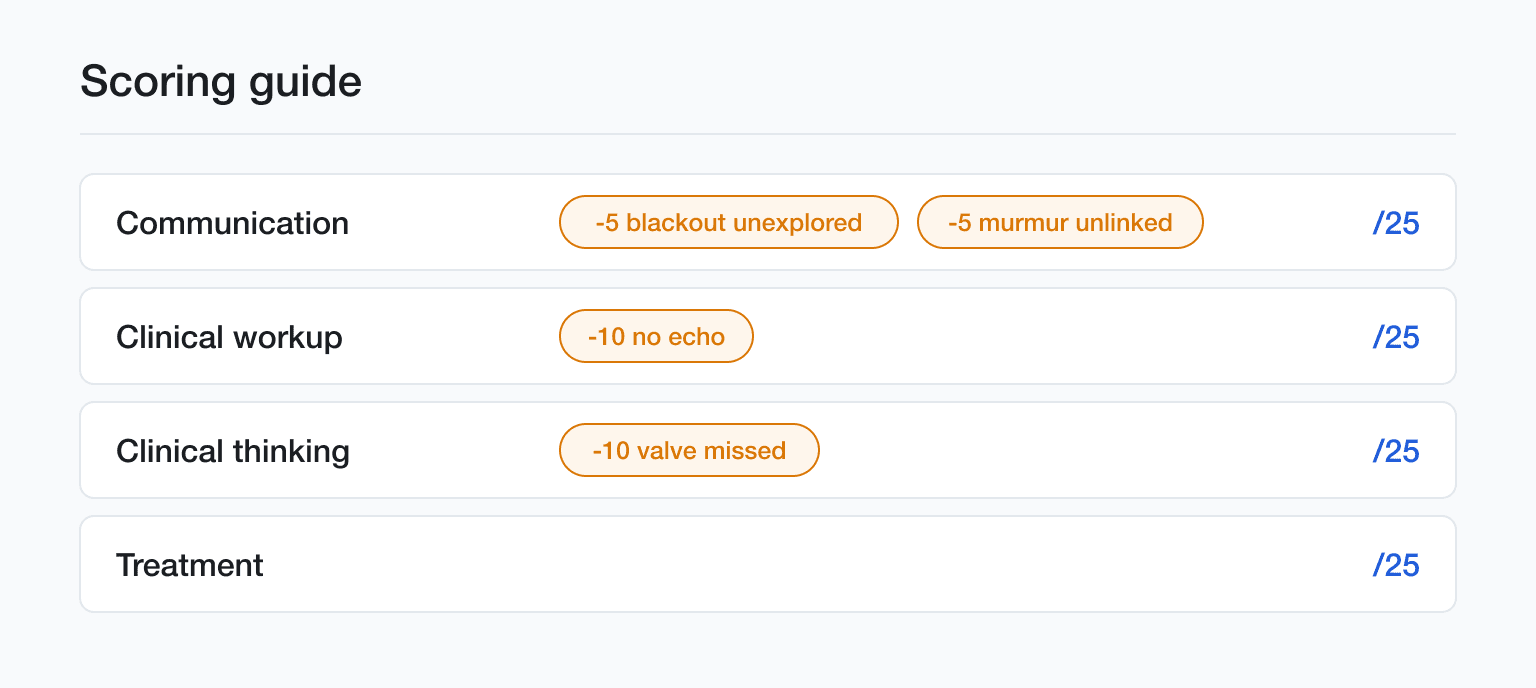
Four 25-point domains with penalties: minus 5 exertional history, minus 5 murmur link, minus 10 no echo, minus 10 missed diagnosis.
In communication, you gain marks for eliciting exertional chest tightness, blackouts and breathlessness, confirming a known murmur, and capturing a decline in activities. In a syncope OSCE station, you also earn credit for conveying how serious exertional blackouts are. Missing deeper exploration of the exertional blackout is minus 5. Not linking the murmur to symptoms is minus 5.
In clinical workup, skipping the echo is minus 10. Clinical thinking loses 10 for not identifying aortic stenosis and 10 for missing urgency. The treatment domain sits outside this post. These numbers are this case's scoring guide, not any exam body. See how history stations are scored, and note real OSCE mark sheets vary by school.
What to take into your station
A syncope OSCE station rewards a tight, escalation-first structure. Ask explicitly about blackout, map before, during, after, state red flags and senior review, then cover murmur, palpitations and whether episodes are getting worse.
- Opening symptom check: Ask directly about blackouts, not only dizziness or falling.
- Before, during, after: Ask sequence, posture and colour, and phone witnesses per NICE CG109.
- Red flags aloud: State same-day senior review if present, and reference NICE CG109 criteria.
- Cardiac specifics: Any known murmur, palpitations, family history, and worsening frequency or severity.
For longer prep, start with a full OSCE revision plan then run the haematuria history station next.
Then run the full case, where you take the history, order tests, make the diagnosis and get the scorecard.