iatroX alternatives in 2026: 4 options, prices checked
The main iatroX alternatives are Passmedicine for UKMLA questions, Quesmed for OSCE stations, AMBOSS for a library, and Diagnosica for a video patient. Checked November 2026.
Diagnosica builds an AI patient simulator, so we have a stake in comparisons. Every competitor detail on this page comes from its own public pricing or features page, checked on 13 November 2026. No company paid for, influenced, or reviewed this page.
Key takeaways
- Decide which iatroX job you're replacing before choosing an alternative.
- Create an account via iatroX pricing for one free simulation as of November 2026.
- Try free banks first: iatroX lists PSA, PARA and MRCP Part 1 as free.
iatroX alternatives compared, prices as of November 2026
Most people replace one iatroX job at a time, pairing patient sims with a question bank, OSCE stations or a library. Here are the real swaps, with prices as of November 2026, so you can plug gaps without duplicating features.
To see how a video avatar feels alongside scoring and teaching points, try a case with a video patient on the web. You can also use the iPhone and Android apps.
Tool | iatroX job it replaces | Price as of November 2026 | Source, checked 13 Nov 2026 |
|---|---|---|---|
iatroX (for reference) | Reference plan only | £29/month; £99/year | |
Passmedicine | Finals and UKMLA questions | £15 (4 months) to £30 (12 months) | |
Quesmed | OSCE and MLA CPSA bank | £39.99/year | |
AMBOSS | Library articles and Qbank | $19.99/month, US price | |
Diagnosica | Video patient, voice or text | Free tier, no card; Standard priced on diagnosica.com | diagnosica.com |
For full breakdowns and promos, see Quesmed prices by bank and AMBOSS membership prices.
Where iatroX is still the stronger pick
iatroX is still the broadest single subscription here if you're juggling exams and practice. One plan spans many banks and now includes voice and text simulations, which makes it a strong all-rounder for question practice plus patient time.
- Breadth in one plan: One subscription covers UKMLA, PLAB 1, MSRA, MRCGP AKT, plus 12 SCEs, all kept under the same plan.
- Free question banks: MRCP Part 1, MRCEM SBA, PSA and PARA are free to practise.
- Simulations included: Voice and text simulations, with the first complete one free after signup.
- Mobile apps: iOS and Android, with offline caching.
All four points are per iatroX pricing page as of November 2026. In our earlier iatroX write-up we said no simulated consultation in August 2026; that changed, trust the pricing page over it. If one plan for many exams suits you, staying may be right.
Pick an alternative by the job you need done
To choose among iatroX alternatives, name the job you want to replace first, then pick the single-job tool. Keep revision focused, not scattered.
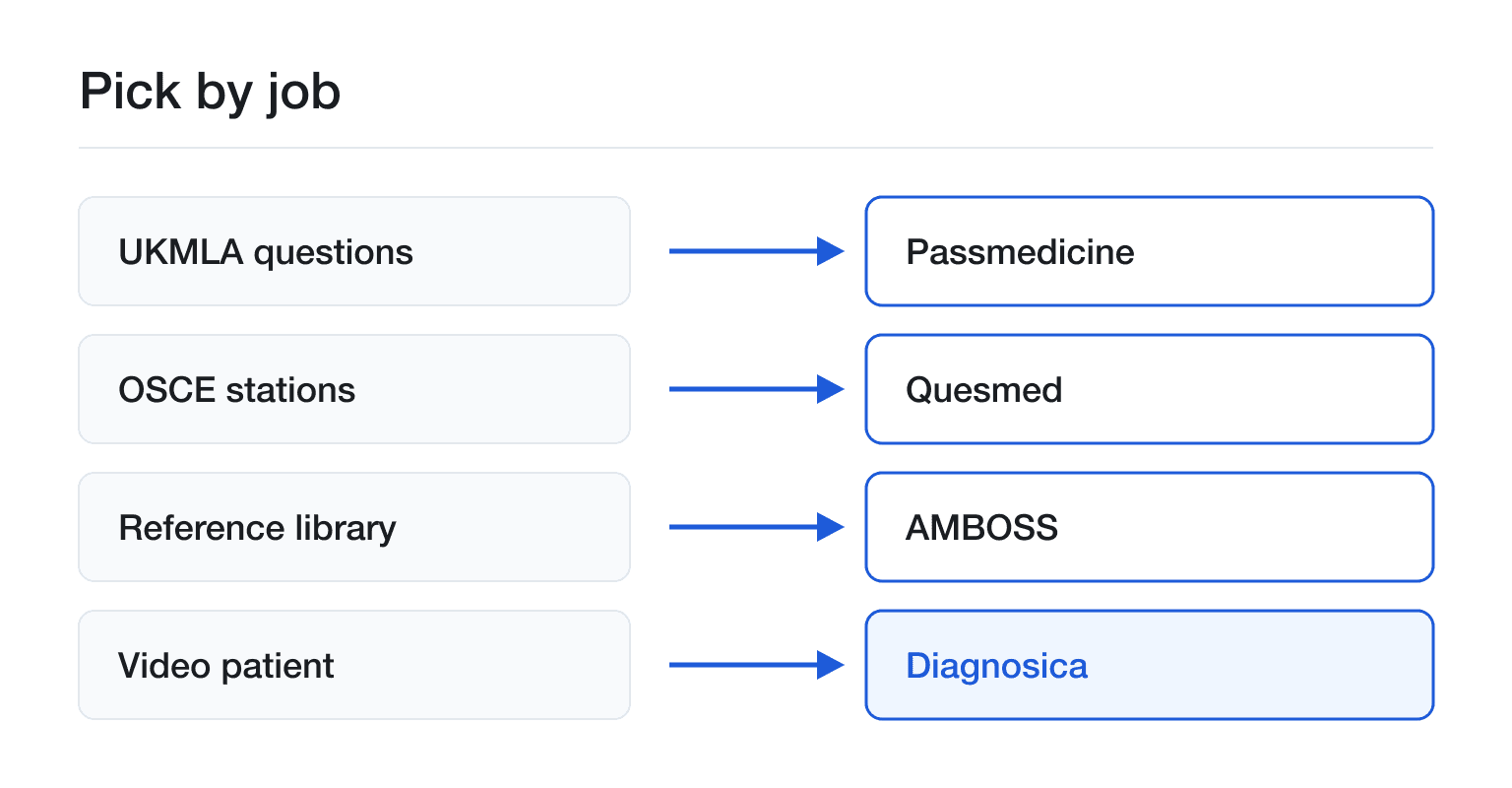
Mappings checked on vendor pages as of 13 November 2026; details may change without notice.
As of November 2026, pick by job, then the single tool that specialises in it:
- UKMLA questions: Passmedicine finals package aligns to the 2026 UKMLA map; £15 to £30.
- OSCE stations: Quesmed 450+ OSCE stations at £39.99 yearly.
- Reference library: AMBOSS lists 1,400+ articles; $19.99 monthly with 50 Qbank questions included.
- Flashcard tools: Use flashcard tools beyond Anki for spaced recall.
- Video patient: Diagnosica has a video patient, voice or text, with rubric scorecards after.
For a wider scan, see more UKMLA question banks and a comparison of AI tools for medical school.
How Diagnosica helps with this
Ask the AI patient, get answers, see what each question uncovered.
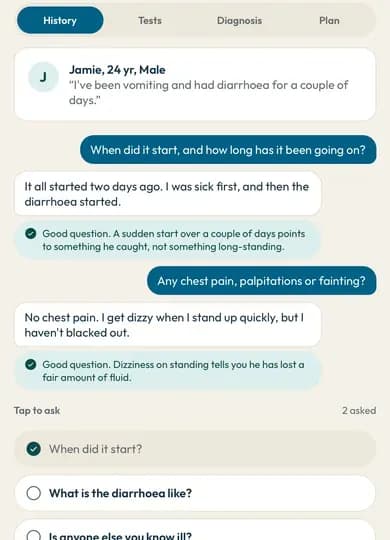
Diagnosica app, guided case history screen, as of November 2026.
- Your question appears on the right.
- Reply plus green note explain why it mattered.
- Tap suggestion or ask by voice or text.
Simulated patient. Screenshot from Diagnosica, November 2026.
iatroX simulations vs a video-patient case
iatroX and a video-patient case both now let you rehearse a consultation. The difference is the format and what you keep afterwards. That changes how you review performance later and how close it feels to sitting with a person.
iatroX runs simulations in voice and text where supported. Your first simulation free is included with an account without a subscription, as of November 2026 on the iatroX pricing page. As of November 2026, its simulations page lists 8 live UK libraries. A video patient appears on neither the pricing page nor the simulations page, also checked in November 2026.
Our simulator gives you a speak-or-type video patient. You get a rubric scorecard after every case, across over 130 cases in 18 specialties.
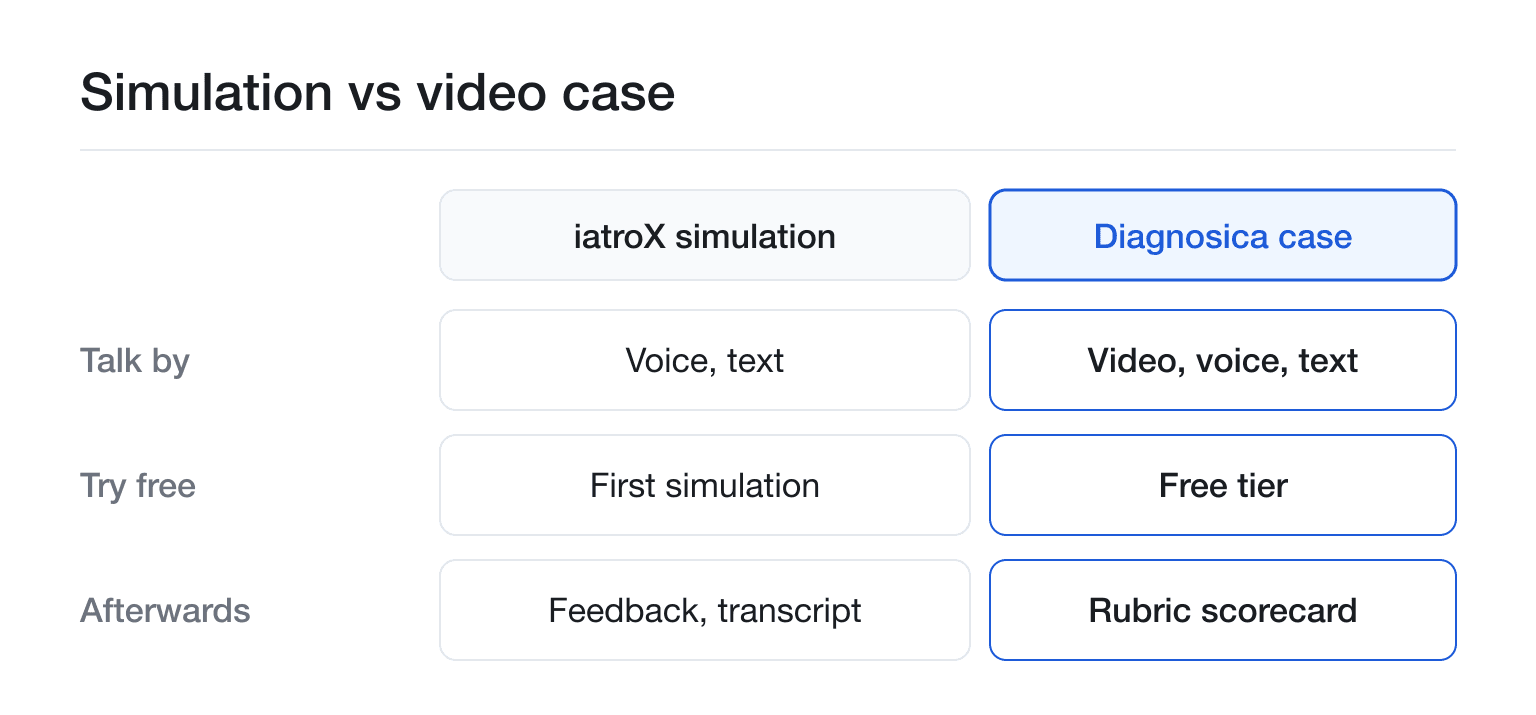
Same job, different artefact: transcript-driven review versus a scored video encounter.
iatroX: voice or text, first simulation free, feedback and transcript. Diagnosica: video, voice or text, free tier, rubric scorecard.
Example. Adam Price, 19, a simulated patient, opens with "My throat's been killing me for about three weeks and I'm shattered all the time." He mentions a rash that appeared three days after an antibiotic from his GP. He also has a dull ache under his left ribs he has told nobody about. You only hear that if you ask for it specifically. That’s the point of history practice.
If you want to try a few side by side, start with these virtual patients to try free.
What none of these tools replace
None of these apps, ours included, replaces examining a real patient with a tutor watching. They practise reasoning and communication, not palpation or procedural skills. Use them to rehearse choices and words, then learn signs at bedside with supervision.
Ours isn't a question bank; no physical exam practice; you'll need bedside teaching and a bank. Pair a bank with our simulator for recall and reasoning. It doesn't give advice about real patients, and it's not a diagnostic system. Treat every output as educational.
Watch out. Check currency at checkout. iatroX shows GBP for UK billing and USD elsewhere, and AMBOSS lists US dollars, as of November 2026. Refunds vary, as of November 2026: iatroX 7 day guarantee on annual plan; AMBOSS 30 day money back.
If you want to see the difference a video patient makes, run a case on any device.