Abdominal pain OSCE station: one case, the questions that count

In an abdominal pain OSCE station, the questions that count are the specific ones. In one simulated case, 10 of 15 history facts surface only when you ask.
If you or someone else has sudden severe tummy pain, call 999 or go to the emergency department now. If it suddenly gets much worse, use NHS 111, per NHS stomach ache advice. This post is exam practice.
Key takeaways
- Ask how long past attacks lasted, in hours or days, and compare with this episode.
- Two red flags are yellow skin or dark urine, and shaking chills or confusion.
- The app covers history, so rehearse abdominal examination in person with peers or tutors.
The case in one line: pain under the right ribs
An abdominal pain OSCE station case: Neil, 48, is a simulated AI patient who says, "I've had bad pain under my right ribs since yesterday." His temperature is 38.1 and his heart rate is 96.
This walk-through is the history half only. A real abdominal pain station may want an examination too. The app doesn't practise it, so rehearse that in person with the Geeky Medics examination guide. Now take this history yourself.
Which questions count in an abdominal pain history?
An abdominal pain history starts with SOCRATES for the pain, then hunts what the patient won't offer: how previous attacks behaved, and the red flags by name you must ask. Asking those by name is what fills in the part of the story a patient leaves out.
The Geeky Medics pain history guide structures the pain history with SOCRATES. Here, it was the negatives that separate diagnoses that split look-alikes: past attacks, colour changes and chills.
Neil, 48 (simulated): what he said, and what we had to ask
Chip | Question | Answer | Why it mattered |
|---|---|---|---|
Volunteered | Where is the pain, and how long has it been there? | He has constant severe pain under his right ribs for about a day, not short like before. | Constant and a day long is the pattern to chase. |
Volunteered | What set it off, and does it spread anywhere? | It started after a fatty takeaway and spreads round to his right shoulder blade. | Trigger plus spread narrows the map. |
Asked | Have you had any fevers? | He feels hot and feverish. | Fever changes what you're worried about. |
Only if asked specifically | Has this happened before, and how long did those last? | He had short similar pains after fatty food two or three times in the past year, settling within an hour or two. | A change in pattern, this attack hasn't settled. |
Only if asked specifically | Any yellow skin, dark urine, or pale stools? | No yellow skin, urine and stools are a normal colour. | A required red flag the case file says you must ask. |
Only if asked specifically | Any shaking chills, fevers in waves, or confusion? | No shaking chills, no fever in waves, and no confusion. | A second required red flag the case file says you must ask. |
10 of the file's 15 history facts only come out if asked specifically.
Simulated patient. Diagnosica case file. Questions written by us as a model, not a learner session.
What Neil volunteers, and what he doesn't
Neil's case file shows how little a patient offers unprompted. Stop at what he volunteers and you'd have the pain, the fatty trigger and the shoulder spread, but no red flag screen.
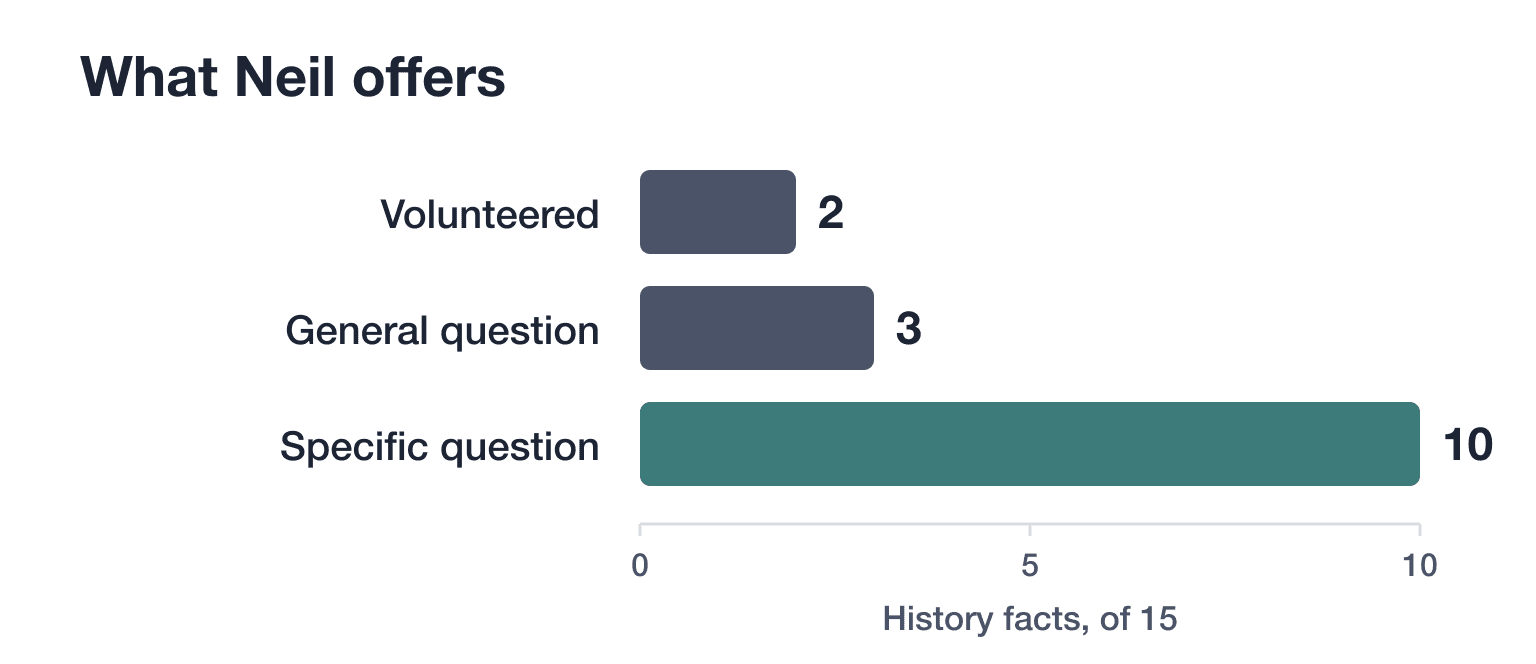
Counts are from one simulated case file.
Of the file's 15 history facts, 2 are volunteered, 3 come on a general question and 10 only if asked specifically.
Watch out. Neil tells you it's very sore to touch under his right ribs and he catches his breath if pressed there. That's his report, not an examination finding; nothing gets palpated in the app.
What the tests add once the history is done
In Neil's case the tests back up the story the history has already told; they don't replace it. From the simulated case file, these are the supportive results that anchor your reasoning and help you prioritise differentials:
- Full blood count: raised white cell count.
- C-reactive protein: raised.
- Liver function tests: mildly deranged, bilirubin and ALP not markedly raised.
- Amylase and lipase: not markedly raised.
Ultrasound is the case file's first-line test.
Diagnosis: acute cholecystitis, and the four it has to beat
Neil's case file lands on acute cholecystitis because the pain is constant and he feels feverish. Prior short attacks settled within an hour or two while this one hasn't, pointing towards inflamed gallbladder over colic.
He was told on a scan about two years ago that he has gallstones, but he only offers that if asked. The NHS acute cholecystitis page says the pain is usually persistent and doesn't go away within a few hours. The case file names the NICE gallstone guideline as its teaching source.
A pain like this could be any of four look-alikes in the case file, with one history question for each:
Look-alike | What points to it | Question that separates it | Neil's answer |
|---|---|---|---|
Biliary colic | Transient pain, no fever, settles within hours | How long did it last, any fever | No: it hasn't settled after a day, and he's feverish |
Ascending cholangitis | Right upper pain, fever and jaundice; septic emergency to exclude | Yellow skin or dark urine; shaking chills, confusion | No: no yellow skin or dark urine, no shaking chills or confusion |
Acute pancreatitis | Severe epigastric pain radiating to the back | Does it go through to your back | No: not through to back, and sitting forward doesn't help |
Perforated peptic ulcer | Typically sudden, epigastric, generalising | Has it spread, any black stools or regular indigestion | No: no black stools or regular indigestion, and the pain stays on the right |
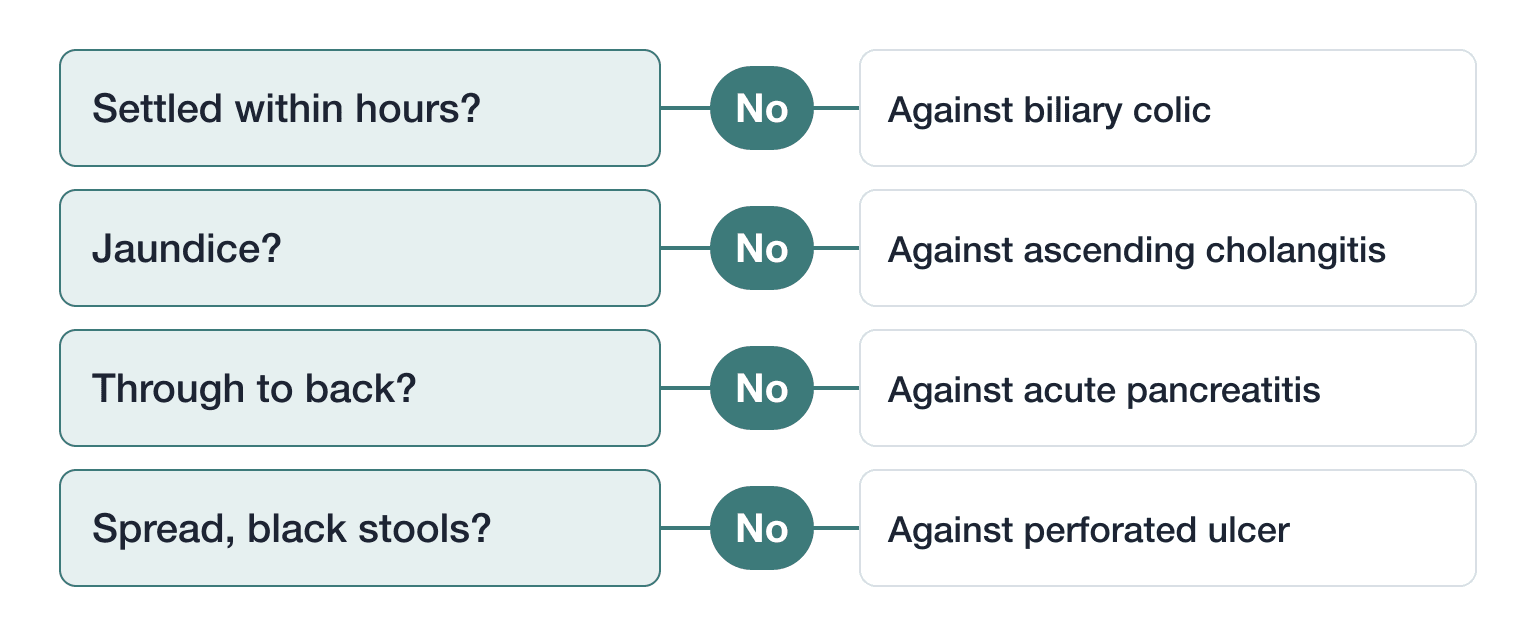
From one simulated case file: four right-sided pain look-alikes with a single separating question, and Neil's answers.
The yellow-skin screen has its own walk-through in jaundice history, in full.
How Diagnosica helps with this
You ask, by voice or typing, and the AI patient answers.
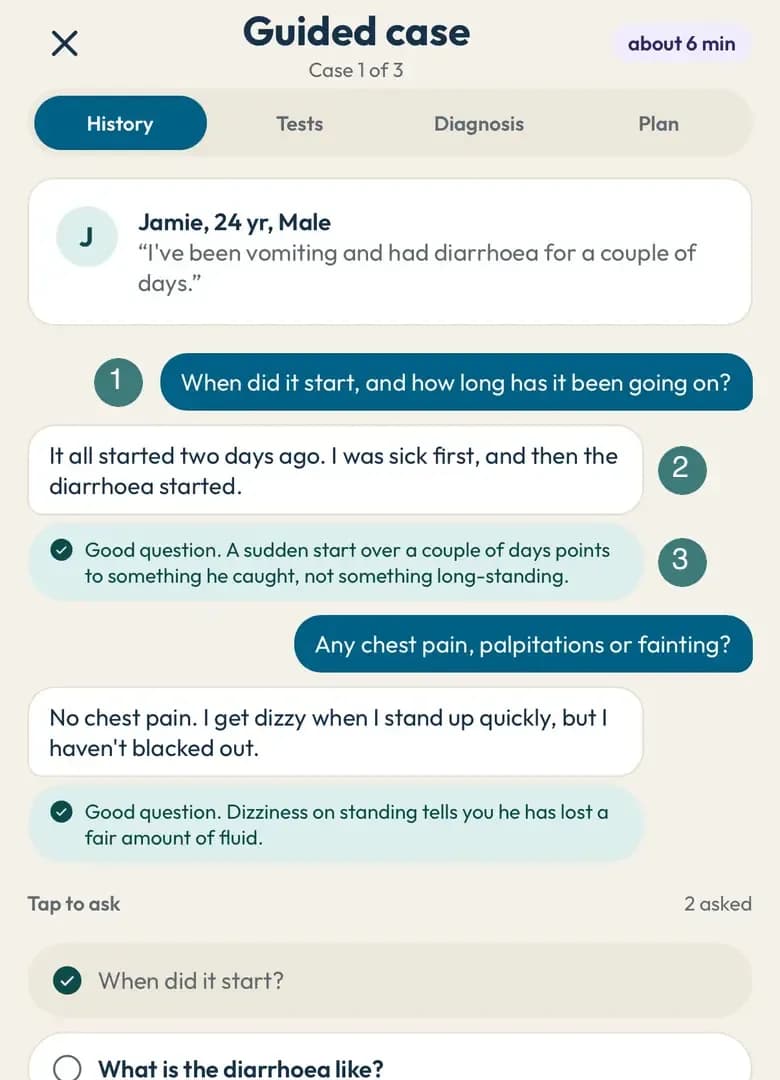
Diagnosica app, guided case history, as of October 2026, different simulated patient.
- Your question, tapped here; in Neil's case you speak or type.
- The patient's reply, in plain words.
- Guided-case feedback on what that question told you.
Simulated patient. Screenshot from Diagnosica, October 2026.
What the scorecard shows after the case
Diagnosica's scorecard splits a case into four sections, each out of 25, for a total out of 100. It's formative feedback, not an exam mark.
The screenshot is real, captured October 2026, from a guided case with a different simulated patient, not Neil. Its numbers reflect that session only and don't predict your result on this case.
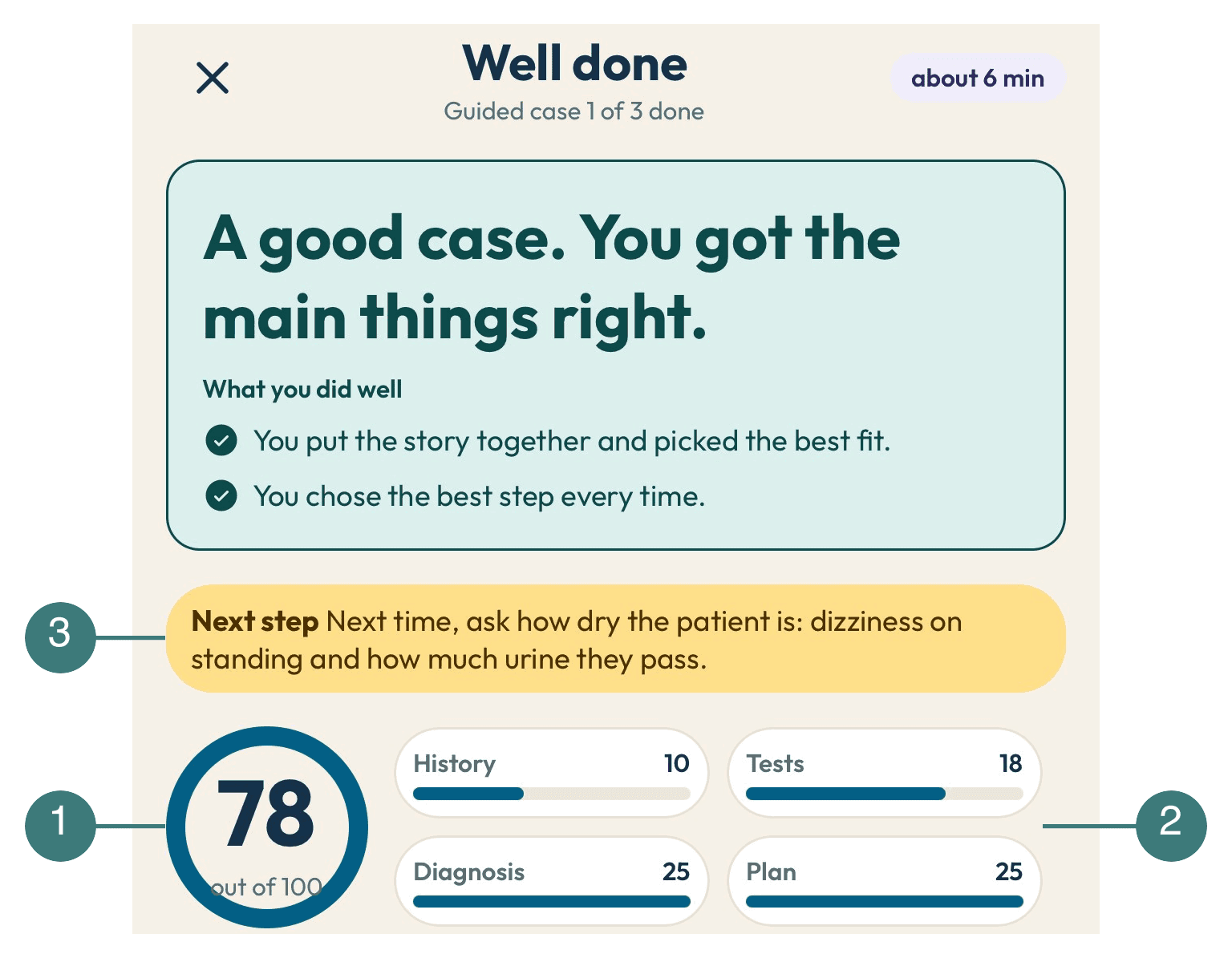
Diagnosica app, guided case result, as of October 2026, different simulated patient.
The screenshot numbers mark three things that the annotations point out for clarity:
- Total out of 100, here 78.
- Four bars: History 10, Tests 18, Diagnosis 25, Plan 25.
- Next step: one thing to try next time.
A full case like Neil's adds a section-by-section breakdown. In Neil's case the History section earns for the constant nature, the fatty trigger, and shoulder spread. It also pays for fever and vomiting, and asking specifically about jaundice and dark urine. Real stations are marked differently. See how real stations get marked.
What to take into your next abdominal pain station
In the abdominal pain OSCE station, chase what the patient won't offer, then explain why you asked it.
Do this:
- Run SOCRATES, ask if it's constant or coming and going.
- Ask whether it has happened before and how long those attacks lasted.
- Screen out loud for yellow skin, dark urine, shaking chills and confusion.
- Close with a summary that states the negatives you found. See summing up for examiners for wording.
See a full history structure, then try another worked symptom station and a headache history station next.
Then try another abdominal case and run the same four questions.