How to take a history

To take a history, use 8 steps: introduce yourself, let the patient talk, explore the complaint, cover past history, drug history, family and social history, screen other systems, then summarise.
Key takeaways
- Work through 8 steps in order, then adapt them to the patient you meet.
- After your first open question, stop: uninterrupted patients took a median of 6 seconds.
- Ask specifically: 10 of 15 simulated-case facts needed a direct question.
- Where guides differ, follow your school's scheme.
What is a medical history, and why does it matter so much?
A medical history is the structured conversation in which you find out what is wrong, what led to it, and what the patient makes of it. It comes before examination and tests, and in the studies below it is where most diagnoses came from.
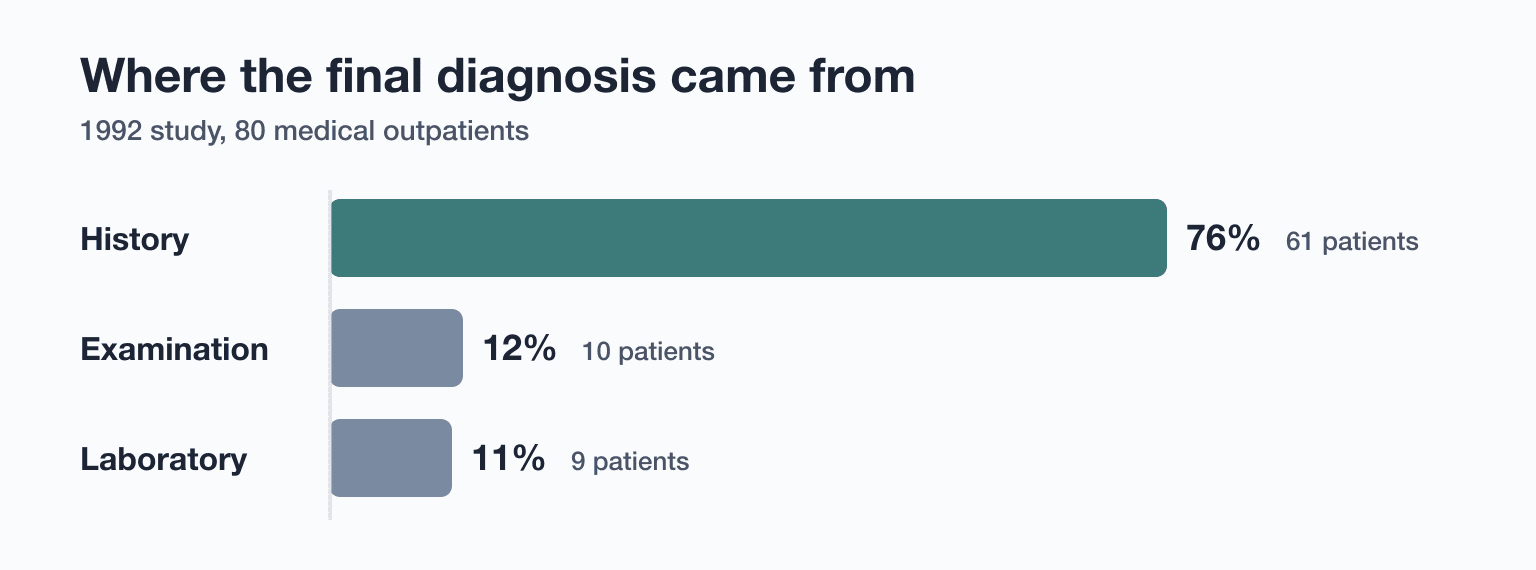
1992 outpatient data: history 76%, examination 12%, laboratory 11% of final diagnoses.
In a 1992 study of 80 medical outpatients, the history led to the final diagnosis in 61 (76%), examination in 10 (12%) and laboratory investigation in 9 (11%). The last two still helped exclude possibilities and increase confidence.
An earlier one, a 1975 outpatient study found the eventual diagnosis was reached after the referral letter and history in 66 of 80 new patients. Small, old, outpatient studies, so read them as a direction, not a law.
You can take a full history from an AI patient while you learn the steps below.
The 8 steps of a full history
The whole consultation runs in 8 steps: the order is a default, not a script, because a real patient won't follow your headings.
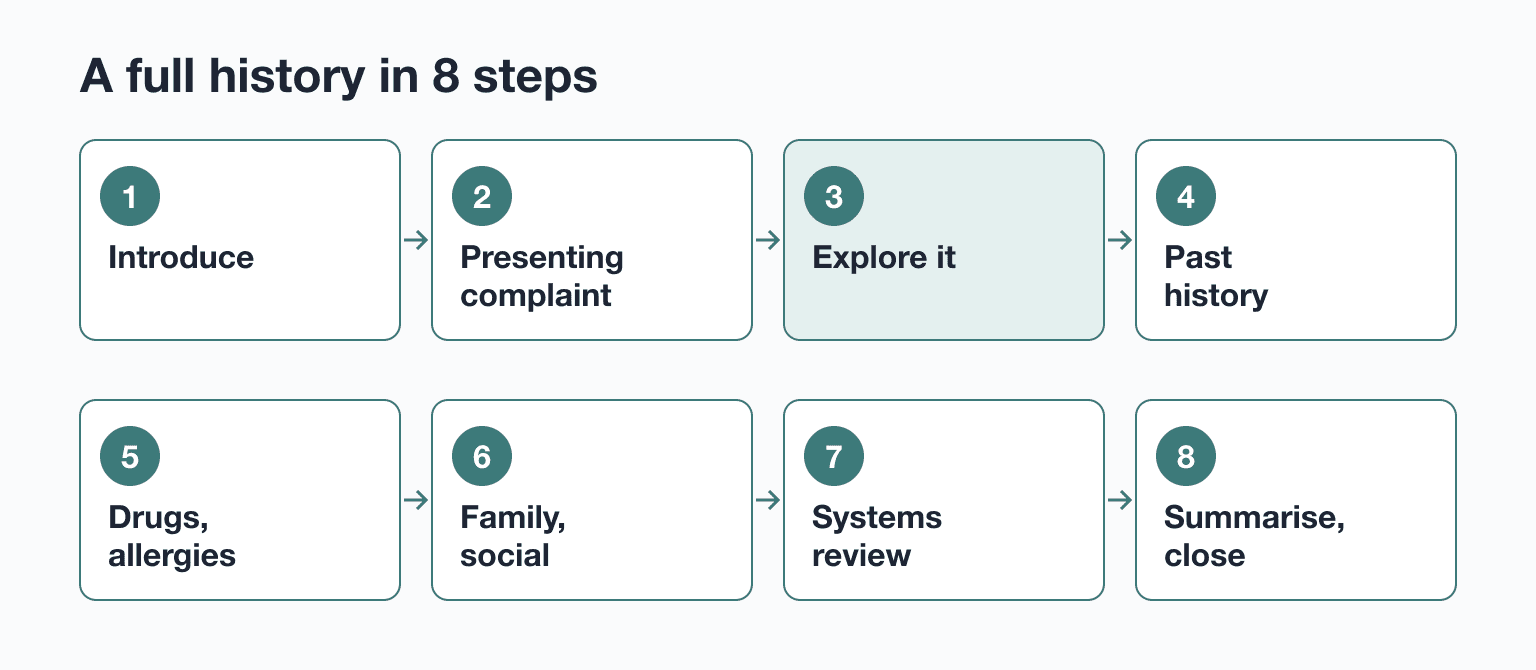
Eight steps from hello to summary for a complete medical history.
Step | What you do | One thing to say |
|---|---|---|
1 Introduce | Name and role, confirm identity, gain consent | Is it OK if I ask some questions? |
2 Presenting complaint | One open question, then listen | "What's brought you in to see me today?" |
3 Explore it | SOCRATES, associated symptoms, ICE | Tell me more about that. |
4 Past medical history | Conditions, operations, admissions | Do you have any medical conditions? |
5 Drugs and allergies | Prescribed, over the counter, the actual reaction | What happened when you reacted to it? |
6 Family and social | Illness and age in relatives, smoking, alcohol, work, home | Who do you live with? |
7 Systems review | A brief screen of other body systems | Anything else I haven't asked about? |
8 Summarise and close | Key points back, questions, thanks | Have I got that right? |
The order follows Geeky Medics' chest pain guide, with the steps grouped by us.
US teaching uses different names. AMBOSS's history entry lists chief concern, history of present illness, past medical history with medicines and allergies, family history, social history and review of systems. That's 6 sections there, and about 7 in UK templates once drugs get their own heading.
The Calgary-Cambridge authors note that learners meet two apparently conflicting models, the communication process and the traditional history content. These steps are the content. How you ask is the process, and you need both.
Steps 1 and 2: introduce yourself, then stop talking
The first minute of a history is an introduction, an identity check, consent and one open question. After that, your job is to stay quiet while the patient answers.
Oxford Medical Education teaches an opening routine of washing hands, introducing yourself, confirming identity, asking permission and sitting at the patient's level. It also says not to interrupt the first few sentences if you can avoid it.
In 112 recorded encounters, clinicians elicited the patient's agenda in 40 (36%), and in 27 of those 40 (67%) they interrupted, after a median of 11 seconds.
Uninterrupted patients took a median of 6 seconds to state their concern. Waiting costs almost nothing.
Example. Try it. Permission: "I'm going to ask you some questions about your cough, is that OK?" Then: "What's brought you in to see me today?" When they stop, ask: "Apart from this, have you noticed anything else?"
Those lines come from Oxford Medical Education, Geeky Medics and In2Med's template, in that order. Open questions come first, and closed ones explore detail once you've heard the story.
Step 3: explore the complaint, then ask what they think
Step 3 is where you narrow the diagnosis by exploring the main complaint: use SOCRATES for pain, lock down associated symptoms and key negatives, then ask the patient's ideas, concerns and expectations to guide risk and next steps.
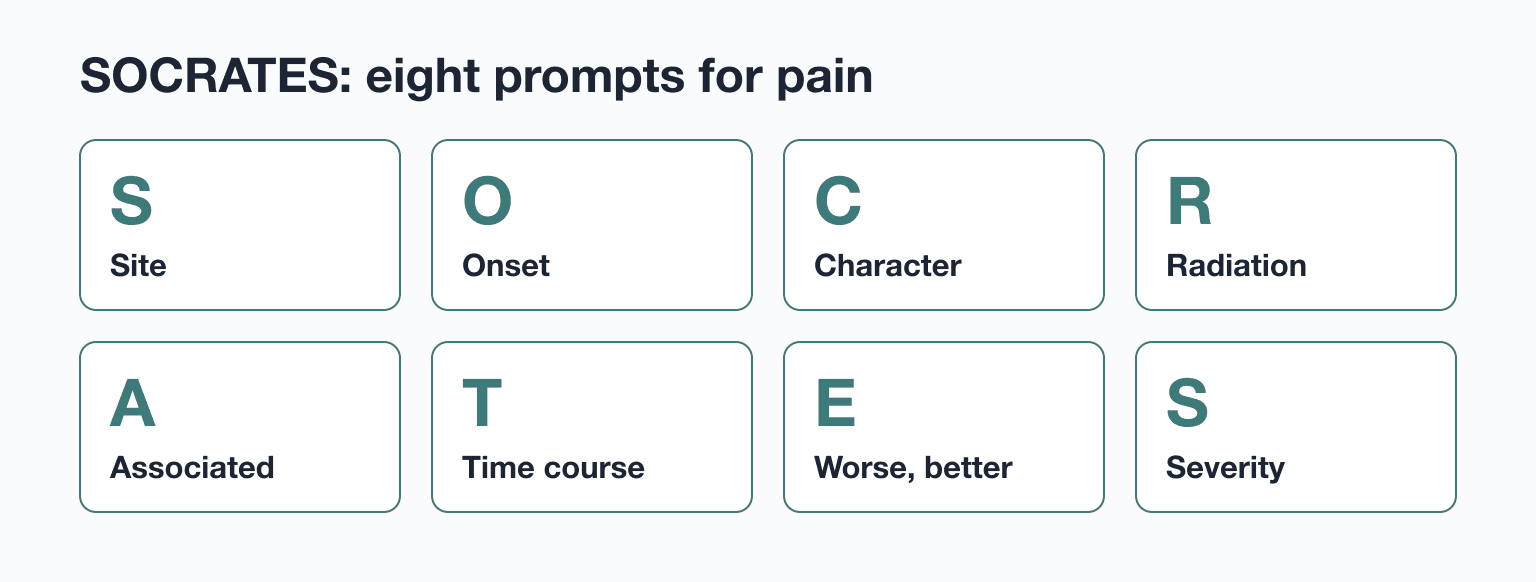
Eight prompts to structure pain history with SOCRATES.
SOCRATES, as Geeky Medics sets it out, stands for site, onset, character, radiation, associated symptoms, time course, exacerbating or relieving factors, severity. For a video example, Geeky Medics' SOCRATES video demonstrates the exchange, and it's a good one.
A negative earns its place when it moves a possibility on your differential. Example from a simulated case: 'not heavy or crushing, no worse on exertion' changes how you weigh a heart attack; the case file notes it makes acute coronary syndrome much less likely in that young man.
Ask what they think is going on, what worries them and what they hoped for. Geeky Medics says ICE should be fluid through the consultation, in response to cues, so it needn't wait for a fixed slot. It suggests asking: "What do you think the problem is?" and "Is there anything, in particular, that's worrying you?"
Steps 4 to 6: the background that changes your differential
Past, drug, family and social history aren't paperwork, they're diagnostic clues and risk filters that shift your working differential. Ask them with the presenting complaint in mind and pull on threads that connect to timing, exposures, and plausibility.
Use these prompts to keep it anchored to today's problem:
- Past history includes conditions, operations, admissions, plus risk factors for this complaint.
- Drugs and allergies cover prescribed and over the counter medicines and the actual allergic reaction.
- Family records who had what, and at what age.
- Social covers smoking, alcohol, recreational drugs, work, who they live with, home, travel.
Watch out. Patients will ask you things you can't answer yet. Medistudents' 11 steps say not to give false information: tell them you'll ask your seniors.
Steps 7 and 8: screen other systems, then summarise
The systems review is a brief screen, and which symptoms you pick depends on the complaint and your experience, says Geeky Medics. The summary that follows gives the patient the chance to correct you.
Closing means summarising the key points back, asking about any questions or concerns not yet covered, and thanking them. Signposting, stating what you've covered and what comes next, is what makes the order feel like a conversation.
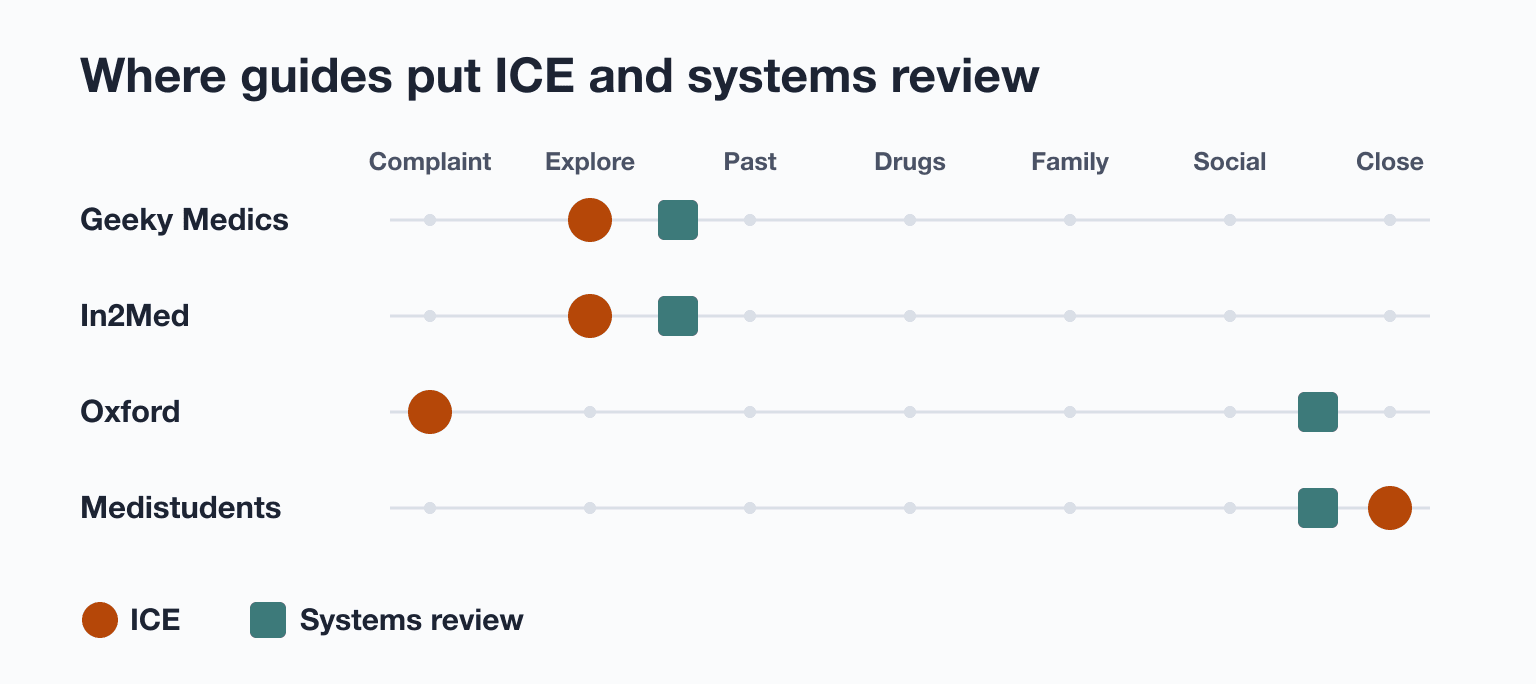
Four guides place ICE and the systems review differently, as checked November 2026.
Guides don't agree on where these two sit, as these four show:
- Geeky Medics places ICE within the complaint, systems screen next, before past history.
- In2Med puts ICE after the complaint, then systems review.
- Oxford Medical Education lists ICE under the complaint, systems review after social history.
- Medistudents places systems review at step 08, ICE at the summary in step 09.
If your school's mark scheme says otherwise, follow your school. Schools differ on this, and from what we can tell none of the four is wrong.
Worked example: one chest pain history, question by question
One simulated chest pain case shows what each question earns. Chest pain is the example only, the method works for any complaint, and this is practice material, not advice about a real person.
Jamie Wilson is a 30-year-old simulated patient from the Diagnosica case library. The marks below are what this case's scorecard gives under communication: 25 in all, 20 of them across 9 major checklist lines. They're formative, specific to this case and not mapped to any exam.
Jamie, 30 (simulated): what he said, and what had to be asked
Chip | Question | Answer | Why it mattered |
|---|---|---|---|
Volunteered | What's brought you in today? | I've had a sharp pain in my chest for a couple of days and I feel feverish. | Sharp pain and fever each sit on the checklist at 2 marks. |
Volunteered | Tell me more about the pain. | Worse lying flat, better sitting forward. | Most discriminating history feature in this case, 2 marks. |
Asked | Does it spread anywhere? | It goes up to my left shoulder, along the top near my neck. | Radiation is a checklist line, 2 marks. |
Only if asked specifically | Any recent illness or infection? | A flu-like cold about a week ago. | Points to a likely trigger, 2 marks. |
Only if asked specifically | Is it heavy or crushing, or worse on exertion? | Not heavy or crushing, and not brought on by exertion. | Makes acute coronary syndrome much less likely here, 2 marks. |
Only if asked specifically | Any breathlessness at rest, near-fainting or leg swelling? | No severe breathlessness at rest, no near-fainting, no leg swelling. | Critical question, 3 marks: screens a dangerous complication. |
Two more lines are worth asking for: no calf pain or long-haul travel (2 marks), and no night sweats or weight loss, with one weekend in Lisbon three months ago (critical, 3 marks). The case file's diagnosis is pericarditis.
Simulated patient. Case file pericarditis-30m. Questions written by us as a model, not a learner session.
How much of a history you have to ask for
Of the case's 15 history facts, 2 are volunteered, 3 come with an ordinary question and 10 come out only on a specific probe. His own worry, "Honestly, I think it's my heart", needs asking for too.
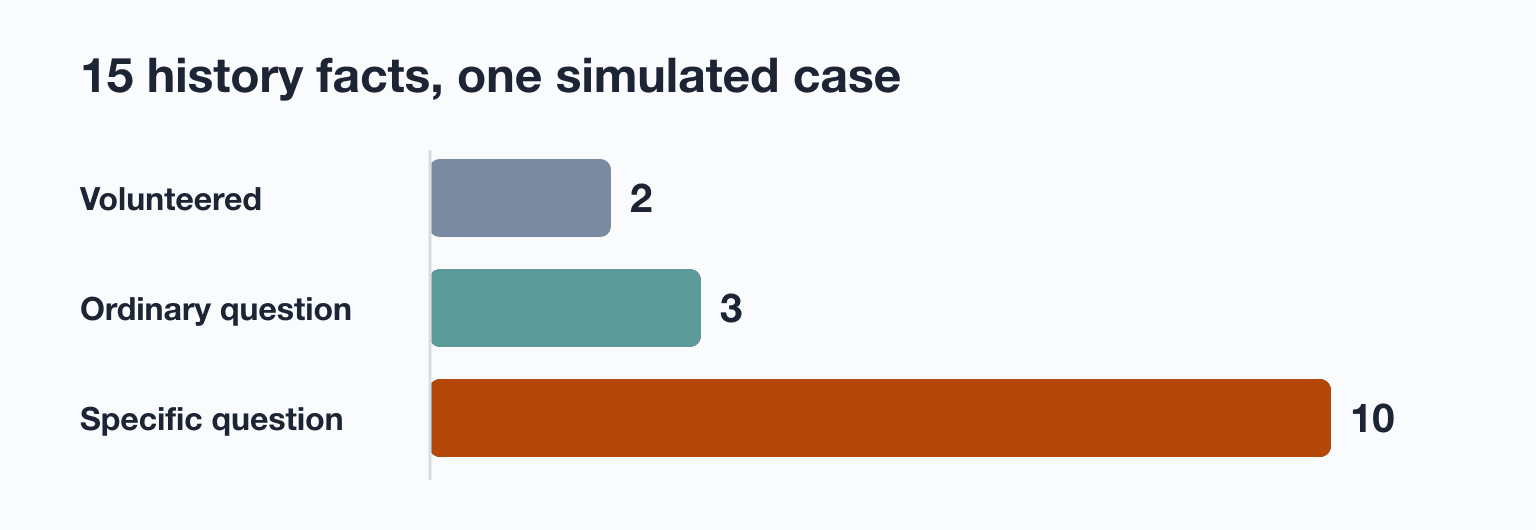
Most of this simulated case's history facts come out only when you ask a specific question.
Geeky Medics' chest pain guide also lists pain worse lying flat and better leaning forward under pericarditis.
How Diagnosica helps with this
Ask an AI video patient anything by voice or typing, then get a scorecard.
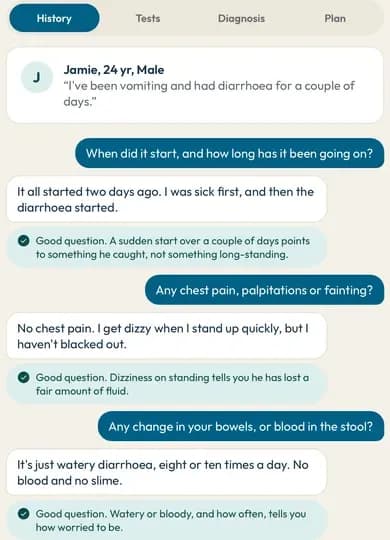
Diagnosica app, guided case history screen, as of October 2026. A separate guided case, not the example above.
- In this guided case you tap a question.
- The simulated patient replies in the chat.
- A one-line note says why it helped.
Simulated patient. Screenshot from Diagnosica, October 2026.
How a history changes in an OSCE, on the ward and in an emergency
A history's content stays the same across an OSCE, a ward and an emergency department, but its depth changes, so decide first how much of the 8 steps this situation needs.
Setting | How much history | Source |
|---|---|---|
OSCE station | The full order if the brief asks for it | Your school's scheme |
New, non-emergency patient | Full: all the key elements | AMBOSS |
Emergency | Problem-focused: chief concern, brief present illness | AMBOSS |
Child, or adult with impaired mental state | Add a collateral history from a relative, friend or carer | Medistudents |
The GMC's CPSA page says UK medical schools set and deliver the CPSA, one of the two MLA components, in the penultimate or final year. So your own school's marking is the one to check.
For revision timing, see your wider OSCE plan.
History taking guides, by the question you have
History taking guides by the question you have are grouped as Start, Next, and Stretch; pick the one that mirrors what went wrong last time. Start means learn it first, Next after you can run the order, Stretch for ward work.
Tune how you ask and how you move between parts:
Guide | Question it answers | Level |
|---|---|---|
build rapport fast with guarded patients | Start | |
when to switch question types | Start | |
what to say between sections | Start | |
which mnemonics work in OSCEs | Start | |
ask ICE naturally, not scripted | Next | |
which negatives change the differential | Next | |
what a short summary contains | Next |
Then choose what to ask and when to widen or narrow:
Guide | Question it answers | Level |
|---|---|---|
which systems to screen, when | Next | |
what to ask about work | Next | |
when travel changes diagnosis | Next | |
how to take collateral histories | Next | |
how a paediatric history differs | Next | |
what to leave out, when busy | Stretch | |
fit the history into clerking | Stretch |
History or examination first, and what you can't practise here
The history comes first. AMBOSS's entry says the history of present illness helps decide which systems to assess in the review of systems and physical examination, so take the history first.
Watch out. Examination isn't practised in Diagnosica. It still needs a real person, a partner or your school's skills sessions.
It doesn't give advice about real patients, and it's not a diagnostic system. Treat every output as educational.
For the rest of the year, try making final year count.
Pick one complaint, run the 8 steps aloud, and practise a full history with an AI patient until the order stops needing thought.