Paediatric history taking: what changes when a parent answers
Paediatric history taking keeps the adult structure and adds feeding, nappies, birth, development and immunisations. With a young child a parent usually answers, so you separate what they saw from what they fear.
If a real child is struggling to breathe, call 999 or go to the emergency department straight away, per NHS advice on children's coughs. This post is for exam and ward practice.
Key takeaways
- Start with what they saw, then ask what they think it is.
- In our worked case, 10 of 18 facts emerged only on a specific question.
- Always ask about drinking, wet nappies, and whether immunisations are up to date.
Do this first: work out who is answering
When a parent speaks for a child, sort out who's who first. Start with the child's age, then name every adult in the room. After that, invite the child in with simple, direct questions.
Age shapes what you ask, and you should name each adult and their relationship to the child, per Geeky Medics' paediatric guide. Young children can stay on a parent's lap, and you use their words, like tummy.
Speak to the child too. Toddlers can answer yes or no to simple questions, so don’t over-rely on the parent, as TeachMePaediatrics on relatives warns. It’s like history from a relative, except the patient is in the room. You can question a parent in a live case; the parent there is an AI.
What does a paediatric history add to an adult one?
A paediatric history keeps the adult frame and adds feeding and toileting. You also cover birth and development, plus growth and immunisations. You still open with the presenting complaint and systems, and with a parent answering, pin down routines and changes rather than impressions, where possible.
If you need the base first, see the full history structure. TeachMePaediatrics remembers the extras as BLINDS: birth, looking for neonatal sepsis risk factors, immunisations, nutrition, development and screening for mental health.
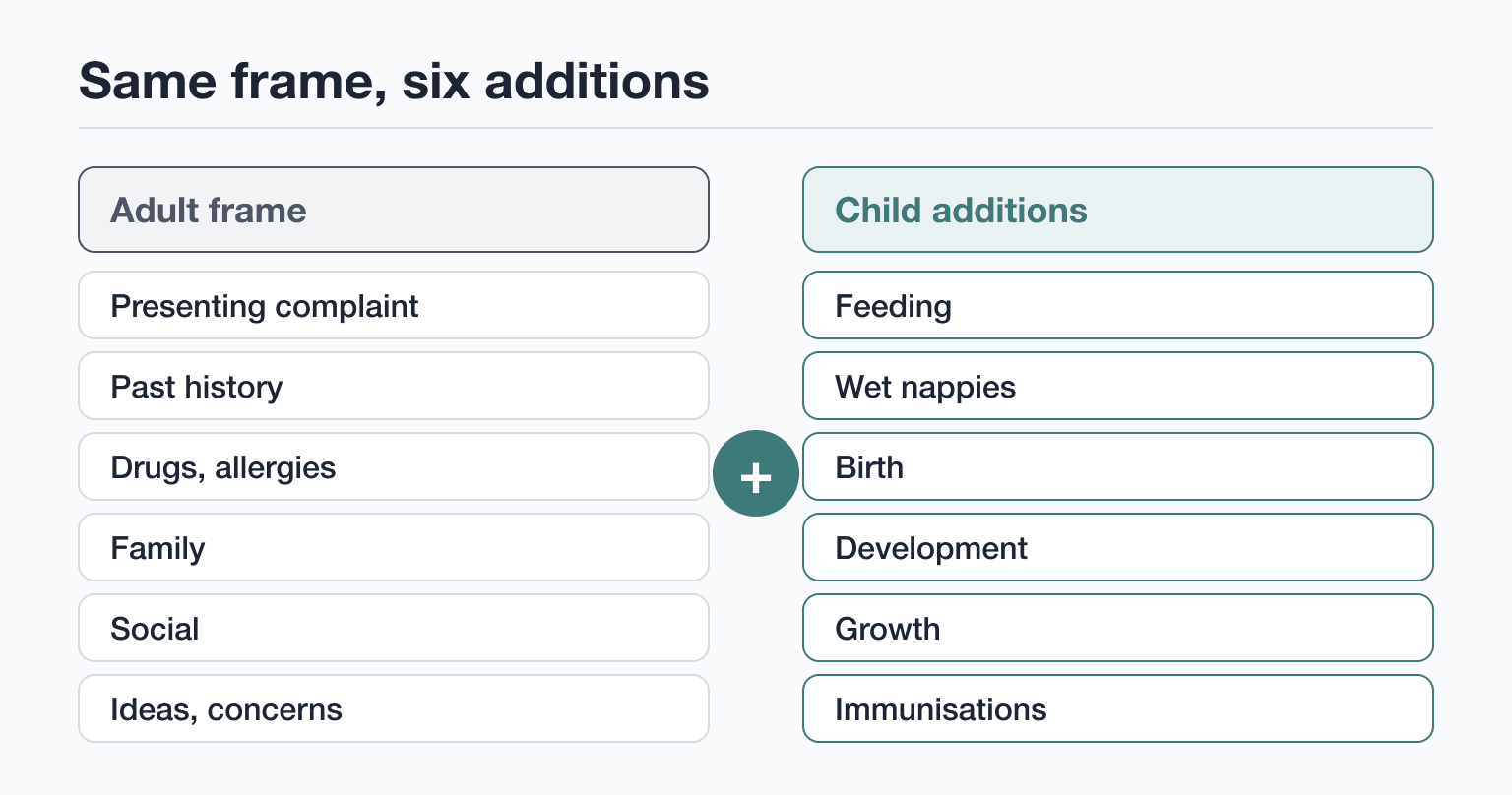
Same frame as adult, plus six child domains you quantify with the parent.
Use this table to guide five extra topics to ask parents in a paediatric history:
Topic | Ask the parent | Why it earns its place |
|---|---|---|
Feeding | breast or bottle, how often, how much, per Geeky Medics guide | NICE lists poor feeding in infants as at least intermediate risk in feverish under-5s. |
Wet nappies | how many a day, any change from normal | NHS dehydration signs include fewer wet nappies than usual in a baby. |
Birth | premature? gestation and birthweight | Depth depends on age and problem. |
Development and growth | milestones, weight and height centile | Shows what's normal for this child. |
Immunisations | up to date, and if not, why missed | The NHS 6-in-1 schedule gives Hib at 8, 12 and 16 weeks and 18 months; check the red book. |
Six steps for a history from a parent
With a parent historian, use six moves. Get exactly what they saw before any theory or label. Finish by summarising back so you both agree on the key facts, and on any gaps.
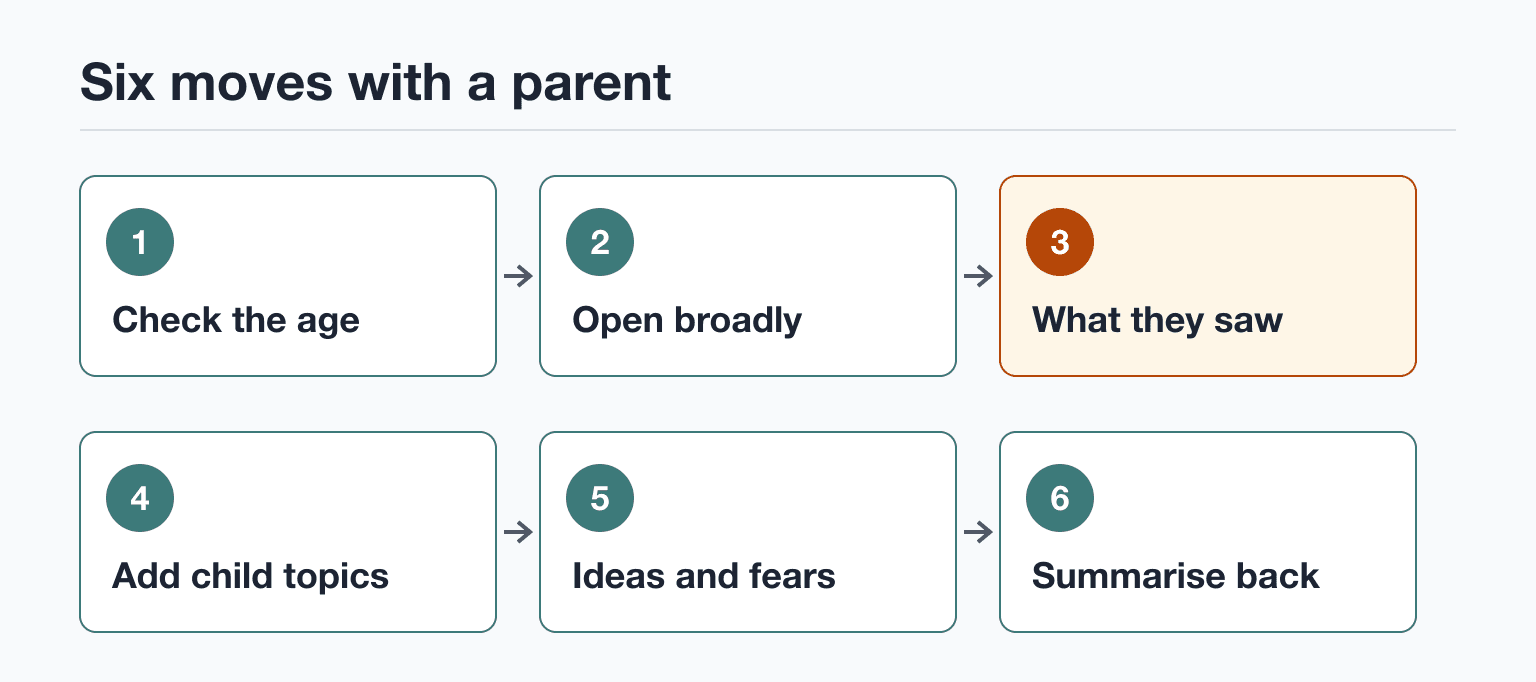
Six moves, from checking the age to summarising back, with what the parent saw ahead of their theory.
Use this default order when a parent gives the history, and adapt it to the child's age:
- Check age and who’s in the room.
- Open with a broad question to the parent.
- Ask what they saw before theories; this is our suggested ordering.
- Add feeding, wet nappies, birth, development, immunisations.
- Ask a parent's ideas and fears.
- Finish by summarising back to a parent and asking what you missed.
Watch out. With adolescents, flip the order: ask them first, invite parents to add detail, and offer time alone for sensitive topics using HEEADSSS.
Worked case: a two-year-old with noisy breathing
Meet Rory Whitlock, 2, a simulated patient from our library. His father gives the history. He starts with this: "He woke up in the night with this awful barking cough".
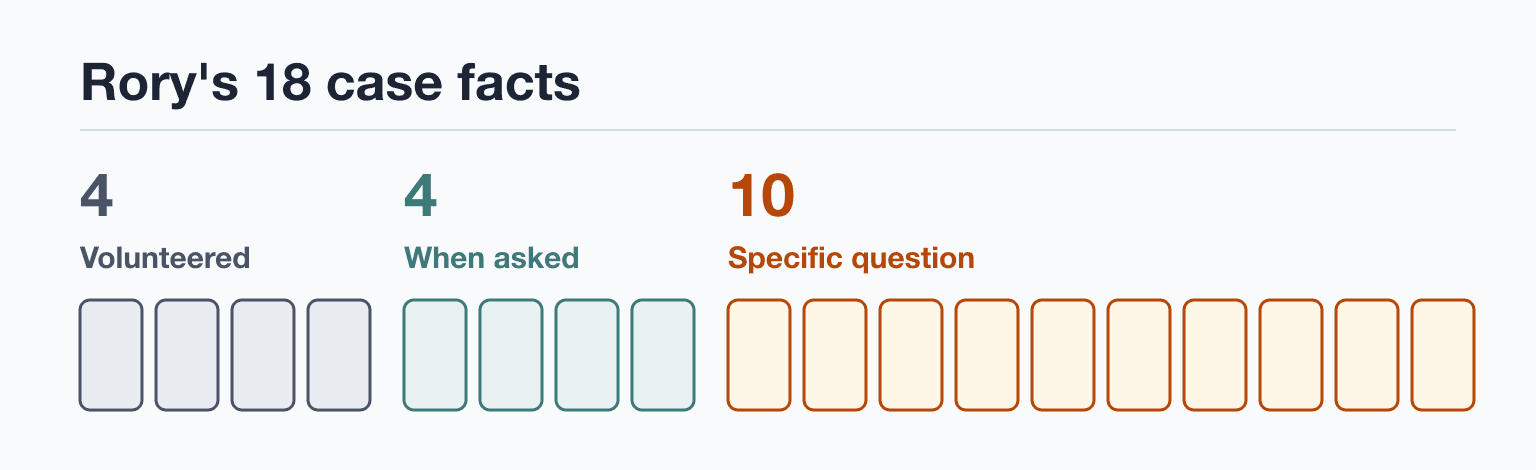
Our count of the case file.
The case file holds 18 facts; the father volunteers 4, gives 4 more when asked and holds 10 back until you ask specifically.
Rory, 2 (simulated): what we had to ask
Chip | Question | Father's answer | Why it mattered |
|---|---|---|---|
Volunteered | What was he like before this? | He had a simple cold for two days: a runny nose, a bit hot. | A slow start after a cold shapes everything after. |
Asked | Can you see him working to breathe? | I can see his skin sucking in under his ribs and at the bottom of his neck. | A parent's observation of effort. |
Only if asked specifically | Is he drinking, and how are his nappies? | He is still drinking, juice and milk, and having wet nappies as usual. | Tells you about intake. |
Only if asked specifically | Any drooling or trouble swallowing? | He is not drooling: he swallows his own spit normally. | A negative you only get by asking. |
Only if asked specifically | Are his jabs up to date? | He is up to date with all his immunisations, including the Hib one. | One short question closes a dangerous branch. |
His father's own theories are a bad chest infection, something swallowed, or asthma, and what he fears is that the breathing will stop. Observation and theory sit side by side, so note them separately. See negatives that reassure you.
Simulated patient. Questions written by us as a model, not a learner session.
How Diagnosica helps with this
Question an AI father by voice or typing, then see scores.
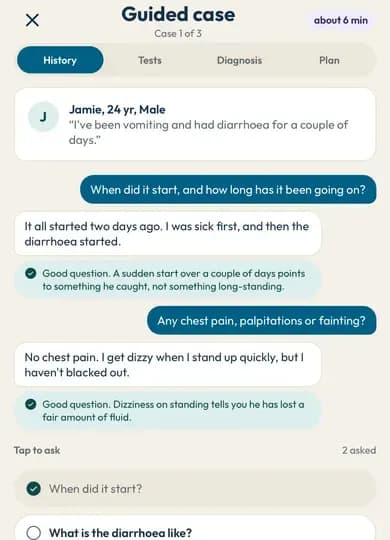
Diagnosica app, guided case history screen, an adult case, as of November 2026.
- Ask your own questions, by voice or typing.
- He holds some facts until you ask.
- You can't examine the child here, only take the history.
Simulated patient. Screenshot from Diagnosica, November 2026.
What the father's answers point to
A two-day cold, then a barking cough, a hoarse voice and noisy breathing in, worse at night, with no drooling and no choking, and overall the pattern fits croup.
NHS croup symptoms list a barking cough like a seal, a hoarse voice, and a rasping sound on breathing in. They usually follow a cold, often worse at night.
Epiglottitis on the NHS can bring drooling and a child leaning forward with the neck pushed out, and Hib is its most common cause. No choking and a gradual start after a cold argue against something inhaled.
Noise at rest and skin sucking in show how hard he's working, see signs of a sick patient. In a real child, the NHS says call 999 for struggling to breathe.
Common mistakes when a parent is the historian
When a parent speaks for a child, you can miss specifics. Ask the child when you can, even for small points. Then probe for concrete details, and keep worries apart from diagnoses.
Watch for these four traps, and see common pitfalls with relatives:
- Stopping at the story: in Rory's case, 10 of 18 facts need a specific question.
- Leaning only on the parent: toddlers can answer simple yes or no questions.
- Dismissing a vague worry: 'just not themselves' can signal early serious illness.
- Adopting their diagnosis: keep an open mind.
Practise it before your paediatrics block
Paediatric history is a talking skill. Say it out loud, and listen on your paediatrics placement to how parents tell it. In a timed OSCE station, cut to what matters, as focusing a timed history shows.
Diagnosica has over 130 cases in 18 specialties, including paediatrics where a parent gives the history, and a scorecard after every case. Practise a paediatric history with Rory's AI father, shown as a video avatar, by voice or typing. It's free to start, no card needed. History only; examining a child stays on the wards.