Headache OSCE station: a worked case and scorecard
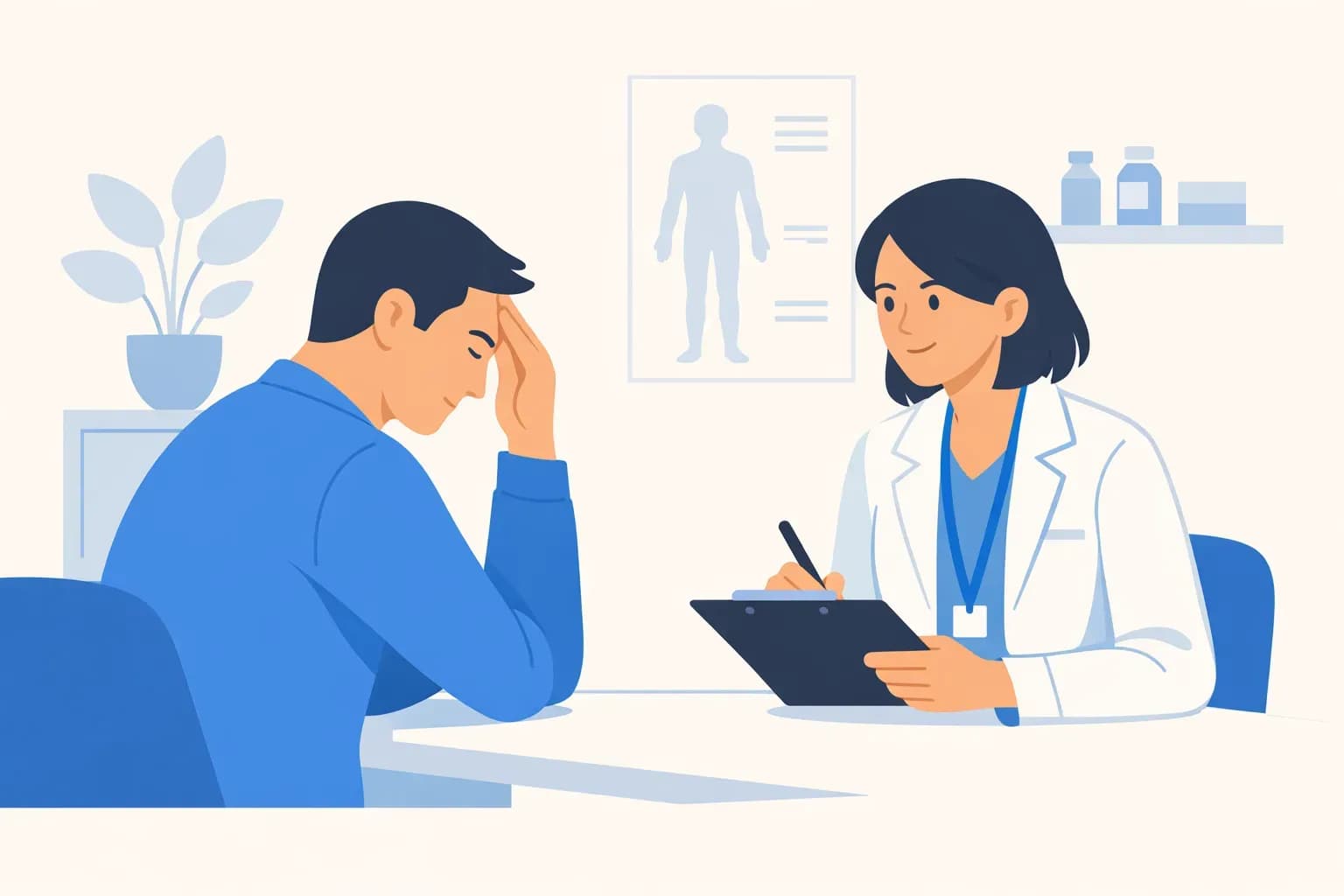
In your headache OSCE station, first pin down how fast the pain peaked. NICE calls a sudden severe headache, typically peaking within 1 to 5 minutes, a red-flag symptom of subarachnoid haemorrhage.
If someone with you gets a sudden, extremely painful headache that doesn't go away, call 999, per the NHS subarachnoid haemorrhage page. Exam practice, not advice for a real patient.
Key takeaways
- Ten of Andrew's 15 scripted history facts need a specific question.
- Ask 'has this happened before, even milder?' in every sudden headache.
- Check for a blackout and drowsiness, two of his three must-elicit flags.
Andrew's case in one line
Andrew, a simulated 50-year-old, opens with: "I've suddenly got the worst headache of my life and I've been sick." The opening line alone makes the diagnosis guessable, and the case turns on what he doesn't volunteer.
Now, take his history yourself.
Part | What the case file says |
|---|---|
Background | High blood pressure, doesn't always take tablets; current smoker, about fifteen a day for thirty years; mum's sister had a brain aneurysm. |
Observations | Blood pressure 182/102, temperature 37. |
Pertinent negatives | No head injury; no limb weakness or speech disturbance; no fever; never migraines. |
Those negatives in a headache history matter: no weakness, no fever, no injury.
[image pending: headache-osce-station-andrew-timeline-week]
Andrew's timeline, from the case file. Simulated patient.
A week ago he had a milder sudden headache that settled, and he ignored it. Two hours ago the worst headache began within seconds, with a blackout and vomiting. Now: stiff neck, light hurts, drowsy.
What should you ask in a headache OSCE station?
In a headache OSCE station, start by pinning down the rate of onset and the time to peak, then sweep for associated symptoms and any altered brain function. Ask about earlier episodes and risk factors. Finish by asking what the patient fears, in their words.
NICE's subarachnoid haemorrhage guideline advises a careful history on rate of onset and time to peak, and NICE's headache guideline flags sudden-onset headache reaching maximum intensity within 5 minutes.
Say it aloud in five steps:
- Ask the time to peak: How quickly did it reach its worst?
- Check neck pain or stiffness, light, or vomiting.
- Screen for blackout, drowsiness, weakness, speech problems, or fits.
- Ask about earlier sudden headaches, even milder than this one.
- Review blood pressure, smoking, family history of aneurysm, then asking what he fears.
This is the red-flag part of the station, not the whole history. Geeky Medics' headache guide has the full SOCRATES walk-through and a 35-item checklist, and it does that job well.
Our broader method is how to take a history. NICE adds that if someone can't describe it, for example with altered consciousness, you ask whoever witnessed the onset, without delaying referral.
Andrew's history, question by question
Andrew volunteers the onset and severity, and most of the rest waits for your question. The questions below are our own model wording.
Andrew, 50 (simulated): what he said, and what we had to ask
Chip | Question | Answer | Why it mattered |
|---|---|---|---|
Volunteered | How quickly did it reach peak intensity? | Worst within seconds, about two hours ago, lifting a heavy box. | NICE wants the rate of onset and time to peak established. |
Asked | Any neck stiffness or light sensitivity? | Neck stiff and sore. Bright light hurts his eyes. | NICE lists neck stiffness and photophobia among other symptoms. |
Only if asked specifically | Did you black out when it started? | Briefly blacked out at the moment it struck. | One of three must-elicit flags in the case file. |
Only if asked specifically | Any similar sudden headache before this one? | A similar, milder sudden headache about a week ago. It settled; he ignored it. | Another must-elicit flag, and he doesn't offer it. |
Only if asked specifically | Have you felt drowsy or confused since it began? | Keeps becoming drowsy and losing the thread. | Third must-elicit flag; NICE lists reduced consciousness. |
Simulated patient. Case file sah-50m. Questions written by us as a model, not a learner session.
[image pending: headache-osce-station-facts-by-question]
Our count of disclosure tags in the simulated case file.
Of 15 scripted history facts, 2 are volunteered, 3 come with a general question, and 10 only with a specific one.
The earlier headache changes the case
In a headache OSCE station, ask Has this happened before? Andrew recalls a milder sudden headache a week ago, settled and ignored. He doesn't offer it first. It could be a sentinel headache or warning leak, but nothing proves it.
Figures vary: a European Stroke Organisation article reports it in 15% to 60% of patients with aneurysmal subarachnoid haemorrhage, and calls its clinical relevance a matter of debate. Wide range.
Compare Andrew and the library migraine case, both simulated:
Question | Andrew | Library migraine case |
|---|---|---|
How fast did it peak | Reached worst within seconds, while lifting a heavy box | 20 minutes of zig-zag lines first, builds over an hour, never in an instant |
Happened before | Similar, milder sudden headache about a week ago | Recurrent for about two years, a few times a month |
Neck and light | Neck stiff and sore, bright light hurts | No neck stiffness; light and noise bother him a lot |
NICE NG228 says thunderclap headache is also associated with migraine, cough, coitus or exertion. Most people with a thunderclap headache do not have a subarachnoid haemorrhage, but this shouldn't deter investigation if suspected. For blackout questioning, see a blackout history walkthrough.
How Diagnosica helps with this
Ask a video patient by voice or text. What comes back depends on your question.
[image pending: headache-osce-station-app-history-screen]
Diagnosica app, guided case history, October 2026; a different simulated patient.
- The patient's reply appears under your question.
- A note says why that question counted.
- In real cases, you ask anything, by voice or typing.
Simulated patient. Screenshot from Diagnosica, October 2026.
Investigations and diagnosis in this station
After a thunderclap history, NICE's guideline sets urgent senior review, then urgent non-contrast CT head if the senior confirms it. CT accuracy is highest within 6 hours of symptom onset, so saying Andrew's two hours aloud is worth doing.
In this headache OSCE station, CT head and cerebrospinal fluid xanthochromia sit among 18 orderable items. The decisive diagnosis is subarachnoid haemorrhage under thunderclap headache, with other diagnosis options including meningitis, migraine and cerebral venous sinus thrombosis.
The app doesn't let you practise fundoscopy or examining a neck, so rehearse those on a partner. Local trust guidance applies, and see our notes on calling a senior early and on closing your station summary.
What the scorecard shows afterwards
The Diagnosica result screen shows a score out of 100 split into four section bars for History, Tests, Diagnosis, Plan. The pictured screen is a guided case with a different simulated patient, scoring 78 out of 100.
[image pending: headache-osce-station-result-screen-annotated]
Diagnosica app, guided case result, as of October 2026; a different simulated patient; numbers mark what to read
Use this numbered key to the four numbers marked on the picture above:
- What you did well, plain words.
- Next step, one thing to try next time.
- The overall score, the example shows 78 out of 100.
- Section bars, example shows History 10, Tests 18, Diagnosis 25, Plan 25.
We're not printing Andrew's marks, as this isn't a learner session. That screen is guided, and says real cases add a full breakdown, section by section. For the wider picture, see how OSCE stations get marked. Real mark sheets differ by school, from what we can tell.
What to take away
For a headache OSCE station, two questions decide this case: how fast it peaked, and whether anything similar has happened before.
Three habits to keep:
- Time to peak first: NICE's red flag typically peaks within 1 to 5 minutes.
- Ask about milder earlier headaches and any blackout, because Andrew volunteers neither.
- Say the time since onset aloud: CT accuracy is highest within 6 hours.
Try the same habit on the abdominal pain station. Try another neurology case.