Dealing with angry relatives as a junior doctor

Sit down, let them finish, name the worry under the anger, say what you know, and agree one next step. GMC Good medical practice (2024) expects compassion towards those close to a patient when dealing with angry relatives.
Key takeaways
Key takeaways
- Ask 'what worries you most?' early, because fear often sits beneath anger
- Escalate to a senior for threat, complaint, harm, or beyond-competence questions (GMC para 2)
- Write a contemporaneous note in real time, legible and accurate (GMC paragraph 69)
What to say first to an angry relative
What to say first to an angry relative is a short, structured opener that shows you’re listening. Use their name, introduce yourself and your role, suggest somewhere private, then sit. Ask an open question like “Tell me what’s happened,” and stop talking until they finish. Keep your voice steady throughout.
That maps to paragraph 23’s focus on kindness, courtesy and respect, including listening and acknowledging concerns. Paragraph 37 adds duties to relatives and confidentiality in GMC Good medical practice. Be sensitive to what they can be told, and check consent if unsure.
Example. Example. Hi, I’m [your name], the junior doctor. Can we find somewhere private? Tell me what’s happened, and what you’re most worried about.
To rehearse listening under pressure, you can practise a worried-parent history, and keep this close during your first FY1 months.
How to de-escalate, step by step
Dealing with angry relatives works when you sequence the conversation. Give listening first and facts second, so feelings are heard before explanations. That order gives space to be heard and reflects GMC Good medical practice paragraph 23 in practice.
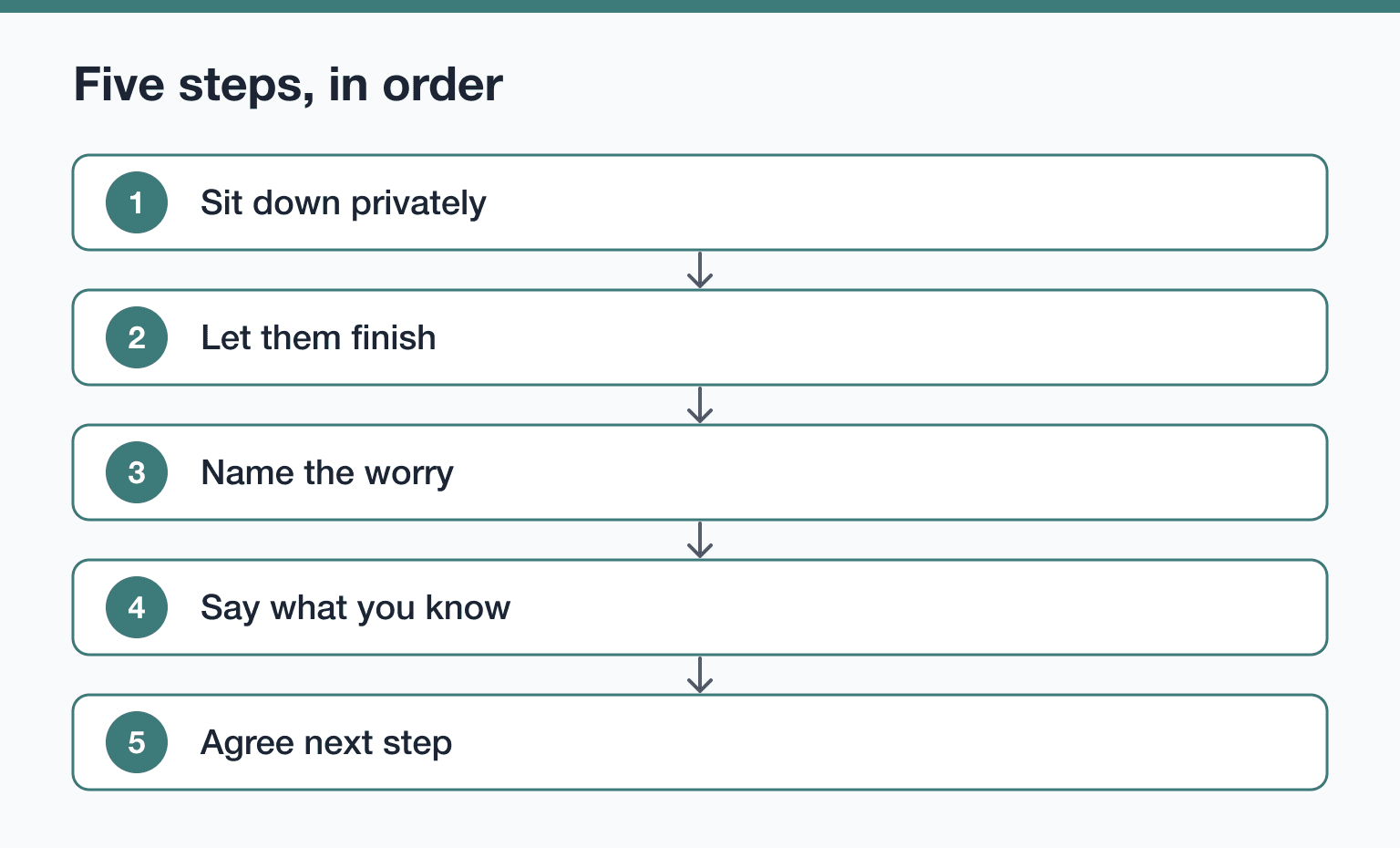
A short script to structure hard conversations when a relative is angry or distressed.
Keep to this order, and lean on GMC Good medical practice paragraph 29 about listening and open dialogue always:
- Sit down somewhere private, at their eye level if you can, and avoid barriers like a desk screen.
- Let them finish without interrupting or defending, even if the account feels unfair.
- Name the feeling and the worry: "It sounds like you're frightened about..." or "It seems you're angry about...".
- Set information boundaries, say what you know, what you don't, when you'll update, check consent, GMC 37 confidentiality.
- Agree one clear next step and a specific time you'll return, so expectations are concrete and realistic.
The same structure, empathy, and boundaries also carry into breaking bad news well. Different conversation, same order, with extra attention to silence, pace, setting, and who should be present together.
The worry under the anger: a worked library case
Start with a plan to surface the fear first. This simulated parent is anxious, not angry, which mirrors many clashes where worry sits under raised voices.
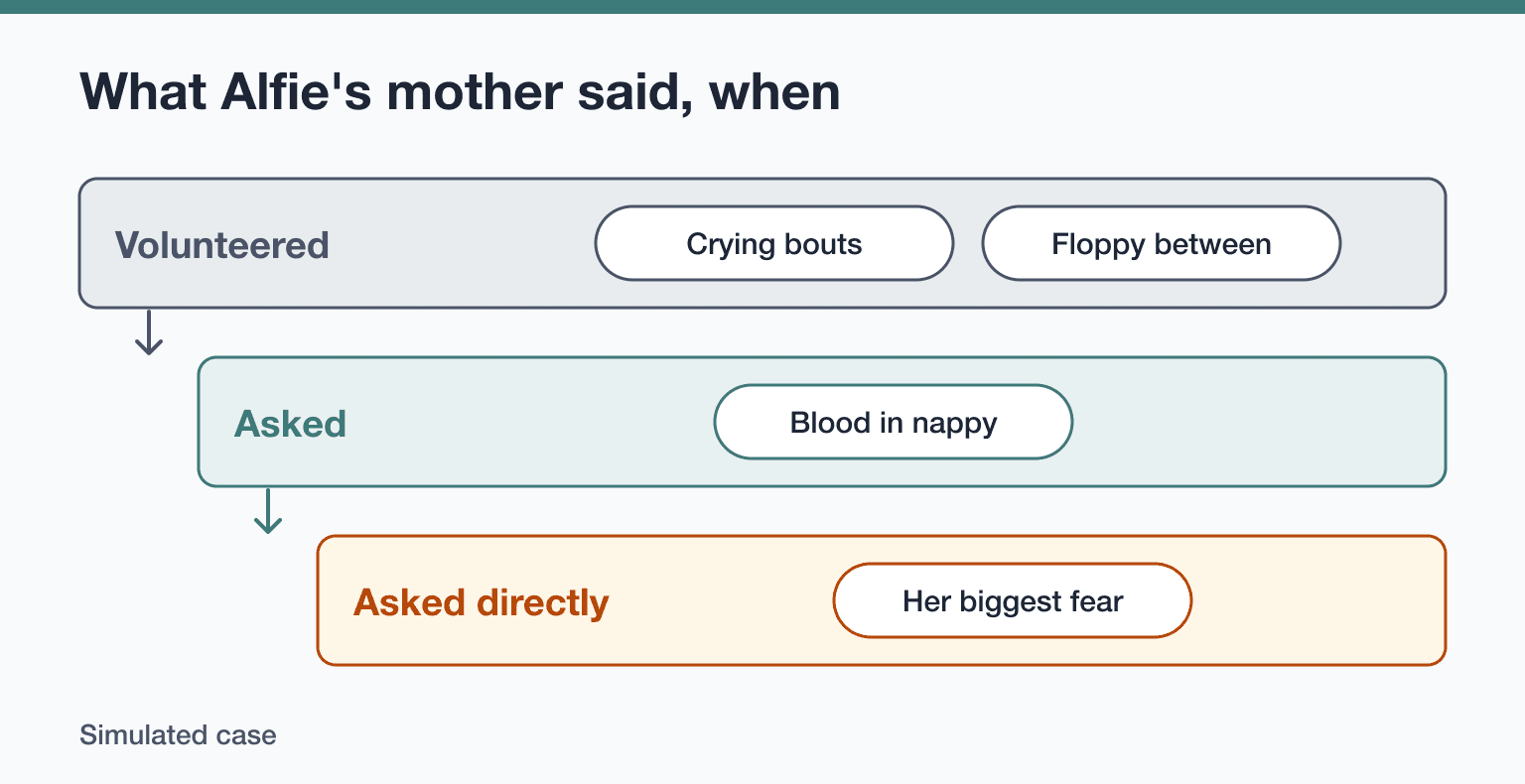
Volunteered items were bouts and floppiness; blood in the nappy and her biggest fear needed asking.
She volunteered crying bouts and floppiness; blood came on asking, fear on probing.
From a BMA resident doctor's account, anger may be about the situation, not you.
Alfie, 9 months (simulated): what his mother said, and what it took to hear it
Chip | Question | Answer | Why it mattered |
|---|---|---|---|
Volunteered | What's happening? | My baby's been having crying attacks and being sick since this morning. | Sets urgency and fear. |
Volunteered | Attacks like? | Crying attacks every fifteen to twenty minutes; he screams, pulls his knees up, goes pale. | Detail builds early trust. |
Volunteered | Between them? | Between attacks he is unusually floppy, quiet and sleepy. | Shows worrying quiet periods. |
Asked | Nappy changes? | His last nappy contained blood mixed with mucus. | Sensitive fact needs asking. |
Only if asked specifically | What worries you most? | What frightens me most is the blood in his nappy | Her core fear explicit. |
Her biggest fear only surfaced when asked directly; ask 'what worries you most' early with an angry relative too.
Simulated patient. Case file intussusception-9mo. Questions written by us as a model, not a learner session.
Use the ICE framework and taking a collateral history to surface fears and structure conversation.
How Diagnosica helps with this
Practise a worried parent's history by voice or text with video patient.
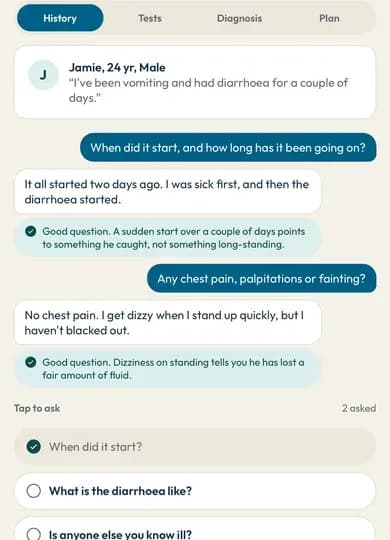
Diagnosica app, guided case history screen, as of October 2026.
- Question appears on right.
- Patient replies below with why helpful.
- Full cases, ask anything by voice or text.
Simulated patient. Screenshot from Diagnosica, October 2026.
Take a worried parent's history, free
If something went wrong, say sorry properly
After something goes wrong, say sorry early and mean it. Under NHS Resolution, an apology is not an admission of liability, and GMC paragraph 45 says apologise and explain promptly.
Apologise as soon as possible, acknowledge what happened, say you will find out more, and reassure them you will keep them informed. See NHS Resolution's saying sorry leaflet. GMC paragraph 45 also expects openness and a prompt, full explanation when facts are known. Report the incident in line with your organisation's policy.
Watch out. Watch out. Avoid blame-shifting phrases like "I'm sorry you feel like that". Favour ownership, for example "I'm sorry X happened", which the leaflet lists under "Do say".
If you were the one who made the error, read owning an error well.
When should you get a senior?
Get a senior early when someone is at risk, a complaint or harm is raised, or there is no clear plan. If questions are beyond your competence, escalate. GMC paragraph 2 says work within your competence. GMC paragraph 7 says seek advice early. Act early.
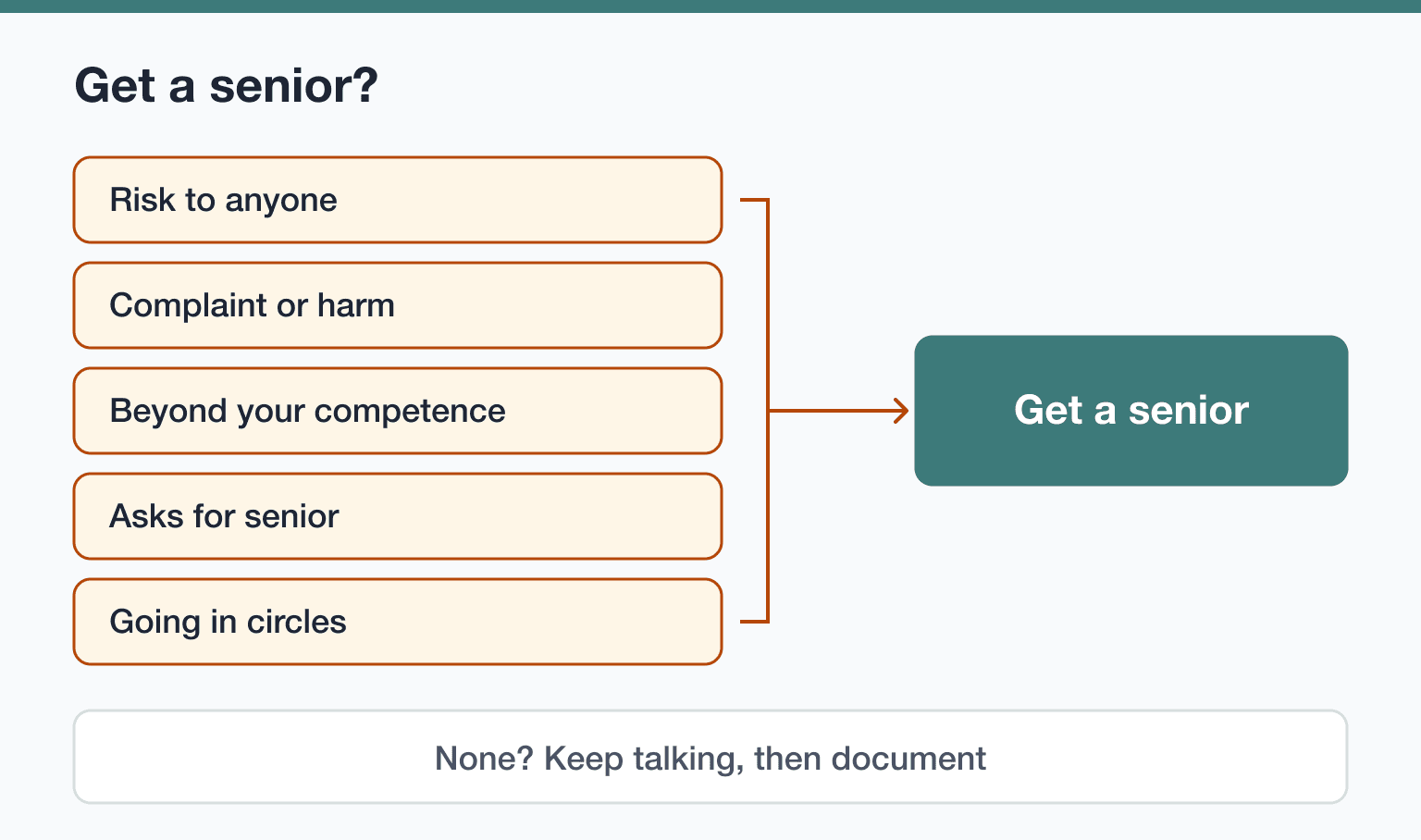
Use this checkpoint to decide between continuing the chat or escalating to a senior.
Use these triggers on the ward to escalate without delay:
Trigger | What to do |
|---|---|
Threat or aggression | Step away, ensure safety, follow local security policy, escalate immediately |
Complaint or harm | Escalate now; paragraph 46 says respond promptly, fully and honestly |
Beyond your scope | Say so, pause, escalate to the appropriate senior for decisions |
They ask for a senior | Acknowledge, contact the covering senior, stay present until they arrive |
Going in circles | Name the impasse, pause, escalate to agree a plan |
Seniors are expected to be reachable, per GMC paragraph 50, when you escalate. Give a short summary when you call, using a tight SBAR handover, and see calling your registrar early. Know the limits of your competence, and follow local trust policies for security and complaints.
How to document the conversation
Write it up straight after. GMC paragraph 69 expects clear, accurate, contemporaneous records, where 'contemporaneous' means at the time of events or as soon as possible afterwards. Do not wait until the end.
Use paragraph 70 in the GMC record-keeping standard to structure your note, then cover these elements:
What to write | Why it helps |
|---|---|
Who was there and when | Establishes context and accountability |
What you told them | Shows information shared and clarity |
Their concerns and whether they were addressed | Demonstrates listening and response |
What was agreed and who acts next | Clarifies decisions and next steps |
Rehearse the listening part for dealing with angry relatives in a paediatric case where a parent gives the history. When you're ready, run a full case and speak or type to the AI patient.