MSRA pass mark: there isn't one, scores are normalised

There is no MSRA pass mark; scores are normalised against the cohort with no maximum, and GP applicants with band 1 (185 or below) in either paper don't progress. Checked 18 November 2026.
Take a 2-minute reset without leaving clinical thinking. Try a two-minute quick case, free to start, no sign-up, as a reset between revision blocks. This quick reasoning drill reveals the answer instantly and differs from MSRA question practice.
Key facts
- GP band 1 is 185 or below in either paper, as of 18 November 2026.
- GP scores: mean 250, SD 40, as of 18 November 2026.
- No maximum score and no appeals, as of 18 November 2026.
What is the MSRA pass mark?
There is no published MSRA pass mark. The test normalises scores against the cohort. No fixed threshold guarantees progression. For GP specialty training, the nearest thing is the GP band 1 floor: you don’t progress if either paper is 185 or below.
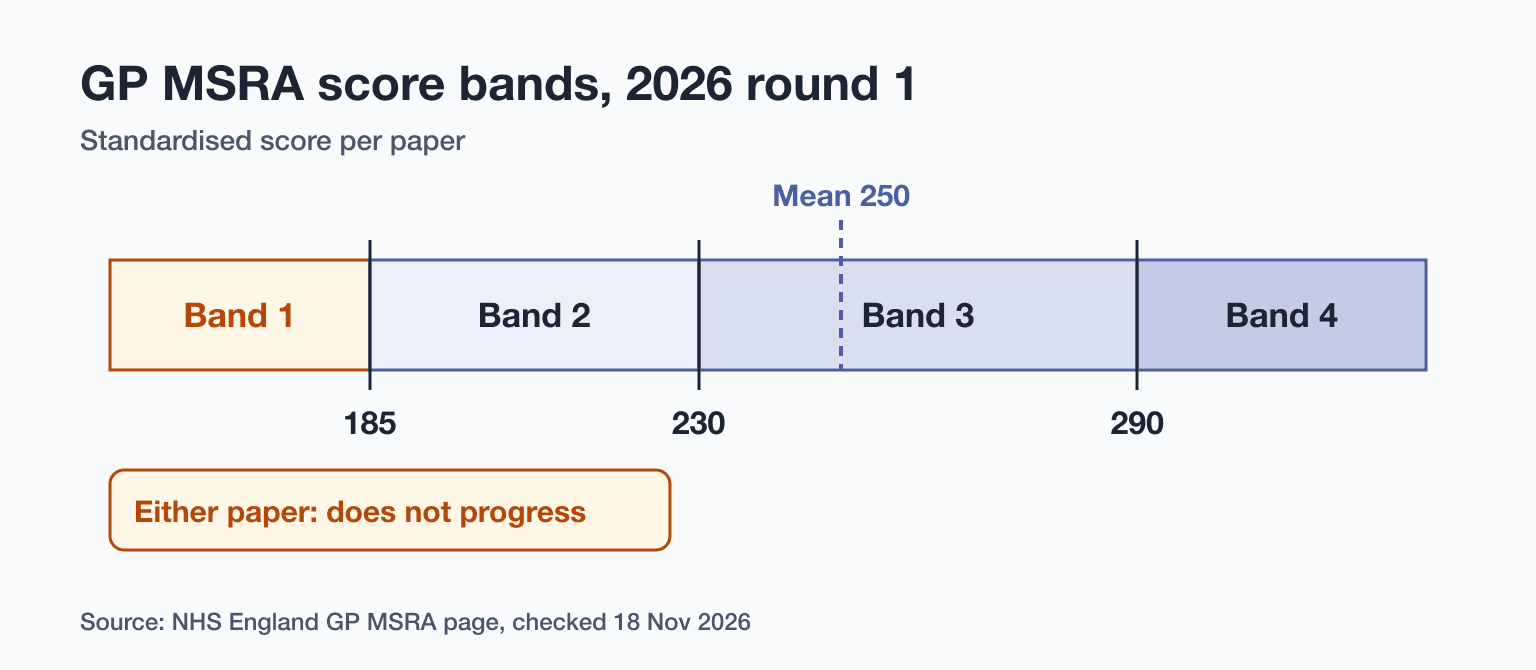
Source: NHS England GP MSRA page, checked 18 November 2026.
The GP National Recruitment Office MSRA page (checked 18 November 2026) gives GP banding and the approximate distribution in 2026 round 1 as follows:
Band | Standardised score | Clinical Problem Solving | Professional Dilemmas |
|---|---|---|---|
1 (does not progress) | 185 or below | about 4% | about 7% |
2 | 186 to 230 | about 16% | about 36% |
3 | 231 to 290 | about 56% | about 53% |
4 | 291 and above | about 24% | about 4% |
The percentages are our sums of the page's rows for GP ST1 2026 round 1. The page shows a review date of 25 September 2023, yet it carries the 2026 table, checked 18 November 2026.
How are MSRA scores normalised?
NHS England normalises MSRA scores against the cohort average, so no single pass mark or fixed maximum exists. The system converts your responses to a standardised score in each paper, built around cohort performance, then bands them 1 to 4. Outcomes vary with who sits.
On the MSRA outcomes and scores page, "Due to the normalisation of all MSRA scores, there is no maximum achievable score." The page publishes no single MSRA pass mark, checked 18 November 2026. Normalisation depends on the cohort average, and "There is no appeals process." The page shows a review date of 25 July 2023.
The GP MSRA page, checked 18 November 2026, says each paper normalises around mean 250 and SD 40. In 2026 round 1, band 1 is 185 or below, which sits about 1.6 standard deviations below the mean, by our arithmetic.
Contrast that with fixed-method exams like the PSA pass mark figures.
What MSRA score do you need for each specialty?
The MSRA doesn't publish a single pass mark. Recruiters use MSRA scores for shortlisting. Priority-group top scorers get interviews. GP publishes the GP band 1 floor, with band 1 at 185 or below in either paper, as of 18 November 2026.
- Check your specialty’s recruitment page for its shortlisting rule; central pages lack cut-offs as of 18 November 2026.
- Read your shortlisting feedback; it shows required score or rank, per the specialty shortlisting guide, checked 18 November 2026.
- Decide at application whether to transfer an earlier score; resits depend on application numbers, checked 18 November 2026.
The 2027 recruitment changes say they laid regulations under the Medical Training (Prioritisation) Act 2026 on 14 September 2026. Prioritisation applies at offer of interview and offer of a place. Checked 18 November 2026.
GP-bound? See MRCGP AKT pass marks and the SCA in GP training, and if you’re stepping into hospital, read starting work as an SHO.
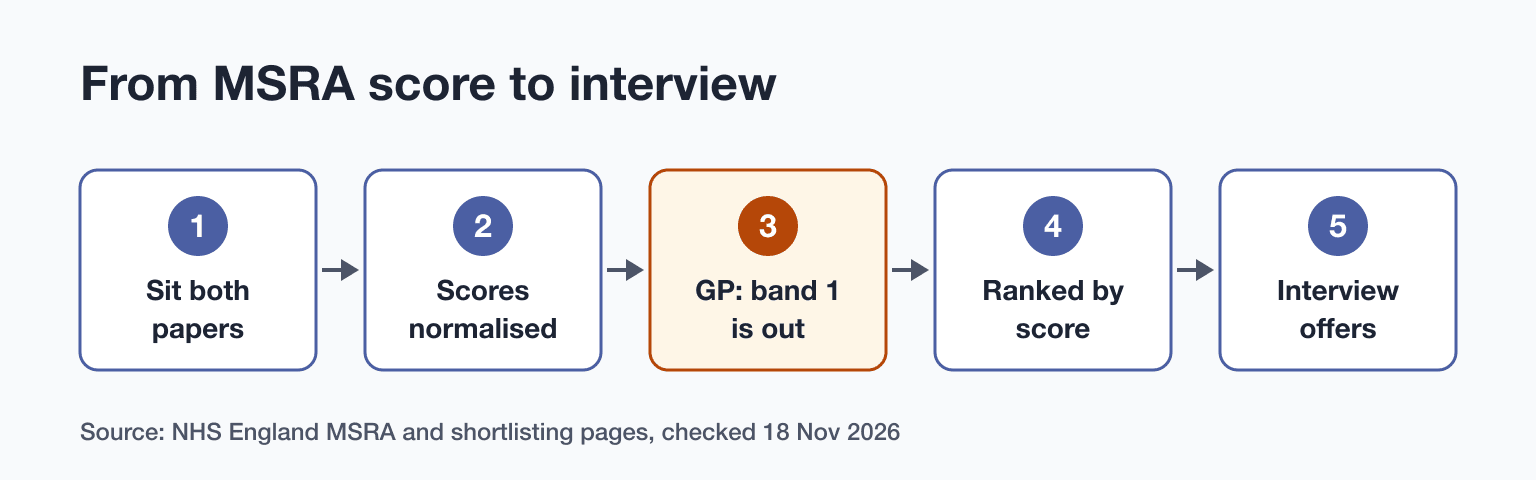
Source: NHS England MSRA and shortlisting pages, checked 18 November 2026.
You sit both papers. NHS England normalises scores. Recruiters exclude GP band 1. They rank candidates by score and offer interviews to top scorers.
How Diagnosica helps with this
Not MSRA question practice; take history from AI video patient and build a differential.
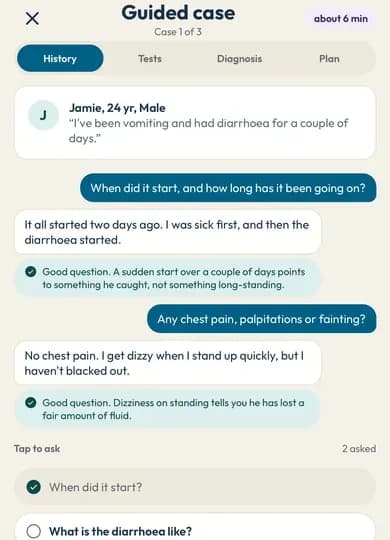
Diagnosica app, guided case history step, as of November 2026.
- Your typed questions show in a running list.
- Patient replies in full sentences.
- Short 'Good question' notes plus suggested next questions.
Simulated patient. Screenshot from Diagnosica, November 2026.
What do the two MSRA papers test?
The MSRA, checked 18 November 2026, runs for 170 minutes, two papers. You sit Professional Dilemmas (SJT), 95 minutes, then Clinical Problem Solving, 75 minutes, with an optional 5-minute break between them. Use that timing to plan practice and pacing.
Per the MSRA structure page, Professional Dilemmas is a Situational Judgement Test. CPS uses Foundation-level scenarios across 12 topic areas and five domains: investigation, diagnosis, emergency, prescribing, management. Per the Clinical Problem Solving page. For 2027 round 1, as of 18 November 2026, January open to all specialties, February reserved for Core Psychiatry and GP applicants.
Example. A simulated patient, Felix Carrow, 58, opens with "I've had this itchy rash for about seven years now and nothing's ever shifted it." He was told eczema, then about three years ago a different GP called it psoriasis. The rash sits on buttocks, hips, lower back and tops of thighs. The point: a given label is a clue to question, the same habit the Clinical Problem Solving paper's diagnosis domain asks for.
Watch out. A "pass score" you saw on a prep site or forum isn't official. Only the GP band 1 floor appears on the official pages, checked 18 November 2026.
If you're mapping revision blocks, start with planning finals revision, then sharpen pattern-spotting with clinical reasoning as an FY2.
Keep clinical reasoning warm: use Diagnosica to keep a daily case going alongside MSRA prep, not MSRA practice. Free to start, no card needed.