PSA pass mark: why no official number exists in advance
There is no PSA pass mark available in advance, because the official PSA site says the exact figure can't be published before the test. Checked November 2026. Reported papers 2016 to 2022 ran from 57% to 65.5%.
Key takeaways
- Prescribing plus review are 112 of 200 marks, so plan time there.
- Don’t borrow an old pass mark as your target; each paper gets its own.
- A pass stays valid for two years.
What is the PSA pass mark?
The Prescribing Safety Assessment has no official pass mark before the test. The official site gives two reasons adjustments may follow, different paper difficulty and issues with items found after the test. So nobody can give you your paper's figure in advance.
While you wait on a number that doesn't exist, take the two-minute quick case for a short clinical-thinking break. It's not PSA practice.
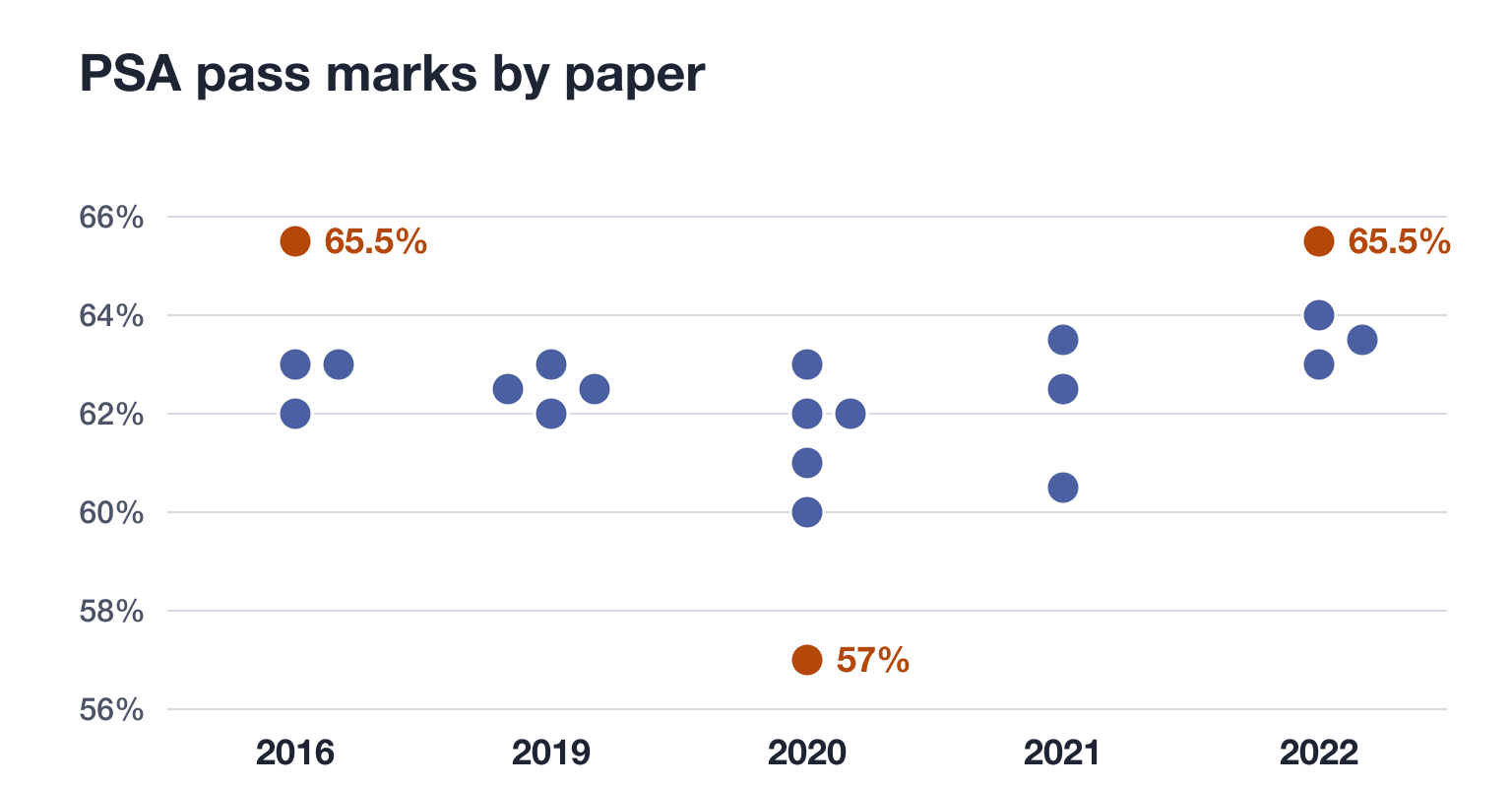
Each dot is one paper's pass mark; sources are the 2016 PSA paper and the 2022 psychometric report; 2017 and 2018 aren't shown.
Per-paper pass marks appear in the 2016 PSA paper, and the 2022 psychometric report lists 2019 to 2022:
Year | Papers | Pass marks by paper |
|---|---|---|
2016 | 4 | 62%, 65.5%, 63%, 63% |
2019 | 4 | 63%, 62%, 62.5%, 62.5% |
2020 | 6 | 61%, 57%, 60%, 62%, 62%, 63% |
2021 | 3 | 62.5%, 60.5%, 63.5% |
2022 | 4 | 65.5%, 63.5%, 63%, 64% |
On 200 marks, 57% is 114 marks and 65.5% is 131. These are the newest per-paper figures we found, so they can't tell you a later paper's mark.
Prep guides read in November 2026 state no percentage either: MedCourse's PSA guide, PassMed's guide and Geeky Medics' tips. A percentage from a forum or a search summary isn't official.
How is the PSA pass mark set?
The Prescribing Safety Assessment uses the Modified Angoff method to set its pass mark. The Standard Setting Group defines the passing standard for each question. That group brings together undergraduate assessment experts from UK medical schools and MSC Assessment Alliance representatives.
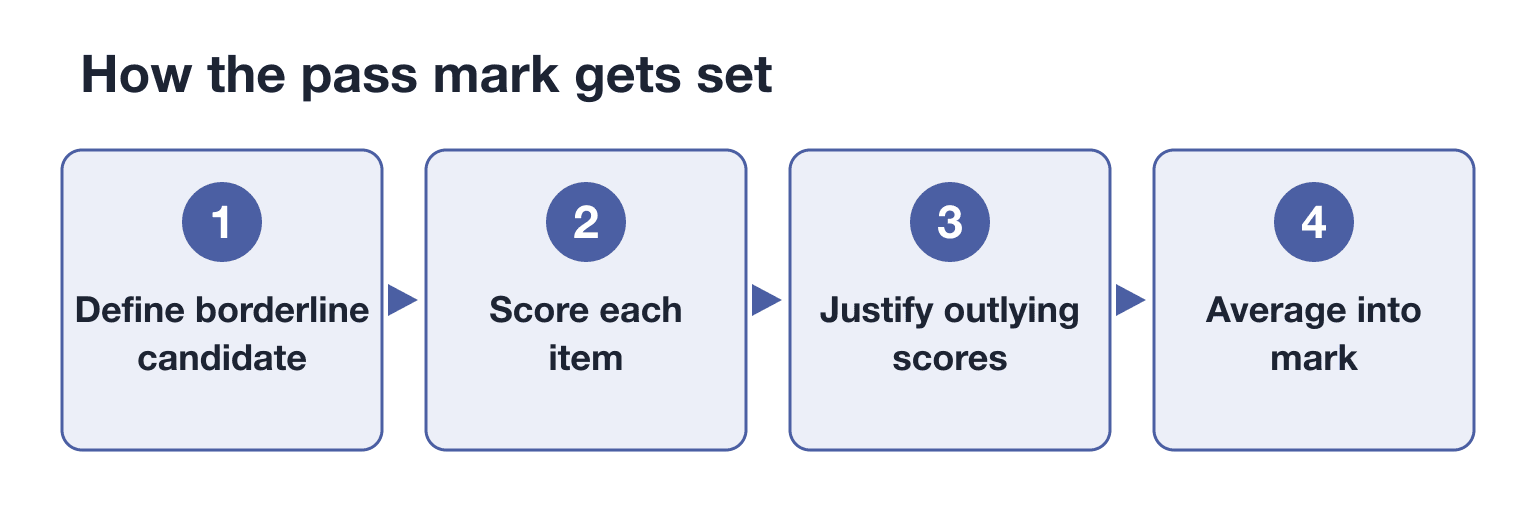
The four steps as the 2016 PSA paper describes them.
The 2016 PSA paper's account describes the steps used that year:
- Agree what defines the just passing candidate.
- Score each item individually.
- Ask members with outlying scores to justify them, then everyone reconfirms or adjusts.
- Use the mean scores for each item to calculate the paper's pass mark.
For how pass marks work in other UK exams, see Angoff in MRCS Part A and UKMLA AKT marking.
What costs marks in the PSA?
The Prescribing Safety Assessment offers 200 marks across 60 items in two hours, going by the official Blueprint and site. Prescribing and prescription review carry 112 of those marks, which makes 56% of the paper. Make your timing plan start there.
Full item-by-item weighting sits in the PSA Blueprint:
Section | Items | Marks each | Total |
|---|---|---|---|
Prescribing | 8 | 10 | 80 |
Prescription review | 8 | 4 | 32 |
Other six sections | 44 | 2 | 88 |
There's no negative marking, according to the 2016 PSA paper and Geeky Medics.
Geeky Medics' timing sum is 36 seconds per mark, so prescribing is worth about 48 minutes; time one practice paper against that. The official PSA site gives registered candidates practice papers they can repeat, with detailed feedback. You can also use the online BNF during the test.
For the wider plan, see revising for medical finals and your UKMLA revision timetable.
Example. Example. In Diagnosica, a simulated patient, Terence Ballard, 67, a retired postman, says he's had "burning pain round my left side for four days" and that blisters came up this morning. Only when asked about family does it surface that his daughter is 28 weeks pregnant, his granddaughter is 5 months old, and both plan to visit tomorrow. Detail worth finding before any plan, and it comes from talking, not a chart.
How Diagnosica helps with this
Not PSA practice: no BNF or chart prescribing, only pre-prescribing thinking with an AI patient.
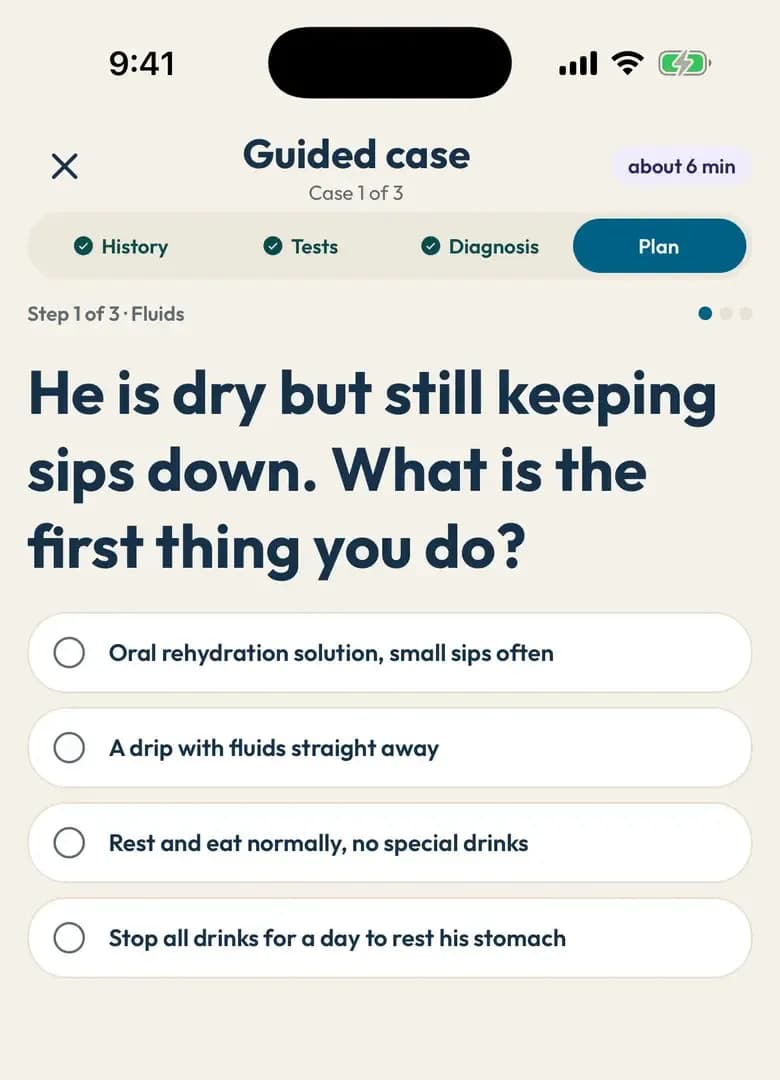
Diagnosica app, plan step, as of November 2026.
- Plan step asks what you'd do first.
- Guided cases offer four choices; full cases build your plan.
- No prescription chart, no BNF lookup, no dose to write.
Simulated patient. Screenshot from Diagnosica, November 2026.
Should you aim for a target percentage?
The Prescribing Safety Assessment has no official target to aim for, because pass marks vary by paper. In the 2022 psychometric report, first-sitting mean scores ran from 78.8% to 81.8%. Pass marks that year ran from 63% to 65.5%, so the average candidate cleared the line comfortably.
First-sitting pass rates in 2022 ran from 92.6% to 95.6% (2022 report's pass rates). MedCourse advises comfortable competence across every section instead of a target percentage. From what we can tell, 2022 is the newest year with these figures in a report we could read.
Watch out. Watch out. An old pass mark isn't your paper's mark, each paper had its own, and yours won't be published before the test.
What happens after your PSA result?
PSA results follow a set timetable on the official site: within four weeks for the first sittings of the year, and within two weeks to schools for later ones. Feedback shows your overall score against the pass mark and your score per domain, not individual questions.
A pass stays valid for two years. If it's older than that when foundation training starts, you retake it before the end of F1. The official FAQ confirms your latest attempt sets your status, so a failed repeat overwrites an earlier pass.
F1 doctors who don't pass at their foundation school's first sitting get remediation and two further chances to retake. The rest of the transition is in your first FY1 day and final-year survival tips.
Start a case and practise thinking before prescribing: free to start, no card needed. It's clinical reasoning with an AI patient, not prescribing practice.