MRCGP AKT pass mark, every sitting since the 160-question change

The MRCGP AKT pass mark was 112 out of 160 at the July 2026 sitting. Checked 18 November 2026. It moves each sitting; since the 160-question format began in October 2025 it has ranged from 107 to 112.
Key takeaways
- Any '142 of 200' refers to the retired paper.
- Since October 2025, pass marks have ranged from 107 to 112 of 160.
- Pass mark varies by difficulty, so aim well above it.
What is the MRCGP AKT pass mark?
The MRCGP AKT pass mark is the number of correct answers out of 160 needed to pass, and it changes each sitting; recent figures range from 107 to 112. The newest figure is 112 of 160 from July 2026, checked 18 November 2026, as reported in the July 2026 AKT feedback report.
Take a breather from pass mark stats and try a two-minute quick case, a short case with an AI patient.
See the table for every sitting since the 160-question change; each row comes from that sitting’s RCGP AKT feedback report and links to the PDF.
Sitting | Pass mark (of 160) | Candidates | Pass rate, all | UK graduates, first time |
|---|---|---|---|---|
October 2025 (AKT 57) | 109 | 1,583 | 70.63% | 88.84% |
January 2026 (AKT 58) | 108 | 1,597 | 76.52% | 89.2% |
April 2026 (AKT 59) | 107 | 1,795 | 80.22% | 88.68% |
July 2026 (AKT 60) | 112 | 1,308 | 73.17% | 86.15% |
Sources: RCGP AKT feedback reports for October 2025, January 2026, April 2026 and July 2026, checked 18 November 2026.
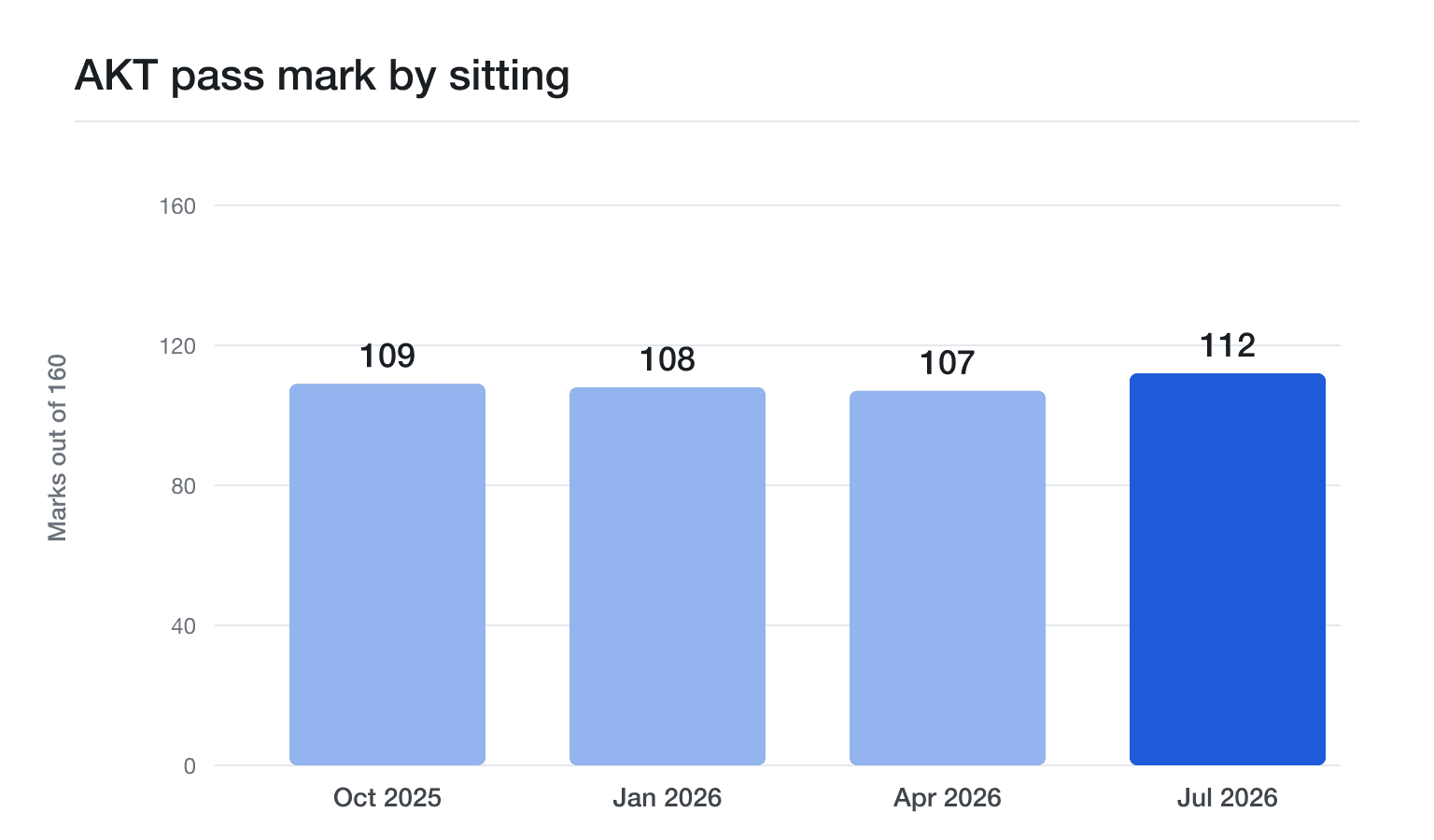
Pass marks source: RCGP AKT feedback reports, October 2025 to July 2026.
Our arithmetic: as percentages of 160, 107 is 66.9% and 112 is 70.0%.
The medical school UKMLA AKT is a different exam with its own pass mark, explained in the UKMLA AKT score.
Why some pages still say 142 out of 200
Some prep pages still quote 142 of 200, about 71%. Those figures come from the old 200-question paper. The RCGP cut the AKT to 160 questions from October 2025, so a mark out of 200 doesn't compare with today's format.
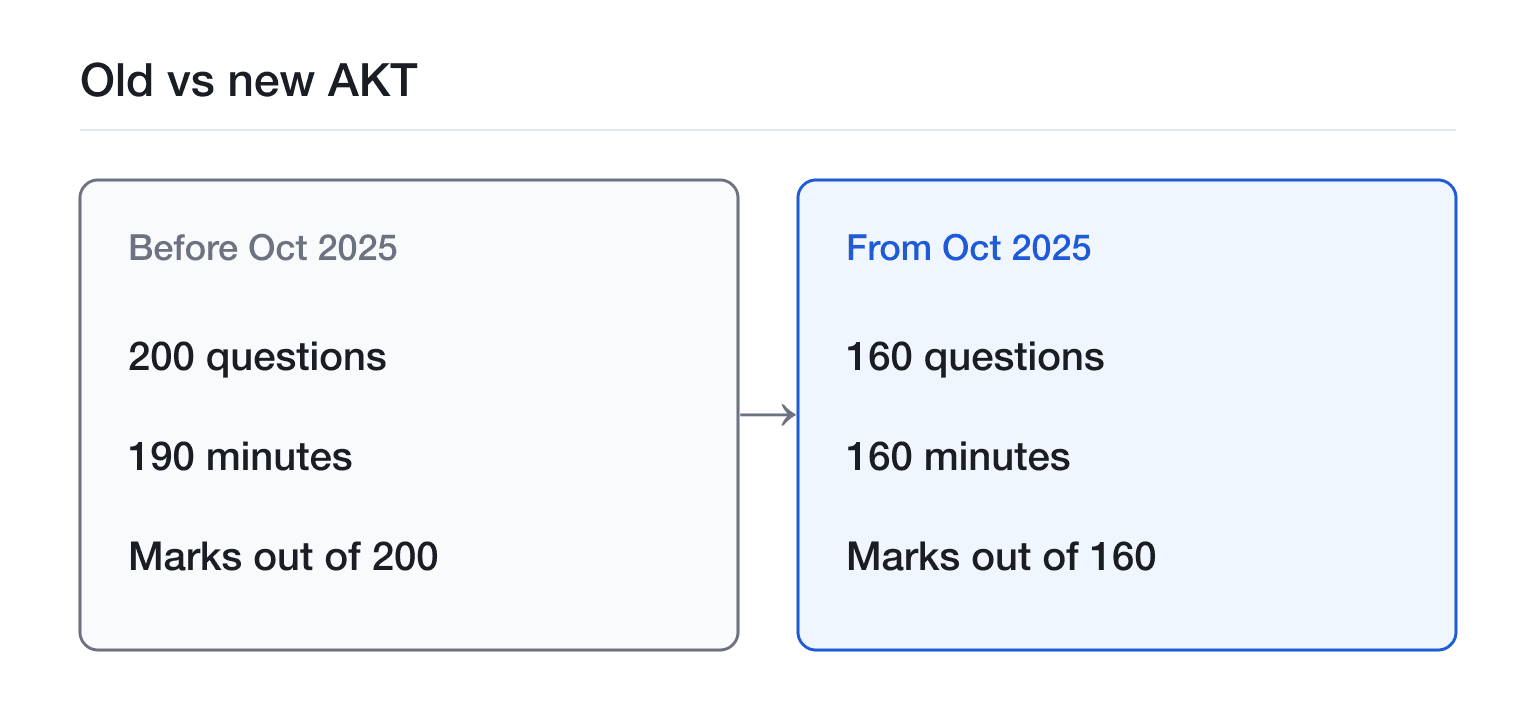
Marks out of 200 and out of 160 aren't directly comparable, source: RCGP AKT introduction page.
Before October 2025, the AKT had 200 single best answer questions in 3 hours 10 minutes. From October 2025, it's 160 in 2 hours 40 minutes, per the RCGP's AKT introduction.
The last four 200-question sittings had pass marks of 145 (October 2024), 139 (January 2025), 144 (April 2025) and 138 (July 2025), out of 200. As percentages, 69% to 72.5%. Newer 160-question marks sit at 66.9% to 70.0%, on April 2026 (107) and July 2026 (112).
Watch out. Don't aim at a single remembered number; a score of one mark below the pass mark is a fail, there's no negative marking, and an unanswered question earns nothing.
How is the AKT pass mark set?
The MRCGP AKT pass mark is set with the modified Angoff method, then maintained across papers using item response theory equating. It moves with paper difficulty, not cohort size, so an easier paper yields a higher cut score and a harder one a lower.
- Modified Angoff A panel of GP trainers, examiners and new GPs judges each question for just-passing candidates.
- IRT equating Item response theory carries the set standard across every new paper.
- Difficulty adjustment The pass mark rises for easier papers and falls for harder ones.
- No quotas There is no fixed pass rate, it's criterion referenced not norm referenced.
See RCGP's standard setting FAQs for method and maintenance. The AKT general FAQs explain withdrawals where the score is scaled out of 159 without changing the standard.
See PSA marking explained and MRCP pass marks compared; other UK exams set marks per paper too.
Example. Simulated patient Nigel Braithwaite, 64, reports intermittent fevers for three months, drenching night sweats, and about 9 kg unintentional weight loss. He’s a former smoker, twenty a day for thirty years, stopped five years ago. The key detail appears only if asked: one painless episode of pink urine four months ago. A written stem often hands you that, but in a consultation you must ask.
How Diagnosica helps with this
Take a spoken or typed history from an AI patient, not AKT question practice.
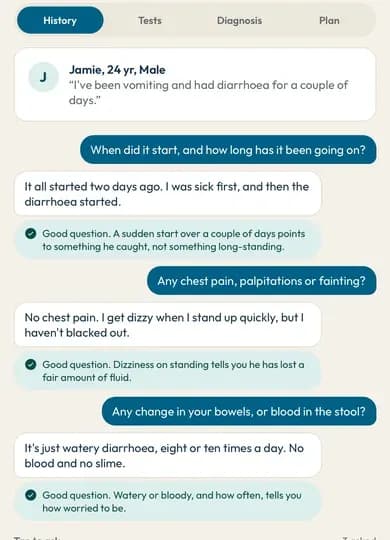
Diagnosica app, guided case history step, as of November 2026.
- You pick or type questions for the patient.
- Each good question gets a one line reason it mattered.
- Full cases let you ask anything by voice or typing.
Simulated patient. Screenshot from Diagnosica, November 2026.
What do the pass rates tell you?
Across the four 160-question sittings, the picture is steady: overall pass rates ran from 70.63% to 80.22% (October 2025 to April 2026). UK graduate first-time takers ran from 86.15% to 89.2% (July 2026 to January 2026). Sources: the four RCGP reports; newest figure checked 18 November 2026.
In July 2026 the mean score was 120.15 marks (75.1%), 8 above a pass mark of 112 (our arithmetic), and the standard error was 5.03 marks, per the July 2026 report, checked 18 November 2026. Scores within 5 marks of the line are hard to separate, as we read it.
If you are years away, read this as breadth. Build wide clinical knowledge for UK general practice, since 80% of AKT questions are clinical knowledge, per the RCGP introduction page.
Where these figures come from
Every pass mark here comes from the RCGP's own AKT feedback reports, listed on the RCGP AKT support page, checked 18 November 2026; the newest is the July 2026 report; no October 2026 report was listed on that date.
Two fair checks elsewhere: Medexia's AKT pass rate page, dated 23 October 2026, lists all four 160-question sittings with RCGP links. iatroX keeps a longer per-sitting history from 2021, which helps spot drift over time.
For more exam data and planning: read SCA results by sitting, check the MSRA pass mark, and pick up tips for GP placements or a sane medical finals revision plan.
Or practise a full consultation with an AI patient on Diagnosica, free to start, no card needed.