What is the UKMLA?
The UKMLA is the Medical Licensing Assessment: an applied knowledge test (AKT) and a clinical and professional skills assessment (CPSA). UK medical students must pass it as part of their degree before joining the medical register.
Key takeaways
- Two parts: AKT via Medical Schools Council, CPSA set and run by your school.
- Read the GMC content map, then check your school's assessment dates.
- Fail the UKMLA and you will not graduate, per the GMC.
Since the CPSA is about doing rather than knowing, you could try one history station with an AI patient.
What the UKMLA is in plain words
The UKMLA tests the core knowledge, skills and behaviours of doctors who want to practise in the UK. UK medical students pass it as part of their degree before they can join the medical register.
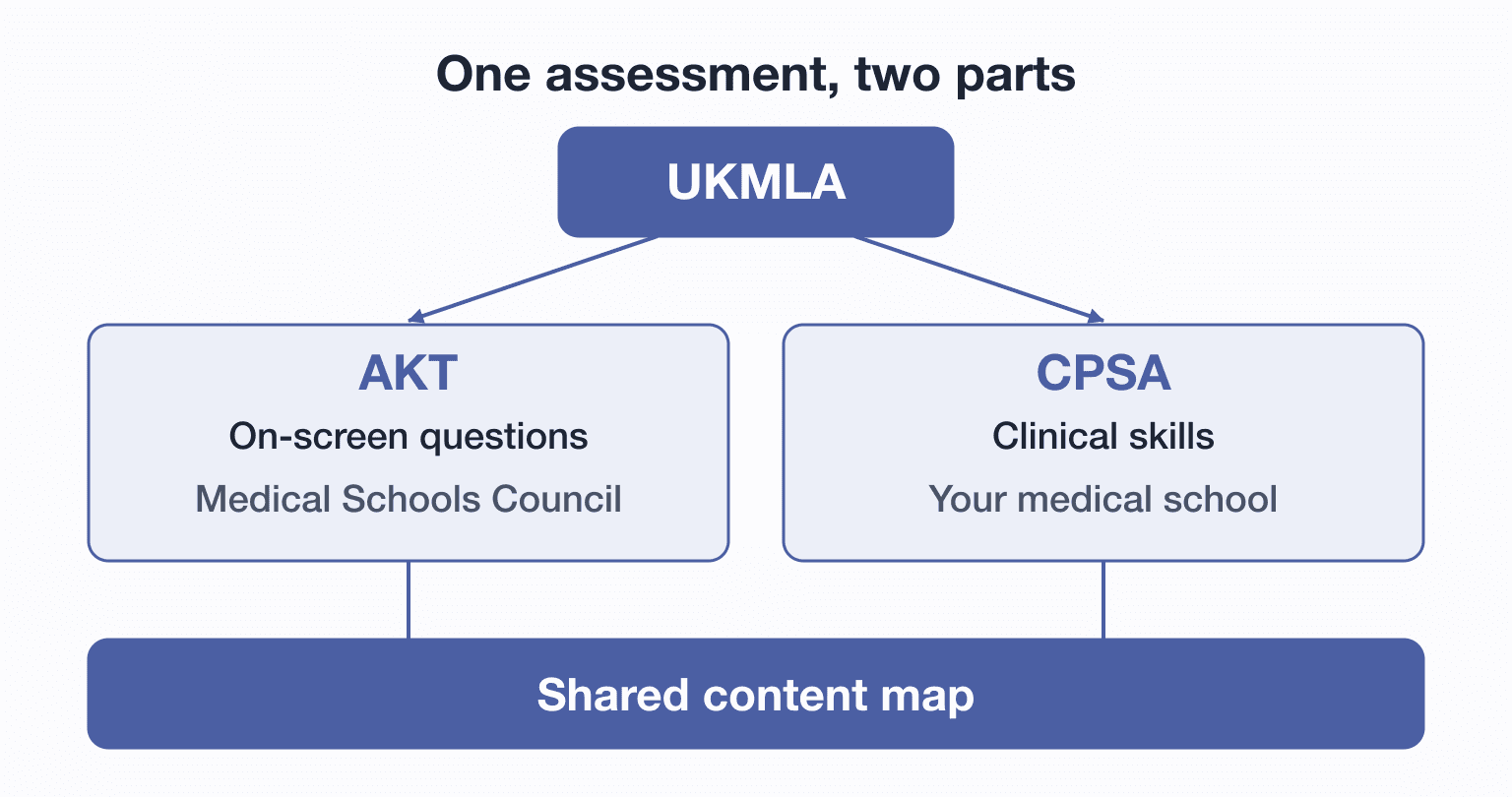
Based on GMC pages, checked November 2026.
The UKMLA has two parts, the AKT and the CPSA, and both draw on the same GMC content map.
On official pages, the GMC calls it the MLA, so use that term when you search or browse their site.
Two groups come under the UKMLA. UK medical students pass it as part of their degree before joining the register. International doctors take PLAB instead, a test that meets MLA requirements. Both work from the same MLA content map, built on three themes: readiness for safe practice, managing uncertainty and delivering person-centred care.
The parts at a glance
The UKMLA has two parts. The Applied Knowledge Test (AKT) is an on-screen multiple choice paper. The Clinical and Professional Skills Assessment (CPSA) is a performance test run by your medical school.
Part | What it is | Who sets it | Read more |
|---|---|---|---|
AKT | On-screen exam with multiple choice questions | Medical schools, through the Medical Schools Council | |
CPSA | Performance-based test of clinical and professional skills | Your own medical school |
The GMC sets the requirements and quality assures both parts. The GMC regulates the AKT against its published requirements and quality assures every school's CPSA. See details on the GMC's AKT page and its CPSA page.
Each school calls its CPSA something different, for example an OSCE or an OSLER. The finals OSCE on your timetable may well be your CPSA. See what happens in an OSCE.
How the UKMLA works, step by step
The UKMLA runs through your medical school, and dates and results go through your school. Your school sets dates for both parts and runs them locally. Results for both parts come from your school.
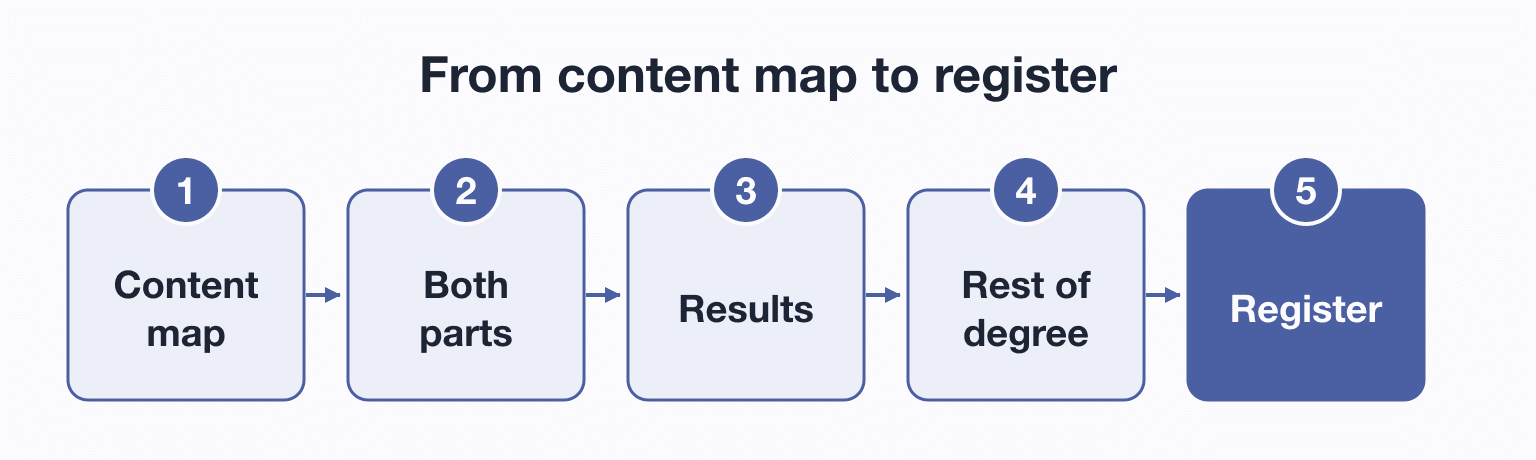
Based on the GMC's student guide, checked November 2026. Your school sets the dates.
If you need the practical order for the UK route, it goes like this:
- Read the content map, which is based on Outcomes for graduates.
- Sit both parts at your own medical school, on dates it chooses.
- Get results for both parts from your medical school.
- Meet the rest of your school's degree requirements.
- Graduate and join the medical register.
These steps follow the GMC's guide, Taking the MLA, which leaves the dates to each school.
Example. Clinical and professional skills can sound abstract, so picture taking a history from a simulated patient. Adam Price, 19, is a simulated patient in Diagnosica. He reports about three weeks of sore throat. He then mentions a rash that appeared three days after starting antibiotics. He doesn't mention the ache under his left ribs, or the rugby match this weekend, until you ask directly.
How Diagnosica helps with this
You talk to an AI patient on video, then get a scorecard.
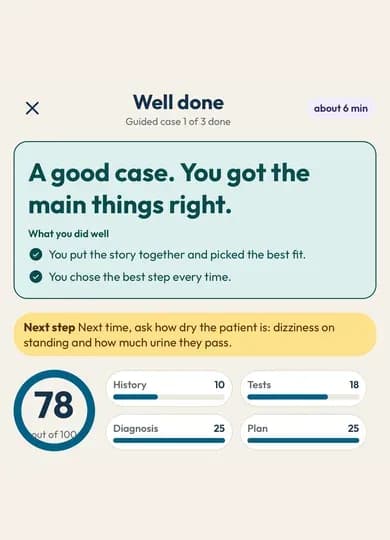
Diagnosica app, guided case result, as of October 2026.
- The headline says what you did well first.
- The next step names one thing to try.
- Four bars show history, tests, diagnosis and plan.
Simulated patient. Screenshot from Diagnosica, October 2026.
Mistakes and myths about the UKMLA
The UKMLA doesn't come with one national CPSA; each school runs its own assessment. The GMC also says UK students won't pay it anything extra, and won't need to study beyond their curriculum.
Keep these straight:
Myth | What the GMC says |
|---|---|
One national CPSA | Each medical school sets and runs its own CPSA. |
A GMC fee | UK students pay the GMC nothing extra, universities cover costs. |
An extra syllabus | Your degree curriculum is the preparation; nothing beyond it is required. |
Free resits everywhere | Some medical schools charge resit fees. |
For the exact fee and resit wording, see the GMC's costs page.
Watch out. Fail the UKMLA and you won't graduate; passing it alone doesn't cover your other degree requirements. Mitigation, adjustments and appeals sit with your university. More on failing a finals OSCE.
What is the difference between the UKMLA and PLAB?
UKMLA and PLAB serve different candidates. UK medical students sit the UKMLA within their degree, while international doctors who need the test take PLAB. The UKMLA and PLAB are built against the GMC’s Medical Licensing Assessment framework. PLAB meets the same MLA requirements and uses the same content map.
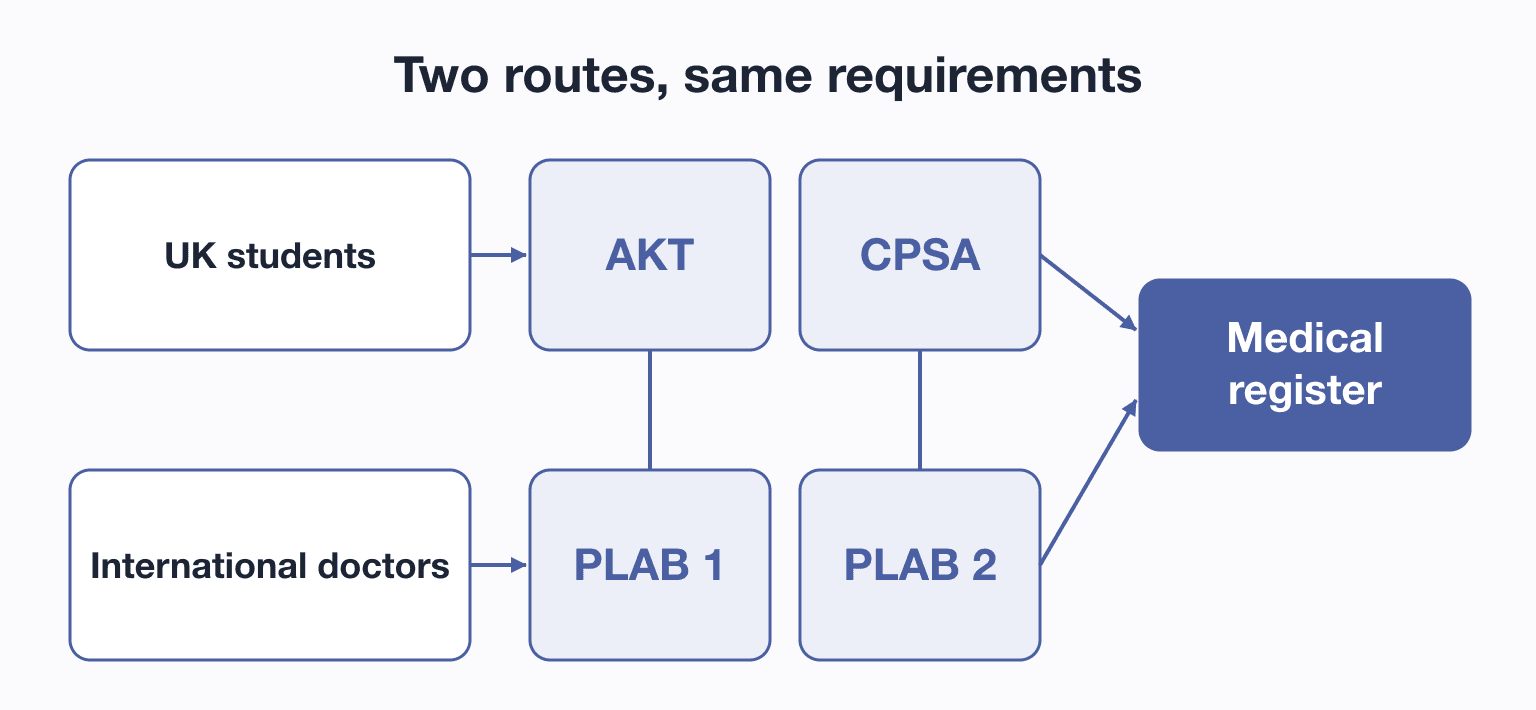
UK and PLAB routes at a glance. Based on the GMC's PLAB and the MLA page, checked November 2026.
PLAB 1 and PLAB 2 meet MLA requirements for international doctors, while UK students take AKT and CPSA at their school.
PLAB 1 meets the AKT requirements, and PLAB 2 meets the CPSA requirements. The GMC says those requirements concern how the test is built and delivered, not individual candidates. See PLAB and the MLA. PLAB keeps its name for now.
Eligibility for PLAB hasn't changed, and some doctors with relevant European qualifications need not take it. International doctors also have other routes, including sponsorship, acceptable postgraduate qualifications, specialist registration and GP registration. For more context, see PLAB 2 pass rates.
Where to go next
Start here with the content map. Then check your school. The GMC says your school will tell you practical arrangements as you approach finals. Your degree course remains the core preparation.
Use revising for medical finals and a full UKMLA revision plan to pace coverage. Then say your history questions aloud. Do not run them in your head alone.
Diagnosica has no physical examination, so CPSA examination stations can't be practised in it. You can practise taking a history from an AI patient: practise a station, free to start, no card needed.