Psychiatry rotation tips: the psych interview, day one

Psychiatry rotation tips: run a steady psych interview, finish with a structured mental status exam, and ask directly about past low mood and risk. The NBME psychiatry outline puts Behavioral Health at 65%-70% of the shelf.
If someone is at risk now: call or text 988 in the US via the 988 Suicide & Crisis Lifeline, available 24/7/365, free and confidential; call 911 if there's immediate danger; this post is training practice for your rotation.
Key takeaways
- Before you start: read the notes, and check with staff before each interview.
- Past low mood: always ask, it can change the diagnosis.
- Ask about risk: then tell your resident the same hour.
Before you walk in: three checks
Before you start the psych interview, do three things: check with staff, read the notes, and know who is nearby. It keeps you oriented, prevents surprises, and sets up a safer first minute for you and the patient.
Per RANZCP's rotation advice, check with staff before you see a patient, review the patient information before you talk with them so you ask the most appropriate questions and can verify what staff told you, and work in pairs when staff say so.
You can practice a psych interview on a simulated AI patient before your first real one, the patient appears as a video avatar, and you take the history by voice or text. For year-wide habits that steady the rest of your rotation, see the full clerkship-year guide and the UK new-doctor guide.
The psych interview, in seven steps
The psychiatric interview runs in a fixed order, and key questions that change the diagnosis surface only when asked directly. These psychiatry rotation tips keep you on track and make escalation easier when risk appears.
Do it in this order:
- Open with what brought them in, using their words first.
- Build a timeline of the current episode, covering sleep, energy, speech, and spending, anchored to dates and triggers.
- Ask about past episodes, especially any prior low mood or loss of function.
- Ask about any new medicine and dose changes, plus drugs and alcohol.
- Ask about family history of mental illness, diagnoses, treatment, and age at onset.
- Ask about risk to self and others directly, including driving, sex, money, and self-harm; use short closed questions.
- Get collateral from family with consent and supervision from your team, following taking a collateral history.
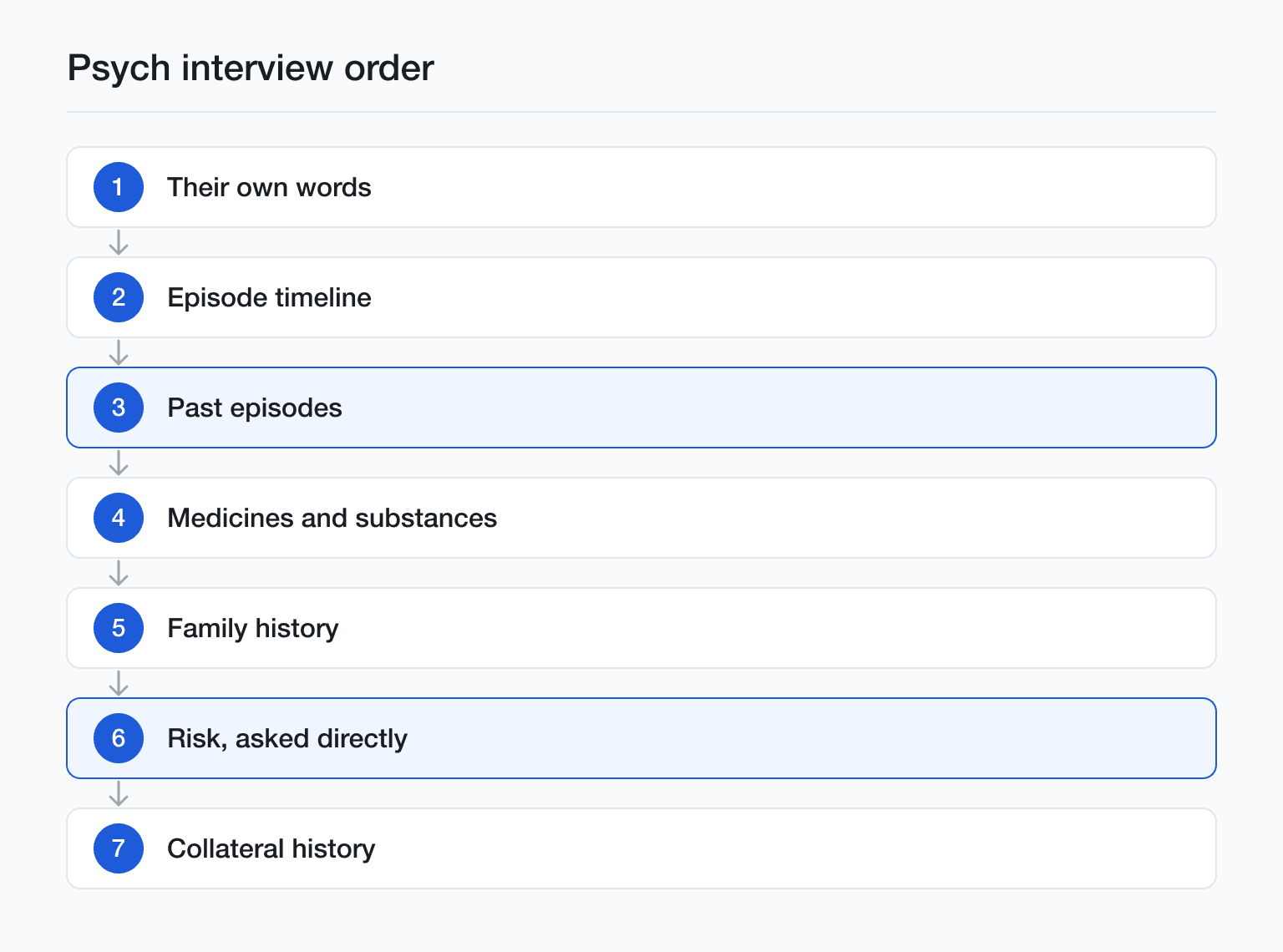
Seven steps, one order you can use under pressure. Open, timeline, past, medicines and substances, family, risk, collateral.
In a manic patient, the case file strongly rewards short, calm, closed questions, one topic at a time.
Worked example: Kieran, 28, ten days without sleep
Kieran is a simulated AI patient from Diagnosica's case library; his family brought him in after ten days of barely sleeping. He opens with, "I'm absolutely fine, it's my brother," then resists illness labels.
Kieran, 28 (simulated): what he said, and what we had to ask
Chip | Question | Answer | Why it mattered |
|---|---|---|---|
Volunteered | How much have you slept? | Two to three hours nightly for ten days, not tired. | reduced need for sleep is the core manic symptom |
Volunteered | Any big purchases? | Paid a car deposit, moved savings into a new business. | reckless spending shows the impairment that separates mania from hypomania |
Only if asked specifically | Ever a long depressed period? | Two months barely out of bed; two years ago. | a prior depressive episode makes this bipolar I disorder |
Only if asked specifically | Any new medicine, and when? | Started six weeks ago, raised three weeks ago, change two weeks later. | a new antidepressant's timing matters, ask about every dose change |
Only if asked specifically | Any risky driving? | Drove fast, ran two red lights, brother took keys after near-miss. | driving risk, tell your team |
11 of the case file's 20 history facts come out only on a specific probe.
Simulated patient. Case file bipolar-i-disorder-28m. Questions written by us as a model, not a learner session.
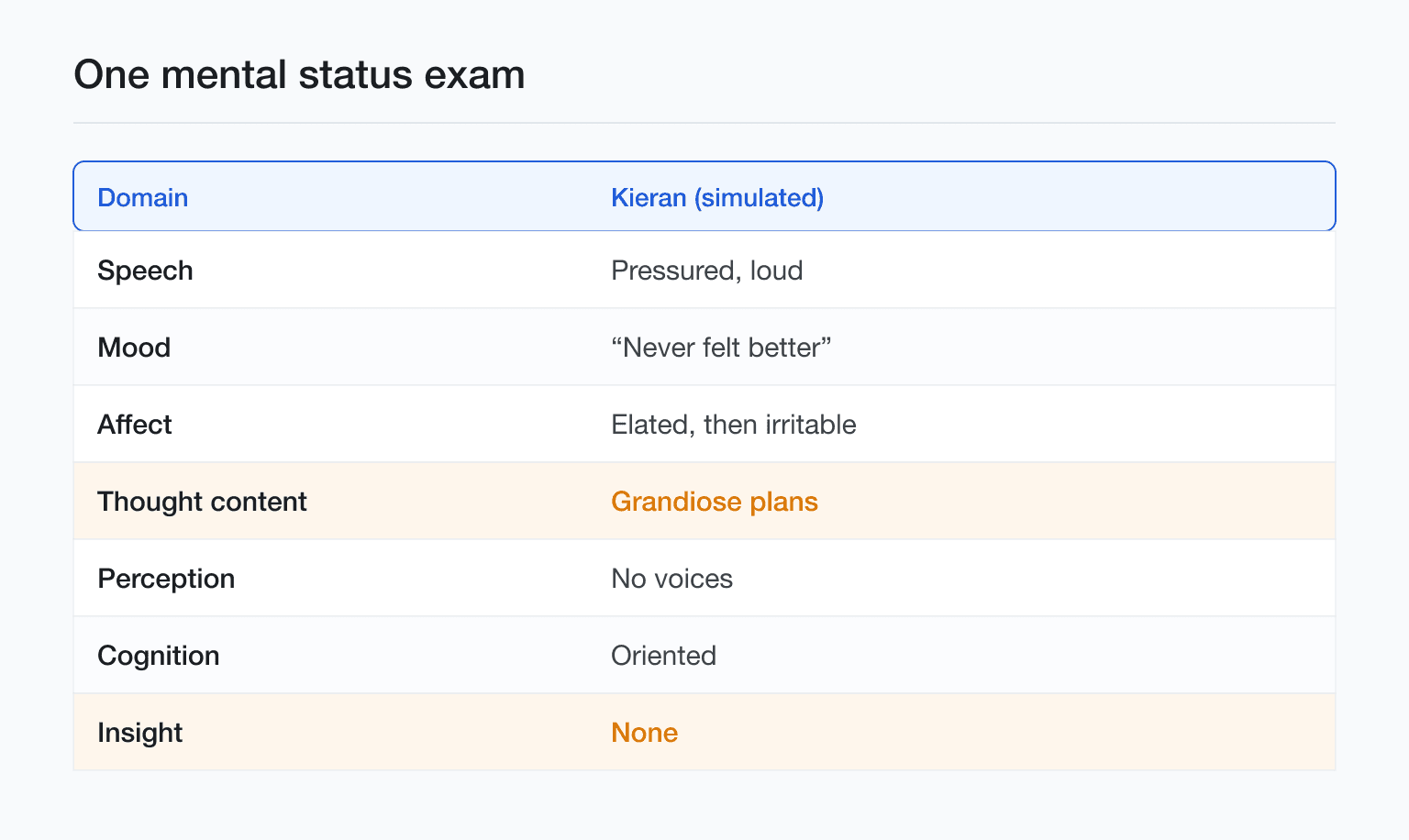
Kieran’s simulated MSE captured by domain, including pressured speech, elated and irritable affect, grandiose thoughts, no hallucinations, oriented, and absent insight.
Document the MSE in the fixed ADMSEP order using ADMSEP's mental status definitions. Mood is quoted verbatim, in his words; affect is your observed description.
Ask about risk directly, then tell your team
Psychiatry rotation tips on risk: ask about self-harm and suicide in plain words, then tell your resident or attending straight away if anything worries you. You're not the one who decides.
UK NICE guideline NG225 says don't use risk assessment tools or scales to predict suicide or repetition of self-harm. It also advises against low, medium or high labels for prediction. This is a UK guideline, and your program’s own policy applies in the US.
In the simulated case, Kieran Garrick, 28, denies self-harm thoughts and says nothing bad could happen. Yet risk sits in sex, driving and money. He reports several new partners without condoms, ran two red lights and his brother took his keys, shifted savings and a car deposit he can’t afford, and says he’ll walk out.
Watch out. A patient denying suicidal thoughts isn't the end of the risk conversation; tell your team what you heard, word for word.
How Diagnosica helps with this
Practice psych interviews by voice or text with simulated Kieran Garrick, then see gaps.
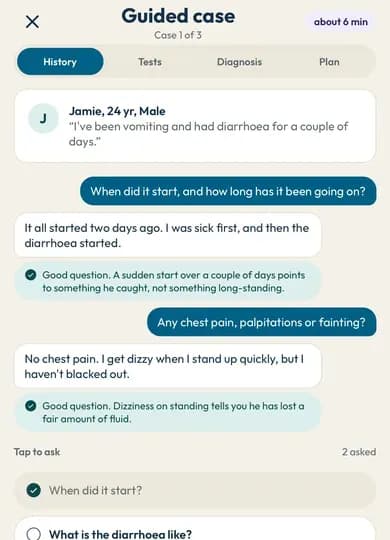
Diagnosica app, history chat, as of November 2026.
- You ask, patient answers in character.
- Eleven facts surface only when you ask specifically.
- The scorecard shows what you missed.
Simulated patient. Screenshot from Diagnosica, November 2026.
Mistakes the case file costs you points for
The simulated Kieran Garrick case grades your interview immediately, and its communication score out of 25 flags common manic interview errors: debating grandiosity, skipping collateral, missing past lows, avoiding sensitive risks, and overlooking initial medical screens:
- Debate or collude: Arguing or colluding with grandiose beliefs costs you many points (-10).
- Skip collateral: Taking no family collateral history is a marked interviewing error (-10).
- Ignore past lows: Not asking about prior depressive episodes loses key credit (-10).
- Avoid sensitive risks: Skipping sex, driving, and money questions for awkwardness still deducts (-5).
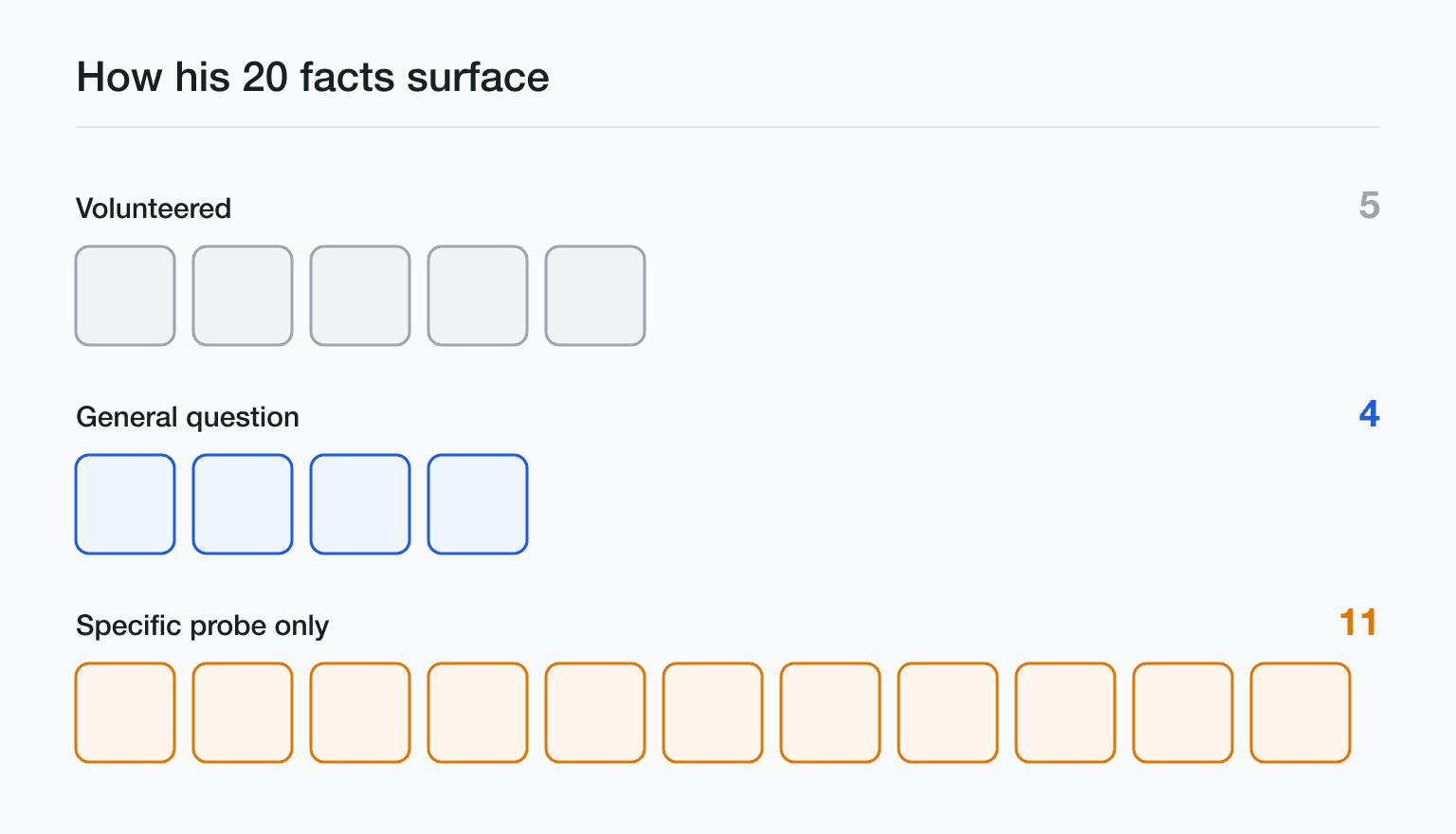
In this simulated case, there are 20 history facts: 5 volunteered, 4 from a general question, and 11 only with a specific probe.
The biggest single deduction, 15 points, is missing an organic cause on a first episode of mania, meaning no urine drug screen and no thyroid testing. MSD Manual says screen TSH for hyperthyroidism and exclude stimulants clinically or by toxicology.
If you're collecting psychiatry rotation tips, interviewing a low-mood patient covers the quiet patient; this one talks over you.
Practice it, then study for the shelf
Practice the interview. The psychiatry shelf is mostly diagnosis, so diagnosis-heavy weighting means your interview habits double as exam prep. Structure the HPI, nail timelines, ask risk directly, and you’re studying while you’re on the rotation.
Per NBME's psychiatry content outline, Diagnosis is 65%-70% and management 30%-35%. Settings skew to Emergency Department 20%-30% and Inpatient 5%-10%.
Learn durations as pairs: a manic episode is 1 week or more, or less if hospitalization needed, with 3 or more symptoms, or 4 if mood is only irritable, per the manic episode criteria. Hypomania lasts 4 days or more, without psychotic features, marked impairment, or hospitalization.
For more, see the surgery rotation guide and the pediatrics rotation guide, then run a full case on the simulated manic patient and see what your scorecard says you missed.