Pediatrics rotation tips: the parent is your historian

The best pediatrics rotation tip is to treat the parent as your historian, then probe for what they won't offer unprompted. In one Diagnosica case file, 7 of 11 must-elicit facts surfaced only with specific questions.
If a real child is unwell now, call 911 immediately, per 911.gov, or your local emergency number. This page is study practice for students, not care for real patients.
Key takeaways
- Rowan, 6 weeks (simulated): 8 facts surfaced only with specific questions, Diagnosica case file count.
- Use a fixed birth and family history checklist, per Med School Insiders and case-file pitfalls.
- Start shelf topics in week one: immunization schedule and developmental milestones, per Sketchy.
Why the parent is your historian on pediatrics
For pediatrics rotation tips, you work more closely with families than on internal medicine, and you have two patients. The parent gives the complaint, so treat parent-led history as structured collateral you document carefully.
Per the AAP's clerkship advice, clerkships vary; expect inpatient and outpatient time, and on wards you work more closely with families than on internal medicine. Med School Insiders says you have two patients, the child and the parents, and the parents usually give the complaint.
With infants, the parent is the whole history, shaped by what they noticed and were told. Rowan, 6 weeks (simulated), has his father as historian, and prior encounters color the story. Frame it as collateral history: see taking a collateral history. Practice with a simulated case, free: take a history from a parent.
A parent-history script for your first patient
Use a repeatable six-step script to get reliable facts, surface hidden concerns, and stay consistent.
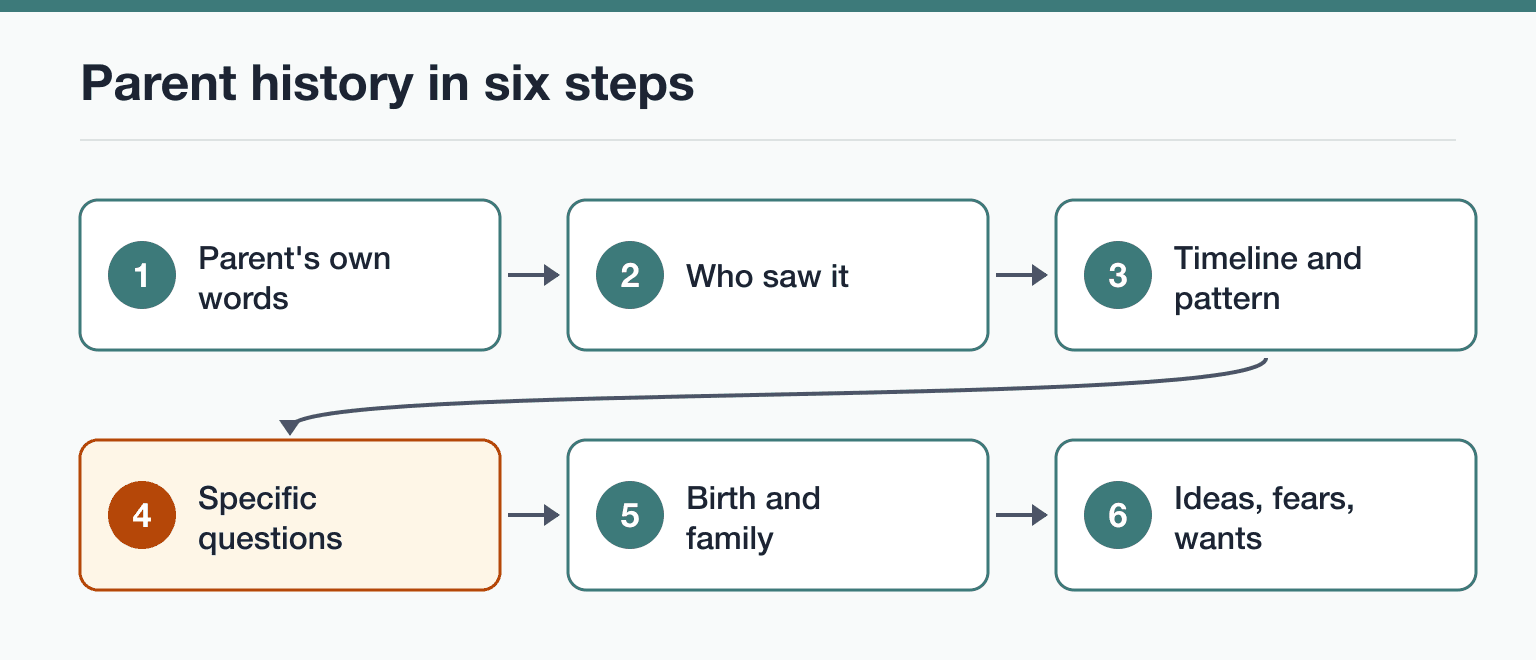
Use this six-step flow to structure a parent historian interview without missing key details.
Use this on day one; it belongs in your pediatrics rotation tips toolkit:
- Open with the parent's own words, then pause until they finish without interruption.
- Ask who is speaking and how they know, including whether they saw the event themselves.
- Pin the timeline and pattern, including onset, frequency, duration, and any triggers or relieving factors.
- Ask the specifics parents rarely volunteer: feeding, wet diapers, color of vomit or stool, and energy between episodes.
- Take birth and pregnancy history, including maternal G/P, delivery type, and monitoring, plus family history Med School Insiders' clerkship guide.
- Ask what the parent thinks is going on, what they fear, and what they want today.
The same ideas, concerns, and expectations questions work in clinic too, as covered in the family medicine rotation.
Worked case: a father, a 6-week-old, and two weeks of vomiting
In one simulated library case, the father volunteers what worries him most, and most discriminating details only emerge when asked.
Rowan, 6 weeks (simulated), a first-born boy. His father is the historian and opens, "He's been sick after every feed for about two weeks." They were sent away twice, and he's frightened and angry.
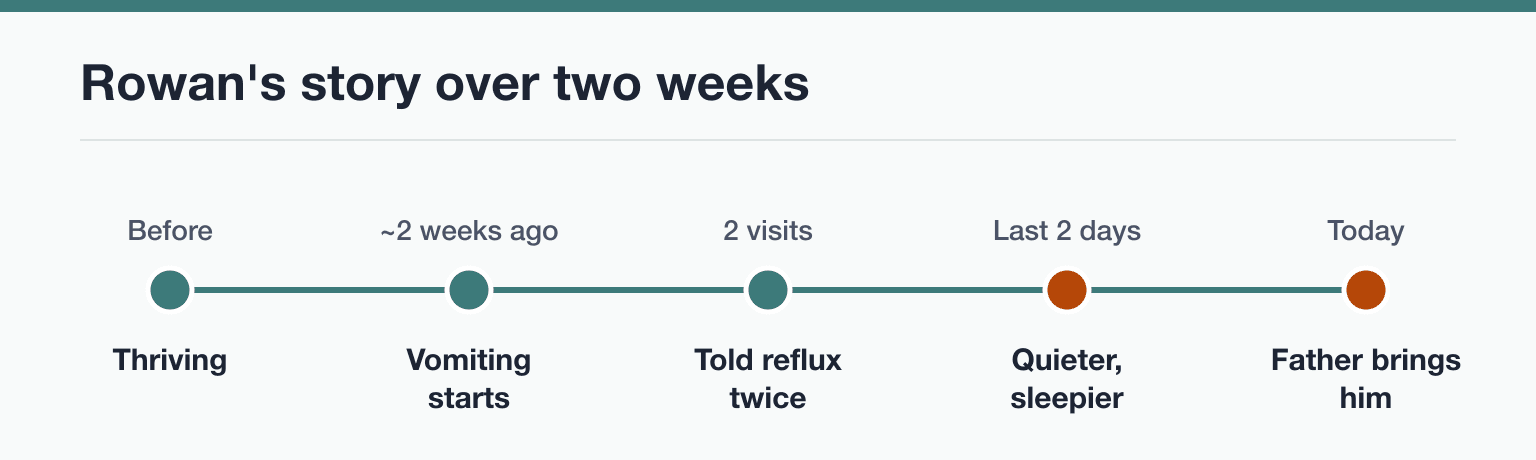
Simulated thriving infant, vomiting about two weeks, told reflux twice, quieter and sleepier two days, father presents today.
He was thriving, then about two weeks ago vomiting started and two visits labeled it reflux; in the last two days he became quieter and sleepier, and today his father brought him in.
Rowan, 6 weeks (simulated): what his father said, and what had to be asked
Chip | Question | Answer | Why it mattered |
|---|---|---|---|
Volunteered | What brought you in today? | He's losing weight. His clothes are loose and you can see his ribs. | Weight loss at six weeks turns a soft story into hard evidence. |
Asked | How soon after a feed does he vomit? | Within about 20 minutes, almost every feed. | Timing and frequency show a near-every-feed pattern, not occasional episodes, guiding next questions. |
Only if asked specifically | Has the vomit ever looked green? | No, it's milk. Never green. | Vomit color is must elicit; negative counts only if asked. Father said milk, never green. |
Only if asked specifically | What is he like right after he vomits? | Straight after, he's ravenously hungry and feeds eagerly again. | Only emerges if asked, nudging you to question the reflux label. |
Only if asked specifically | How many wet diapers has he had each day? | About three wet diapers a day instead of six or seven. | Fewer wet diapers put a number on dehydration. |
Only if asked specifically | Any family history of stomach problems or surgeries as babies? | I had stomach surgery as a baby for constant vomiting. I never mentioned it. | Family history is rarely volunteered, and skipping it is a pitfall. |
7 of 11 must-elicit items only surfaced on specific questions; next step, weigh the baby.
Simulated patient. Case file pyloric-stenosis-6w. Questions written by us as a model, not a learner session.
Parents don't know what matters, so ask
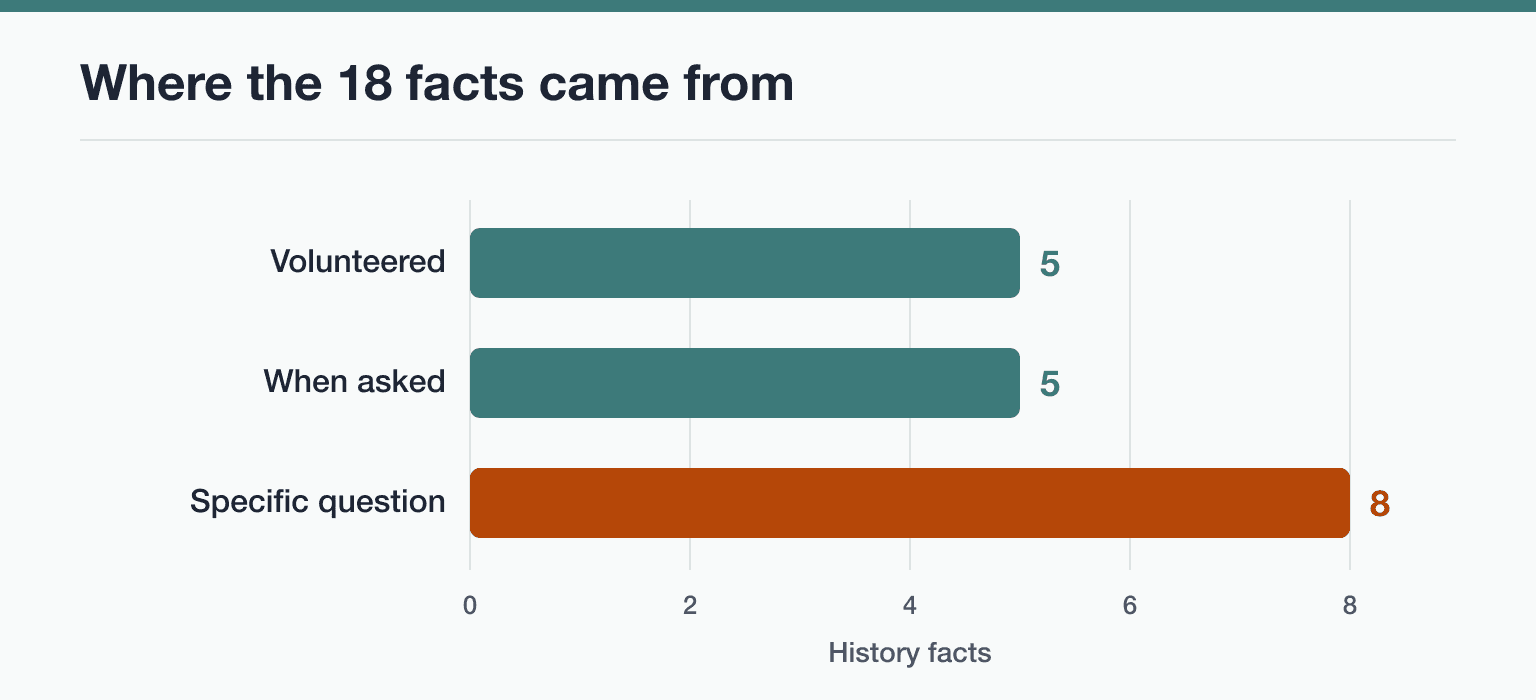
Single simulated case, Rowan age 6 weeks, our count from the case file of history sources.
Seven of 11 must-elicit facts only surface when you ask directly. The parent isn't hiding anything. They don't know which details matter, so ask specific questions.
Guard against the case file's teaching pitfalls. Don't accept a 'reflux' label if treatment failed; that failure is evidence against it. Weigh the baby, every time. Ask about family history; it's rarely volunteered. Put never green on your list of negatives that steer the differential.
How Diagnosica helps with this
Talk to a simulated parent by voice or text, your questions decide what you learn.
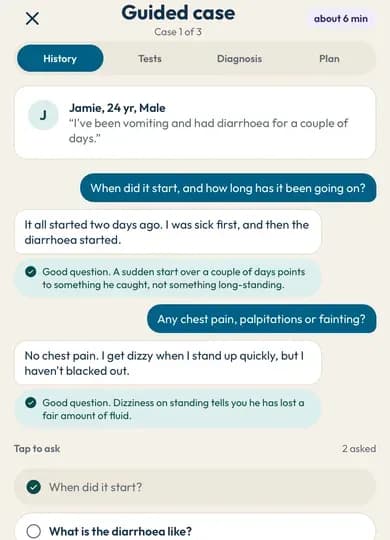
Diagnosica app, history screen in a simulated practice case, as of October 2026.
- Your question appears on the right.
- The patient's answer appears on the left.
- A short note says why that question was worth asking.
Simulated patient. Screenshot from Diagnosica, October 2026.
Mistakes that cost you on a pediatrics rotation
These pediatrics rotation tips start with what not to do: talking only to parents, arriving without a differential, accepting failed reflux diagnoses, and sidelining family supports. Fix them with tighter structure, better questions, and clear roles for everyone.
On inpatient pediatrics, you work more closely with families than on medicine, per the AAP, so watch for these patterns and correct them before they snowball:
Mistake | Fix |
|---|---|
Only parent talking | Tailor to developmental age; adolescents need time alone, per Sketchy guidance. |
No differential first | Take 5 minutes for differential, per Sketchy's pediatrics rotation advice (as of November 2026), before history. |
Label equals diagnosis | Re-examine labels when treatment fails and vomiting is forceful, per case teaching. |
Forgetting the family | Use Child Life and treatment rooms; partner closely with families, per AAP. |
Watch out. Weight, wet diapers, and energy level are facts, not impressions. Ask and present them on rounds. See presenting the infant on rounds. Skipping the weight here is a common miss in the case file.
Shelf and reading: keep it small and early
Keep pediatrics rotation tips small and early. Make a tight daily habit: review shelf must-knows first and skim what you saw today. Aim for steady reps, not marathons. Schools differ, but this mix of sources and timing tends to stick.
Sketchy, as of November 2026, lists the immunization schedule and developmental milestones by age among high-yield shelf topics, and says start in week one. Med School Insiders suggests 1 to 2 UWorld blocks each week. Keep extra reading anchored to patients you saw that day, and see the broader MS3 playbook.
For well-child visits, the Bright Futures guidelines provide a common framework from birth to age 21, per the AAP. Next in this series: psychiatry rotation tips.
Practice the parent history before day one
Run the six-step script on a simulated case, then compare what you asked with what the case says you had to ask; no physical examination practice, and UK trainees see the UK first-year guide. It doesn't give advice about real patients, and it's not a diagnostic system. Treat every output as educational.
Talk or type to a video avatar, free to start, no card needed, and run a full case.