What is SBAR handover?

SBAR handover means passing a patient to the next doctor in four parts: Situation, Background, Assessment and Recommendation. NHS England’s SBAR tool also includes change-of-shift report between peers as a stated use.
Key takeaways
- Use the same four parts for every handover.
- Start with the sickest patient; do bedside handover with a senior when possible.
- End with a timed check, an if-then escalation plan, and ask for a read-back.
What is SBAR handover?
SBAR handover is how a doctor makes a safe transfer of responsibility for a patient's immediate and ongoing care to the next team. It uses a four-part structure. SBAR stands for Situation, Background, Assessment, Recommendation. In handover you pass the plan, risks, and time-critical checks. You don't request immediate attendance.
SBAR was "originally developed by the United States military for communication on nuclear submarines". Michael Leonard and colleagues at Kaiser Permanente of Colorado later adapted it for healthcare. The Institute for Healthcare Improvement records this adaptation in its SBAR tool description.
NHS England lists change-of-shift report between peers as an SBAR use, and notes the military origin in the same document: NHS England's SBAR communication tool. Here, you pass on a plan. If you need the phone call script, see phoning a senior with SBAR.
Try this tonight: practise on a simulated case, then say your SBAR handover out loud. The app does not simulate the handover itself.
The four parts at a glance
In SBAR handover, each letter answers what the incoming doctor needs now. S covers who and what; B why they're here; A what you think; R what to do next and when. Keep it short and make the actions explicit.
Part | What it means | What to say at handover |
|---|---|---|
S | Concise statement of the problem | Name, location, working diagnosis |
B | Pertinent brief background | Admission reason, key history, recent vital signs, labs, imaging, interventions given |
A | What you found or think | Severity, stable or critical, and trajectory, worsening or improving |
R | Action you recommend | Tasks to do, timeline, contingency plan, if X then Y |
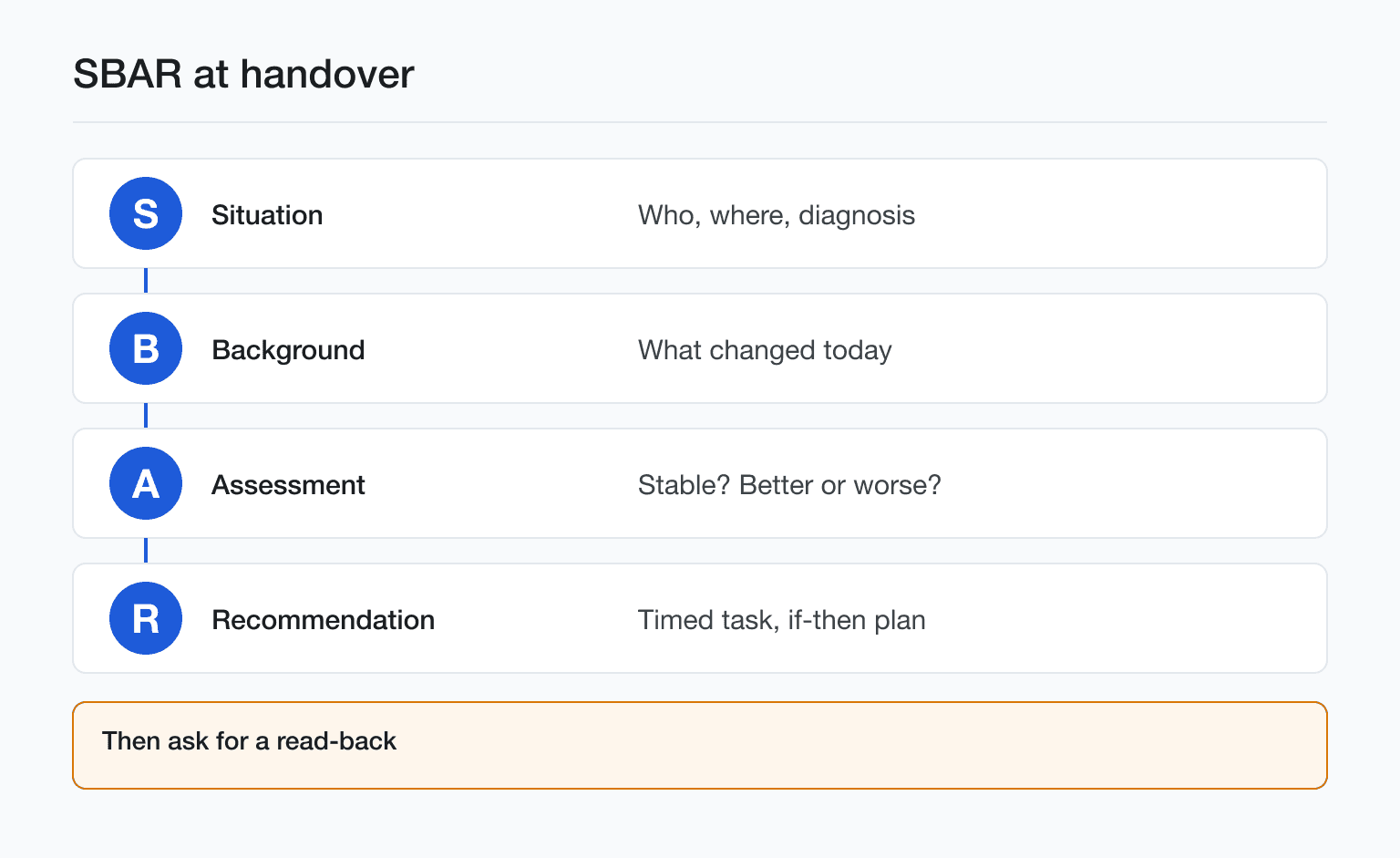
The four SBAR parts with prompts and a final read back request. Source: WHO SBAR handover card and IHI.
Definitions follow the Institute for Healthcare Improvement, and the handover items follow the WHO SBAR handover card. The WHO card ends with "Ask receiver to repeat back key information", a final check that the essentials landed.
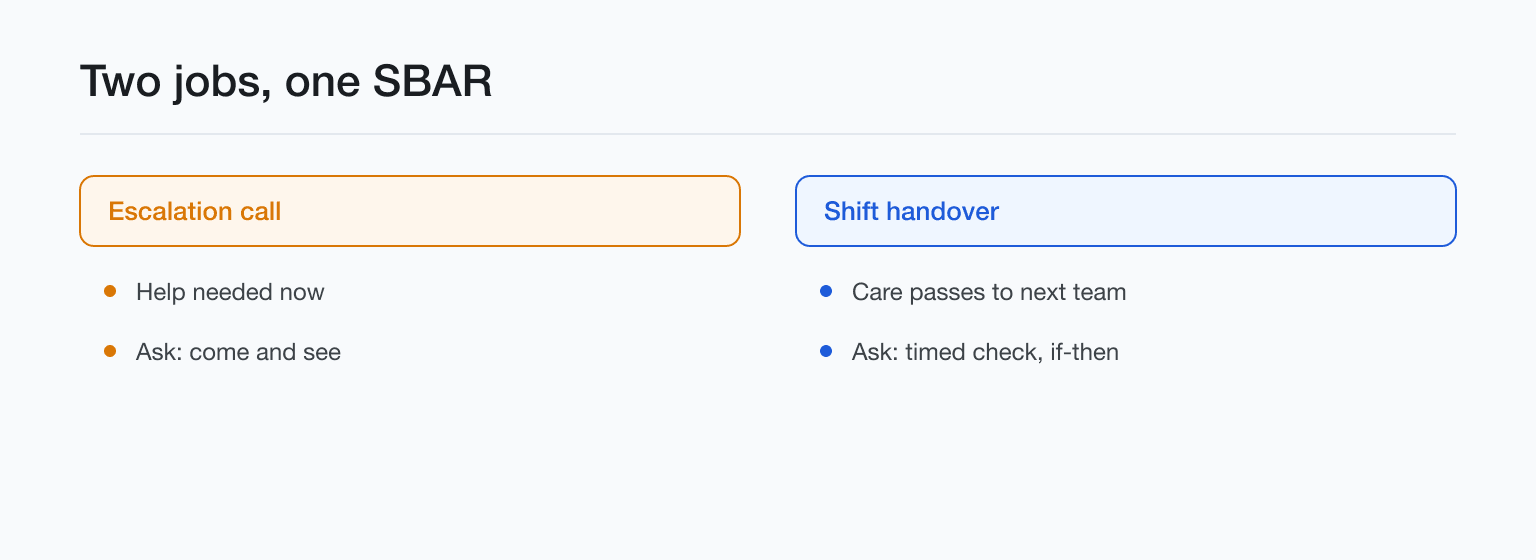
Side by side of escalation calls versus shift handovers with the different asks. Source: NHS England SBAR tool and WHO handover card.
The biggest difference from an escalation call is R. On a call you ask a senior to "Come to see the patient in the next (XX mins)". At handover you set a timed check and an if-then plan, with contingency stated for the incoming night or weekend team.
How to give an SBAR handover, step by step
For new doctors, give SBAR handover in the same order every time. Use one written list and six spoken beats. Prioritise by sickness, focus on today, and end with timed tasks plus contingencies.
- Write the list first: RCP toolkit says "a standardised proforma for written handover is essential"; keep a tidy jobs list.
- Order by sickness: sickest first; the Royal College of Physicians handover toolkit says sickest may require bedside handover with senior medical staff.
- Give S in one line: name, age, ward and bed, and the current working diagnosis.
- Give B as changes today: include latest observations and key results, not the entire admission.
- Say A out loud: stable or critical, and if worsening or improving; WHO says "State patient trajectory".
- Give R as a task with time plus if-then plan; WHO says state contingency plans; NHS England's tool says read-back.
Local trust handover policy applies on top of this.
A worked SBAR handover: Paul Osei, 40
Paul Osei is a fictional, simulated patient from the Diagnosica case library (case file adrenal-crisis-40m). The handover below is model wording written by us from the case file, not a real handover.
His wife's opening line is: "My husband collapsed at home, and he's been vomiting for a couple of days."
S: Paul Osei, 40, [ward and bed], admitted after collapsing at home; working diagnosis adrenal crisis; the sickest patient you're handing over. >B: Known Addison's disease. Two days of vomiting and diarrhoea; could not keep his regular tablets down. Drowsy and weak on arrival. Hot and shivery since the sickness started. Obs: heart rate 124, respiratory rate 24, blood pressure 82/50, oxygen saturation 97%, temperature 38. Bloods: low sodium, high potassium, raised urea, low glucose. ECG: tall tented T waves. [what has been given and when, read from the drug chart] and [latest obs and the trend]. >A: Critical; trajectory [improving or worsening, from the latest obs]. >R: Please see him first, within [time]. Repeat obs and recheck glucose and electrolytes at [time]. If his blood pressure stays low or he gets drowsier, call the registrar straight away. "Can you read that back to me?"
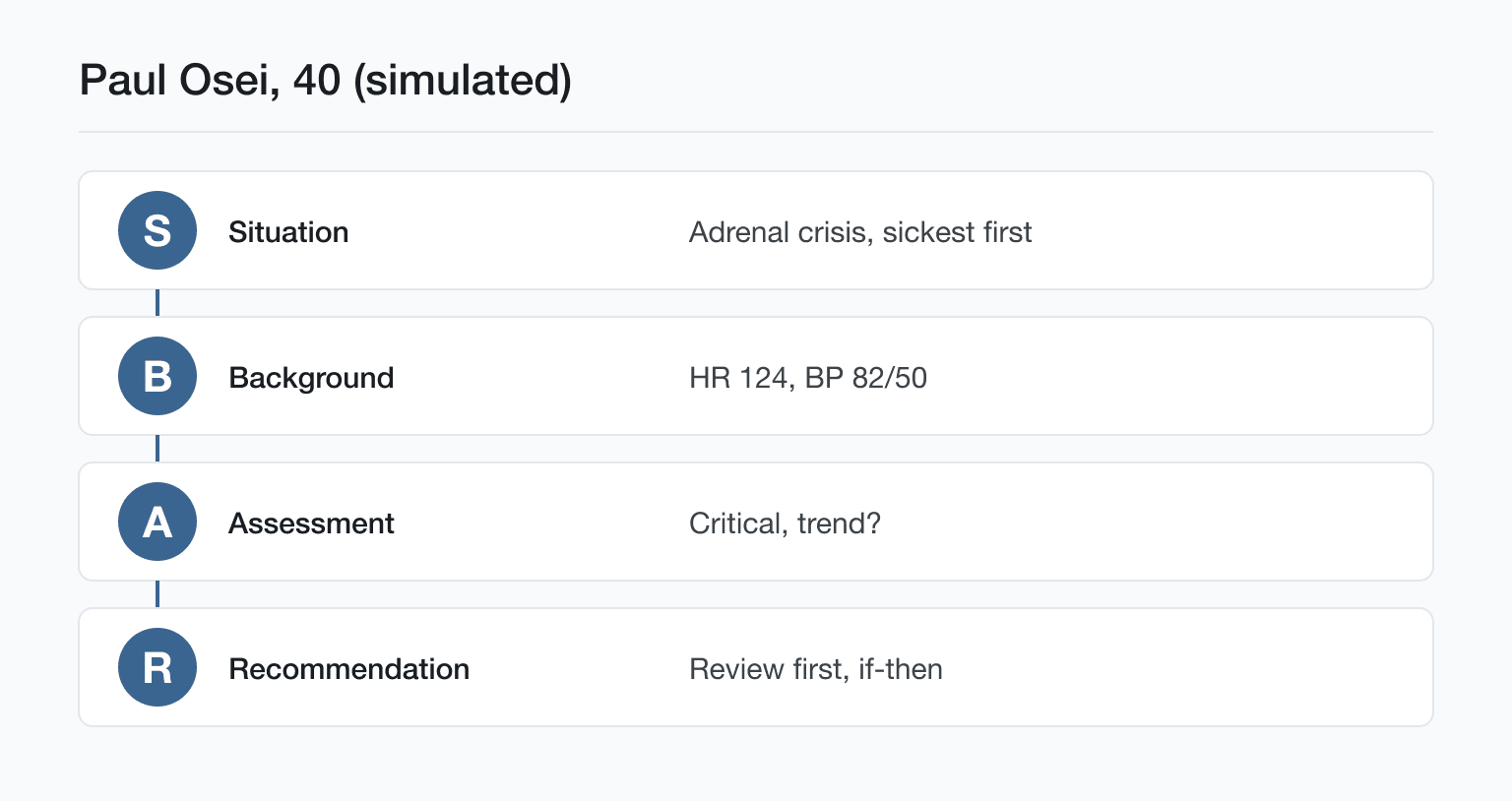
Worked SBAR for a simulated adrenal crisis with trend and an if then trigger. Source: Diagnosica case file adrenal-crisis-40m, simulated patient.
That works because it leads with the diagnosis and how sick he is. It gives numbers not adjectives. The A names a trajectory, and the R sets a time, a clear trigger and a read-back.
Example. Weak R: "Keep an eye on him overnight." Strong R: See him first by [time]; if his blood pressure stays low or he gets drowsier, call the registrar. Specific times and triggers make prioritisation safer.
How Diagnosica helps with this
Read simulated case results and decide what they mean.
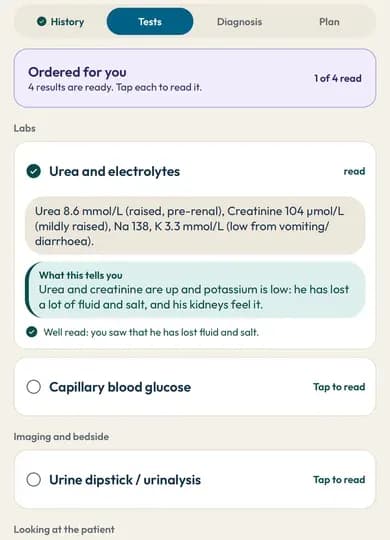
Diagnosica app, tests and results screen, as of October 2026.
- Results arrive as cards you tap to read.
- Decide what the result means for this patient.
- Turn what you read into your SBAR A line.
Simulated patient. Screenshot from Diagnosica, October 2026.
Mistakes new doctors make at handover
Most SBAR handover errors are about the R and the order, not medical knowledge. The R is Recommendation. Vague timing or triggers, plus messy sequencing, leave the night team unsure what to do next.
These are the friction points SBAR handover is meant to fix. NHS England's tool says it "prevents the unreliable process of ‘hinting and hoping’":
- Hinting and hoping: say the concern out loud.
- No clear ask: recommendation needs a time or trigger, or the night doctor guesses.
- Reading the whole admission: give what changed today, not the full history.
- Skipping the read-back: "Ask receiver to repeat key information to ensure understanding".
Spotting deterioration starts before handover. Review the trend, set a timed check, and escalate early if concerned. For a focused refresher, see spotting a deteriorating patient.
Watch out. If you're worried but can't name why, say so at handover. NHS England's tool accepts "I don't know what's wrong but I am really worried".
Where to go next
Start with FY1 basics, then focus on the handovers that bite: Friday evening to weekend cover, weekday late to night team, and post-take mornings. One rule, keep it structured: SBAR for shift-to-shift handover every time.
Then read the FY1 starter guide.
- Read surviving your first nights for receiving the handover cleanly and setting your task list.
- Use covering the wards at weekends to plan Friday’s pass-off into weekend cover.
- Keep talking to worried relatives handy for conversations after a handover changes the plan.
Diagnosica is an AI clinical simulator where you take a history from an AI patient by voice or text. You order investigations, commit to a diagnosis and get a scorecard. It doesn’t simulate the handover, but it trains reading obs, checking results and committing to an Assessment. Now run a full case and say the SBAR out loud at the end.