Final year medical student tips: 9 for your last year

The final year medical student tips that matter start with fixed dates, such as foundation school preferencing closing on 10 February 2027. Split revision between the UKMLA and the PSA, and practise working like the new doctor.
Key takeaways
- Finish the three PSA practice papers and expect 60 items in two hours.
- Look for the GMC’s provisional registration invite in April.
- Shadowing and induction are mandatory at the end of July.
Tips 1 and 2: put the fixed dates in your calendar
Certain UK dates in your final year won't move for anybody, so diarise them first and arrange placements and revision around them. This table covers the UK only, and dates vary elsewhere.
Tip 1. Add the fixed milestones to your phone, with reminders a week and a day before each one. When the admin gets dull, try a two-minute quick case.
Lock these in now:
Date | What happens | Source |
|---|---|---|
December 2026, date to be confirmed | Pre-allocation outcomes released | |
28 January 2027 | PSA sitting, medical schools only | |
10 February 2027, midday | Foundation school preferencing closes | UKFP timeline |
March 2027, date to be confirmed | Foundation school allocation | UKFP timeline |
18 March and 15 April 2027 | PSA sittings | PSA schedule |
29 April 2027, midday | Reference window closes | UKFP timeline |
3 June 2027 | PSA sitting, medical schools only | PSA schedule |
Your medical school will tell you which PSA sitting is yours.
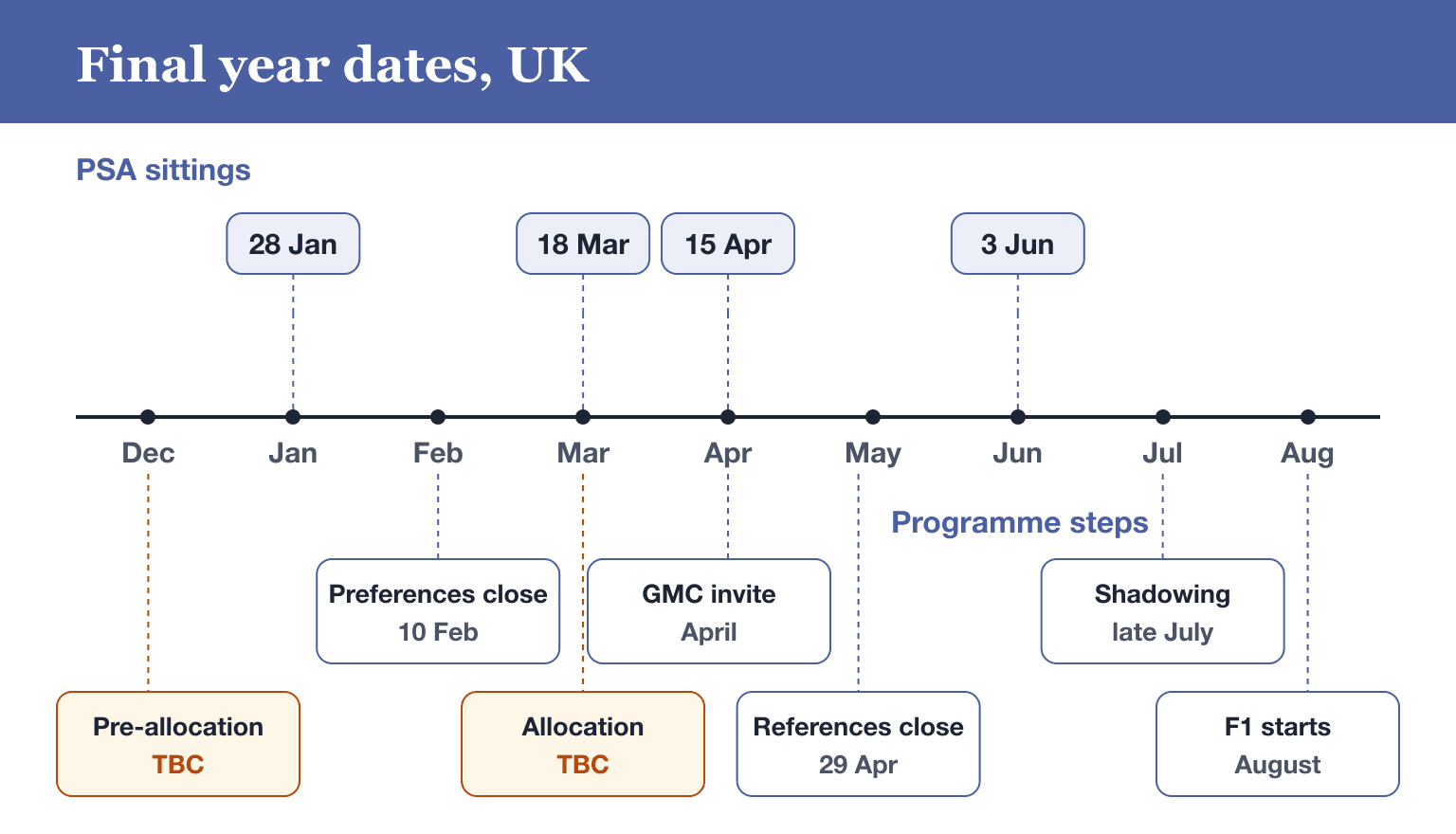
PSA sittings and Foundation Programme steps, sourced from UKFP and PSA pages; TBC marks items still to confirm.
Tip 2. The GMC says it invites you in April to apply for provisional registration, so apply soon after it opens, and read the GMC's registration guide. Check your start date with your employer, since you may need to be registered for shadowing. Being registered is your own responsibility.
F1 starts on the first Wednesday in August, and mandatory shadowing and induction take place at the end of July, per the UKFP start dates.
Outside the UK, exams and dates differ, though tips 6 to 9 still carry over, and US readers can start with the US intern start.
Tips 3 to 5: split revision between the UKMLA and the PSA
The UKMLA and the PSA are separate assessments that ask for different things. Give each its own time so one doesn't swallow the other.
Tip 3: Treat the UKMLA as two exams. The applied knowledge test and the clinical and professional skills assessment happen at your school on dates it picks, and your school may call the second an OSCE or OSLER, according to the GMC's MLA guide.
Tip 4: Finish all three PSA practice papers. Once your school registers you, the PSA system gives you two 30-item papers and one 60-item paper, and those come with feedback on your answers.
The real PSA runs 60 items over two hours and a pass lasts two years, per the PSA's own FAQs.
Watch out. Whether your degree depends on the PSA is your school's call, but all F1 doctors must pass it for the F1 certificate, per UKFP's PSA page.
Tip 5: Download your PSA certificate. Do it soon after results come out, because the PSA warns it may not be possible later if your registered email address expires.
The GMC says you won't need anything beyond your curriculum, and its content map shows the topics. For the detail, read revising for finals, a two-part UKMLA plan and the PSA pass mark.
Tips 6 and 7: work like the new doctor on placement
Clinical assessors in final assessments may judge you partly as a future junior on their team, as well as against the curriculum, so how you behave on placement counts as preparation too.
That comes from a twelve-tips paper in MedEdPublish. The authors explored its theory in final OSCEs, and they say it may also apply to workplace assessment. Treat it as a guide, not a rule; your own school’s examiners may weigh it differently.
Tip 6. Calibrate to the new graduate. Watch what the F1s on your team do. Ask what a capable new graduate would do in each situation, guided by getting more from assistantship and what the FY1 year asks.
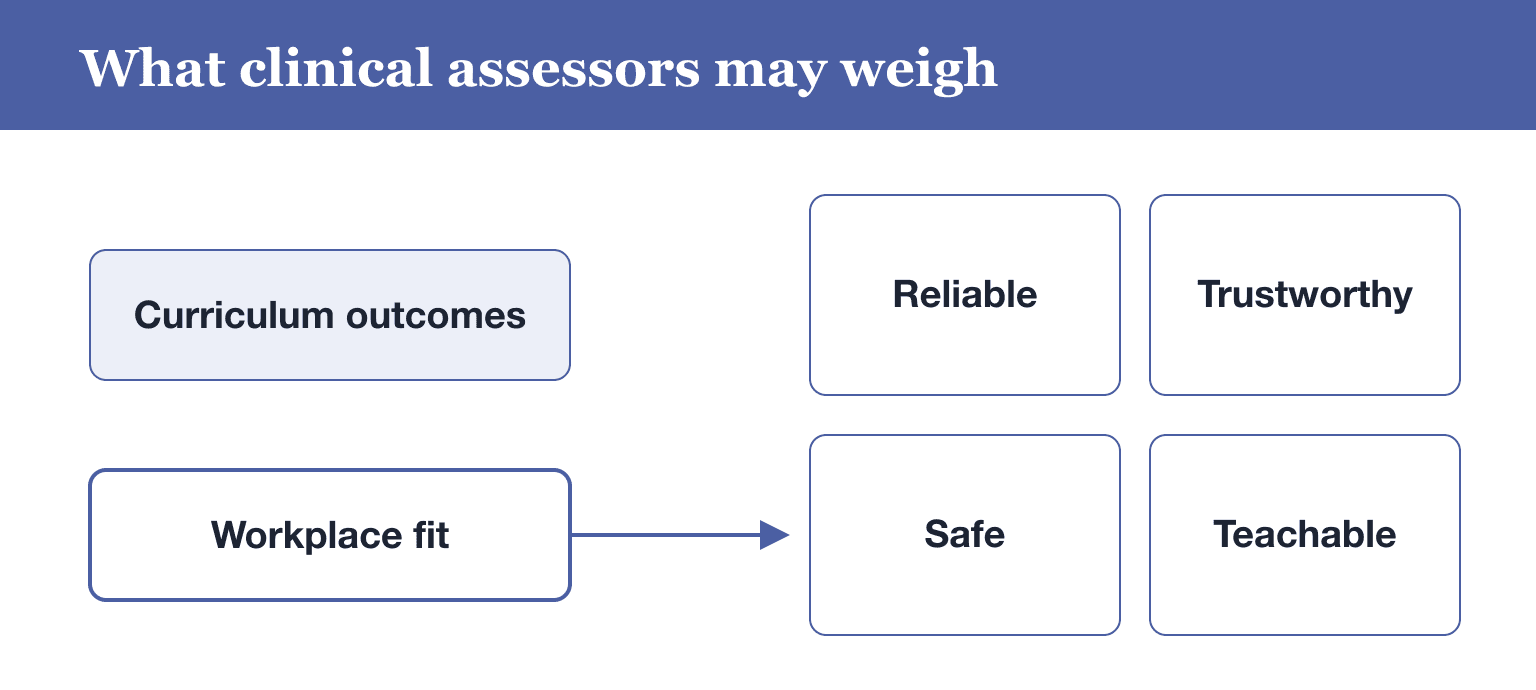
From the MedEdPublish twelve tips paper: reliability, trustworthiness, patient safety and teachability guide judgements.
That judgement rests on reliability, trustworthiness, patient safety and teachability.
Tip 7. Say when you don't know. The paper's line is "Never guess or make something up", so admit the gap and explain how you'd find out, whether that's asking a senior or looking it up. Read this on handling questions you can't answer.
Tip 8: could you handle this as an FY1?
Nobody can answer that from a blog post, and this check is not a readiness test, since three cases can't measure it. What it can show is how you think when the picture is incomplete, using first clues from real Diagnosica quick cases, each a two-minute mini case with five clues.
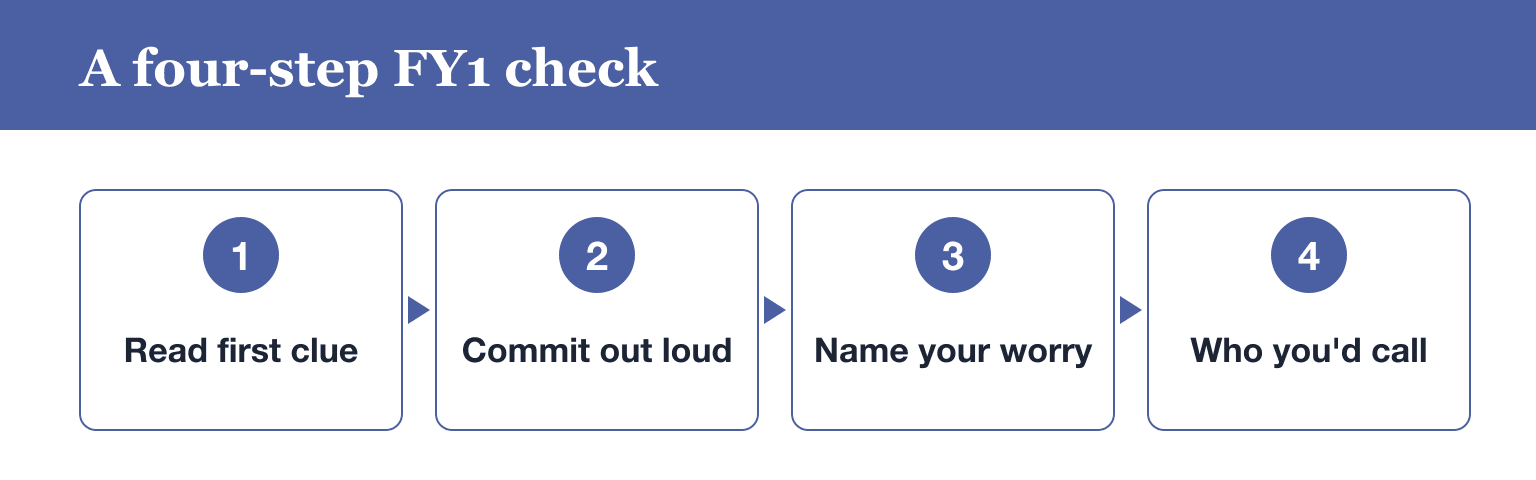
A practice habit you can run daily, not a readiness test.
Work through these four steps in order for each case in the table below:
- Read only the first clue.
- Commit to a working diagnosis out loud.
- Name what worries you most.
- Say who you'd call and what you'd ask them.
For how to frame that call, read phoning a senior.
Cover the middle and right columns, and try the first clue of the three quick cases:
First clue | Next clue | Quick case answer |
|---|---|---|
A 78-year-old man develops fever and productive cough three days after admission with a stroke. | He is drowsy, has swallowing difficulty, and coughs while eating. | Aspiration pneumonia |
A 72-year-old man has been unable to urinate for 10 hours despite a strong urge, with worsening lower abdominal pain. | He has had a weak urinary stream and nocturia for years. | Acute urinary retention due to BPH |
A 46-year-old woman developed a sudden severe headache while lifting weights, reaching maximum intensity within seconds. | She has vomited twice and feels neck stiffness. | Subarachnoid haemorrhage |
Simulated patients, wording taken from the quick case files, not from real patients.
If you changed your answer at clue two, that's the mechanic working, not a verdict on you.
How Diagnosica helps with this
One line, five clues, a guess after each, practises rapid differential thinking.
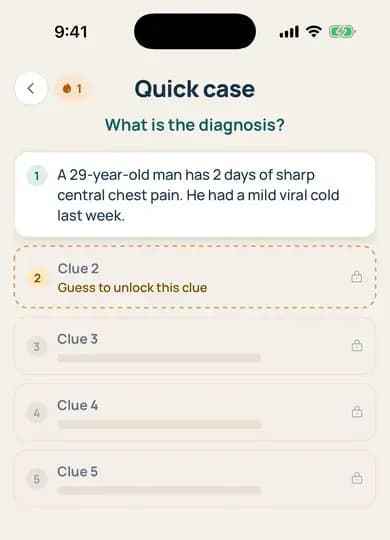
Diagnosica app, quick case screen, as of November 2026.
- Read the first simulated patient clue
- Type a diagnosis, wrong guess unlocks the next clue
- Solve it, or reach clue five, then read the teaching line
Simulated patient. Screenshot from Diagnosica, November 2026.
Start a two-minute quick case, free
Final year mistakes worth avoiding
These four warnings come from the GMC, the PSA site and the MedEdPublish paper. They're pointers taken from those pages, not a survey of how often students make them.
Watch for these traps:
- Leaving GMC registration late, risking not being registered in time.
- Treating the BNF as the whole answer.
- Skipping the feedback on optimal and suboptimal answers in the PSA practice papers.
- Guessing in front of an assessor.
Tip 9: how many hours should you practise?
Nobody official gives a weekly number, and we couldn't find one on the GMC, PSA or UKFP pages, so don't treat any quoted hours as a rule. Keep practice small enough to repeat daily, since a habit you can sustain beats a timetable you'll drop.
A quick case takes about two minutes. A full Diagnosica case gives you an AI video patient, investigations, a diagnosis and a scorecard, but it covers clinical reasoning and history taking only, with no physical examination and no PSA practice. It doesn't give advice about real patients, and it's not a diagnostic system. Treat every output as educational.
If that fits your plan, start a daily case habit, free to start, no card needed.