MRCEM Primary pass mark: how RCEM sets it

There's no fixed number: RCEM sets the MRCEM Primary pass mark for each sitting with the Angoff method, and the total Angoff score is the pass mark. Checked 25 November 2026.
Key facts
- 2024 pass rate 57.4%, 2,770 of 4,824, RCEM, checked 25 November 2026.
- 180 questions, one mark each, no negative marking, RCEM, checked 25 November 2026.
- Primary, no SEM added; MRCEM SBA adds 1xSEM, RCEM, checked 25 November 2026.
Try a two-minute quick case for a break from question banks, free and no sign-up, see if you spot the diagnosis. It isn't MRCEM Primary question practice.
What is the MRCEM Primary pass mark?
The MRCEM Primary pass mark has no fixed number. RCEM sets it each sitting using Angoff, where a panel’s total Angoff score is the pass mark for Primary, with nothing added. You get one mark per correct answer, no negative marking. The paper is 180 questions in 3 hours (checked 25 November 2026).
How RCEM sets pass marks across exams, and how recent pass rates compare:
Exam | How the pass mark is set | 2024 pass rate | 2023 pass rate |
|---|---|---|---|
MRCEM Primary | Total Angoff score | 57.4% (2,770 of 4,824) | 58.0% (2,314 of 3,987) |
MRCEM SBA | Total Angoff score plus 1 SEM | 30.9% (958 of 3,101) | 47.0% |
FRCEM SBA | Total Angoff score plus 1 SEM | 51.1% (558 of 1,093) | 47.0% |
Sources: RCEM Angoff explainer and 2024 pass rate report, checked 25 November 2026.
SEM means standard error of measurement. RCEM adds it for MRCEM SBA and FRCEM SBA; Primary skips it. See RCEM's Angoff explainer, which still labels MRCEM SBA as Intermediate, plus RCEM's 2024 pass rate report and RCEM's MRCEM exams page for format.
Other colleges use Angoff differently; for comparison see the MRCP pass mark.
How RCEM sets the Primary pass mark
RCEM sets the MRCEM Primary pass mark using Angoff. A panel of practising emergency medicine consultants judges each question. RCEM exams are criterion referenced, so all candidates could pass or fail (Angoff explainer, checked 25 November 2026).
What that looks like in practice:
- Rate each question by the share of minimally competent candidates who'd get it right.
- Discuss differences and adjust.
- Average the ratings into an Angoff score per question.
- Add up every question's score, and for Primary that total, rounded to one decimal place, is the pass mark.
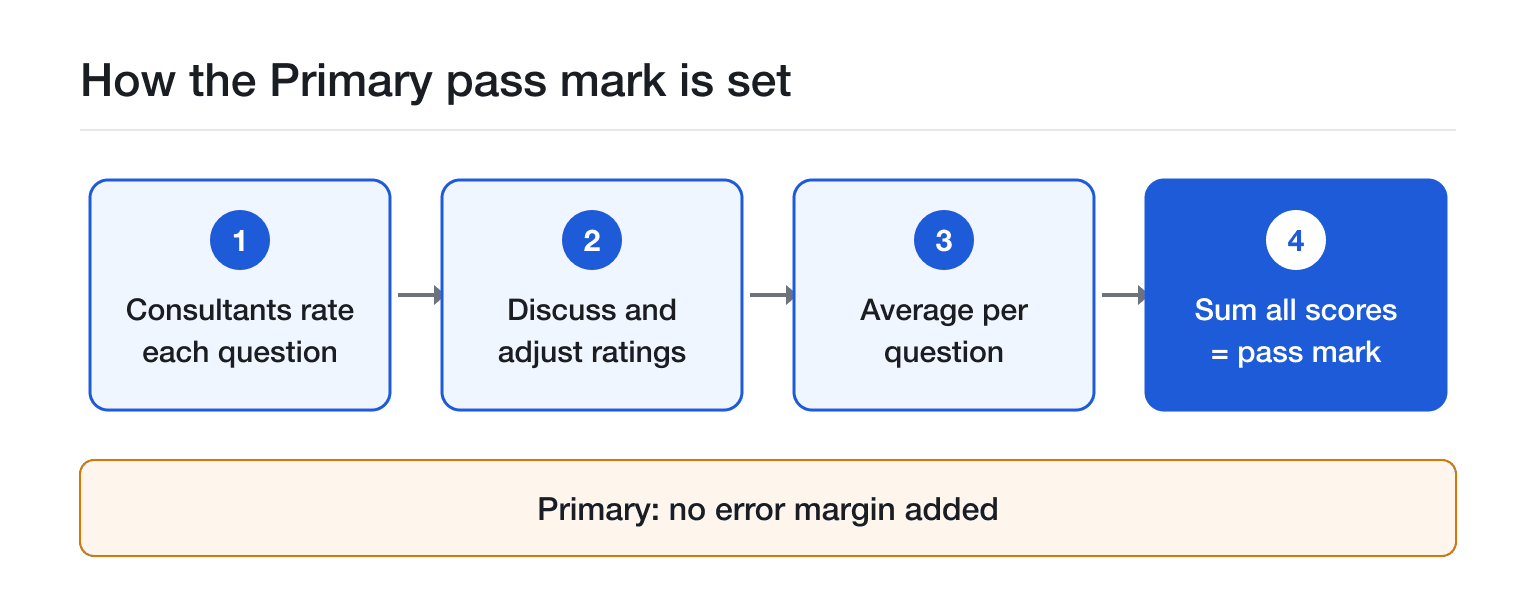
How RCEM turns question ratings into the Primary pass mark, from its Angoff explainer, checked 25 November 2026.
The MRCEM Primary pass mark moves between sittings because each paper uses a different mix of items. RCEM’s Angoff explainer, checked 25 November 2026, says the total Angoff score changes.
Example. Example. RCEM's worked table removes 3 flawed questions after an exam, so a 180-mark paper is marked out of 177. The Angoff total drops from 107.12 to 105.365 and the pass rate in that example rises from 24% to 27% (checked 25 November 2026). RCEM's example also adds a standard error, illustrating SBA papers; for Primary, on our reading, the Angoff total alone would be the line.
MRCEM Primary pass rate and what the paper tests
MRCEM Primary pass rate was 57.4% passed in 2024 (2,770 of 4,824) and 58.0% in 2023. RCEM's report says the change isn't statistically significant (checked 25 November 2026). Plan against what the paper actually tests.
Questions follow a published blueprint weighted to anatomy and physiology. That totals 117 of 180 by our sum from the Primary information pack, as of 25 November 2026. Pass rates source: RCEM pass rate report, as of 25 November 2026.
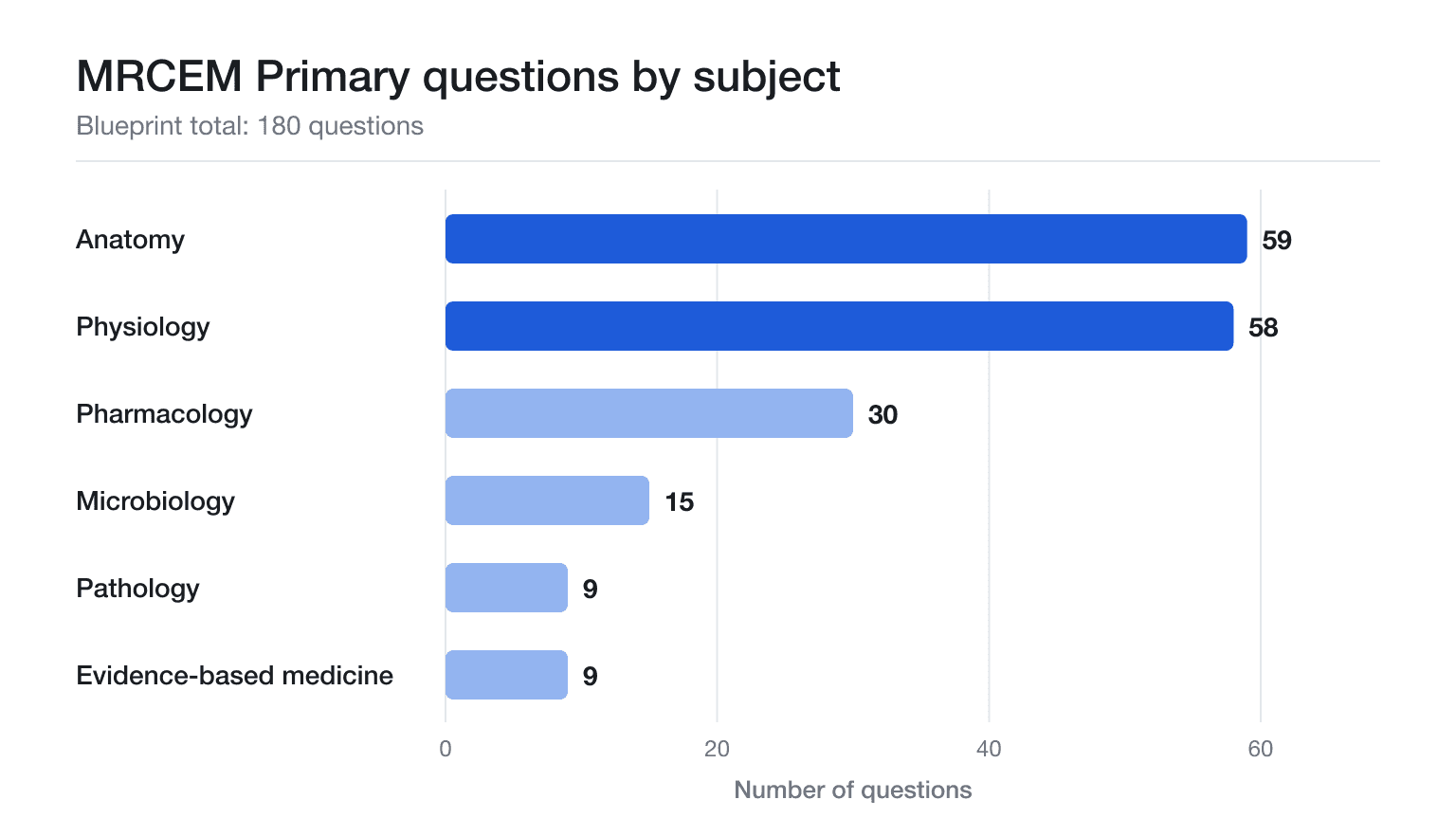
MRCEM Primary blueprint by subject, from the RCEM information pack, checked 25 November 2026. RCEM says live numbers may vary slightly.
Across the rest: pharmacology 30, microbiology 15, pathology 9, evidence based medicine 9, as of 25 November 2026. Weight your revision to match the split and use active recall for revision.
How Diagnosica helps with this
Practise history-taking with an AI video patient, not SBA or MCQ prep.
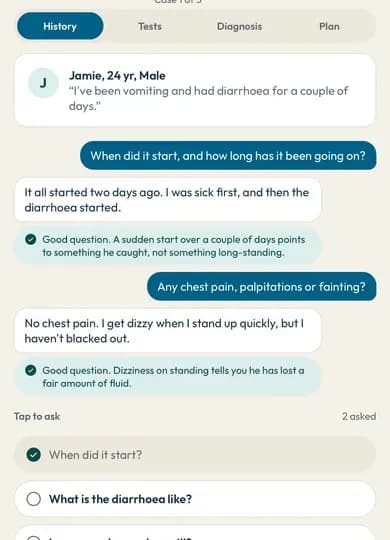
Diagnosica app, guided case history screen, as of November 2026.
- Ask questions by voice or typing
- The patient answers, and feedback flags good questions
- Then order tests, commit to a diagnosis, get a scorecard
Simulated patient. Screenshot from Diagnosica, November 2026.
Unofficial numbers and your results letter
For the MRCEM Primary pass mark, course-provider figures circulate. For example, Bromley Emergency reports 108 in May 2025 and 107 in May 2026, but label them unofficial. They were not on RCEM pages read on 25 November 2026.
According to RCEM's sample feedback letter and the MRCEM exams page, as of 25 November 2026, your results letter shows several items. It includes the pass mark, your score, the cohort average, and a score breakdown by basic-science subject. Results arrive by 17:00 on a pre-advised day, about 6 to 8 weeks after the exam.
Watch out. Watch out. Don't plan around a forum number; the only official mark for your sitting is the one on your own letter.
RCEM regulations, as of 25 November 2026, allow six attempts. They give seven years from the day you pass Primary to complete all MRCEM exams. Some DRE-EM trainees with MRCS or MRCSI after 1 January 2012 are exempt, see the MRCS Part A breakdown.
After Primary come the MRCEM SBA and the MRCEM OSCE, per RCEM's MRCEM exams. The OSCE is marked differently, see the MRCEM OSCE pass mark. The OSCE and your first emergency department shifts run on spoken histories. You can practise an emergency patient by voice or text with an AI video patient, free to start. It isn’t Primary question practice.