Shelf exam passing score: who actually sets it
NBME doesn't set a shelf exam passing score; each school sets its own pass line. In NBME's 2022 survey of clerkship directors, the median minimum passing score was 60% equated percent correct. Checked 25 November 2026.
Take a breather from question banks and try a two-minute quick case, free and no sign-up, between study blocks.
Key facts
- 92% of respondents require a pass, per the 2022 survey.
- Median honors threshold was 80% in the 2022 survey.
- NBME says scores shouldn't be used alone, per the NBME guide.
Who sets the shelf exam passing score?
NBME writes and scores the Clinical Science Subject Exams, often called shelf exams, and reports equated percent correct (EPC) on a 0 to 100 scale. It publishes grading guidelines to help schools set passing and honors standards. Your school sets the pass line, not NBME.
NBME's score interpretation guide says subject examination scores should not be used alone and provides grading guidance for schools. NBME's 2022 clerkship director survey covered 178 directors from 84 schools in October 2022, not a census. New to the term, see what a shelf exam is.
Who publishes what, and who sets your line:
Who | What they publish | Sets your pass line? |
|---|---|---|
NBME | EPC scores, national norms, grading guidelines for schools | No |
NBME 2022 survey | Median minimum pass 60% EPC, honors 80% | No, a survey of 178 directors |
Your school | Pass, high pass and honors cutoffs | Yes |
Sources: NBME score interpretation guide and 2022 survey report, checked 25 November 2026.
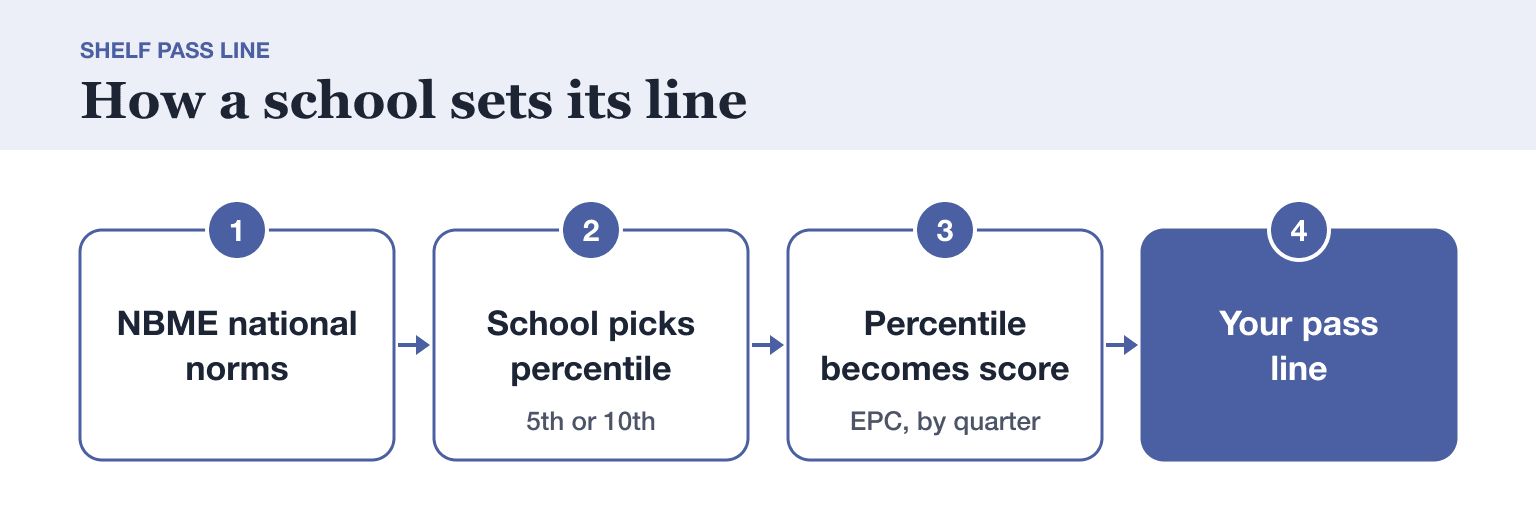
Flow from NBME national norms to a school pass line, drawn from NBME's guide and two school policies.
NBME publishes national norms; the school picks a percentile cut, like the 5th (UTHSC, Mount Sinai) or 10th (TTUHSC). That percentile becomes an equated percent correct by quarter or clerkship period, which sets your pass line.
Same shelf, three schools, three pass lines
On the same NBME shelf exam, the NBME shelf exam passing score varies by school because each one chooses a percentile cutoff and converts it to equated percent correct.
Three schools' pass lines for the same shelves:
Shelf exam | UTHSC 2025-2026 cutoffs (5th percentile) | TTUHSC 2026-2027 tables (10th percentile) | Mount Sinai 2024-2025 cutoffs (5th percentile) |
|---|---|---|---|
Internal medicine | 57 to 59, by quarter | 61 or 63, by clerkship period | 58, one line all year |
Surgery | 57 to 60 | 61 or 64 | 59 |
Psychiatry | 73 to 74 | 77 | 73 |
Minimum passing scores (equated percent correct) from each school's own published table, checked 25 November 2026. Mount Sinai's table is from 2024-2025.
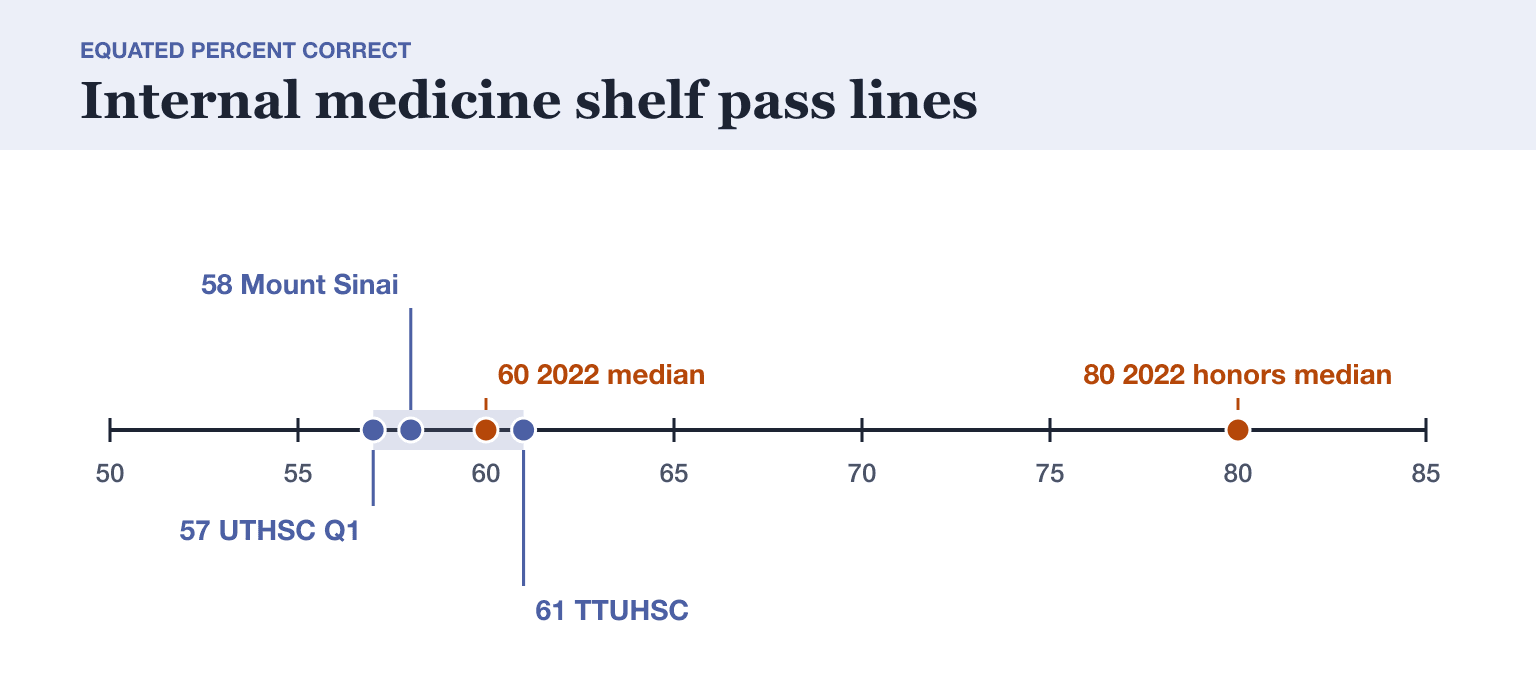
Pass lines from three internal medicine policies and the 2022 survey median, sources named in text, checked 25 November 2026.
On the internal medicine shelf, the lowest pass lines are 57 at UTHSC (first quarter, 2025-2026), 58 at Mount Sinai (2024-2025), and 61 at TTUHSC (2026-2027), near the 2022 survey pass median of 60; the 2022 survey honors median is 80.
Psychiatry sits well above medicine and surgery at all three, so a 70 can pass one shelf and fail another. Time your study for the psychiatry rotation and start reps before surviving the surgery clerkship.
Why the pass line and your score move
Schools set cutoffs by quarter or clerkship period from NBME quarterly norms, and EPC scores have measurement error. The line shifts, and a 1 to 2 point margin is thin.
Per NBME's Clinical Science Score Interpretation Guide, EPC scores are equated, so a harder form does not lower your score. USMLE Step 2 CK is different, with one national passing standard, as covered in how Step 2 CK scoring works.
NBME publishes quarterly norms and reports some subjects score higher later. UTHSC used 57 to 59 by quarter in 2025 to 2026, TTUHSC 61 or 63 by clerkship period in 2026 to 2027, and TTUHSC says the same score can yield different grades. Psychiatry's standard error is 4 points.
Watch out. Do not plan around a forum pass line. It may use a different percentile, quarter, or year.
How Diagnosica helps with this
Take clerkship-style histories from an AI patient by voice or text, anywhere.
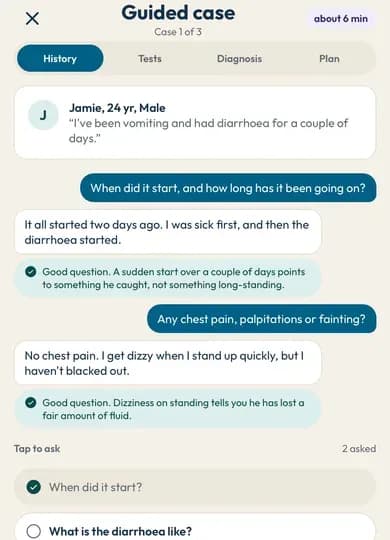
Diagnosica app, guided case history screen, as of November 2026.
- Ask questions, the patient answers.
- Good questions get short notes.
- Order tests, commit to a diagnosis.
Simulated patient. Screenshot from Diagnosica, November 2026.
How to find your school's pass line
To find your school's pass line for any NBME shelf exam passing score, read your own clerkship documents. Your clerkship syllabus or grading policy is the only source that counts, since schools set their thresholds and weighting.
Use this sequence to get the number that applies to you:
- Read the clerkship syllabus or the school grading policy PDF.
- Check whether the pass line is a percentile or an EPC score.
- Check which quarter or clerkship period table applies to your rotation dates.
- Ask the clerkship coordinator for the policy if nothing is published.
- Check how much the shelf counts toward the final clerkship grade.
NBME's grading guidelines and norms sit on its MyNBME portal for schools, per NBME's clinical science exam page. In the 2022 survey of clerkship directors, about 30% were unaware of those guidelines.
See the rest of your clerkship grade and start building an exam revision plan.
What the shelf tests, and where a patient case fits
NBME shelf exams use multiple-choice vignettes assessed in MCQ format; NBME's medicine sample items show cases ending, “Which of the following is the most likely cause,” with lettered options A to E. A patient case builds the reasoning behind the vignette.
Diagnosica is not MCQ practice and won’t replace a question bank. You take a history from an AI patient on video, by voice or text, order investigations, commit to a diagnosis, then see a scorecard. Rehearse vignette reasoning, then write a one-line problem representation. It isn't a diagnostic system or advice about real patients.
Example. Simulated case: Dennis Holloway, 58, opens with "a pain in my chest that started about an hour and a half ago." It began while he sat watching television. In a vignette those facts are handed over; with a patient, you have to ask for them.
If you're tracking your pass line, start with format fluency, then work the reasoning. Try the approach with a video avatar, any hour, no booking, and practice a clerkship patient, free.