What is a shelf exam?
A shelf exam is a standardized NBME subject exam you take at the end of a core clerkship, usually in the third year of US medical school. Most have 110 multiple-choice questions, checked 25 November 2026, per NBME.
Key takeaways
Key takeaways
- 8 NBME Clinical Science shelf exams, one per core subject, checked 25 November 2026.
- Your school sets pass and honors lines, not NBME, per NBME grading guidelines.
- Do two things now: consistent multiple-choice practice questions, and real patient conversations to build reasoning.
What is a shelf exam in plain words?
A shelf exam is a written, computer-based exam from the National Board of Medical Examiners (NBME). You take it at the end of a core clinical rotation, often called a clerkship. It assesses specialty knowledge and clinical reasoning. NBME's formal name is the Clinical Science Subject Exam.
The nickname comes from schools buying the exam ready-made from NBME rather than writing their own. As the American College of Physicians puts it, obtained from NBME "off-the-shelf," it's commonly referred to as the shelf exam.
Many schools require one at the end of each core rotation, checked 25 November 2026, per the American Academy of Family Physicians (AAFP). Core rotations are 6 to 12 weeks, checked 25 November 2026. See how clinical rotations work.
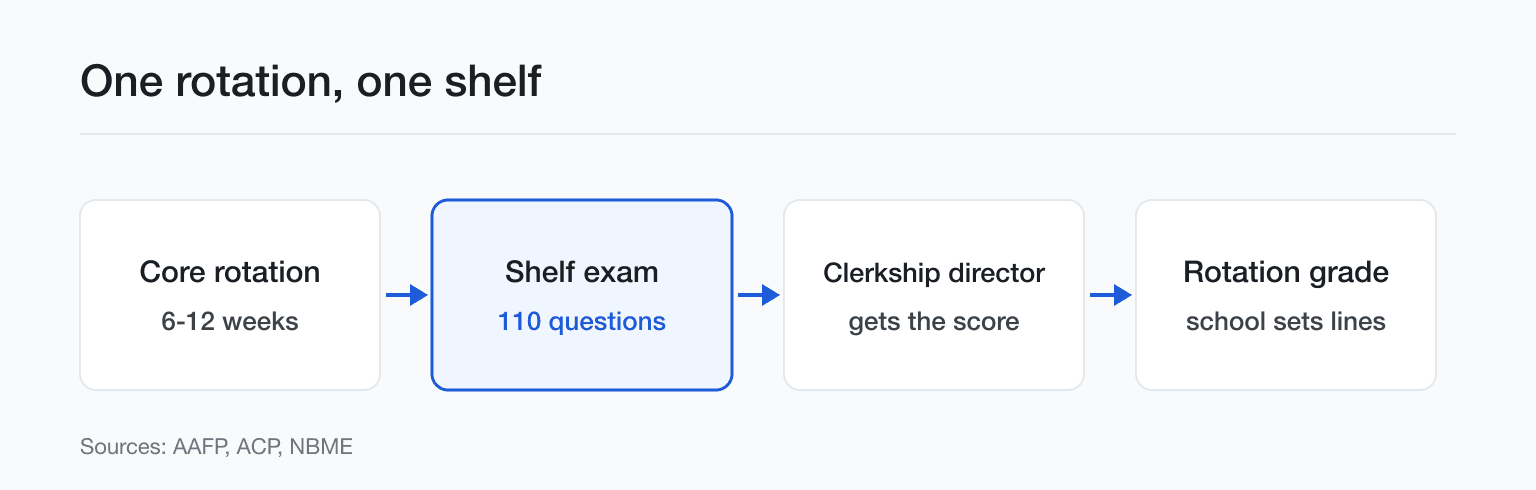
Sequence from rotation to shelf to grade. Sources: AAFP, ACP, NBME, checked 25 November 2026.
The shelf exams at a glance
NBME (National Board of Medical Examiners) lists 8 Clinical Science shelf exams on its NBME Clinical Science Subject Exams, checked 25 November 2026. Most are 110 questions in 2 h 45 min, per the NBME subject exam timing chart.
Figures below were checked 25 November 2026 on NBME's timing chart, which NBME dates July 2021:
Shelf exam | Questions | Time | Read more |
|---|---|---|---|
Medicine | 110 | 2 h 45 min | n/a |
Surgery | 110 | 2 h 45 min | |
Pediatrics | 110 | 2 h 45 min | |
Obstetrics and Gynecology | 110 | 2 h 45 min | n/a |
Psychiatry | 110 | 2 h 45 min | |
Clinical Neurology | 110 | 2 h 45 min | n/a |
Family Medicine Modular | 90 to 110 | 2 h 15 min to 2 h 45 min | three module versions |
Ambulatory Care | 110 | 2 h 45 min | n/a |
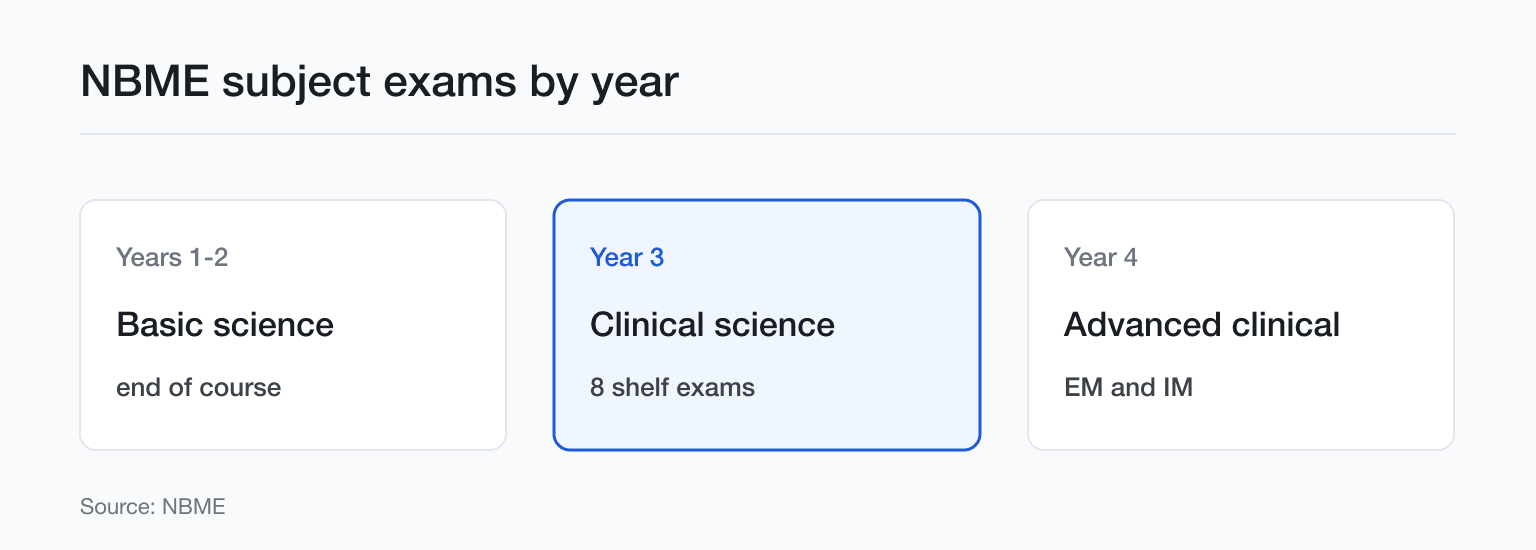
Typical timing across years. Source: NBME, checked 25 November 2026.
NBME also has two Advanced Clinical Science exams for fourth-year students, in emergency medicine and internal medicine, on the Advanced Clinical Science exams page. In pre-clinical years, Basic Science subject exams assess end-of-course knowledge per the NBME program guide.
How a shelf exam works, step by step
A shelf exam is an NBME subject exam schools use to assess a core clerkship. You sit it in a secure proctored setting and answer single-best-answer cases. Then your clerkship director receives your score and applies NBME grading guidance locally.
- Finish the clerkship, a core clinical rotation, 6 to 12 weeks, checked 25 November 2026 (AAFP).
- Sit the exam at school in a secure proctored room, or at a Prometric test center, except Ambulatory Care.
- Do the 15-minute tutorial that comes before every web exam, checked 25 November 2026.
- Answer single-best-answer multiple-choice questions, 110 in 2 hours 45 minutes for Medicine, checked 25 November 2026 (ACP).
- Your clerkship director gets the score and uses NBME grading guidelines, checked 25 November 2026, to set pass and honors.
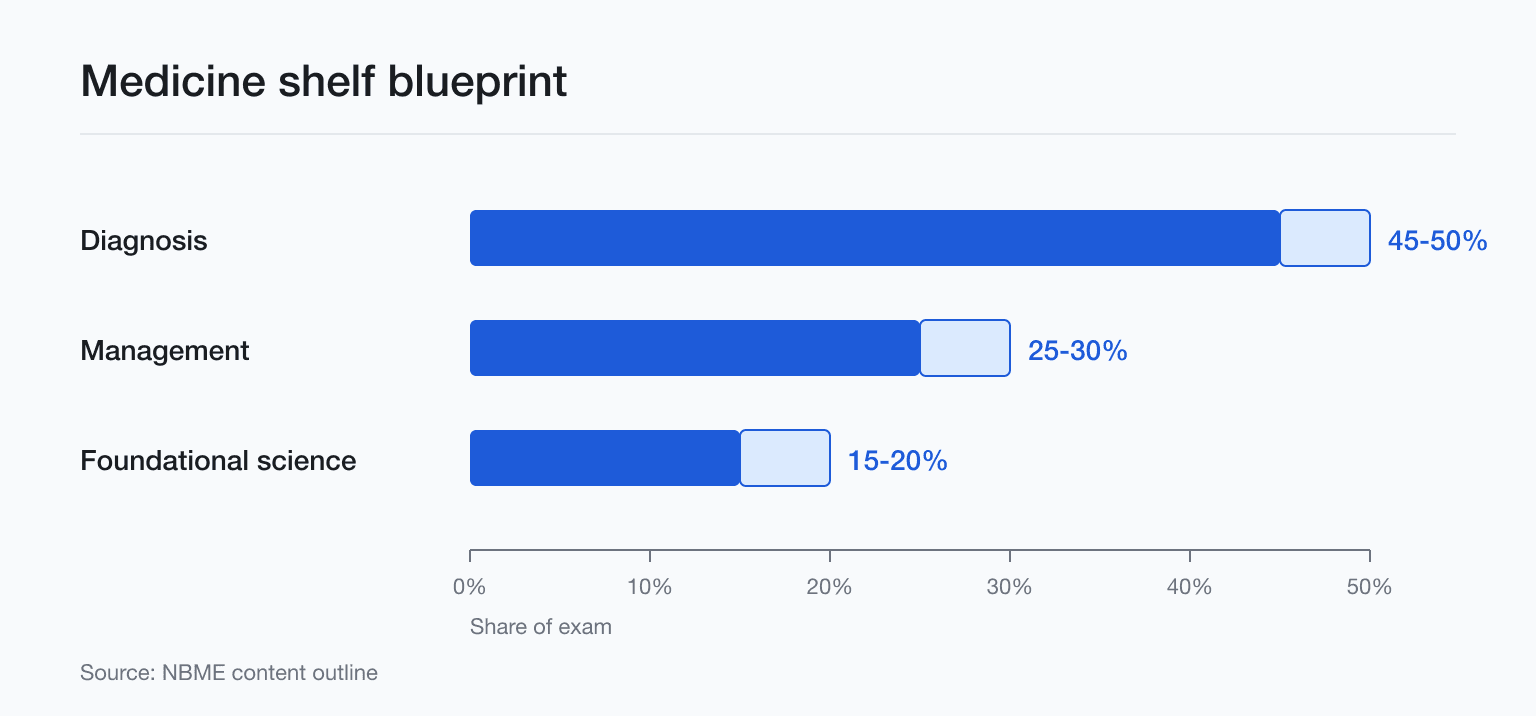
Weighting ranges from NBME Medicine outline. Source: NBME Medicine content outline, checked 25 November 2026.
In NBME's Medicine content outline, checked 25 November 2026, diagnosis questions make up 45% to 50% of the exam. Management is 25% to 30%, and applying foundational science 15% to 20%. So about half the exam asks you to work out what’s wrong from a history, exam findings and test results, not to recall isolated facts. NBME sample items use a clinical vignette and one question with A to E choices, checked 25 November 2026.
Example. Example. NBME's Medicine sample items open with a written patient story: age, symptoms, history, examination and test results. Then they ask one question, such as the most likely diagnosis, with five options labelled A to E.
How Diagnosica helps with this
Diagnosica isn’t a shelf question bank. It trains diagnosis-from-clues thinking.
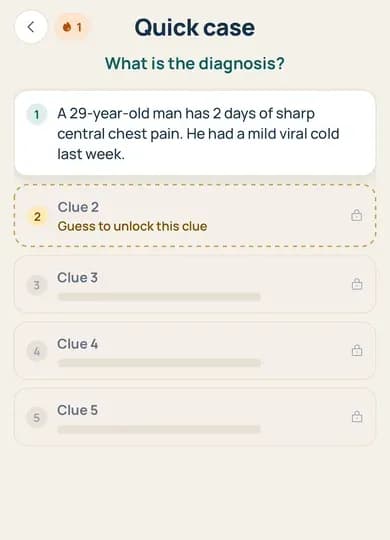
Diagnosica app, quick case screen, as of November 2026.
- The first clue is a short patient story.
- Type a diagnosis; a wrong guess unlocks the next clue.
- Up to five clues, then the answer and a short explanation.
Simulated patient. Screenshot from Diagnosica, November 2026.
Mistakes and myths beginners make
Common shelf exam myths mix up what gets tested, who sets pass lines, and how scores get used. Early on, you may hear that shelves mirror Step 2 CK, that NBME alone decides passing, and that the exam dominates the rotation grade.
Start by replacing these with the correct picture:
- Shelf vs Step: Separate from Step 2 CK, scored independently, Step-level rigor.
- Who sets pass: Schools set pass and honors using NBME grading guidelines.
- Shelf vs grade: May count toward rotation grade and the Medical Student Performance Evaluation (MSPE).
- Who writes it: Most US internal medicine clerkships use NBME; some schools write their own.
For sources and policy context, see Step 2 CK pass rules, how shelf exams are graded, and the AAFP rotation guide.
Watch out. Watch out. Failing one shelf usually means a retake or remediation, not the end of the rotation, per AAFP. Check your own clerkship handbook for your school's rule.
Where to go next
Start here: a practical map of third year, in a guide to third year. It covers what clerkships expect, how grading works at many schools, and how to plan time around call and exams.
Read how evaluations and exams feed into honors in how honors grades are earned.
Question banks train the multiple-choice format, and taking a history from an AI video patient trains the reasoning underneath. Try this to practice a clerkship patient, free.