Falls history OSCE: one case, the questions that matter
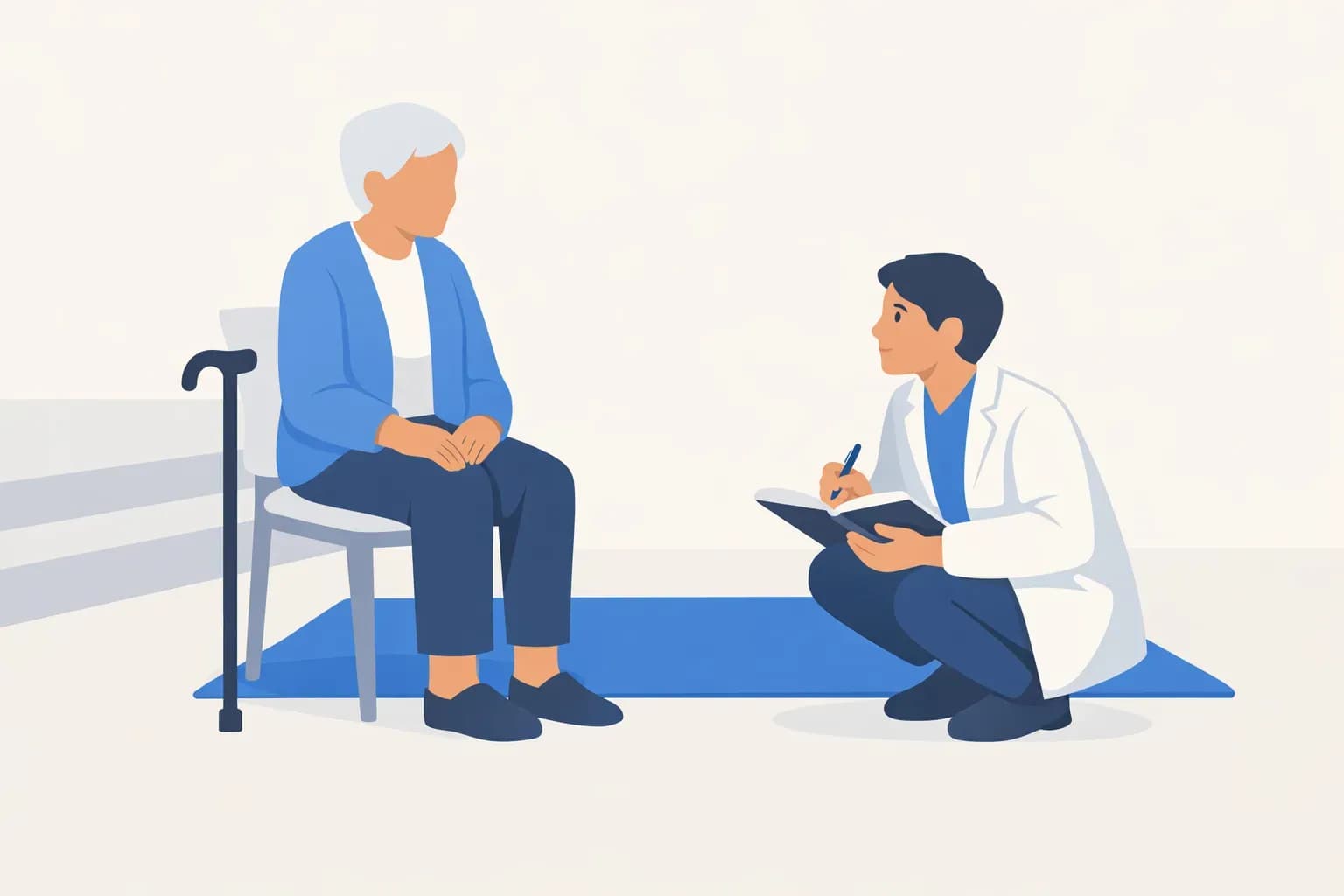
In a falls history OSCE, ask what happened before, during and after the fall, then whether they could get up alone. NICE NG249, 29 April 2025, lists "unable to get up independently after a fall" for full falls assessment.
Call 999 for a fall with inability to rise, or head, back, neck or hip injury (the NHS falls page). Back pain with both-leg weakness or numbness, or new bladder or bowel trouble, needs 999 or the emergency department (NHS back pain advice). This post is exam practice, not advice.
Key takeaways
- Ask before, during, after the fall, then whether they got up unaided.
- Simulated patient Terence gives 4 of 18 facts unprompted; 9 need a specific question.
- In his case, skipping bladder and bowel questions costs 15 of 25 history marks.
Terence's case in one line
Terence Aldworth, 72, simulated patient, retired warehouse supervisor, says his mid-back has hurt for about six weeks and "now my legs feel like lead." Near-fall presentation, caught his feet on the stairs twice this week.
Before reading on, take this history yourself.
Part | What the case file says |
|---|---|
Who he is | 72, retired warehouse supervisor, married, lives with wife, house with stairs |
Opening line | Mid-back pain six weeks; now legs feel like lead |
What he volunteers about falling | Legs heavy for a week, walking through water, caught his feet on the stairs twice |
His worry | Frightened of ending up in a wheelchair; hasn't told wife how bad legs are |
He is an atypical older faller. The near-falls are the clue. Diagnosica does not include gait or neurological examination practice.
A relative who saw him on the stairs could add detail, see a witness account of falls. His home has stairs, and the social history section is where that comes out.
What should you ask in a falls history OSCE?
In a falls history OSCE, cover the event before, during and after the fall. Ask whether they got up alone and how many falls in the last year. Screen for warning signs like dizziness or blackouts. Ask about medicines, continence, vision, hearing, mood, memory, alcohol, and fear of falling.
NICE NG249, published 29 April 2025, says ask 'the details of any falls' at presentation. It also says ask opportunistically 'whether they have fallen in the last year'. The guideline updates and replaces CG161.
Run this five-step sequence in an OSCE:
- Ask about warning signs, ask about the presence and nature of any dizziness (NICE wording).
- Clarify what happened, and any blackout or loss of consciousness.
- Establish whether they got up independently, and any injury needing treatment.
- Count falls, including whether there were 2 or more in the last year.
- Review medicines, continence, vision, hearing, mood, memory, alcohol, and any fear of falling.
NICE's triggers for a full assessment include loss of consciousness, injury needing treatment, unable to get up, and 2 or more falls.
If it sounds like a blackout, see the blackout station guide; if dizziness dominates, use the dizziness history guide.
For mnemonics, TalkOSCE's falls guide (30 April 2026, checked 18 November 2026) teaches SPLATT. It includes a table separating a mechanical fall from vasovagal and cardiac syncope.
For the rest, use a history station structure.
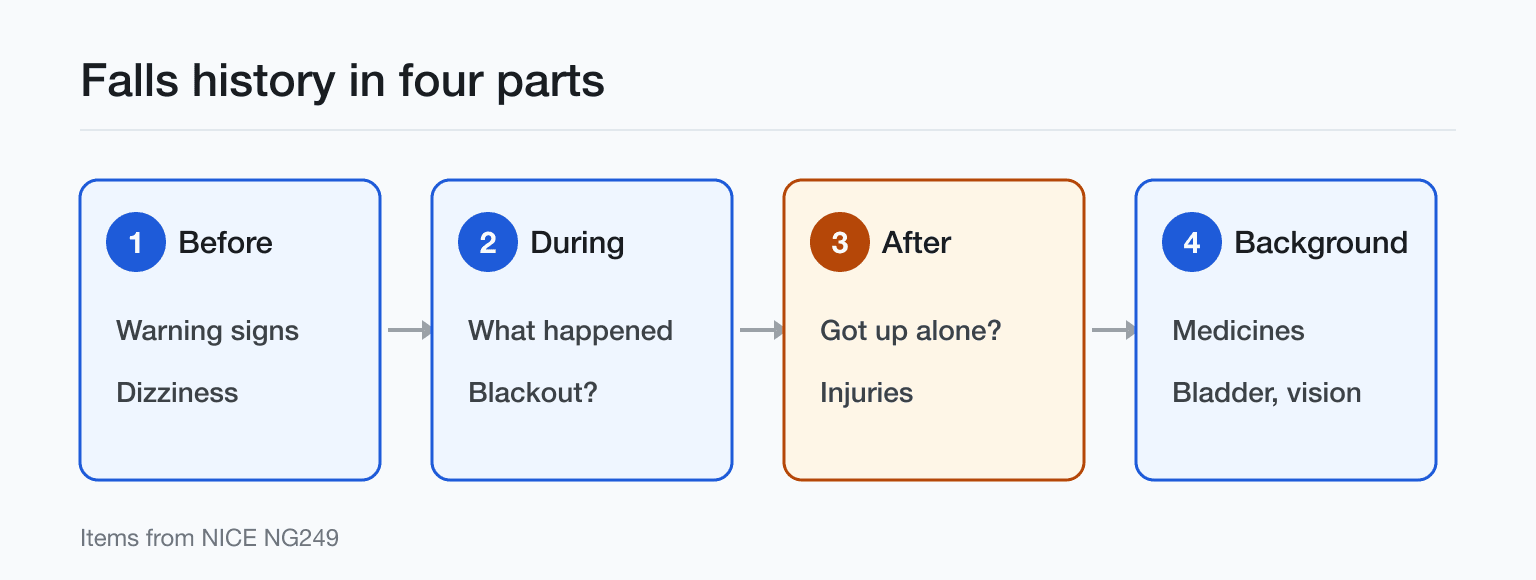
Flow of the four parts of a falls history, drawn from NICE NG249.
Falls history OSCE, four-part teaching layout, with items from NICE NG249. Before (warning signs, dizziness). During (what happened in detail, any blackout). After (could they get up independently, injuries). Background (medicines, bladder control, vision).
Terence's history, question by question
In the simulated case of Terence Aldworth, 72, a falls history OSCE lives on disclosure: of 18 scripted history facts, 4 are volunteered, 5 come on a general question, and 9 only surface with a specific question.
Terence, 72 (simulated): what he said, and what we had to ask
Chip | Question | Answer | Why it mattered |
|---|---|---|---|
Volunteered | "What's brought you in today?" | Mid-back pain for about six weeks, now legs feel like lead | Back pain plus new leg symptoms, so look past the trip |
Volunteered | "What happened on the stairs?" | Legs heavy for a week, like walking through water, caught his feet on the stairs twice | Two near-falls in a week; ask why each happened |
Asked | "Have you fainted, any chest pain or racing heart?" | No chest pain or racing heart, and he hasn't fainted | No blackout makes a faint less likely |
Only if asked specifically | "Any injury, a fall or heavy lifting?" | No injury, no fall, no heavy lifting | Nothing mechanical explains the pain |
Only if asked specifically | "Any change in passing water or opening bowels?" | Water hard to start for a few days; bowels not opened for three days, cannot feel the urge | Bladder and bowel change with heavy legs is a red flag |
Only if asked specifically | "Any numbness anywhere?" | A band of numbness round his middle at the bottom of his ribs | A level across the trunk points to the spine, not the feet |
He blamed the constipation on painkillers, which is why he never mentioned it. Ask about bladder and bowel every time.
Simulated patient. Questions written by us as a model, not a learner session.
How Diagnosica helps with this
Speak or type to an AI video patient, only your questions get answers.
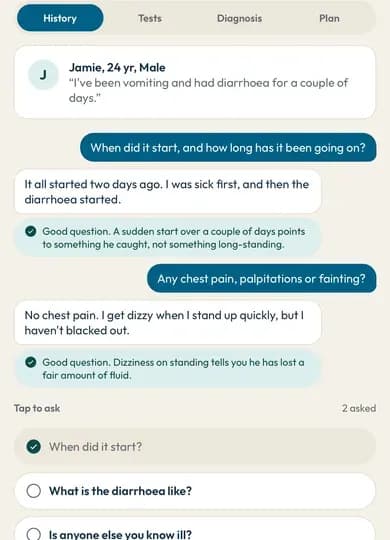
Diagnosica app, guided case history, November 2026. Another simulated patient shown.
- Guided cases use tap-to-ask questions.
- Answers only what you ask, here dizziness on standing.
- In real cases you ask anything, by voice or typing.
Simulated patient. Screenshot from Diagnosica, November 2026.
When a trip isn't a simple trip
In older patients who trip, focus on why the legs failed rather than the mechanics. With simulated patient Terence Aldworth, red flags surfaced when asked directly. The case lists 7 must-elicit red flags, and he volunteers two.
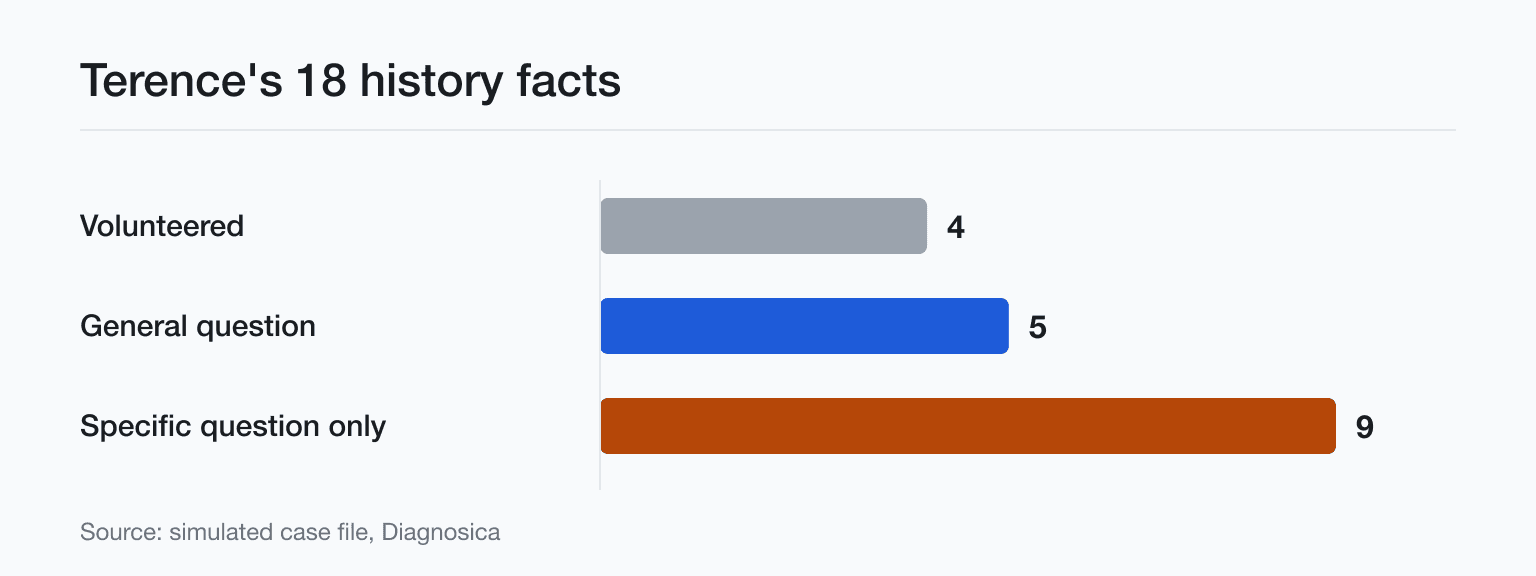
Bar chart of Terence's 18 history facts by how they come out, simulated case file.
In this simulated case, 4 facts are volunteered, 5 surface on a general question, and 9 appear only with a specific probe. Counts come from the disclosure tags in the simulated case file.
History is the tool here, so ask:
- Heavy legs: both legs heavy for a week, caught his feet on the stairs twice.
- Water start: water hard to start, straining for days.
- Bowels stopped: not opened bowels three days, can't feel urge.
- Girdle numbness: band of numbness around his middle, at the bottom of his ribs.
- Weight, prostate test: lost a stone in three months, prostate test up, never followed.
The NHS back pain page says both-leg weakness or numbness, or bladder or bowel changes, need 999 or the emergency department, and local trust guidance applies.
In the simulated case file, the diagnosis is metastatic prostate cancer causing spinal cord compression. Mechanical back pain and cauda equina syndrome appear as distractors. For a younger patient's lumbar red-flag screen, see the back pain worked case.
Watch out. The GP called it wear and tear; a label someone else gave is a hypothesis to test against the history, not a fact to inherit.
What the history marks reward
In Terence Aldworth's simulated case, the falls history OSCE communication domain is scored out of 25, one of four domains; the case marking key lists specific faults, and never asking about bladder or bowel function alone is a minus 15.
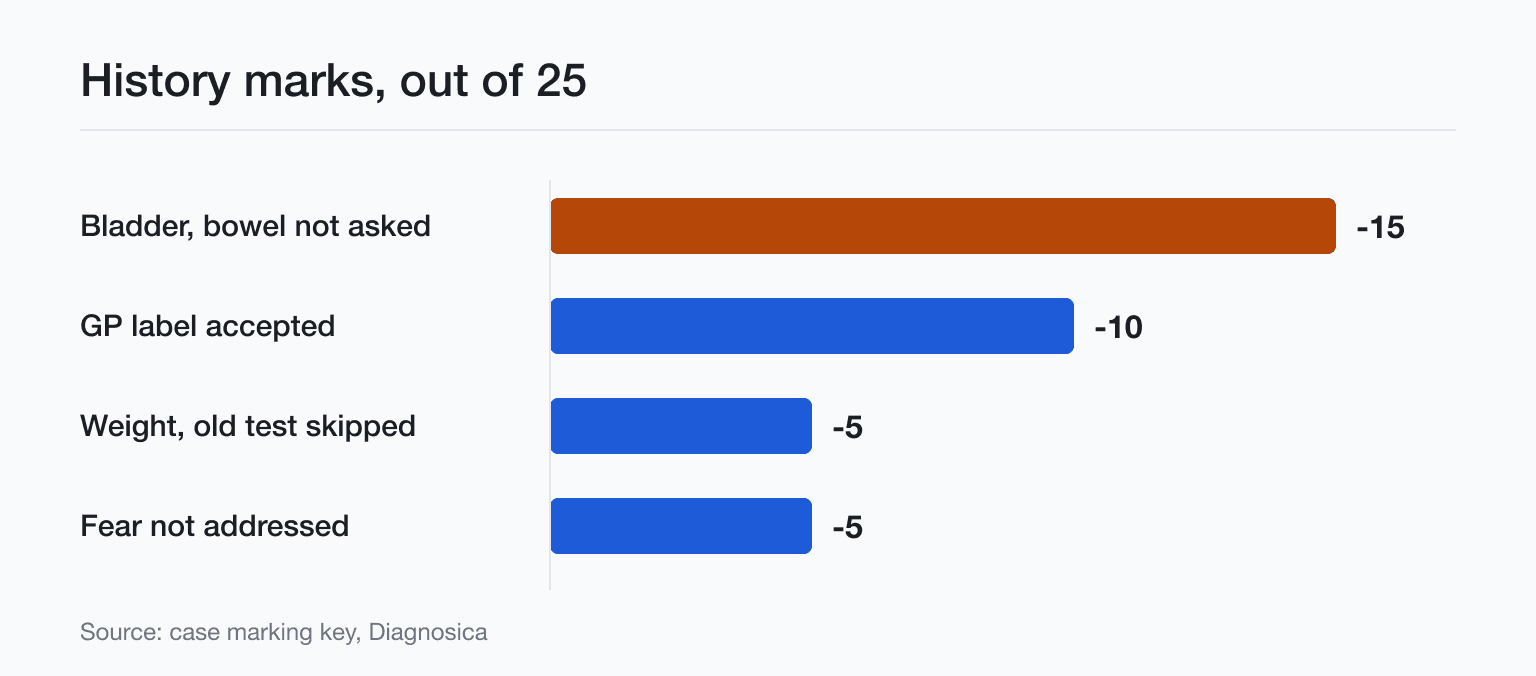
Bar chart of the four history faults in the simulated case's marking key.
The four penalties are weighted. Never asking about bladder or bowel function, minus 15. Accepting the previous label without testing it against the history, minus 10. Not exploring the ignored prostate follow-up or the weight loss, minus 5. Not addressing his fear of a wheelchair or leaving his wife out, minus 5.
Diagnosica shows a scorecard after every case, free and paid alike, and full-case scoring is a fixed checklist from the case author key. The gait, balance and neurological examination isn't in the app, so rehearse that half with a partner.
What to take away
Keep this habit: focus on why they fell, cover before, during and after, confirm whether they got up alone, and capture near-falls, per NICE's falls guideline too.
Practise the same habit across stations with the full OSCE station list. Then try another case.