OSCE stations list: the common stations, by type
Staring at an OSCE stations list that blurs? Most OSCE stations fall into five types: history taking, communication, data interpretation, physical examination and practical procedures. PLAB 2 runs 16 scenarios of eight minutes each, GMC, checked 18 November 2026.
If you’re weighing practice options to rehearse those station types, we’ve reviewed current simulators and apps in AI OSCE practice tools compared, with strengths, limits and what each one actually offers.
Key takeaways
- Plan hands-on exam practice elsewhere.
- Start with a history station and its worked guide.
- GMC CPSA: schools set finals, counts vary, GMC quality assures, checked 18 November 2026.
- Diagnosica library: 136 cases across 18 specialties, counted 18 November 2026.
Choose a history station from the list below. Then take that history with an AI patient, free to start, no card needed.
What are the main types of OSCE station?
OSCE stations group into five types: history taking, communication, data interpretation, physical examination and practical procedures. Examiners mark PLAB 2 scenarios in three domains, and AMC uses four focus areas. OSCEhub labels similar types as of 18 November 2026, while almostadoctor groups by body system. Schools mix names, and stations often blend types.
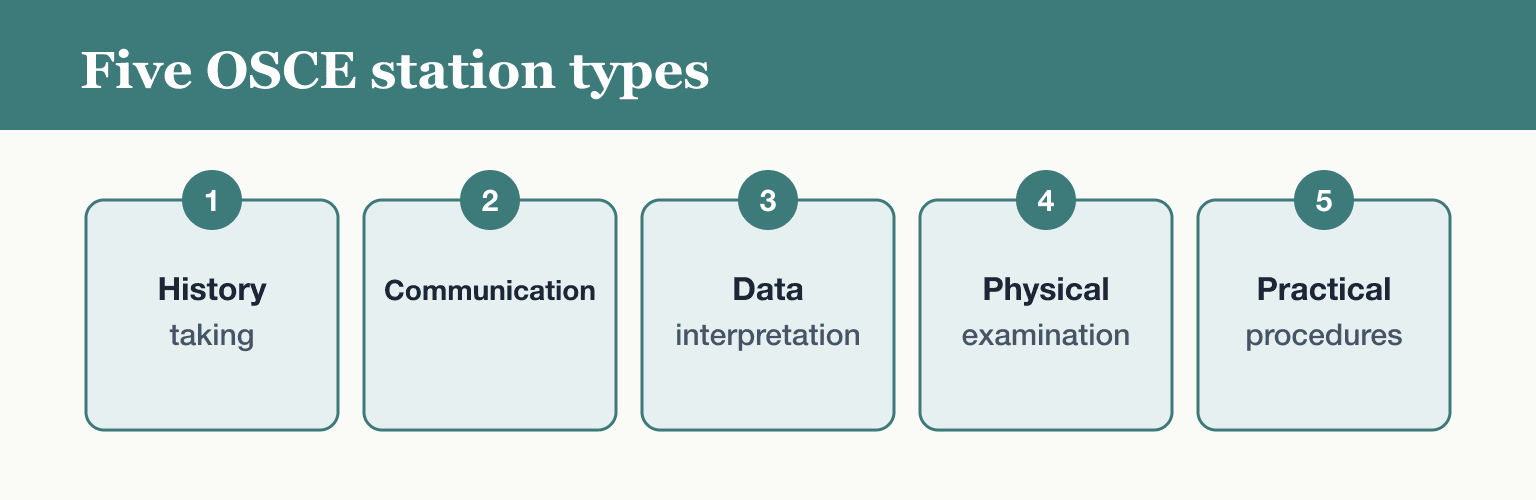
The five OSCE station types at a glance: history, communication, data interpretation, examination, and procedures.
- History taking: Appears in clinical exams, see the AMC clinical exam page.
- Communication: Explaining, breaking bad news and consent, see the PLAB 2 testing guide.
- Data interpretation: Interpreting an ECG, X-rays or other results, see OSCEhub station bank.
- Physical examination: The exam includes core physical examinations.
- Practical procedures: The exam assesses venepuncture, cannulation, suturing and catheterisation as practical skills.
How many stations are in an OSCE?
Station counts vary by exam. PLAB 2 has 16 scenarios of eight minutes with at least two rest stations, about three hours overall, checked 18 November 2026. AMC clinical exam has 16 assessed and four rest, result from 14 scored, checked 18 November 2026. Schools set UK finals CPSA, GMC quality assures it, checked 18 November 2026.
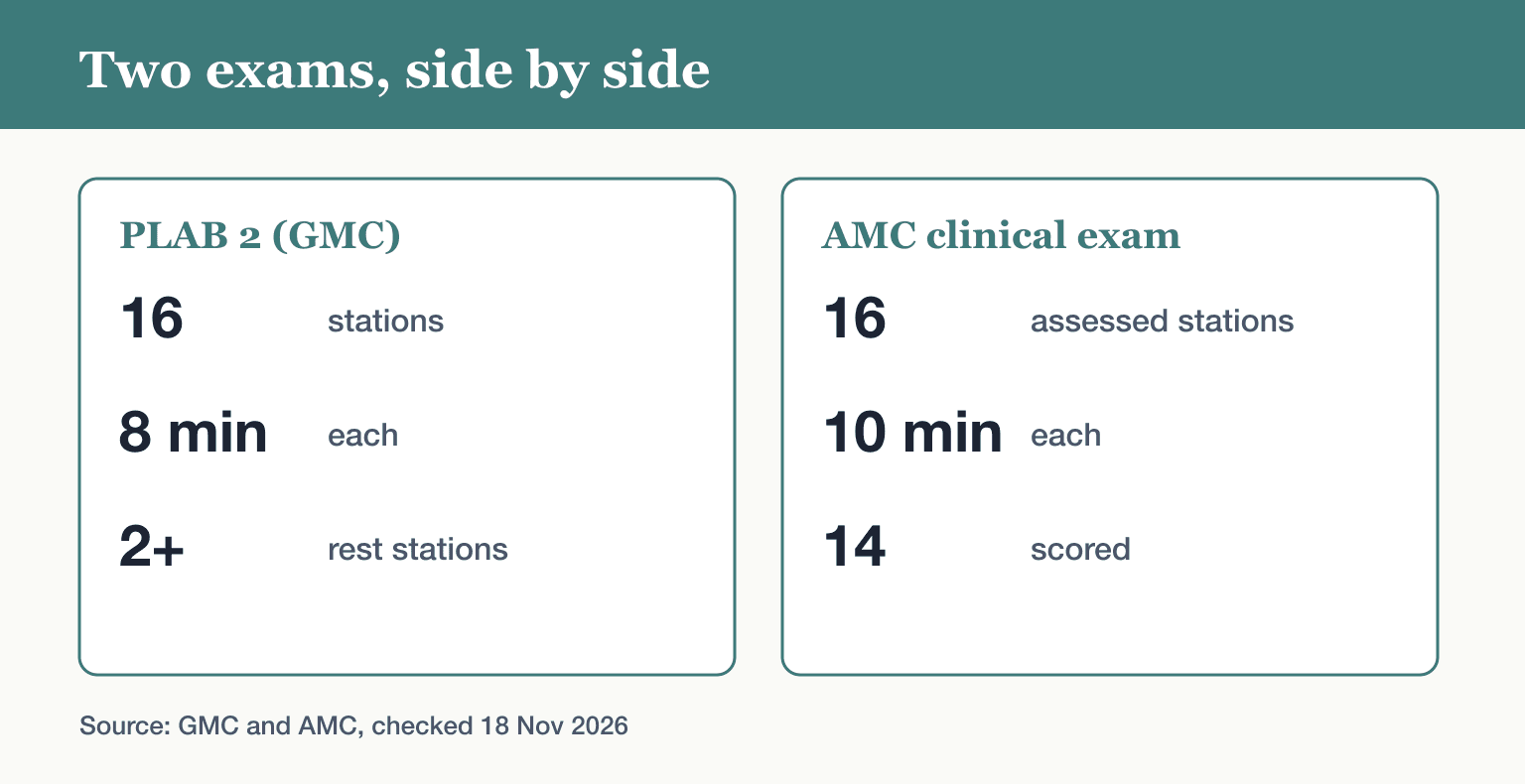
Station formats for PLAB 2 and the AMC clinical exam. GMC and AMC pages, checked 18 November 2026.
Exam | Stations | Time per station | Source |
|---|---|---|---|
PLAB 2 | 16 scenarios, at least 2 rest | 8 minutes | GMC, checked 18 November 2026 |
AMC clinical exam | 16 assessed + 4 rest, result from 14 scored | 10 minutes, 2 reading, 8 assessment | AMC, checked 18 November 2026 |
MCC NAC exam | 12, including 2 unscored pilots | 11 minutes | MCC, checked 18 November 2026 |
UK finals CPSA | Set by your school | Varies | GMC, checked 18 November 2026 |
The Canadian NAC has 12 stations, including 2 pilots, with 11 minutes per station, per the MCC NAC exam page, checked 18 November 2026. UK schools build CPSA stations around the MLA content map, which provides the framework for the content of the AKT and CPSA, checked 18 November 2026.
For full specifications see the GMC PLAB 2 guide and the GMC CPSA page. For how UK finals are scored, read the CPSA marking criteria guide.
History stations: chest, heart and lungs
Chest, heart and lungs stations go better with clear structure and tight time control. Use these guides to drill the common presentations.
Station guide | What the guide walks you through | Library cases (counted 18 November 2026) |
|---|---|---|
Conducting a focused cardiothoracic history in timed stations | 4 name chest pain | |
Running a structured respiratory history within exam constraints | 11 name breathlessness | |
Taking a concise respiratory history with clear signposting | 6 name a cough | |
Opening, organising and closing a safe cardiovascular history | 3 start with a collapse or blackout | |
Covering introductions, sequence and systems for cardiac histories | 8 cardiology cases | |
Covering introductions, sequence and systems for respiratory histories | 5 respiratory cases |
Counts come from each case's opening complaint; a case can sit in two rows.
History stations: abdomen, liver and kidneys
Abdomen, liver and kidney stations are focused OSCE histories, with guides to structure questions, timing and signposting.
Station guide | What the guide walks you through | Library cases (counted 18 November 2026) |
|---|---|---|
Structuring a focused abdominal pain history in an OSCE | 9 name abdominal pain | |
Covering a general GI history for timed OSCE stations | 14 GI cases | |
Structuring a focused swallowing history in an OSCE | 2 name trouble swallowing | |
Covering a jaundice-focused history for OSCE timing and fluency | 4 have turned yellow | |
Structuring a focused haematuria history in a timed OSCE | 3 name blood in the urine |
Use these when your OSCE station stem points to abdomen, liver or kidneys.
History stations: head, nerves, bones and joints
Head, nerves, bones and joints stations need clear, time-bound conversations and a repeatable structure you can reuse under pressure.
Station guide | What the guide walks you through | Library cases (counted 18 November 2026) |
|---|---|---|
Focused OSCE history, chronology, precipitating factors, daily impact, and context. | 12 name a headache | |
Clarify patient meaning, duration, precipitating factors, associated context, and risk. | 3 name dizziness | |
Efficient OSCE conversation on onset, course, functional effects, and context. | 8 name back pain | |
History structure on pattern over time, distribution, function, and context. | 5 name joint pain |
History stations: mental health, children, pregnancy and falls
Stations on mental health, children, pregnancy and falls pair best with worked guides and practice.
Station guide | What the guide walks you through | Library cases (counted 18 November 2026) |
|---|---|---|
Structuring a psychiatric history in an OSCE setting. | 5 psychiatry cases | |
Taking a paediatric history from a parent or carer. | 9 paediatrics cases | |
Taking an obstetric history for a pregnant patient. | 1 obstetric case | |
History taking focused on a recent fall event. | 3 start with a fall |
Only one female patient, counted 18 November 2026, so this isn't practice for women's health, gynaecology or obstetric stations; use a partner or your school's sessions for those.
History skills every station tests
Across stations, the same history parts earn marks. The GMC PLAB 2 testing page names open and closed questions and rapport in the interpersonal domain, checked 18 November 2026. Focus on repeatable structure and patient-centred questioning.
Skill | Guide |
|---|---|
Structure of a history | |
The presenting complaint | |
Patient's ideas and concerns | |
Negatives worth asking | |
Systems review | |
Social history | |
Closing summary |
History stations can be phone calls, as in the GMC's sample PLAB 2 station, with a 45 year old reporting head pain, 8 minutes, checked 18 November 2026. It asks for occurrences, location, duration, triggers, associated symptoms, and the patient's concerns.
For speed and calm, build mnemonics for each history, practise open versus closed questions, and use signposting between sections. Tune a focused history for occupational history, travel history, and timely collateral histories.
How Diagnosica helps with this
You take an OSCE-style history by voice or text, the AI patient answers.
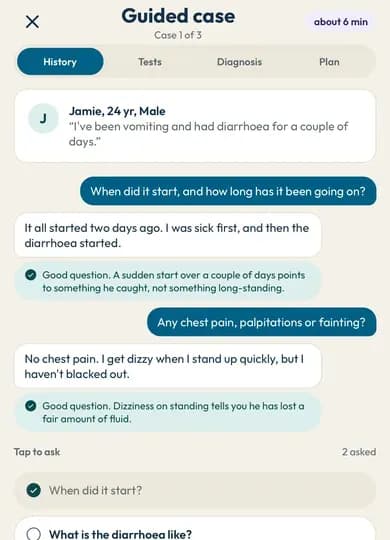
Diagnosica app, guided case history screen, as of November 2026.
- Jamie: vomiting and diarrhoea for two days.
- You ask onset, he says two days ago.
- Green note, Good question, explains why it mattered.
Simulated patient. Screenshot from Diagnosica, November 2026.
Communication stations
Communication stations test conversation skills rather than diagnosis. GMC PLAB 2 tasks include explaining a diagnosis, breaking bad news, seeking consent, dealing with anxious relatives, and giving discharge or lifestyle advice (checked 18 November 2026). Source: the GMC PLAB 2 testing page.
- Bad news stations: Keep it humane and structured under time pressure, with practical wording.
- Angry relatives guide: Defuse heat, set boundaries, keep care aligned and safe.
- Building rapport guide: Build trust early.
- Depressed patient interview: Ask sensitively without sounding scripted or cold.
- Talking to patients guide: Core phrases and early pitfalls.
The app has no counselling-only or explanation-only stations; the closest it gets is rapport and the patient's concerns inside a history.
Data interpretation stations
Data interpretation stations give you a result to explain. GMC PLAB 2 lists interpreting ECGs and X-rays and basic respiratory function tests, checked 18 November 2026. OSCEhub has murmurs, CXRs and ECGs inside stations, as of 18 November 2026.
OSCEhub sorts stations as History, Examination, Explanation, Data Interpretation, Procedures, Emergency, Communication and Mixed, as of 18 November 2026. It also says you can listen to murmurs, interpret CXRs and read ECGs inside stations. That breadth is a strength if you want image and trace practice.
The app is not ECG or X-ray reading practice. Inside a case you take a history from an AI patient, order tests and see results, then commit to a diagnosis and get a scorecard with teaching points. No reading drills. For ward-side basics, see reviewing blood results.
Examination and procedure stations
Examination and procedure stations are hands-on stations, so you use a partner or manikin, or your school’s clinical skills sessions. These aren't solo revision items. If you’re compiling an OSCE stations list, put these in a different bucket to history or data tasks.
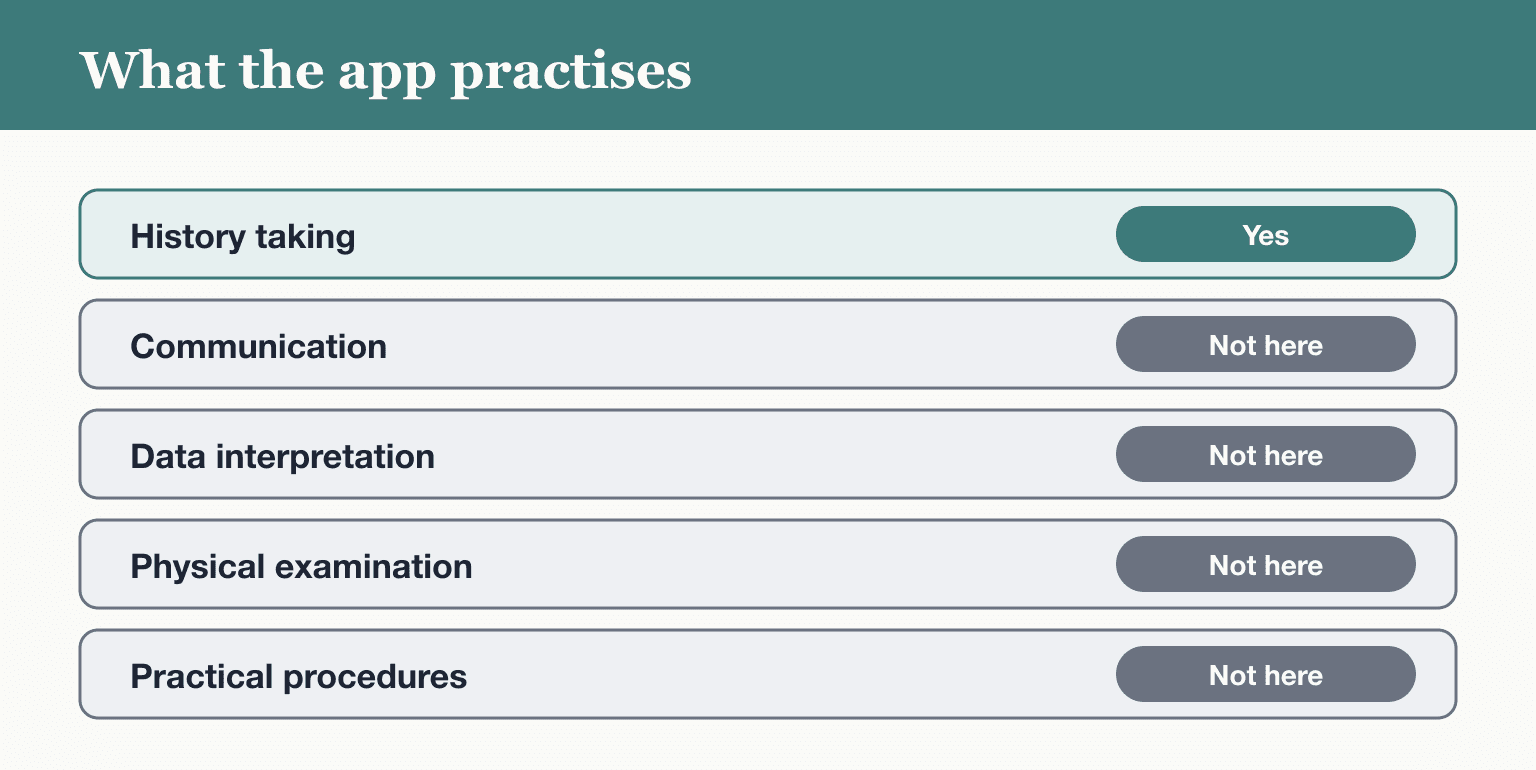
What Diagnosica covers: history taking only. No examination, procedures, communication-only, or data interpretation drills.
The GMC PLAB 2 testing page, checked 18 November 2026, expects basic exams of abdomen, breast, chest, hand, heart and joints, rectal or bimanual vaginal exams, ear, eye or nervous system with equipment. It says mental state examination counts as examination for PLAB 2. Some stations use a model, manikin or high-fidelity simulator, same source.
The same GMC page, checked 18 November 2026, says practical skills may include checking blood pressure, venepuncture, cannula insertion, injections, basic CPR, suturing, urinary catheterisation, taking a cervical smear and safe sharps disposal. The GMC practical skills list sets the core skills and minimum level new doctors need, as of 18 November 2026.
OSCEhub says its mark schemes are "threshold-based" and its examination stations cover ground we don’t, as of 18 November 2026. Diagnosica has no physical examination or procedure practice, and no case on this page should be read as examination practice.
What our case library covers
Our case library holds 136 cases across 18 specialties (counted 18 November 2026). Every case is a history-led interaction with an AI patient, where you can order investigations, commit to a diagnosis and receive a competency scorecard.
Cases by specialty, counted 18 November 2026:
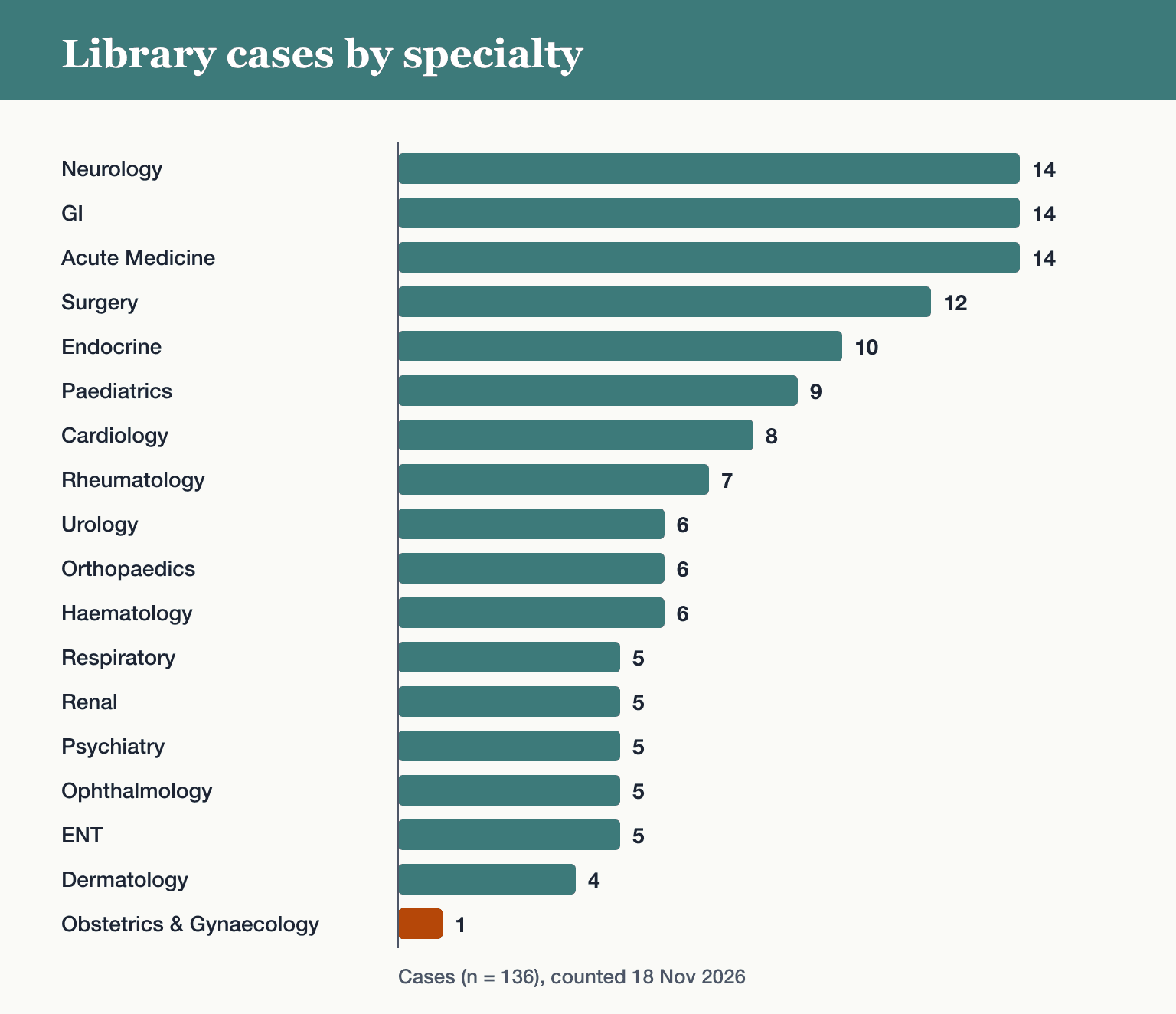
Diagnosica case library by specialty; Neurology, GI and Acute Medicine top at 14 each, counted 18 November 2026.
Specialty | Cases |
|---|---|
Neurology | 14 |
GI | 14 |
Acute Medicine | 14 |
Surgery | 12 |
Endocrine | 10 |
Paediatrics | 9 |
Cardiology | 8 |
Rheumatology | 7 |
Urology | 6 |
Orthopaedics | 6 |
Haematology | 6 |
Respiratory | 5 |
Renal | 5 |
Psychiatry | 5 |
Ophthalmology | 5 |
ENT | 5 |
Dermatology | 4 |
Obstetrics & Gynaecology | 1 |
135 of the 136 patients are male and the only female patient is an obstetric case, so the list above links women's health guides but the app does not practise those stations. It doesn't give advice about real patients, and it's not a diagnostic system. Treat every output as educational.
How to work through this OSCE stations list
To work through this OSCE stations list, pick one station type a week, read its guide, then say the history out loud against a timer. Keep it structured with one focused routine, and stick to spaced, weekly cycles for recall.
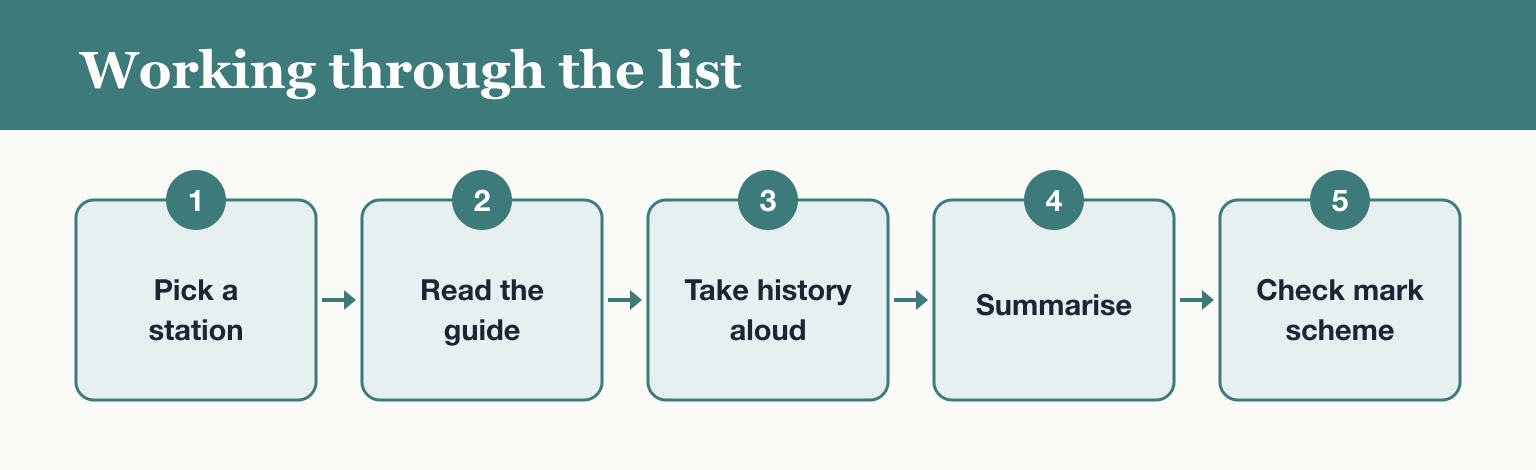
Use this loop on any history station: choose, read, speak, summarise, then check the mark scheme.
- Pick a station from the tables, if unsure of types read how an OSCE works.
- Read its guide, then plan your week with an OSCE revision timetable.
- Take the history aloud for eight minutes, PLAB 2's station length, GMC PLAB 2 guide, checked 18 November 2026.
- Close with a crisp summary, then reinforce your structure with solo station practice.
- Check yourself against the examiner's mark scheme, and note missed domains or unsafe cues.
If you want to try one now, jump into a random case and take the history, free to start, no card needed: Start a random history case.