How to get honors on clerkships: 10 surgery director traits

To get honors on clerkships, read your school's grading rules first, then build complete histories, deliver clear presentations, and keep up with shelf prep. A 2019 study found a median 34% received the highest clerkship grade, range 5% to 97%.
Key takeaways
- Before day one, read the policy.
- Use the 10 agreed traits from surgery directors to shape histories and presentations.
- Practice a full history before rounds and keep presentations short.
How do clerkship grades work?
Clerkship grading has no national standard, so your school's own policy decides what earns honors, how progress is judged, and what evidence counts in the final call. Read it before day one, write out the exact criteria in your notes, and check them against what your clerkship expects.
Westerman and colleagues (2019) studied 137 of 140 schools, 2016 to 2017, finding 19 different grading schemes; a 4-tier system was most common, at 31%. Alexander and colleagues (2012), using 2009 to 2010 data, showed the same word "honors" meant different things.
Before day one, find these in your school's policy:
- Who fills in your evaluations.
- Shelf exam weighting, schools differ.
- What share of last class earned honors, if published.
A small place to start: practice one history before rounds.
What share of students get honors?
Honors rates depend on the school, and the same label varies widely; in surgery the median was 32.5%, with schools spanning 5% to 67%, based on 86 schools in the 2017 Match cycle, a large but still incomplete national snapshot. Source: Vokes and colleagues.
[image pending: how-to-get-honors-on-clerkships-honors-share-by-clerkship]
Lowest, median and highest honors share per clerkship across schools, 2017 Match cycle, Vokes and colleagues 2020.
Medians sit between 32% and 41% across clerkships, while family medicine alone ranges from 5% to 96% across schools.
Clerkship | Median honors | Lowest school | Highest school |
|---|---|---|---|
Psychiatry | 41% | 10% | 88% |
Obstetrics and gynecology | 35% | 10% | 80% |
Family medicine | 33.5% | 5% | 96% |
Pediatrics | 33% | 5% | 72% |
Surgery | 32.5% | 5% | 67% |
Internal medicine | 32% | 7% | 80% |
The data come from applications to one orthopedic residency program, so treat them as a sketch. Schools that give more honors in one clerkship tend to do so in all.
What do directors say an honors student does?
An expert panel of 15 surgery clerkship directors and 14 program directors agreed on 10 traits for honors-level performance. This is consensus about surgery, not a study of who received the grade, and other specialties may differ, per a 2016 expert panel. The last column is our suggestion, not the panel's:
Group | Traits the panel named | Try this week |
|---|---|---|
Thinking | shelf exam score; outstanding clinical acumen; organizing data into meaningful care plans | say your plan for one patient out loud |
Patient work | accurate and complete history and physicals; communication skills | ask the patient one more clarifying question |
Team | becoming an essential member of the care team; outstanding work ethic; enthusiasm | offer to chase a pending test result |
Conduct | absence of professionalism issues; taking advantage of learning opportunities | show up on time and ask for feedback |
One history worked through: what comes out only if you ask
History-taking is something you control, and evaluators can hear it. In this simulated case, four of five key facts only surfaced when asked directly. Marcus Bell, 38, is a fictional AI patient.
Marcus Bell, 38 (simulated): what he said, and what we had to ask
Chip | Question | Answer | Why it mattered |
|---|---|---|---|
Volunteered | What brought you in today? | He reports three to four weeks of intermittent fevers and drenching night sweats | Weeks of fever signals a slow illness, not an acute one |
Only if asked specifically | Any heart problems or murmurs before? | He was told since childhood he has a murmur and a differently shaped valve | An abnormal valve changes how weeks of fever are interpreted |
Only if asked specifically | Any recent dental work or infections? | He had a back tooth taken out about six weeks ago | Recent tooth extraction gives the illness a plausible starting point |
Only if asked specifically | Any skin or nail changes, tender spots on fingers? | He has thin dark streaks under fingernails and tender fingertip lumps | Fingertip findings make a valve-related cause more likely |
Only if asked specifically | Any brief weakness, speech trouble, or vision changes recently? | A few days ago he had slurred speech and a weak right arm for about ten minutes | A transient neurological episode raises the urgency of the clinical picture |
Four of these five facts took a specific question; try it in your own words next.
Simulated patient from the Diagnosica case library. Questions written by us as a model, not a learner session.
How Diagnosica helps with this
Practice clerkship histories: you ask, the AI patient answers, by voice or typing.
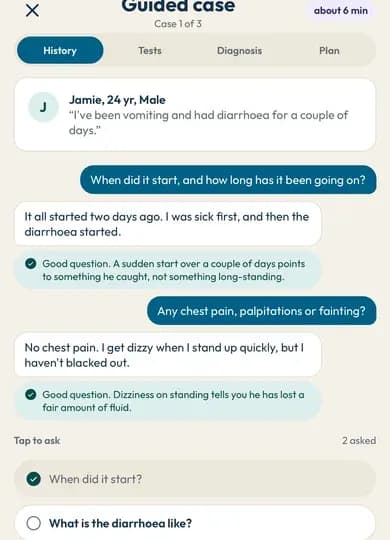
Diagnosica app, guided case history screen, as of November 2026.
- You ask a question and the AI patient answers.
- A note explains why that question helped.
- In full cases, ask anything by voice or typing.
Simulated patient. Screenshot from Diagnosica, November 2026.
How do you move from reporter to interpreter?
RIME describes trainee growth from reporter to interpreter to manager to educator, and moving up means adding your take on the facts to the raw data. Pangaro set out this vocabulary in 1999. In plain terms, a reporter says what was found, and an interpreter says what it probably means, and why.
The source is a paper, Pangaro's RIME vocabulary, describing the stages. We can't say which schools use it.
[image pending: how-to-get-honors-on-clerkships-rime-reporter-to-educator]
The four RIME stages, from Pangaro 1999; the short descriptions are our plain-English reading, not the paper's wording.
Reporter says what was found, interpreter what it means, manager what to do about it, educator what they read and teach others.
On rounds, move beyond reporting by giving your read and being ready for questions, and start with answering an attending's question. Here is a quick contrast:
Example. Reporter: 38-year-old man, weeks of fevers and night sweats. Interpreter: Adds the childhood murmur, the tooth out six weeks ago, the fingertip findings, and says he's worried about the heart valve.
[image pending: how-to-get-honors-on-clerkships-what-asking-adds-to-a-history]
How the simulated Marcus Bell history builds, from what he volunteers to what asking adds to the presentation.
He opens with fevers and exhaustion; specific questions add the murmur, the tooth, the fingertips and the speech episode, and the presentation gains a read.
How to work toward honors on your next clerkship
No routine guarantees the grade; these steps track what the directors named and what you'll do as a resident anyway; start them on your next service.
Use these seven actions:
- Read the grading policy, then ask who evaluates you.
- See patients before rounds, using pre-rounding on your patients.
- Take a complete history, and document what wasn’t volunteered.
- Present tightly with tightening your rounds presentation.
- Commit to a ranked differential, say why, using ranking your own differential.
- Ask for midpoint feedback, while there’s time to change something.
- Study daily for the shelf with daily active recall.
The AAMC's core activities list 13 day-one tasks, including gathering a history (EPA 1) and giving an oral presentation (EPA 6), so this work carries over.
For more, see the day-to-day clerkship routine and the first months of residency.
What if you don't get honors?
A missed honors grade says less than it feels like, and it shouldn't define your year or your trajectory. In a national review of 119 US schools (2009-2010 data), the top-grade share inside a single school swung from 18% to 81% between clerkships.
In that review, 97% earned a top-three grade and under 1% failed a required clerkship, per the same 2012 review. Vokes and colleagues say surgery clerkship grades are unreliable for comparing applicants across schools, and that class rank deserves attention.
Watch out. Next step after a disappointing grade: request evaluations and pick one change. Don't overcorrect.
For a sense of the debate, read a long Student Doctor Network thread.
If you're thinking about habits after graduation, UK included, see the UK new-doctor year.
Before tomorrow's rounds, run a case tonight.