Weight loss history OSCE: unintentional weight loss, one worked case
In a weight loss history OSCE, ask how much, over how long and with what appetite, then about fever, sweats, medicines, travel and contacts. NICE NG12 flags over 5% unexplained loss in 6 months at 60 and over.
The NHS says to see a GP if you keep losing weight without changing your diet or exercise routine (the NHS weight loss page). Go sooner if there are other symptoms. This post is exam practice.
Key takeaways
- Ask 3 measures: amount lost, time course, appetite fell or rose.
- Simulated patient Roger volunteers 4 of 18 history facts; 11 need a specific question.
- Skipping travel, contact and immune-drug questions costs 15 of 25 history marks.
Roger's case in one line
Roger Mowbray, 52, simulated patient, a council surveyor with rheumatoid arthritis, married with two grown-up daughters. He opens with, "I've had a fever for two months and I'm melting away", and he's lost nearly two stone without trying.
If you take Roger's history yourself before reading on, you take it from an AI patient on video, by voice or by text.
Part | What the case file says |
|---|---|
Who he is | Council surveyor, 52, married, two grown-up daughters, rheumatoid arthritis. |
What he volunteers | Daily fever for two months, climbs afternoons and evenings; drenching night sweats; about 11 kg lost, no appetite. |
What has happened so far | Two clinics sought lymphoma or other cancer; CT and PET scans gave no answer. |
His worry | He fears lymphoma or another cancer, and nobody has given him a diagnosis. |
In a weight loss history OSCE, the weight loss is the headline, but the answer hides in unasked questions. Diagnosica has no physical examination practice, so no lymph node or abdominal examination here. Recognise the pattern and refer.
What to ask in an unintentional weight loss history
An unintentional weight loss history OSCE starts by confirming it's unintentional: no change in diet or exercise. Then quantify how much over how long in kilos or stone. Ask appetite down or up, then sweep for associated symptoms. Close with medicines and new treatments, travel and residence history, and household or close contacts.
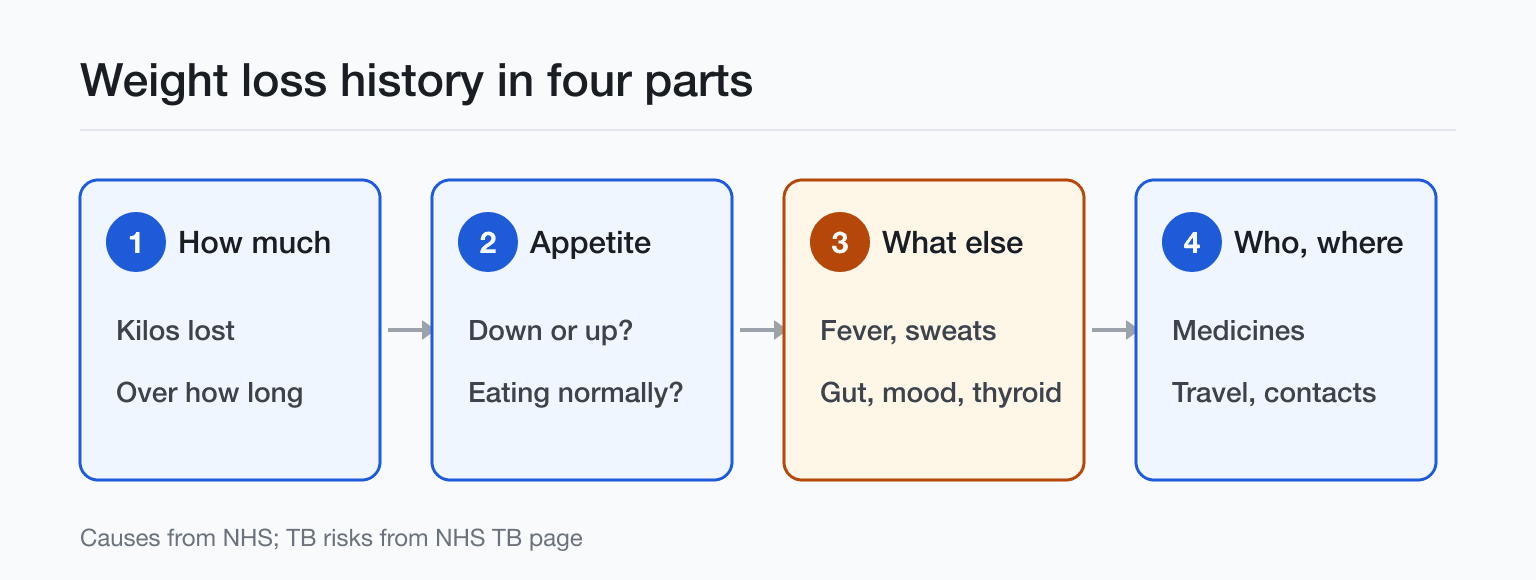
Four prompts for unintentional weight loss: quantify, appetite, other symptoms, exposures. Teaching layout, not a NICE algorithm. See NHS weight loss and NHS TB risks.
Use this five-step flow in weight loss history taking stations and on the wards:
- Quantify the loss: kilos or stone lost, over what time, clothes or rings now loose.
- Ask about appetite: reduced, normal, or increased.
- Screen for other symptoms: fever, night sweats, gut issues, swallowing difficulty, low mood, thyroid and thirst symptoms.
- Take the medicines history, including any new injection or immune-suppressing treatment.
- Ask where they were born and have lived or worked, and who they've lived with.
The NHS lists causes including stress, depression, anxiety and eating disorders, coeliac disease and inflammatory bowel disease. Overactive thyroid or type 1 diabetes, heart failure and medicine side effects are listed too (the NHS causes list).
TalkOSCE's weight loss guide (dated 30 April 2026, checked 25 November 2026) has a clear table splitting reduced appetite from preserved appetite. Confetto's weight loss guide (updated 11 November 2026, checked 25 November 2026) works through a percentage calculation against the NICE threshold.
If swallowing or bowel symptoms lead, switch to a full GI history; for the rest use a history station framework.
Roger's history, question by question
In the simulated case file, Roger Mowbray has 18 scripted history facts. Of these, 4 are volunteered, 3 on a general question, and 11 only on a specific question.
Roger, 52 (simulated): what he said, and what we had to ask
Chip | Question | Answer | Why it mattered |
|---|---|---|---|
Volunteered | Weight and appetite? | about 11 kg, nearly two stone, in two months, no appetite, wedding ring falls off | a big, fast loss with appetite gone; keep going |
Asked | Any cough or chest symptoms? | hardly any cough, no phlegm, no blood; "the one thing that's fine" | a quiet chest is not the end of the question |
Only if asked specifically | Any new medicines or injections? | started a new injection for his arthritis five months ago, no TB test before it | immune-suppressing treatment changes what fever and weight loss can mean |
Only if asked specifically | Where have you lived or worked? | most of his twenties on construction sites in India | time abroad is part of the risk history |
Only if asked specifically | Anyone at home ever unwell with a cough? | as a teenager shared a bedroom with his father, who coughed for a year and was sent to a sanatorium | an old household contact |
Only if asked specifically | Any confusion, dizziness or skin change? | confused and slow at times this week; dizzy on standing, craving salt, skin darker | new symptoms beyond the weight loss |
Simulated patient. Questions written by us as a model, not a learner session.
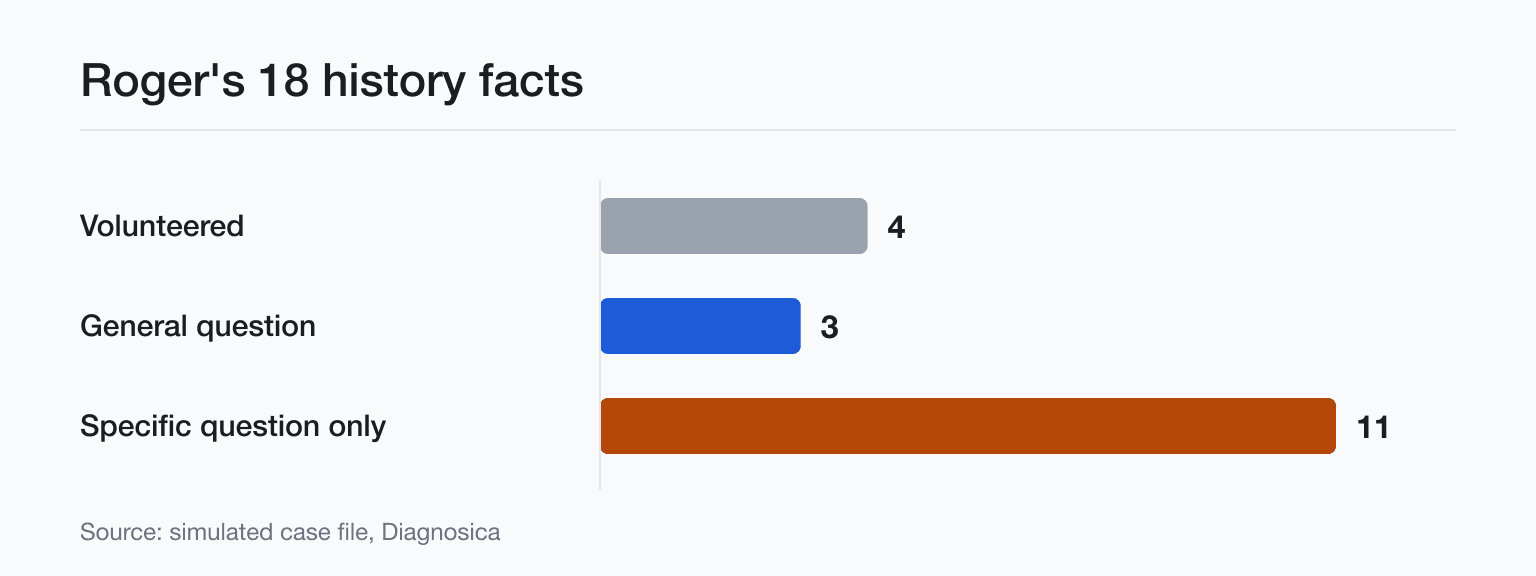
In simulated patient Roger Mowbray, 52, 11 of 18 history facts appeared only on specific questions. Four were volunteered, three came on general prompts.
Build the habit of asking where they have lived when weight loss feels unexplained, then finish with the systems review sweep.
How Diagnosica helps with this
Voice-first: you speak, the AI patient answers what you ask, or you type.
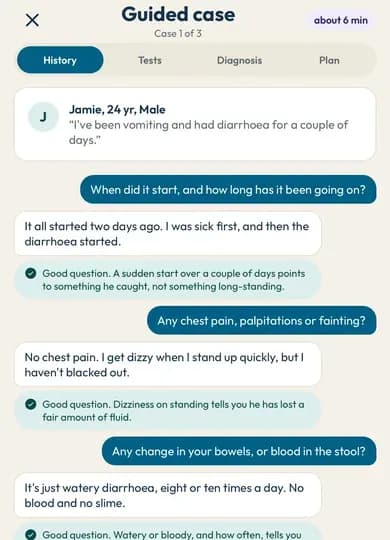
Diagnosica app, guided case history, November 2026. Another simulated patient shown.
- Guided cases use tap-to-ask questions
- Each reply gets a short why-it-mattered note
- In real cases you ask anything, by voice or typing
Simulated patient. Screenshot from Diagnosica, November 2026.
Unintentional weight loss red flags and NICE NG12
In a weight loss history OSCE, your job is to recognise urgent referral triggers and say so. You should point out that local trust guidance applies. You are not planning investigations. "Sometimes weight loss and loss of appetite can be caused by cancer" NHS advice.
Treat these as NICE NG12 red flags:
- Aged 60+ with over 5% weight loss in 6 months, offer urgent investigation or suspected cancer referral (NICE NG12 1.13.2).
- Any dysphagia, or aged 55+ with weight loss plus upper abdominal pain, reflux or dyspepsia, refer on a suspected oesophageal cancer pathway (NG12 1.2.1).
- Unexplained lymphadenopathy or splenomegaly, consider suspected lymphoma referral, factoring fever, night sweats and weight loss (NG12 1.10.6).
For the swallowing branch, see the dysphagia worked case.
Roger Mowbray, a simulated 52-year-old, does not meet the 60+ threshold; fever, night sweats and weight loss were why two clinics chased lymphoma. In the case file the diagnosis is miliary tuberculosis, with lymphoma, sarcoidosis, HIV infection and leukaemia as distractors.
The NHS TB page lists "a high temperature or night sweats" and weight loss. Risk is higher if you lived where TB is common or take "biologic medicines for inflammatory conditions".
Watch out. A label another clinic gave is a hypothesis to test with risk questions, not an answer to inherit; Roger's quiet chest never closes the question.
What the history marks reward
In Roger's simulated case, the history domain is scored Communication /25, one of four domains. Never taking a TB exposure or immunosuppression history costs 15 marks on unintentional weight loss history scoring.
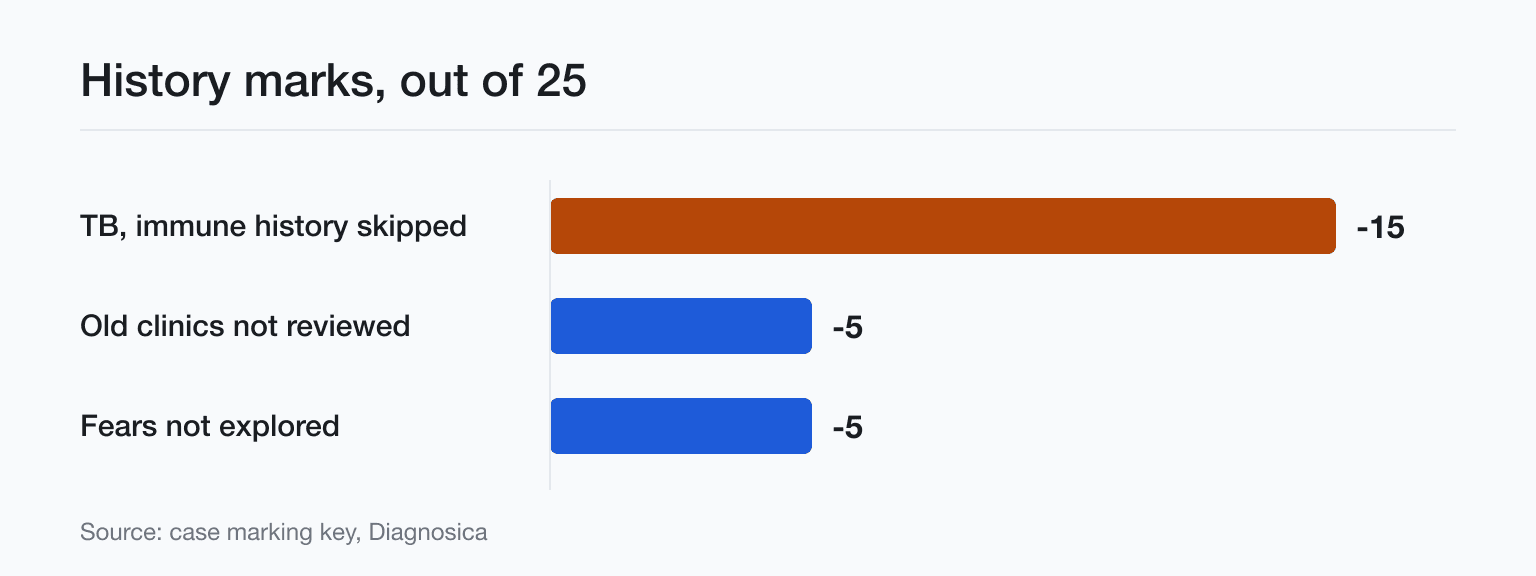
History, 25 marks: missing TB exposure or immunosuppression costs 15. Not reviewing prior clinics costs 5. Not exploring fears costs 5.
In a weight loss history OSCE, marks go to asking about country of birth, time abroad, household and childhood contacts, and immune suppressing drugs. The other two faults are 5 each. Not reviewing what previous clinics concluded and why is one fault. Not exploring his ideas and fears after two months of uncertainty is the other, including asking about cancer fears.
Diagnosica shows a scorecard after every case, free and paid alike.
What to take away
Build a weight loss history habit: quantify how much and how fast, appetite change, then what else. Always ask who and where: medicines, travel, contacts. In Roger's simulated case, 11 of 18 facts needed a specific probe.
Next station: place the seizure history station next to this one in your head. Then run the full station on any device.