Neurological history taking: a step-by-step guide
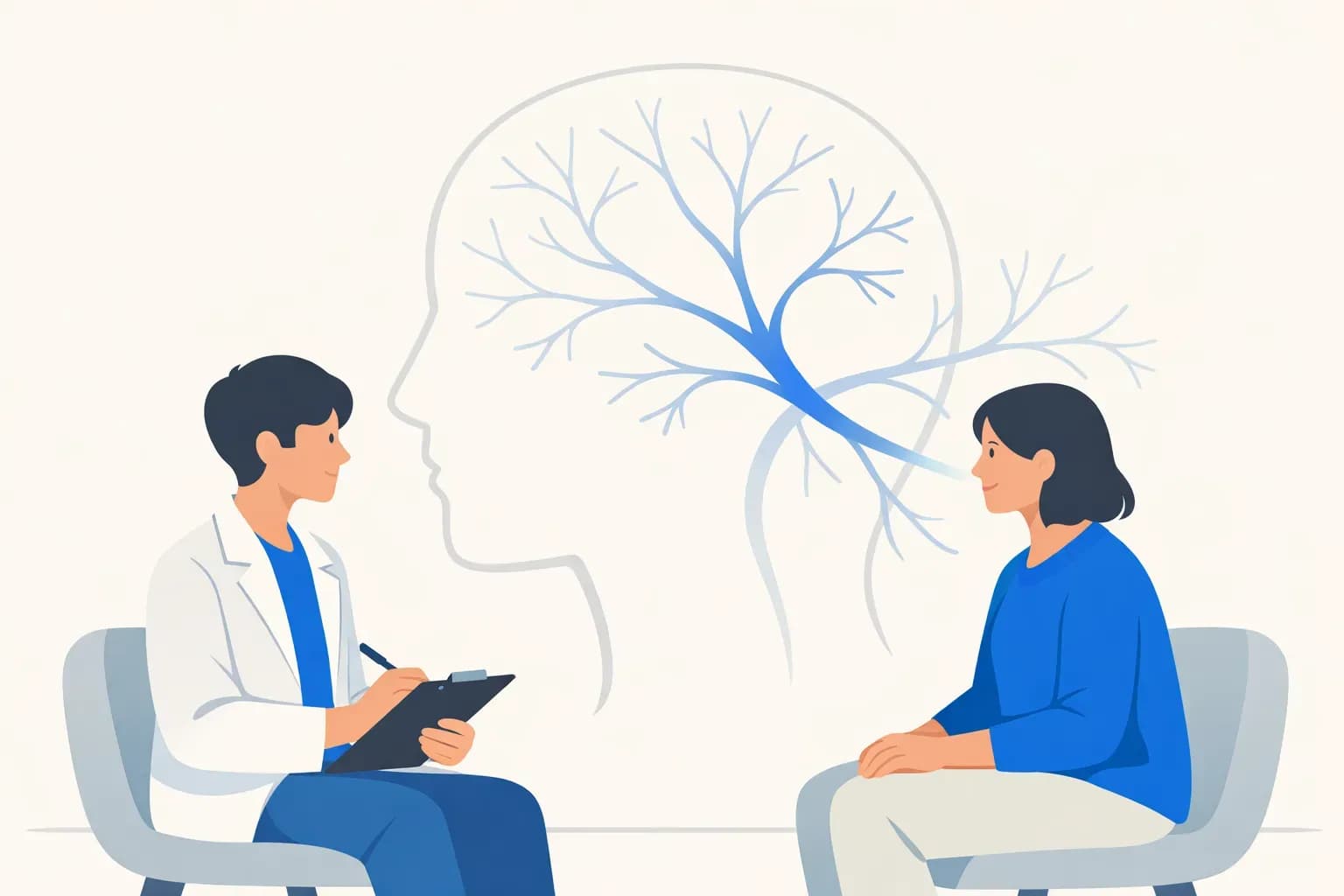
Neurological history taking starts with onset and tempo: sudden, over days to weeks, or gradual over months. NICE NG127 links sudden-onset unsteady gait to the stroke and TIA guideline, and days-to-weeks gait ataxia to suspected cancer pathway neurological assessment.
Key takeaways
- Ask when it started and how fast, before anything else in neurological history taking.
- Sudden neurological symptoms go down stroke pathways, and NICE NG128 says not to use ABCD2.
- Craig: 9 of 15 facts needed specific questions.
Start with onset and tempo
Neurological history taking starts with onset and tempo. Ask when symptoms began and how quickly they changed. Tempo sorts urgency and patterns, so anchor the story before character, triggers or associations, then work forward from the first abnormal moment.
On a neuro station or during ward clerking, a patient may report feeling unsteady or vague dizziness. Your first job is dates and speed: sudden, over days to weeks, or gradual over months.
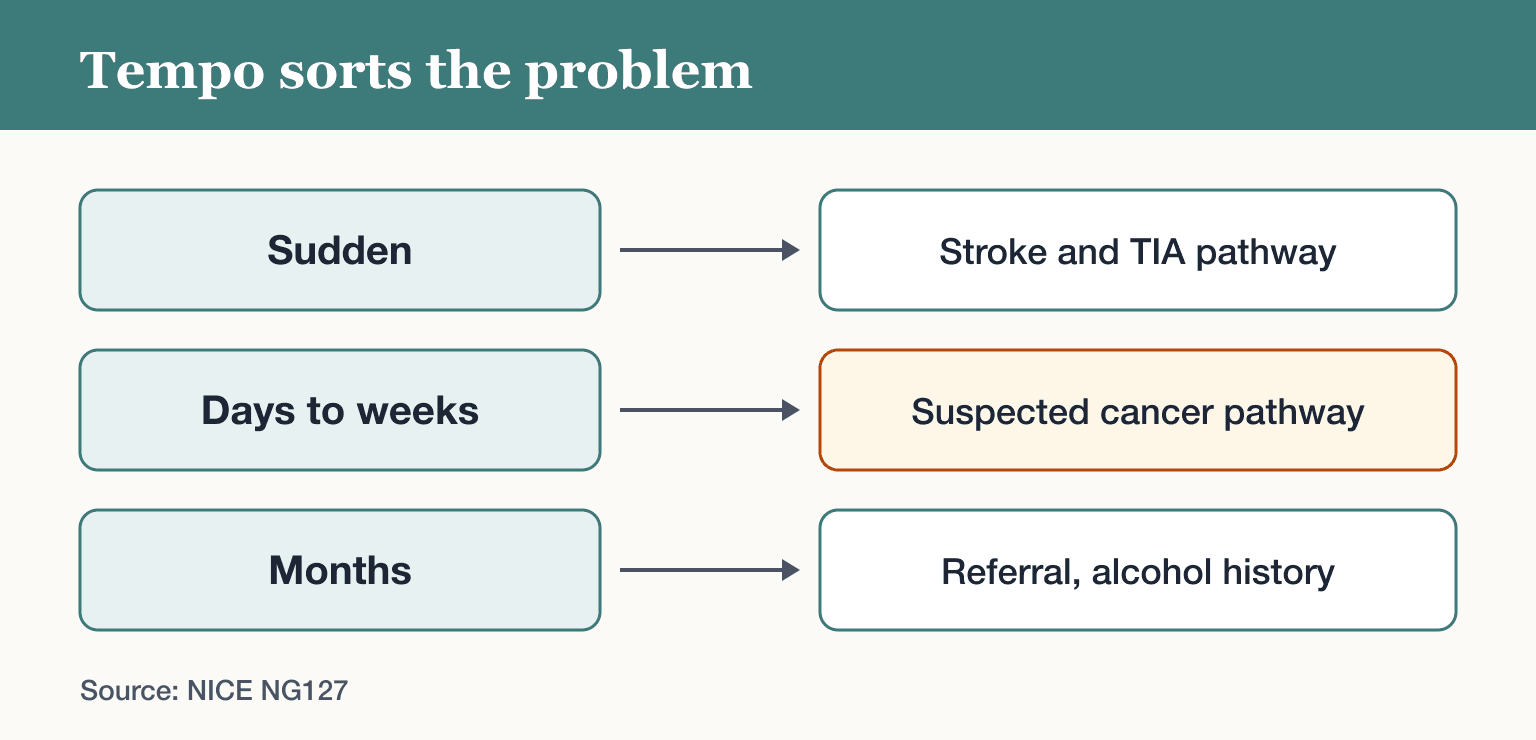
Sudden onset, see stroke and TIA guidance; days to weeks, suspected cancer pathway; months, refer and take an alcohol history. Source: NICE NG127.
NICE NG127 draws clear lines. Sudden-onset unsteady gait should trigger the stroke and TIA pathway. Rapidly progressive gait ataxia within days to weeks needs suspected cancer pathway referral. Gradually progressive gait ataxia merits referral and an alcohol history. See the referral details in NICE's neurological symptoms guideline.
To practise questioning, take this history from an AI patient; the AI patient appears on video and answers by voice or text.
Neurological history questions, in order
Keep it structured. Start with an open question, then move symptom by symptom. Return to the standard history order when you need anchors. Your aim is clarity on onset, pattern, affected systems and function:
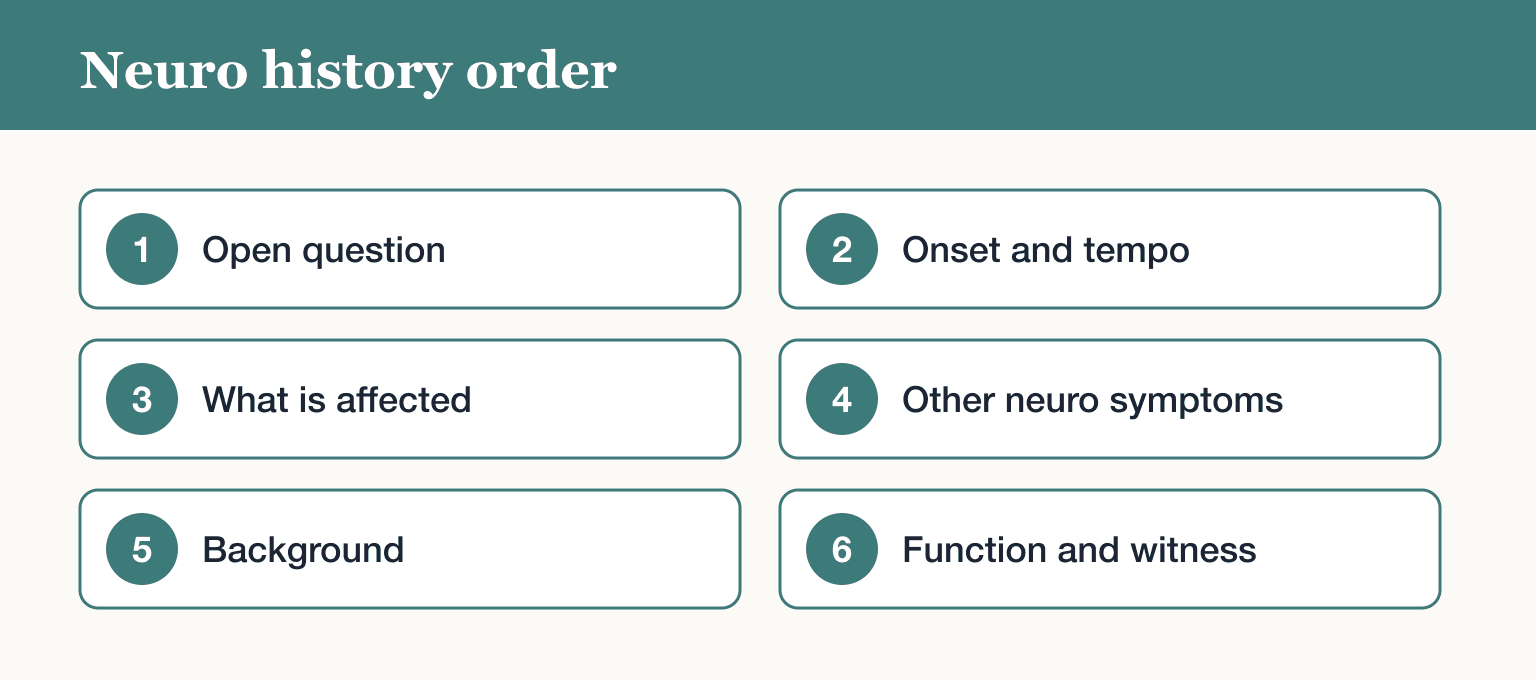
Open broad, pin down onset and tempo, then map function and witness input. Six repeatable steps for neurological history in exams and on wards.
- Open the conversation, ask what brought them and let them talk without interruption.
- Pin down onset, tempo and pattern, sudden or days to weeks or months, constant or episodic.
- Ask what exactly is affected, weakness, numbness or tingling, speech, vision, balance, memory.
- Screen the other neurological symptoms, headache, blackouts or fits, dizziness, confusion.
- Cover past history including operations, medicines, alcohol and family history.
- Ask about function and safety, work, driving, falls, and who saw it happen.
For single symptoms, go step by step: the headache OSCE guide, a dizziness history walkthrough, the syncope OSCE guide, and a seizure history. Each symptom has its own deeper post.
Worked case: Craig, 42, unsteady and confused
Craig is a simulated AI patient from our library. His wife does most of the talking. Opening line: "He's been getting unsteady on his feet and confused for about ten days." Staff labelled him drunk, though he doesn't drink alcohol.
Craig, 42 (simulated): what his wife said, and what we had to ask
Chip | Question | Answer | Why it mattered |
|---|---|---|---|
Volunteered | Can you describe his walking? | Walks with legs wide apart, like a drunk man, can't walk without holding on. | Wide-based gait and progression shape the tempo. |
Volunteered | Does he drink alcohol? | He does not drink alcohol. | Points away from alcohol as the main cause. |
Asked | Have his eyes been flickering? | His eyes flick from side to side. | Second neurological sign beyond gait, uncovered only by asking about eye movements. |
Asked | Any weight change recently? | About 35 kilos lost since the operation. | Large loss suggests nutritional issues as a driver. |
Only if asked specifically | What operation did he have, and when? | Weight-loss surgery four months ago, sick almost every day since. | Surgery and vomiting point towards a cause beyond alcohol. |
Only if asked specifically | Any weakness, face droop or slurred speech? | No limb weakness, no facial droop, no slurred speech. | Negatives reduce the likelihood of an acute stroke. |
Without the specific questions, the recent weight-loss surgery and the stroke negatives would have stayed hidden.
Simulated patient. Case file from our library. Questions written by us as a model, not a learner session.
Nine facts needed specific questions
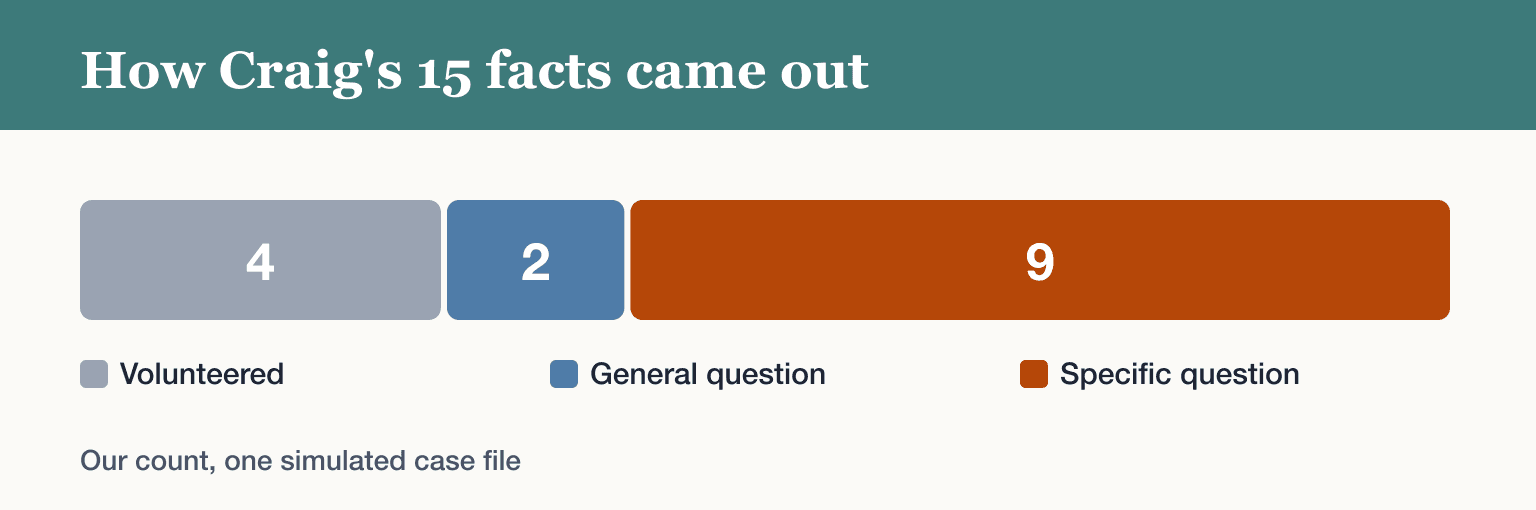
Four volunteered, two on a general question, nine only on a specific one, our count from one simulated case file.
This file has 15 history facts: 4 volunteered, 2 on a general question, and 9 only on a specific question. Seven are marked red flags, and 3 of those surface only when asked specifically. The NHS page on ataxia lists nutritional deficiencies among causes. Structured questioning helps uncover tempo and non-alcohol drivers that informal conversation often misses.
Negatives matter early: no headache, no stiff neck, no fever, and no limb weakness, facial droop, or slurred speech. See examples of negatives that rule out stroke for concise wording and timing during neurological history taking.
How Diagnosica helps with this
Practise neurological histories with an AI patient by voice or text.
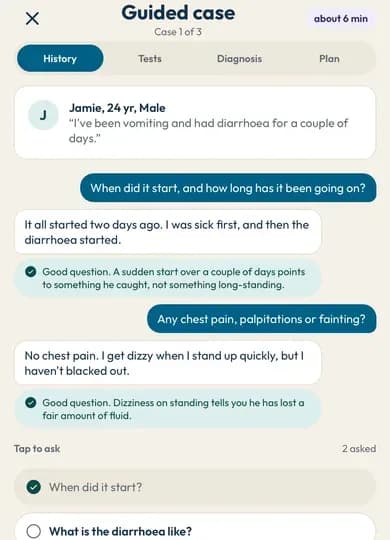
Diagnosica app, guided case history tab, a different case, as of November 2026.
- You ask onset, the simulated patient answers.
- Feedback explains why onset shapes your differential.
- History only here, no physical examination.
Simulated patient. Screenshot from Diagnosica, November 2026.
Which neurological red flags need urgent action?
Neurological red flags that need urgent action include features where sudden-onset weakness may be stroke or TIA, rapid progression over days to weeks, and new blackouts with seizure features. Sudden onset points to stroke pathways. Rapidly progressive gait ataxia or symmetrical limb weakness needs immediate neurological assessment or a suspected cancer pathway referral.
In neurological history taking, these findings trigger urgent referral pathways:
History finding | What NICE or the NHS says | Source |
|---|---|---|
Sudden weakness, face, arm or speech change | FAST symptoms, call 999. | NHS, checked 25 November 2026 |
Suspected TIA, symptoms gone | Refer immediately, be seen within 24 hours of onset. | NICE NG128, checked 25 November 2026 |
Unsteady gait over days to weeks | Use suspected cancer pathway referral for neurological assessment. | NICE NG127, checked 25 November 2026 |
Symmetrical limb weakness within 4 weeks | Refer immediately for neurological assessment. | NICE NG127, checked 25 November 2026 |
New blackouts with seizure features | Refer urgently for neurological assessment. | NICE NG127, checked 25 November 2026 |
NICE NG128 says "Do not use scoring systems, such as ABCD2". Guides that still teach ABCD2 for TIA are out of date. See NICE's stroke and TIA guideline and the NHS stroke symptoms page for FAST and 999 wording.
Watch out. These guidelines steer referral, local trust guidance applies; as a student, flag these findings to a senior straight away rather than deciding the pathway yourself.
Common mistakes in a neuro history
Common mistakes include skipping tempo and accepting a 'drunk' label. Others are missing recent surgery and intake, and forgetting a witness if the patient is confused. Fix these four habits and your differentials and referral decisions get sharper.
These crop up in wards and exams, and in simulated cases too:
- Skipping tempo: Separate sudden, rapid and gradual courses as NG127 treats them differently.
- Accepting 'drunk': Ask about alcohol first, then challenge assumptions made by staff.
- Missing weight and eating: Ask about operations, vomiting, intake and weight loss since surgery.
- No witness history: If confused, get a history from a witness early and document.
Practise it before your next station
Neurological history taking improves when you say the questions out loud in order. Keep the same opener, then ask about timing, triggers, associated features and red flags. Stop when the flow feels automatic.
The library has over 130 cases across 18 specialties, as of 25 November 2026, free to start, no card needed. For a longer rep, practise another full history.