Urological history taking: a step-by-step guide for medical students
A urological history sorts urinary symptoms into storage, voiding and post-micturition groups, then screens for red flags. NICE CG97 uses those storage, voiding and post-micturition groups for lower urinary tract symptoms in men.
If urinary symptoms come with confusion, drowsiness or difficulty speaking, call 999 or go to the emergency department, per the NHS UTI page. The NHS sepsis page lists peeing very little in the past 18 hours as a symptom. This post is exam practice, not advice.
Key takeaways
- Group symptoms into storage, voiding and post-micturition sets (NICE CG97).
- Visible blood, fever with confusion, or no urine all day change escalation.
- Simulated patient Harold, 76, volunteers 3 of 18 history facts; ask about urine directly.
What a urological history covers
Urological history taking keeps the standard order of presenting complaint; history of presenting complaint; past medical, drug, family and social history; plus allergies, per the BAUS trainee history guide. It then adds urology-specific questions when the presentation suggests urinary, testicular or pelvic problems.
BAUS also asks about childhood urological problems and past abdominal or pelvic surgery. It asks about implants or meshes, and pelvic radiotherapy. In social history, smoking raises bladder and upper tract cancer risk. Alcohol, caffeine and fluid habits can worsen lower urinary tract symptoms. Sexual history matters in testicular pain.
After the opening question, move straight into the symptom groups below, keeping the order consistent. Before you read on, take this history from an AI patient. For the general framework, see structuring a full history.
What should you ask in a urological history?
Urological history taking starts with an open question, then covers onset and course, storage and voiding symptoms, pain, fever and blood in the urine. Then ask about medicines, past urological history, surgeries or infections, and social habits including smoking, fluid and caffeine intake. Close by eliciting the patient's ideas, concerns and expectations.
Use the BAUS standard structure to keep urological histories tight, complete and consistent:
- Open: let the patient describe the problem in their own words without interruption.
- Ask: onset, duration, and whether change was sudden or gradual, plus any triggers.
- Separate: storage, voiding and post-micturition symptoms, one set at a time.
- Screen: burning when peeing, cloudy or bloody urine, tummy or back pain, fever or shivering, per NHS UTI symptoms.
- Review: all medicines including herbal and over-the-counter ones (NICE CG97 1.1.1); BAUS also flags anticoagulants.
- Close: smoking, fluid and caffeine habits, and the patient's ideas, concerns and expectations.
In older, frail people, the same NHS page lists new confusion (delirium), incontinence worse than usual, and new shivering as possible UTI signs.
For the wider end-of-history screen, use the systems review screen.
Storage, voiding and post-micturition symptoms
Lower urinary tract symptoms in men, per NICE CG97 on LUTS in men, are best grouped into storage, voiding and post-micturition. The groups help target questions and start to localise dysfunction in early urology histories.
Map each group to NICE symptoms, then translate into patient words:
Group | Symptoms (NICE CG97) | How a patient may say it (NHS) |
|---|---|---|
Storage | urgency, frequency, urgency incontinence, nocturia | needing to pee more often or urgently, including getting up at night. |
Voiding | weak or intermittent stream, straining, hesitancy, terminal dribbling, incomplete emptying | difficulty starting, a weak flow, stopping and starting. |
Post-micturition | post-micturition dribbling | dribbling pee after you finish. |
The patient column mirrors NHS enlarged prostate symptoms. It helps you notice weak flow or dribbling after you finish in urological history taking.
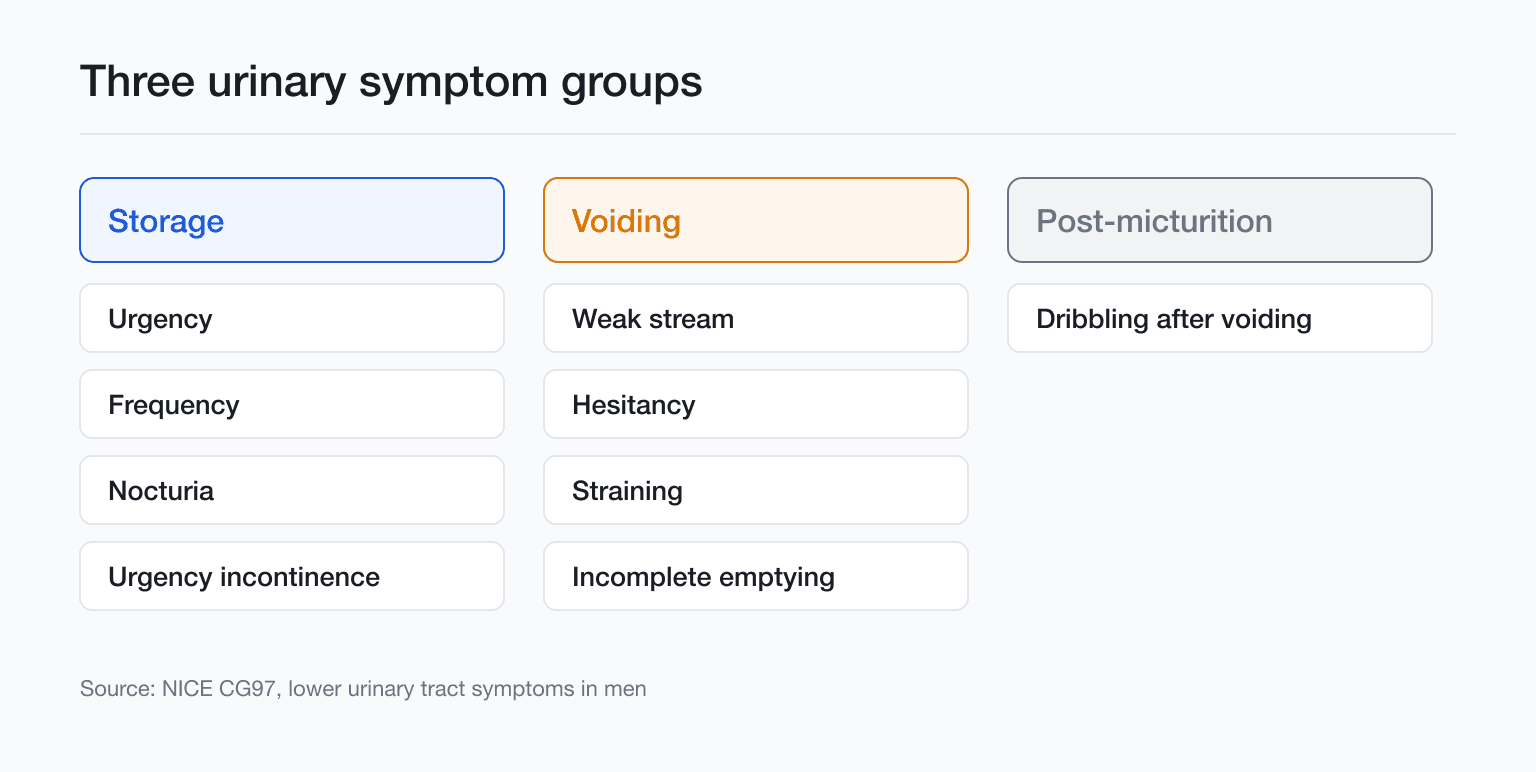
NICE CG97 groups LUTS into storage, voiding and post-micturition categories for a clearer history.
NICE CG97 splits lower urinary tract symptoms into three groups. Storage symptoms include urgency, frequency, nocturia, and urgency incontinence. Voiding symptoms include weak stream, hesitancy, straining, and incomplete emptying. Post-micturition symptoms include dribbling after voiding.
Example. Simulated patient Harold, 76, has had a weak stream and gets up three or four times a night for years. The weak stream is a voiding symptom. Getting up at night, nocturia, is a storage symptom. Ask about both groups every time, because patients often describe them in plain words, not categories.
Red flags to screen in every urinary history
In urological histories, some red flags always change escalation, so ask about them even if unprompted. Screen for visible blood, confusion, little or no urine, testicular changes and night wetting in every encounter, and document them clearly.
Screen these in every urinary history, regardless of the presenting complaint, and document:
- Visible blood: Per NICE NG12 suspected cancer recommendations, visible haematuria, 45 or over, without infection needs referral.
- Painless testicular lump: NICE NG12 advises considering suspected cancer referral for non-painful testicular enlargement or texture change.
- Fever with confusion: The NHS advises calling 999 for adult confusion, drowsiness or difficulty speaking.
- Little or no urine: The NHS sepsis page lists peeing very little, and NHS enlarged prostate warns about complete retention.
- Night wetting or weakness: BAUS flags nocturnal enuresis and neurological symptoms with retention or incontinence.
For the blood-in-urine version of this station, see the visible haematuria station.
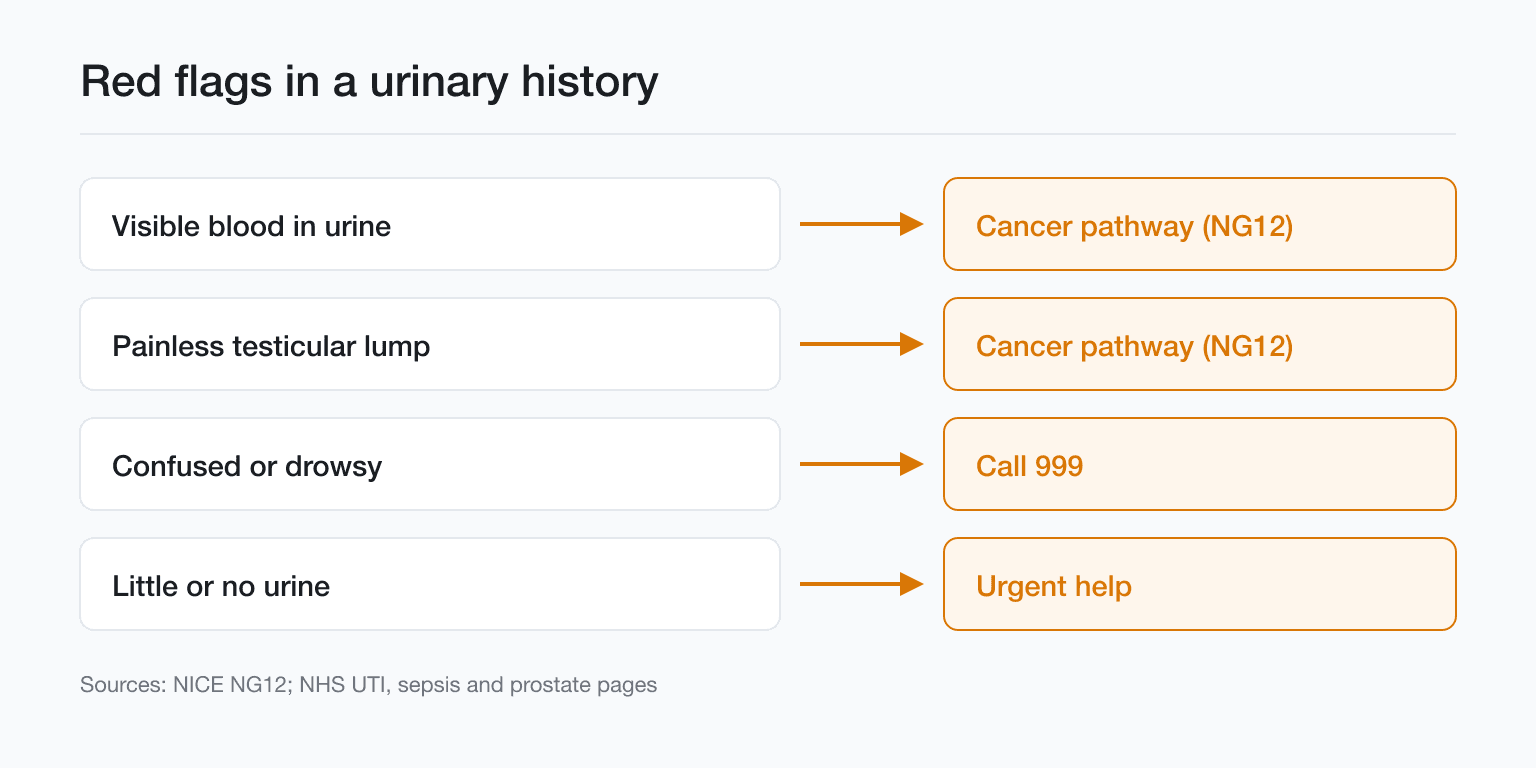
NICE NG12 and NHS guidance show routes for visible haematuria, painless testicular lumps, confusion or drowsiness, and little or no urine.
Visible blood in urine goes to a suspected cancer pathway under NICE NG12. A painless testicular lump goes to a cancer pathway. Confusion or drowsiness prompts calling 999. Little or no urine needs urgent NHS help.
Watch out. The NHS sepsis page says a high temperature is less common in older adults. A missing fever doesn't rule out a serious infection; ask about shivering, confusion and how much they've peed.
Worked case: Harold, 76, confused since last night
Simulated patient Harold Pickering, 76, a retired joiner who lives alone. His daughter Janet says, "My dad's been confused since last night and he isn't making any sense." The urinary story only comes out if asked.
When the patient can't give the history, take it from the person who knows them; see history from a worried relative.
Harold, 76 (simulated): what Janet said, and what had to be asked
How it came out | Question | Answer (from the case file) | Why it matters |
|---|---|---|---|
Volunteered | "When did this start?" | Confused since yesterday evening; clear at lunchtime, never confused before | Sudden change from a sharp baseline |
Asked | "Any stinging or going more often?" | About two days of stinging, passing small amounts very often | Storage symptoms point to the urinary tract |
Asked | "Any fever or shivering?" | Shaking with cold, then burning hot, last night | Rigors raise the stakes |
Asked | "How much has he drunk and peed?" | Hardly anything for a day and a half; very little dark urine today | Low output is an NHS sepsis symptom |
Asked | "Any trouble with his waterworks before?" | Weak stream for years, up three or four times a night | Long-standing voiding and storage symptoms |
Simulated patient. Questions written by us as a model, not a learner session.
How Diagnosica helps with this
Ask urology questions by voice or text. The patient answers in video.
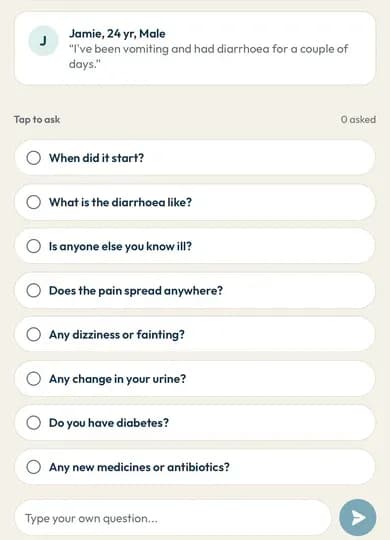
Diagnosica app, guided case question list, November 2026. Another simulated patient shown.
- Guided cases: tap a suggested question.
- A urine question sits in the list.
- In real cases you ask anything by voice or typing.
Simulated patient. Screenshot from Diagnosica, November 2026.
What Harold's case file rewards
The case file has 18 history facts. Three are volunteered, 12 come on general questions, and three only after a specific probe. A right lower back wince is one. Nine must-elicit red flags sit in that list.
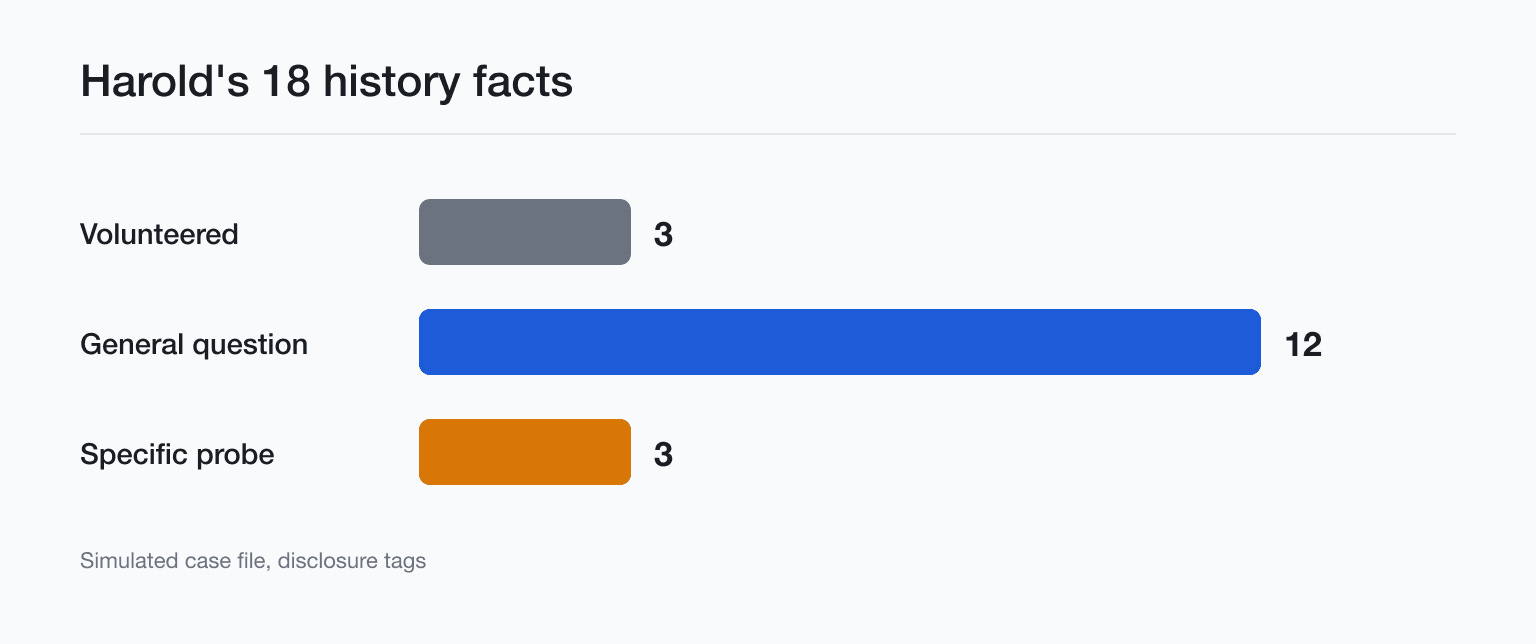
Simulated case file: Harold volunteers 3 of 18 facts, 12 on general prompts, 3 with specific probes.
In a simulated patient case, Harold offers 3 facts unprompted. 12 appear with broad questions. 3 surface only with a specific, targeted probe during the history.
The history communication domain is scored out of 25. Skipping baseline and onset, or not asking about urinary symptoms or fever, each costs 5 marks. A febrile, newly confused older adult needs sepsis ruled out, and escalation follows local trust guidance. Loin pain overlaps with the abdominal pain station.
Common mistakes in a urology history
Common urology history errors are omissions. Most lost marks come from questions never asked, not weak knowledge. In Harold Pickering's file, he'd never been confused before, and key urinary details surfaced only when asked directly.
Watch for these common misses in urological history taking:
- Single-symptom focus: Ask storage, voiding and post-micturition, not one complaint only.
- New confusion: Always ask about urine, as the NHS UTI page lists delirium.
- Skip smoking: BAUS flags bladder or upper tract cancer risk from smoking.
- No negatives: Document absent red flags clearly; see pertinent negatives that score.
Practise your question order out loud on one more system, then check it against the musculoskeletal history guide. For a scored rehearsal with an AI patient any hour, practise another full history.