Musculoskeletal history taking: step-by-step with NG100 red flags

A musculoskeletal history pins down pain, stiffness, swelling, which joints and what the patient can still do, then sorts inflammatory from mechanical. Osteoarthritis morning stiffness "usually wears off within 30 minutes of getting up".
Key takeaways
- Ask morning stiffness duration; over 30 minutes leans inflammatory, per NHS guidance
- 7 of Colin’s 16 facts surfaced only on a specific probe question
- NICE NG100: urgent referral for small joints, multiple joints, or 3-month presentation delay
Do this first: inflammatory or mechanical
Musculoskeletal history taking starts with one job, sort inflammatory from mechanical. Inflammatory disease gives long early morning stiffness that eases with activity. Non-inflammatory pain is worse with activity and brings more pain than stiffness. Arthritis UK describes this split.
Colin Barrett, 52, a self-employed joiner, is a simulated AI patient. He opens with "My hands have been sore for about four months now, doctor." The inflammatory versus mechanical split is from Arthritis UK's MSK history guide. From that line, time stiffness and check its change with activity.
Before reading on, take this history from an AI patient (by voice or text), then keep the rest in the standard history order.
The musculoskeletal history, step by step
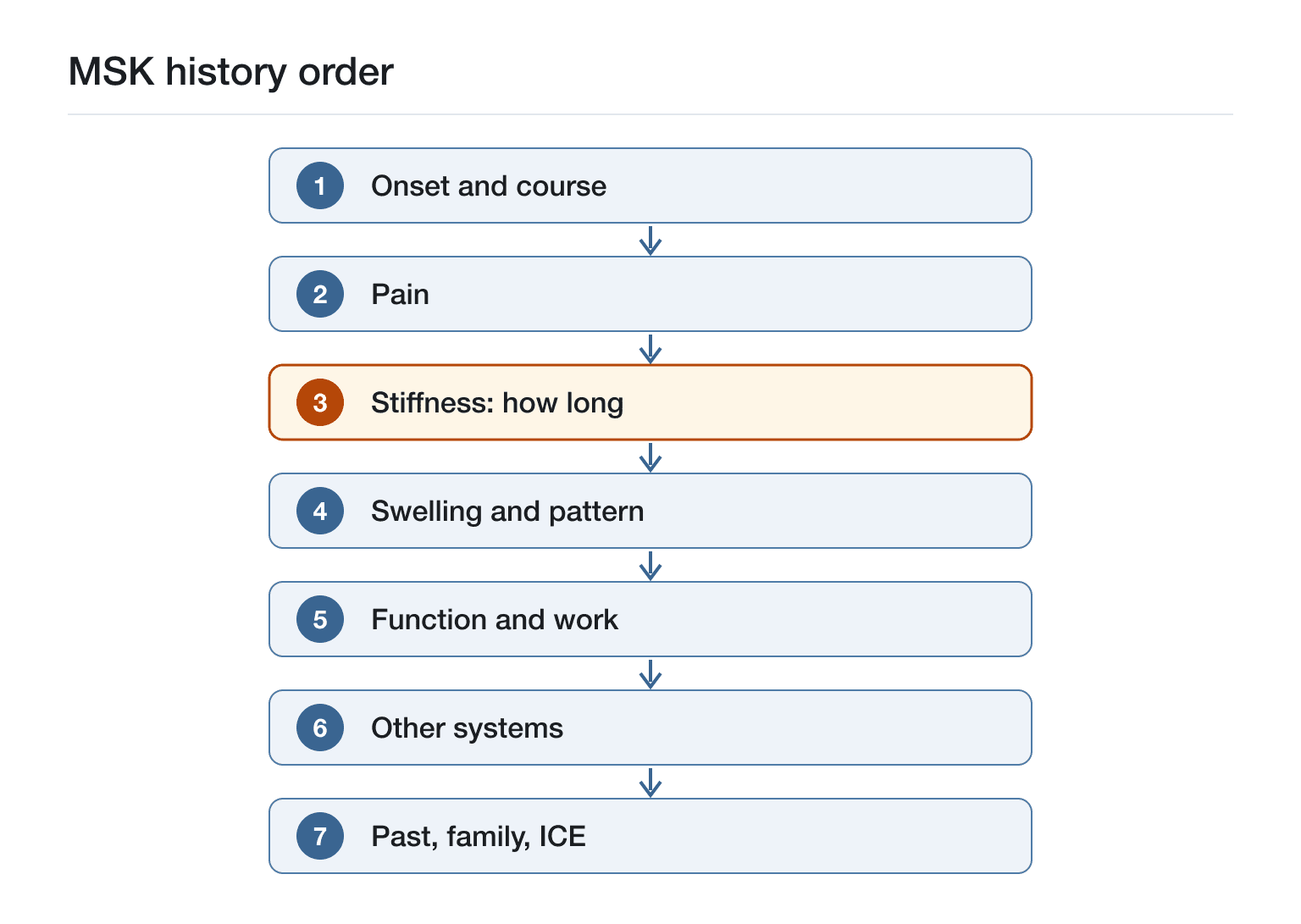
Seven-question flow for musculoskeletal history taking, useful for ward and OSCE practice. Order adapted from Arthritis UK.
Musculoskeletal history taking uses a set order that keeps you safe and structured. Start with onset and pain, then stiffness, pattern, and function. Screen other systems, then finish with past history and ICE for clarity.
Use this sequence in clinics and OSCEs:
- Ask when it began and course, over six weeks counts as chronic per Arthritis UK.
- Map pain site, character, radiation, and what worsens or relieves it.
- Ask when stiffness occurs and exactly how long it lasts.
- Count involved joints and pattern, including symmetry and size, ask about tight rings or pebbles sensation per Arthritis UK.
- Ask them to describe a typical day and work impact per Arthritis UK, then cover the occupational history questions.
- Screen for weight loss, fevers, night sweats, skin or eye involvement per Arthritis UK, then complete a full systems review.
- Cover past, family and social history, then explore ideas, concerns and expectations, including what he thinks it is.
Inflammatory vs mechanical: the questions that separate them
Musculoskeletal history taking splits inflammatory from mechanical using pattern, activity response, and body clues. Stiffness length is the best single question. Over 30 minutes with puffy swelling and malaise suggests inflammatory disease. Under 30 minutes with load-linked pain suggests mechanical pain.
Ask about | Inflammatory | Mechanical | Colin (simulated) |
|---|---|---|---|
Morning stiffness | Often longer than 30 minutes | Under 30 minutes | About two hours |
Activity | Eases with use | Worse with use | Movement and a hot shower help |
Swelling | Puffy joints, tight rings | Bony, hard lumps | Wedding ring tight |
Pattern | Many small joints, both sides | Weight-bearing joints | Both hands and wrists; knuckles, middle joints |
Whole-body symptoms | Tiredness, weight loss, fevers | Not expected in osteoarthritis | Tired, about 2 kg lost |
According to NICE's osteoarthritis guideline, diagnose clinically at 45 or over with activity-related pain and "morning stiffness that lasts no longer than 30 minutes". The NHS rheumatoid arthritis symptoms page says "the small joints in the hands and feet are often the first".
Worked example: what Colin said, and what we had to ask
In musculoskeletal history taking, Colin offers the soreness and the stiffness, but most of what matters needs a question. Expect a couple of opening clues. Then work by steps to find distribution, function, swelling, family history, and extra-articular review.
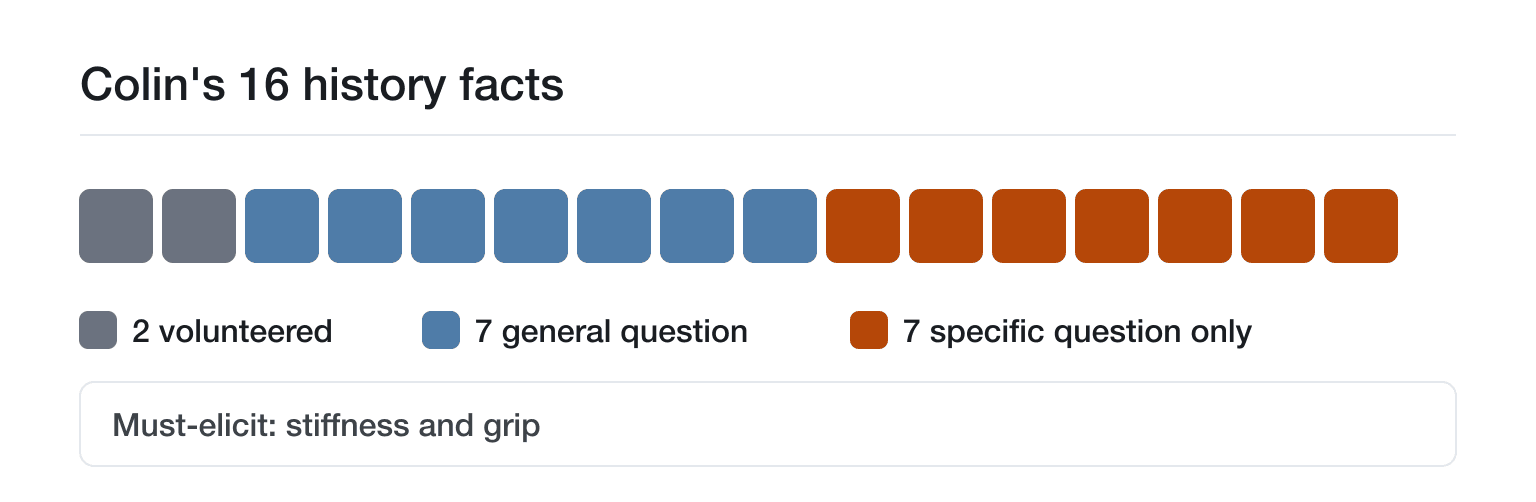
Our count from one simulated case file of disclosure types.
The file contains 16 history facts: two volunteered, seven from general questions, and seven only after specific probes. The must elicit pair were morning stiffness and loss of grip.
Colin, 52 (simulated): what he said, and what we had to ask
Chip | Question | Answer | Why it mattered |
|---|---|---|---|
Volunteered | What did you notice in the morning? | Morning stiffness about two hours, eases with moving and a hot shower | Stiffness over 30 minutes leans inflammatory |
Asked | Which joints are involved? | Both hands and wrists, symmetric; knuckles and middle finger joints, the joints nearest the fingertips are fine | Same joints both sides fits an inflammatory pattern |
Asked | Any swelling or puffiness? | Puffy knuckles, and his wedding ring has become tight | Tight rings point to soft swelling |
Asked | What can't you do now? | Can no longer grip his chisel or hold a hammer | Shows the impact on his work |
Only if asked specifically | Does anything similar run in your family? | Mother had bad hand arthritis in her sixties, ended up with twisted fingers | A family clue he would not volunteer |
Only if asked specifically | Fevers, rashes, psoriasis, sore eyes, mouth ulcers? | No fever, night sweats, rash, psoriasis, red eyes, or mouth ulcers | Negatives make other joint diseases less likely |
Family history only surfaced once it was asked directly.
Simulated patient. Case file from our library. Questions written by us as a model, not a learner session.
How Diagnosica helps with this
Ask by voice or text, AI patient answers, feedback line follows.
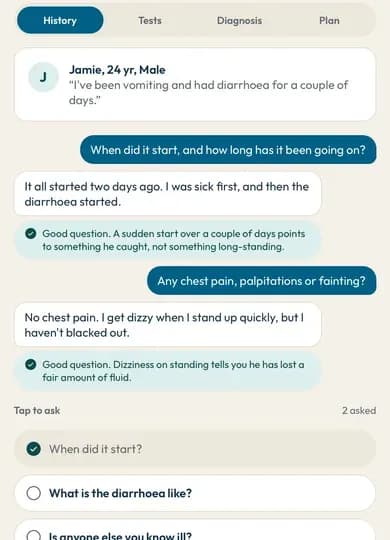
Diagnosica app, guided case history screen, a different simulated patient, as of November 2026.
- Your question gets an answer, voice or text.
- Green line explains why that question matters.
- History only, no joint examination to practise.
Simulated patient. Screenshot from Diagnosica, November 2026.
Which MSK red flags need action?
Musculoskeletal history taking red flags start with suspected persistent synovitis, which goes for specialist opinion under NICE NG100. Urgent if small hand or foot joints, urgent if more than one joint, or urgent after a 3-month delay, even with normal blood tests. For full criteria, see NICE's rheumatoid arthritis guideline.
NICE NG226 lists signs that point away from simple osteoarthritis. These include recent trauma, long morning stiffness, fast symptom worsening or deformity. Also a hot swollen joint, or worries that suggest infection or malignancy. Arthritis UK says tumour-related bone pain is severe and "often unremitting and persists through the night".
A sudden, severe single hot joint means an urgent GP appointment or NHS 111, per the NHS septic arthritis page. The station is here: the hot joint station. Back pain red flags are in the back pain history station.
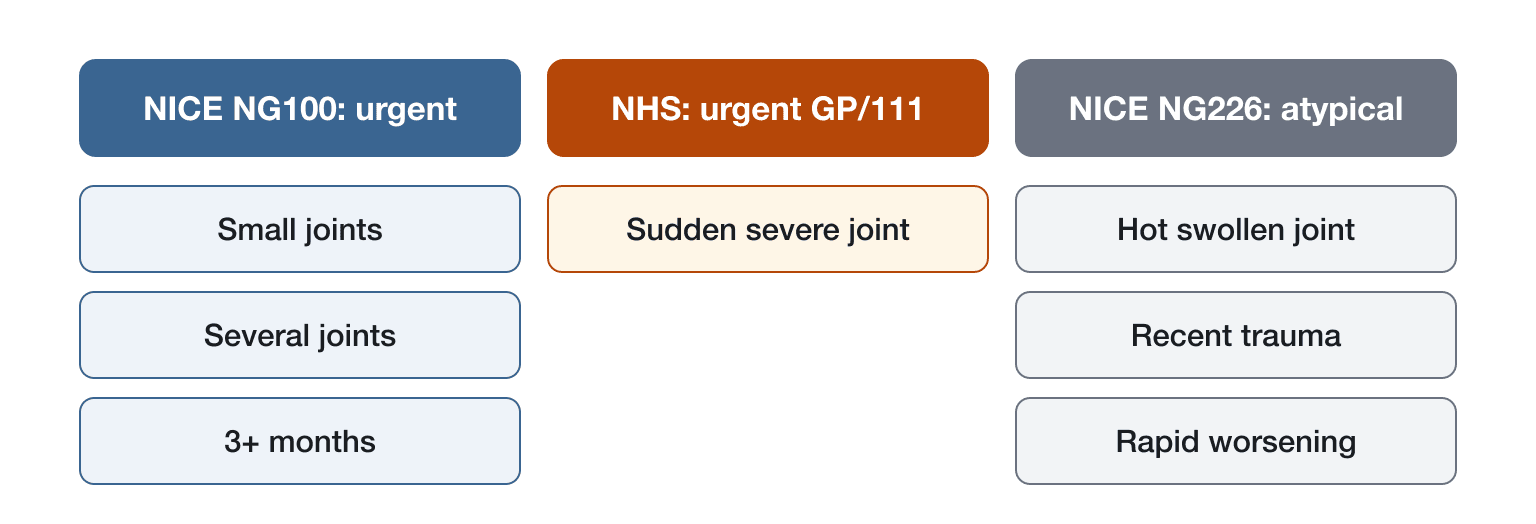
At-a-glance MSK red flags grouped by urgency. Criteria from NICE and NHS, checked 25 November 2026.
Colin Barrett, a simulated 52-year-old joiner, reports small joints in both hands and wrists with fingertip joints spared and several joints involved. NG100's urgent route fits.
Watch out. Watch out. Local trust guidance applies. A student's job is to spot the flag, say it plainly, and tell a senior, not decide the referral.
Common mistakes in an MSK history
Musculoskeletal history taking often falters on duration, feet, function, and family. Avoid traps. NHS says osteoarthritis morning stiffness is usually under 30 minutes. NHS says rheumatoid arthritis is longer, and small hand and foot joints are often first:
- Only stiff. Ask duration, OA morning stiffness under 30 minutes, RA often longer.
- Forget the feet. He aches in the balls of his feet on first steps.
- Skip function. He cannot grip his chisel or hold a hammer properly.
- Miss family history. His mother's hand arthritis surfaced only after a specific question.
His own theory is wear and tear from thirty years of joinery.
Practise the MSK history out loud
Use Diagnosica to speak the musculoskeletal history. The AI patient answers by voice or text. Asking the stiffness and family questions out loud helps them stick when timing and pattern blur.
Carry the same habit into urology with a urological history.
Then practise another full history from a library of over 130 cases across 18 specialties, as of 25 November 2026.