Back pain OSCE station: one case, inflammatory or mechanical?

In a back pain OSCE station, ask what morning stiffness, rest and night waking do to the pain. NICE NG65 flags low back pain starting before 45 and lasting longer than 3 months for a referral check.
If someone has back pain with weakness or numbness in both legs, numbness around the genitals or anus, or new bladder or bowel trouble, call 999 or go to the emergency department, per the NHS back pain page. This post is exam practice, not advice.
Key takeaways
- Simulated patient Lewis Selby volunteers 2 of 14 facts, and 8 need specific questions.
- NICE: back pain before 45 and over 3 months; refer with four or more features.
- Ask all back pain patients about legs, genital or anal numbness, bladder or bowel change.
Lewis's case in one line
Lewis Selby, 28, simulated patient, reports pain and stiffness in his lower back and buttock, saying "for about nine months and it just won't settle". Vitals are normal and his ideas and worries push you to sort inflammatory from mechanical.
To feel the timing and phrasing under pressure, take Lewis's history yourself.
Part | What the case file says |
|---|---|
Opening line | Pain and stiffness in lower back and buttock, "for about nine months and it just won't settle". |
His own theory and worry | Told it's a "muscle strain" or "bad posture"; worried it's permanent; wants a proper explanation. |
Observations | Heart rate 72, temperature 36.8. |
For context, see diagnoses that hide for years; NICE NG65 says axial presentations are "often misdiagnosed as mechanical low back pain".
What should you ask in a back pain OSCE station?
In a back pain OSCE station, start with an open question, then sort inflammatory vs mechanical by asking about morning stiffness and night waking, what rest and movement do, and age at onset; finish by screening red flags. Keep it brisk, listen for patterns, and pin symptoms to time.
Per NICE's spondyloarthritis guideline, referral features include onset before 35, waking during the second half of the night, buttock pain, improvement with movement, and either a first-degree relative, or current or past arthritis, enthesitis or psoriasis.
To keep your questions ordered under pressure, run this five-step sequence:
- Start with one open question, then let him talk without interruption.
- Ask how long morning stiffness lasts after waking.
- Ask what rest and exercise do to pain, better or worse.
- Ask whether it wakes him, when in the night, and when it started.
- Ask about red eyes, heels, skin, bowels, and family history of spondyloarthritis.
For the full SOCRATES walk-through, red flags and an OSCE checklist, Geeky Medics' back pain guide does that well and was updated April 2025. For the whole structure across stations, see structuring any history station.
Lewis's history, question by question
Lewis volunteers the duration of his morning stiffness; most of what matters appears only when asked. Of 14 scripted facts in the simulated case file, 2 are volunteered, 4 on a general question and 8 on a specific probe.
Lewis, 28 (simulated): what he said, and what we had to ask
Chip | Question | Answer | Why it mattered |
|---|---|---|---|
Volunteered | How long are you stiff for after waking? | Stiff for more than an hour in the morning. | Inflammatory pattern, not mechanical. |
Asked | Is it better with exercise or worse with rest? | Better with exercise, worse with rest. | Matches NICE NG65 improvement with movement. |
Asked | Any buttock pain that switches sides? | Yes, buttock pain that switches sides. | Matches NICE NG65 buttock pain. |
Only if asked specifically | Do you wake in the second half of the night? | Wakes in the second half and gets up to move. | Matches NICE NG65 second-half night waking. |
Only if asked specifically | How old were you when it first started? | Started in his early twenties. | Matches NICE NG65 onset before 35. |
Only if asked specifically | Any episodes of a painful red eye with light sensitivity? | Painful red eye last year, light hurt it, treated at eye clinic. | Extra-articular inflammatory hint, not mechanical. |
Simulated patient. Case file ankylosing-spondylitis-28m. Questions written by us as a model, not a learner session.
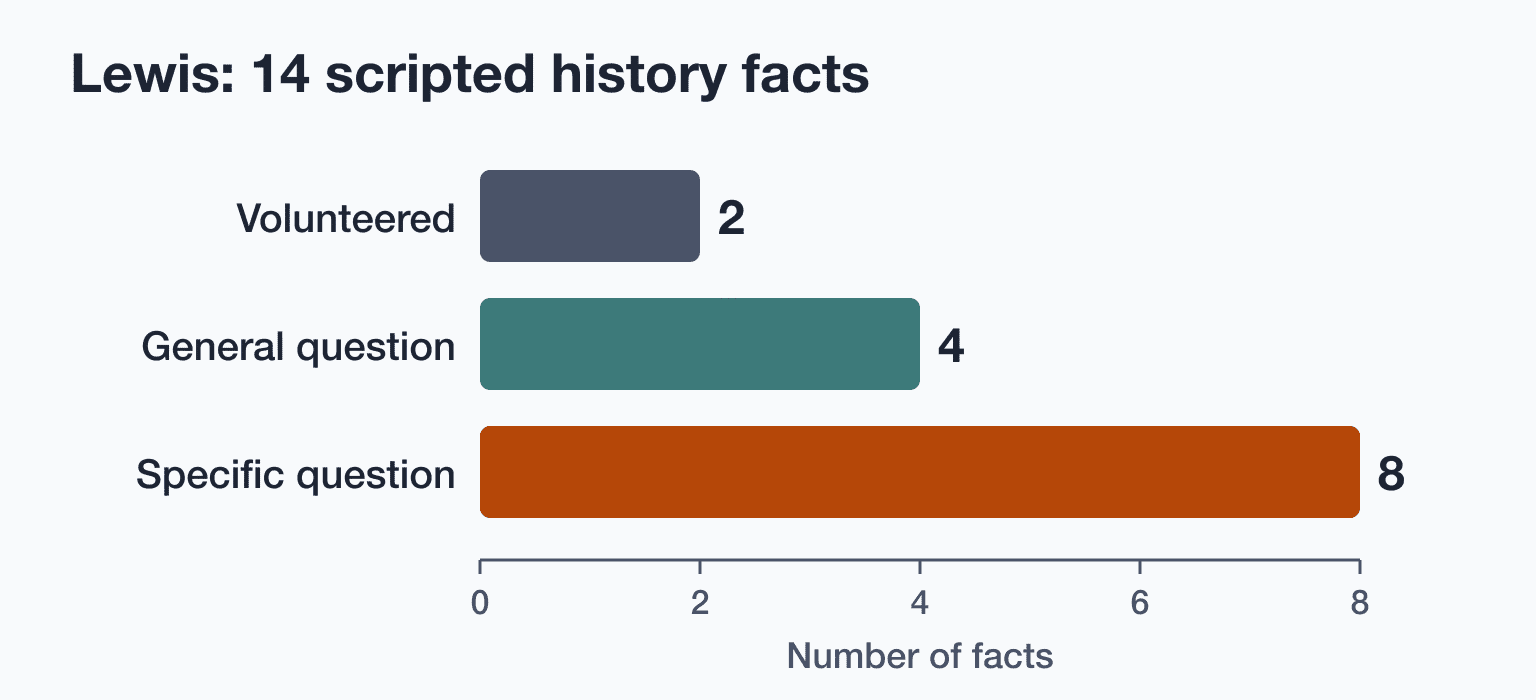
Bar chart: 14 history facts for simulated patient Lewis Selby, 2 volunteered, 4 general, 8 specific.
Lewis Selby shares only 2 of 14 facts unprompted. Four emerge on general prompts, while 8 need specific questions. The counts come from disclosure tags in the simulated ankylosing-spondylitis-28m case file.
The heel shows the same pattern if you ask about feet: painful swollen heel at the back of his foot, on and off. His father had a stiff back, told it was spinal arthritis. NICE NG65 asks about a first degree relative with spondyloarthritis, so confirm what he was told in a quick systems sweep.
Red flags to screen in every back pain history
Simulated patient Lewis Selby’s story suggests inflammatory pain, but every back pain OSCE station still needs a consistent red-flag screen; NICE's low back pain guideline says to exclude cancer, infection, trauma or inflammatory disease.
Screen for the following, in every back pain history, even if the story sounds mechanical:
- Both legs: weakness, numbness or tingling affecting both legs.
- Saddle area: numbness around the genitals or anus.
- Bladder or bowel: new difficulty passing urine or leaking.
- Weight loss or night pain: weight loss without trying, or pain worse at night.
- Systemic or trauma: feeling hot, shivery or unwell, or pain after a serious accident.
For cauda equina syndrome, a Royal Free NHS leaflet calls it rare but serious, lists saddle numbness, altered feeling when wiping and bladder changes, and also says early treatment before symptoms become severe can reduce the risk of permanent disability.
Watch out. The simulated patient, Lewis, denies leg weakness, numbness, bladder or bowel trouble only when asked, and denies injury, fevers, and weight loss. Say these aloud as negatives that close doors.
How Diagnosica helps with this
Speak or type to an AI patient video avatar, and only your questions get answers.
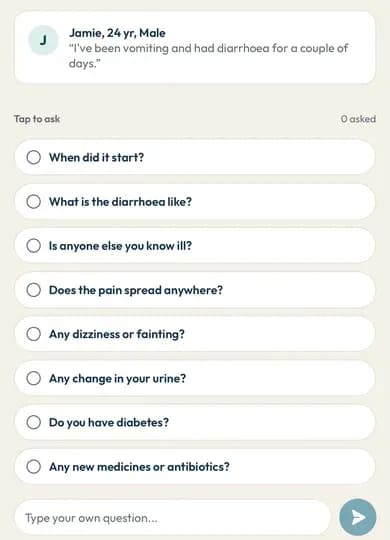
Diagnosica app, guided case history, November 2026. Shown with a different simulated patient, tap-to-ask questions and a free-text box.
- Guided case shows tap-to-ask questions.
- Or type your own question, free-form.
- In real cases, ask anything by voice or typing.
Simulated patient. Screenshot from Diagnosica, November 2026.
Investigations and diagnosis in Lewis's case
In Lewis Selby's simulated back pain OSCE, history does most work. NICE NG65 referral check flags pain before 45 and over 3 months, then counts criteria: 4 or more refer to a rheumatologist, exactly 3 means an HLA-B27 test.
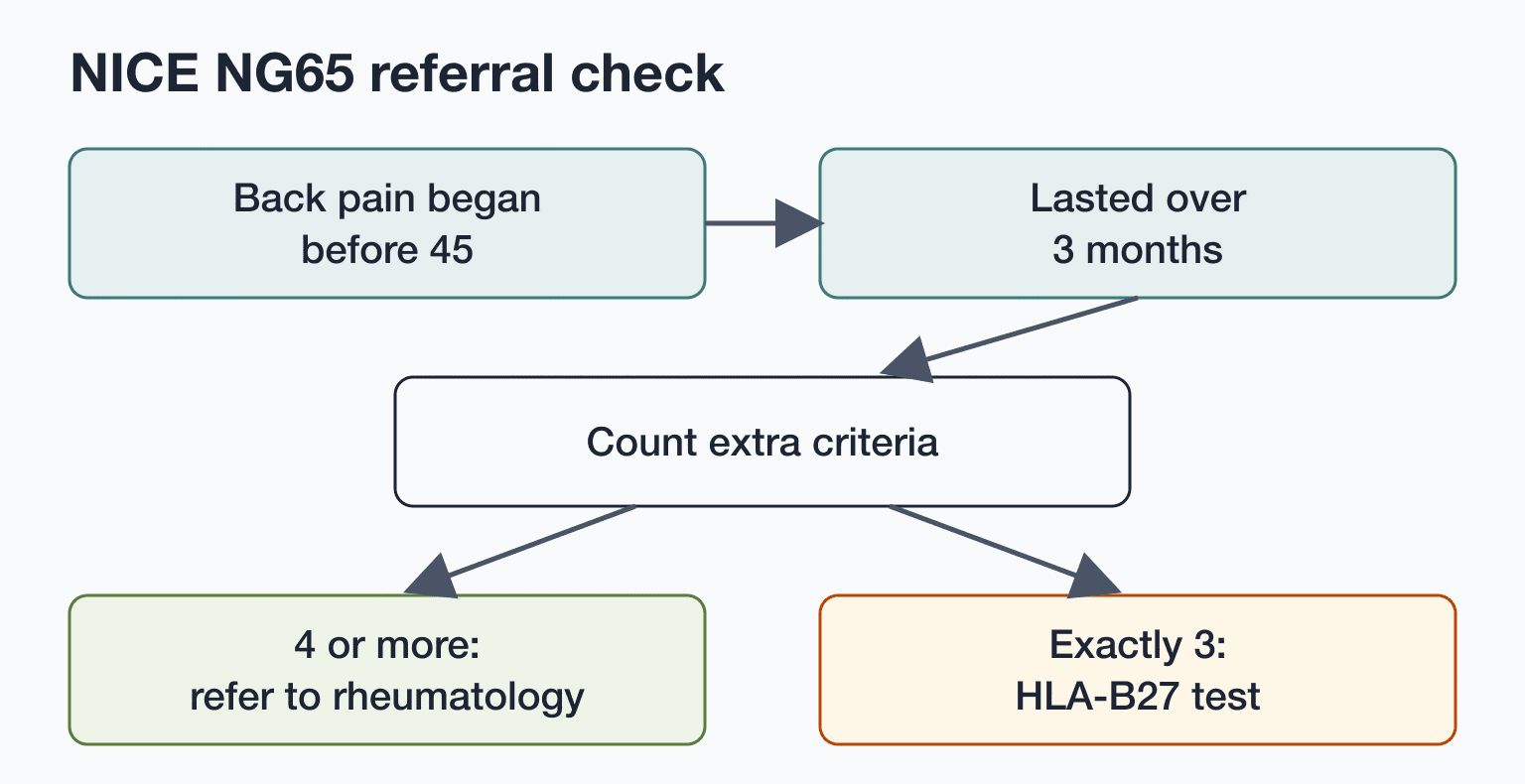
Flowchart: NICE NG65 referral check, pre-45 back pain over 3 months, 4+ criteria refer, 3 criteria test HLA-B27.
NICE NG65 advises a referral check if low back pain began before 45 and lasts over 3 months. Refer with 4 or more extra criteria, or do HLA-B27 testing when exactly 3 are present.
Lewis Selby's simulated case file offers 9 tests and scans, 5 blood tests and 4 imaging. CRP and ESR may be normal or raised. Sacroiliac joint X-ray shows sacroiliitis, while MRI shows marrow oedema before X-ray changes. NICE adds it may occur without plain-film sacroiliitis, in HLA-B27 negative people, and affects women and men similarly.
In this simulated case file the decisive diagnosis is ankylosing spondylitis, with mechanical back pain, psoriatic, reactive, enteropathic, rheumatoid and osteoarthritis set as distractors. NICE advises not to rule out spondyloarthritis on any single sign or test. Close by summing up for the examiner.
What the scorecard shows afterwards
Diagnosica shows a scorecard after every case, on the free tier too, and the guided result screen reports a score out of 100 split into four bars labelled History, Tests, Diagnosis and Plan.
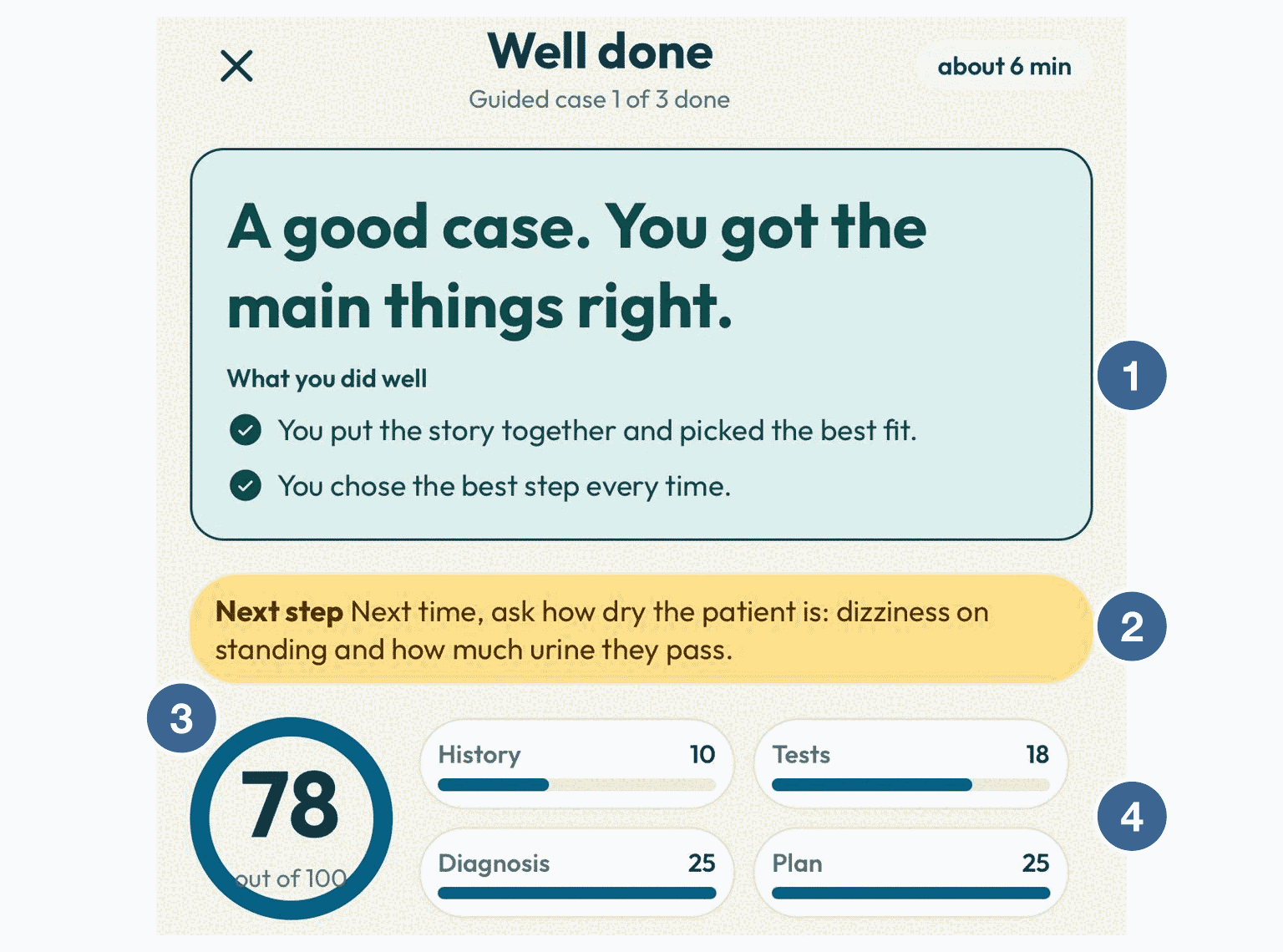
Diagnosica app, guided case result, as of November 2026, with markers 1 to 4, for a different simulated patient.
Match these four markers to the guided result screen, then check:
- What you did well.
- The next step to try, a single practical prompt.
- Overall score, example shows 78 out of 100.
- Section bars, History 10, Tests 18, Diagnosis 25, Plan 25.
Shown is a guided case with another simulated patient. We're not printing Lewis Selby's marks. Real cases add a full section by section breakdown. Spine and neurological examination can't be practised in the app, so rehearse that half on a partner. See the headache worked case for the same layout.
What to take away
In a back pain OSCE station, lead with one filter: sort by morning, rest and night. NICE NG65 lists improvement with movement and second-half waking as inflammatory clues.
In Lewis Selby's simulated case, six facts are flagged must-elicit, and he volunteers only the morning stiffness. The red-flag screen is never optional, per NHS back pain.
Try the same sorting habit on the joint pain station. Then try another rheumatology case.