Dizziness history taking: one case, the questions that split it
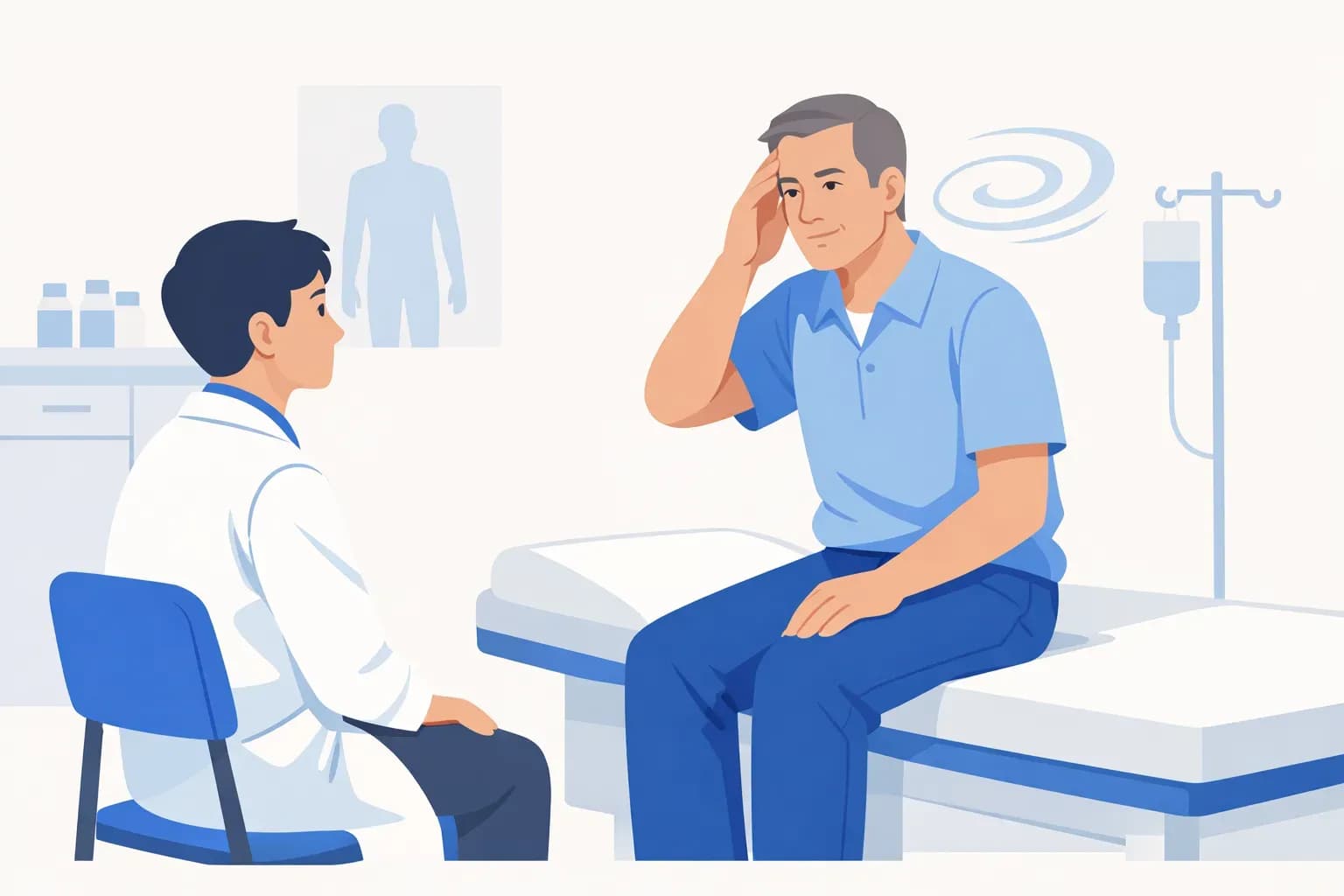
In a dizziness history, first ask whether the room spins, then how long each attack lasts and what brings it on. GPnotebook says objective questions must differentiate vertigo from other forms of dizziness.
Vertigo with double vision or loss of vision, hearing loss, trouble speaking, or arm or leg weakness, numbness or tingling means call 999 or go to the emergency department, per the NHS vertigo page. This is exam practice, not advice for a real person.
Key takeaways
- Spinning, episode duration, and provoking triggers.
- Raymond volunteers 4 of 18 scripted facts; 11 surface with specific probing.
- Ask about falls and driving; DVLA requires telling them for sudden, disabling or recurrent dizziness.
Raymond's case in one line
Raymond Fletcher, a 55-year-old simulated patient, delivery van driver who lives alone, opens with: "Every time I turn over in bed the whole room spins." Take a focused dizziness history that separates timing and triggers from red flags.
You can take Raymond's history yourself in the simulator.
Part | What the case file says |
|---|---|
Opening line | "Every time I turn over in bed the whole room spins." |
What he thinks and fears | Thinks his blood pressure tablets or something in his ear. Fears stroke, falling, and "he will be told to stop driving and lose his job". |
Who he is | 55, simulated; drives a delivery van for a living and lives alone. |
For the full structure of any history station, see the core history framework for questions, order, and timing.
What should you ask in a dizziness history?
Dizziness history taking starts by pinning down what dizzy means, then timing each attack, and checking ear and neurological symptoms. NHS descriptions include off-balance, giddy, lightheaded, faint, or spinning. GPnotebook groups these as vertigo, dysequilibrium, presyncope and light-headedness. Ask what brings it on.
Use this five-step sequence, keeping the NHS dizziness symptoms and GPnotebook in mind for definitions and types:
- Ask what they mean by dizzy, for example, "do you get the feeling of rotation?"
- Ask how long each attack lasts, seconds, minutes, hours, or continuous, and how many episodes so far.
- Ask what brings it on, head movement or position change, standing up, or nothing between attacks.
- Ask about hearing loss, ringing in the ears, and ear fullness, and recent ototoxic drugs.
- Ask about headache, double vision, slurred speech, limb weakness, and any falls or injuries.
MyPANotes' dizziness guide covers key questions, red flags, differentials and examination points, plus a summary template. GPnotebook's dizziness page also lays out causes by attack length, last edited 19 June 2024. A faint or light-headed story belongs with the fainting history station.
Raymond's history, question by question
Raymond volunteers the spinning, the seconds, the trigger, and being well between attacks. Most else needs direct questions. Our count of the case file's tags: 18 scripted facts, 4 volunteered, 3 general, 11 specific.
Raymond, 55 (simulated): what he said, and what we had to ask
Chip | Question | Answer | Why it mattered |
|---|---|---|---|
Volunteered | What does the dizziness feel like? | violent room spinning, not feeling faint or light-headed | Spinning supports vertigo; brief, triggered episodes favour BPPV. |
Volunteered | How long does each spell last? | under a minute, usually twenty to thirty seconds | Brief episodes favour BPPV. |
Volunteered | What brings it on? | every head movement, rolling, lying down, sitting up, bending, looking up | Position change fits BPPV, not standing hypotension. |
Asked | Which side or movement is worst? | worse when rolling onto his right side | Specific movement provocation supports positional vertigo. |
Only if asked specifically | Any hearing loss, ringing, or ear fullness? | hearing normal, no ringing, no fullness or pressure | No ear symptoms narrow peripheral causes toward BPPV. |
Only if asked specifically | Any headache, double vision, speech or weakness? | no headache, double vision, slurred speech, swallowing trouble, or weakness | Negative stroke screen lowers likelihood of central causes. |
Simulated patient. Case file benign-paroxysmal-positional-vertigo-55m. Questions written by us as a model, not a learner session.
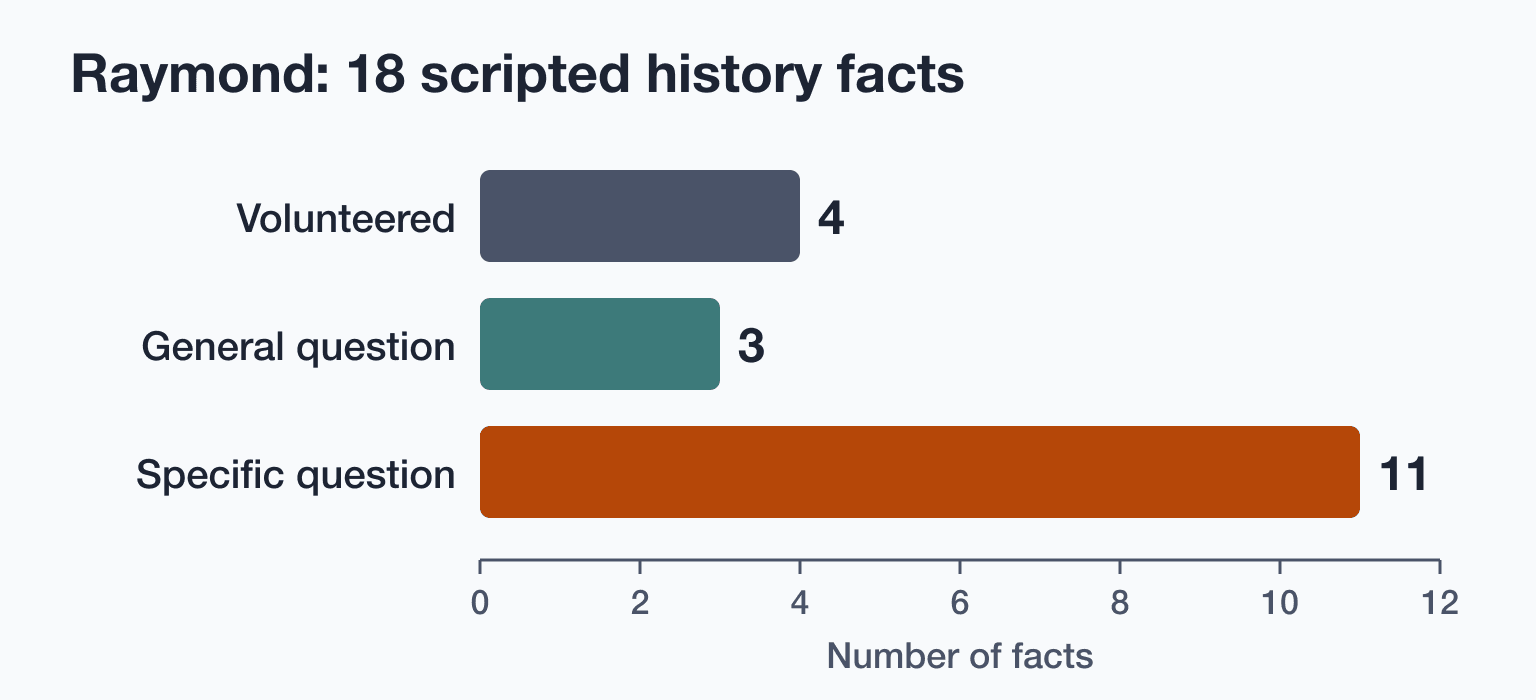
Bar chart: 4 volunteered, 3 on general, 11 on specific probe, simulated BPPV case.
His normal hearing and a clean neurological screen are negatives that rule things out only if you ask explicitly. He’s scared too: his brother had a stroke last year. Ask what frightens the patient.
Red flags in every dizziness history
Raymond's story sounds benign. Still, screen for stroke first, always. The NHS lists "feeling dizzy or falling over" among stroke symptoms on its stroke symptoms page.
Ask these red-flag questions early in dizziness history taking and make the route of care explicit for a dizziness OSCE station:
- Vertigo plus double or lost vision: call 999 or go to the emergency department.
- Vertigo with hearing loss: 999 or the emergency department.
- Vertigo, slurred speech: 999 or emergency department.
- Vertigo with limb weakness, numbness or tingling: 999 or the emergency department.
- Severe headache, being sick or a very high temperature need urgent GP or NHS 111.
Beyond stroke screening, elicit two safety points this case flags. He nearly lost balance twice getting out of bed and lives alone; he drives a delivery van and had an attack while reversing. Tell DVLA about dizziness that is sudden, disabling or recurrent on GOV.UK's dizziness and driving page. See the work and driving questions.
Watch out. Raymond denies blackouts, palpitations and chest pain only when asked, and treated high blood pressure plus past smoking habit only come out on specific questioning. Say these aloud; vascular risk keeps stroke on the list.
How Diagnosica helps with this
Speak or type, video patient answers only what you ask.
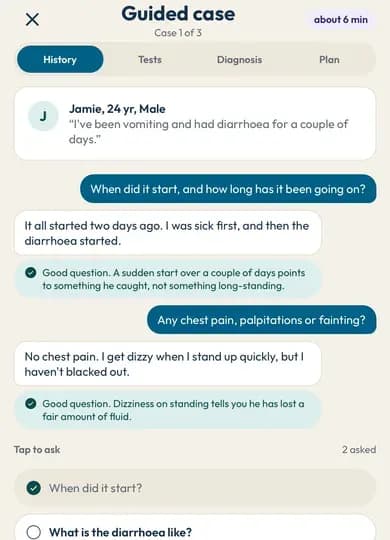
Diagnosica app, guided case history, November 2026, shown with a different simulated patient.
- Guided case suggests high-yield questions to tap in sequence.
- Each question you ask gets a short note on why it mattered.
- In real cases you ask anything, by voice or typing.
Simulated patient. Screenshot from Diagnosica, November 2026.
Investigations and diagnosis in Raymond's case
Raymond’s simulated history already points to BPPV: seconds long spinning with head movement and completely well between attacks. MyPANotes says brief triggered episodes favour BPPV, and the NHS describes BPPV where specific head movements cause vertigo.
Attack length is the splitter. The NHS page on Meniere's disease says symptoms last minutes to 24 hours, with tinnitus and hearing loss. The NHS page on labyrinthitis and vestibular neuritis says neuritis spares hearing and symptoms ease after a few days. MyPANotes adds hours to days needs careful assessment for central causes.
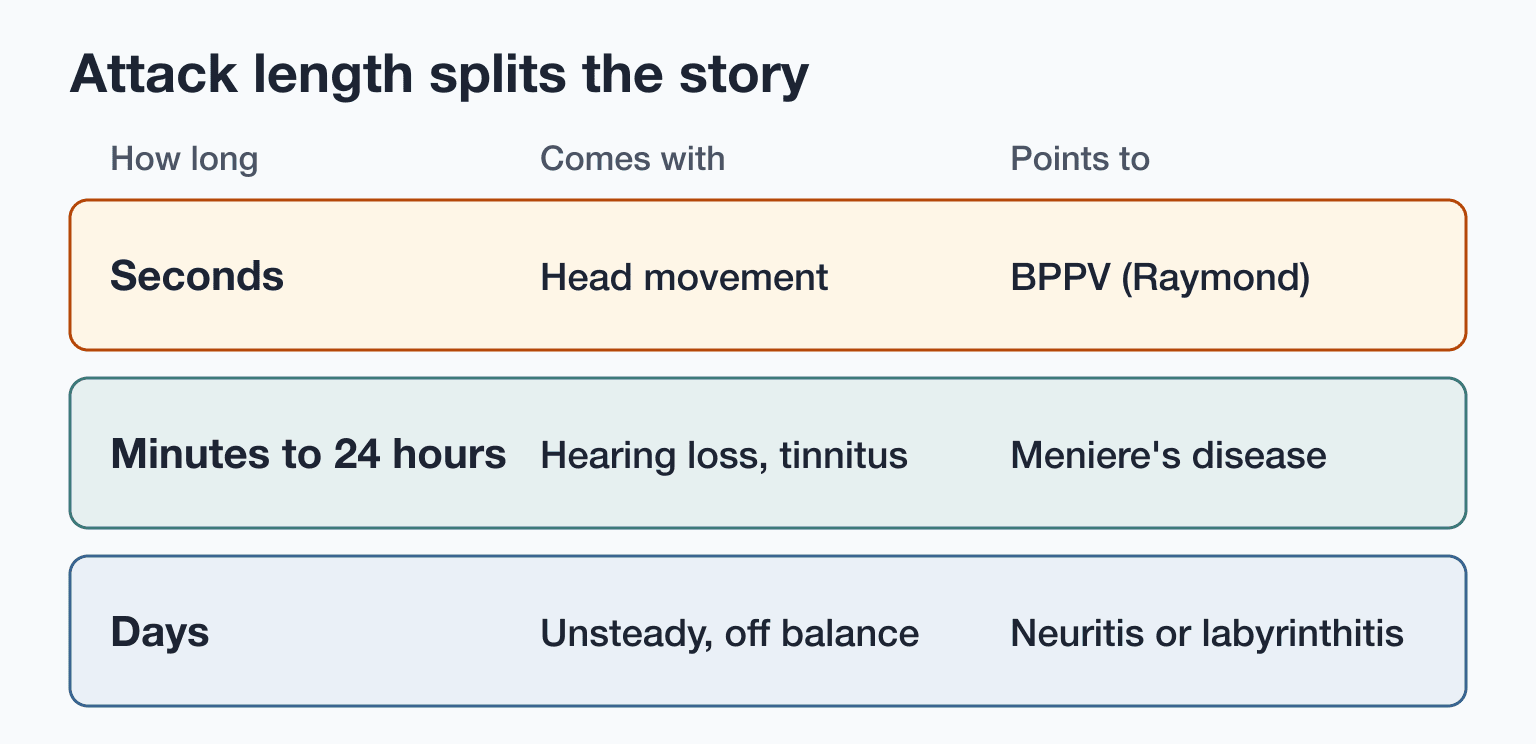
Seconds, minutes to 24 hours, days with hearing spared, mapped to causes; sources NHS and MyPANotes.
Inside the simulated case you can order the Dix-Hallpike and read its result, you don't perform it. It returns positive on the right and reproduces his attack. The decisive diagnosis is BPPV, with Meniere's, vestibular neuritis, labyrinthitis, stroke and postural hypotension as distractors. End with a clean closing summary.
What the scorecard shows afterwards
Every run ends with a scorecard after every case, free tier too, showing a score out of 100 split into four section bars: History, Tests, Diagnosis and Plan.
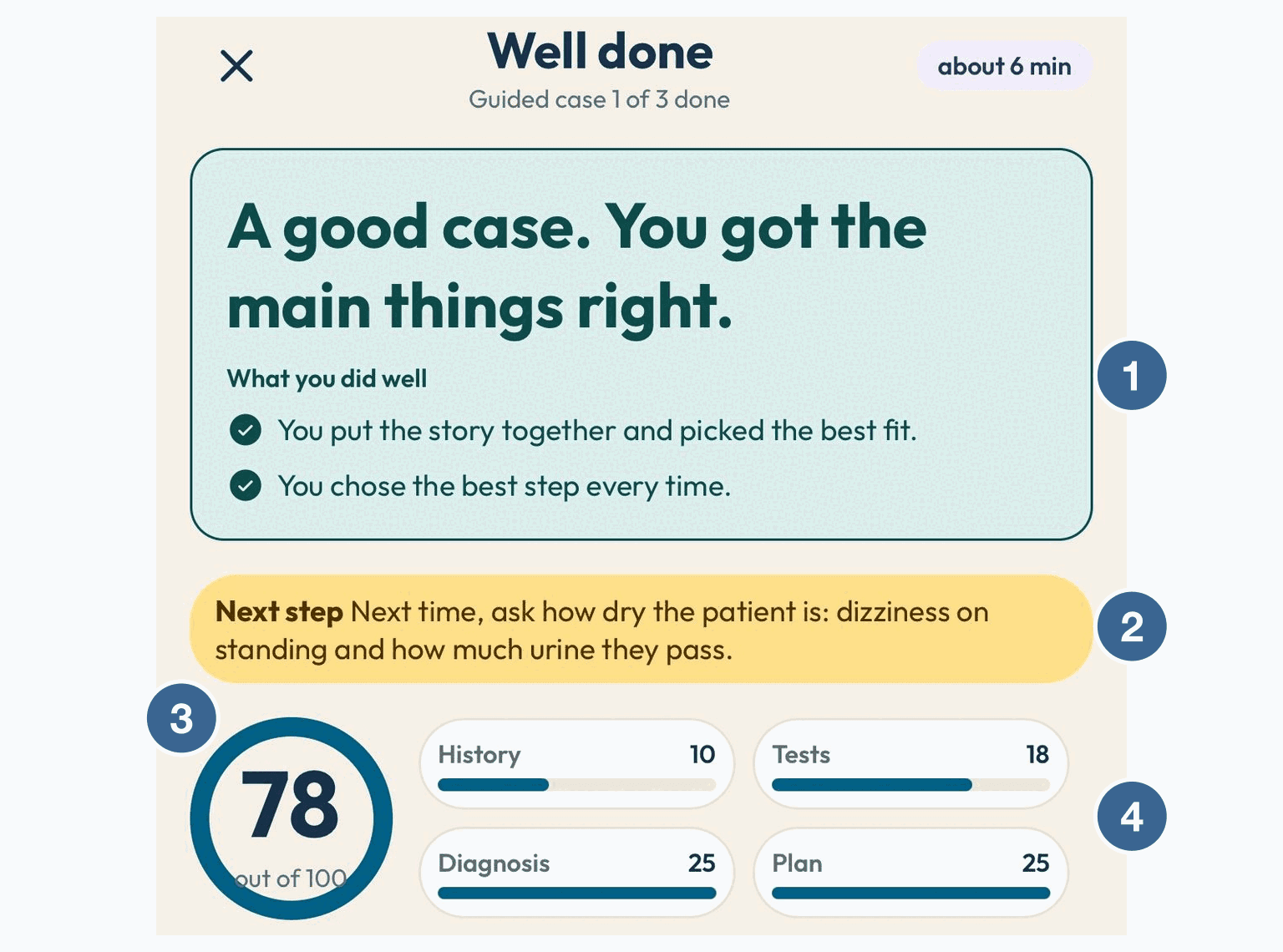
Diagnosica app, guided case result, as of November 2026, a different simulated patient. Numbers 1 to 4 mark what to read.
Marker 1 highlights the 'What you did well' box. Marker 2 flags the 'Next step' suggestion. Marker 3 shows the overall score, 78 out of 100 in the example. Marker 4 points to the four section bars, History 10, Tests 18, Diagnosis 25, Plan 25.
This is a guided case with a different simulated patient. We’re not showing Raymond Fletcher’s marks here. Real cases add a full breakdown, section by section. Ear, eye-movement and neurological examination can’t be practised in the app, so rehearse with a partner.
What to take away
Start by pinning down 'dizzy' in their words, then go straight to length and trigger. In this simulated case, seconds-long, position-triggered vertigo points to BPPV, but the stroke screen is never optional.
Ask directly about near falls, driving and vascular risk; he doesn’t offer them unprompted. Use the same sorting habit on a cough history worked through. Then try another case.
Then switch to a falls case that drills before, during and after the fall, plus getting up alone, at the falls history worked case.