Cough history taking: one case, the questions that count
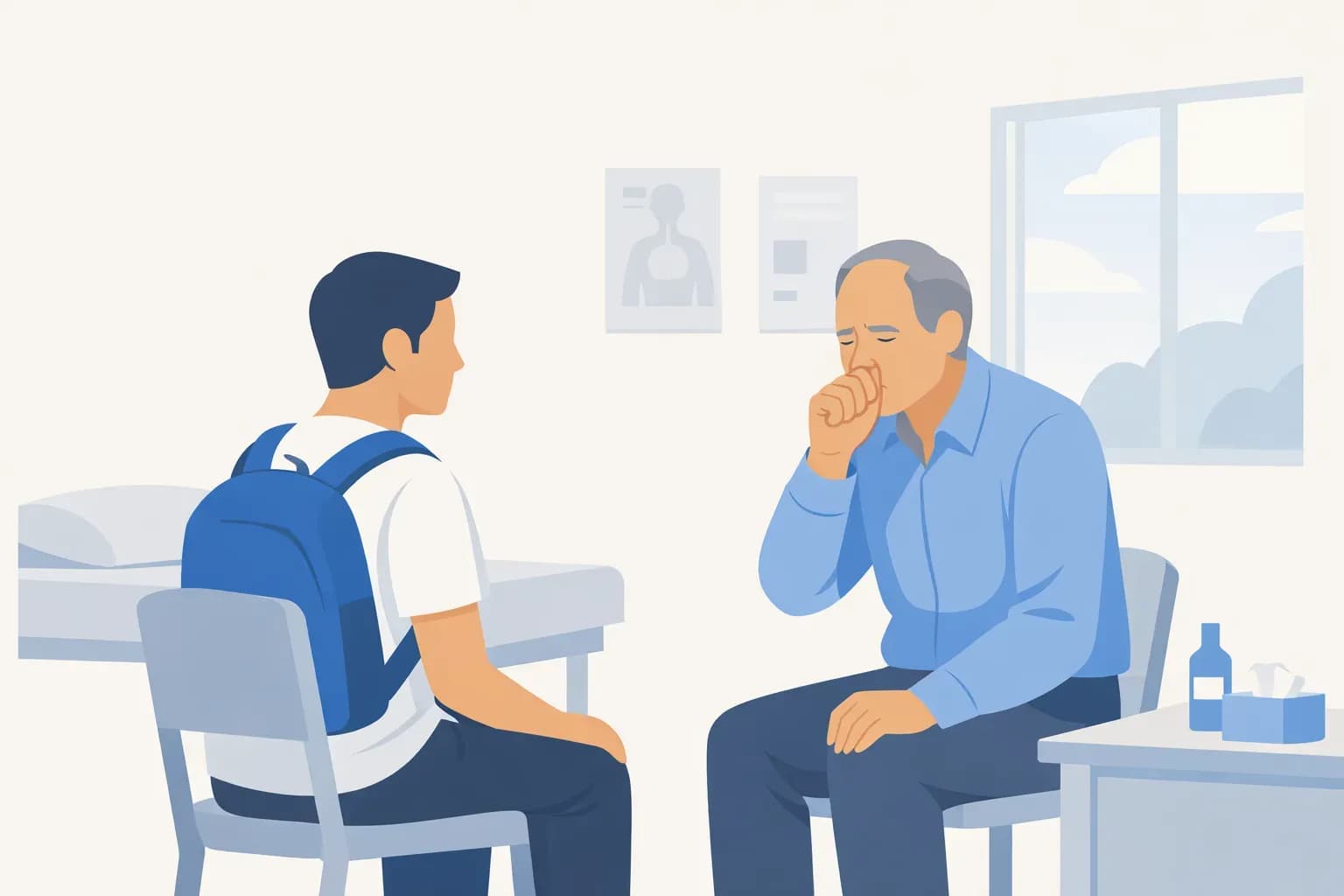
Cough history taking starts with safety: the NHS advises seeing a GP if a cough lasts more than 3 weeks. A cough history runs onset, character, sputum and blood, timing, then smoking, work, travel and red flags.
If you're coughing blood, request an urgent GP appointment or call NHS 111; if you struggle to breathe or have chest or upper back pain, call 999 or go to the emergency department (NHS advice on lung cancer symptoms). This post is exam and ward practice.
Key takeaways
- Ask about blood, weight, smoking and work in every chronic cough.
- Three of Frank's seven red flags appeared only on a specific question.
- NICE NG12: unexplained haemoptysis at 40 or over means a suspected cancer pathway referral.
The case in one line: Frank, 67, and a cough that changed
Frank Doyle, 67, is a retired builder who lives alone. He's a simulated AI patient from our library; you're here for cough history taking, and he opens with, "I've had a cough that won't go away for about three months."
A cough on its own is common, and the NHS on coughs says, "A cough is rarely a sign of something serious like lung cancer." That is exactly why the history decides how worried to be.
Before you read on, take Frank's history yourself: You take a history from an AI patient on video, by voice or text.
What to ask in a cough history, in order
Cough history taking keeps the whole history framework and adds cough-specific questions: start with an open question and give the patient the Zero to Finals cough checklist golden minute. Let them speak for 30 to 60 seconds without interruption, then narrow with focused prompts.
After the golden minute, use the questions in order covering breathlessness, sputum, blood, chest pain and wheeze from the full respiratory history.
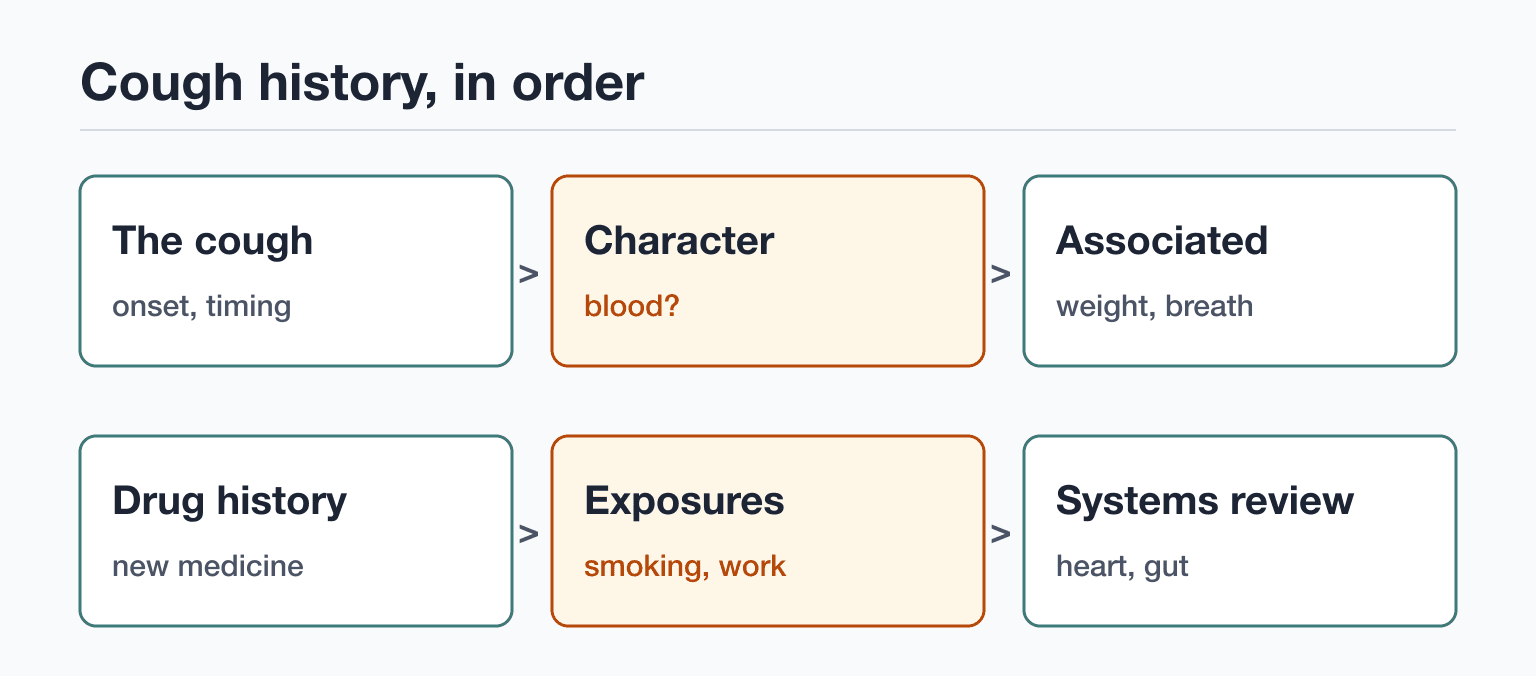
Start broad, then drill to risks, exposures and red flags. Order adapted from Zero to Finals.
Use this order to keep you on track and surface red flags early, especially when the history feels messy or rushed:
- Start with the cough itself: onset, frequency, timing, what makes it better or worse, previous episodes.
- Ask about character: dry or productive, sputum colour, any blood.
- Screen for associated symptoms: breathlessness, wheeze, chest pain, fever, weight and appetite.
- Review drug history, including whether the cough started after a new medicine.
- Ask about smoking, including passive smoking, work and asbestos, travel abroad and contacts with similar symptoms.
- Finish with a targeted systems review: heart, gut and ENT, plus reflux (GORD) if chronic cough features suggest it.
Worked example: what Frank said, and what we had to ask
In cough history taking, Frank volunteers the cough and the blood, but not the risks. The answers that change the picture need a question, and some of the most important ones need a very specific one.
Frank, 67 (simulated): what he said, and what we had to ask
Chip | Question | Answer | Why it mattered |
|---|---|---|---|
Volunteered | Tell me about the cough. | About three months, and different from his usual smoker's cough | Change in a long-standing cough can indicate a new underlying process |
Volunteered | Anything in the phlegm? | Streaks of blood over the last few weeks | Blood in sputum is a red flag, needs character, frequency and triggers |
Asked | Has your weight changed? | About 7 kg lost in three months without trying | Unintentional weight loss over months raises concern for systemic disease |
Asked | Do you smoke? | A pack a day for around 45 years, and still smoking | Signals risk and baseline odds |
Only if asked specifically | What work have you done? | Decades in the building trade, around asbestos and dust | Asbestos and dust exposures shift the differential and your threshold for concern |
Only if asked specifically | Has your voice changed? | Hoarse over the past few weeks | Hoarseness with cough can point to airway or nerve involvement |
Two more facts only came out on specific questions: unusual thirst with constipation and a foggy head, and a few drenching night sweats.
Simulated patient. Case file from our library. Questions written by us as a model, not a learner session.
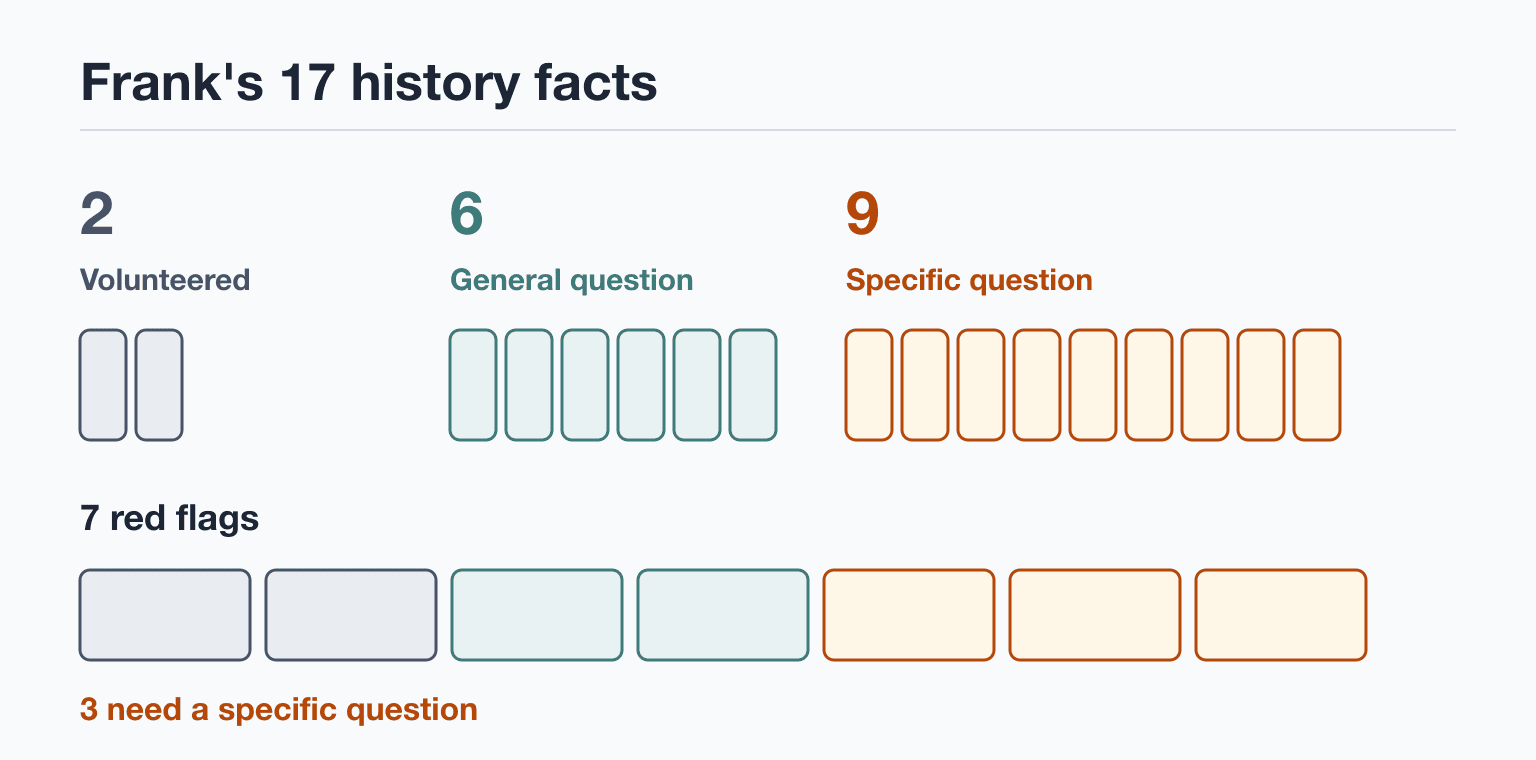
Our count from one simulated case file.
Our count of this case file: 17 history facts, 2 volunteered, 6 on a general question, 9 only on a specific question. The case file marks seven as red flags, and 3 of those only surface on a specific question. Fix it after the open start with specific closed questions.
Work is the easiest one to skip: ask for a proper occupational history, not just “are you retired?”. And Frank only says he’s most afraid it’s cancer when pressed, so finish by asking about his fears.
What the scorecard checks
After the case, the scorecard gives a score out of 100 across four areas of 25 points each: history taking, choosing tests, diagnosing and treating. It shows what you covered and missed, and adds teaching points for the next attempt.
In Frank’s case, ordering a chest X-ray returns "A large, obvious right-sided lung mass". You read the report. This isn’t a film-reading drill, and there’s no physical examination practice in the app. The marks we’re chasing here sit in the history. We’re holding back the final answer so the case stays worth playing.
How Diagnosica helps with this
Question an AI patient on video by voice or text, then get a scorecard.
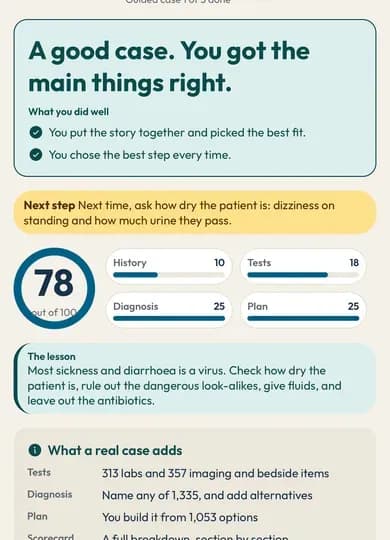
Diagnosica app, guided case scorecard, a different case, as of November 2026.
- Score out of 100, four 25-point areas.
- Next step lists missed history questions.
- History only, no physical exam.
Simulated patient. Screenshot from Diagnosica, November 2026.
Which cough red flags need urgent referral?
NICE's suspected cancer guideline, NG12, sets the red lines. It triggers a suspected cancer pathway referral for unexplained haemoptysis at 40 or over. At 40 or over, offer an urgent chest X-ray for 2 or more unexplained symptoms, or for 1 or more if the person has ever smoked.
NICE revised NG12 on 15 April 2026. The symptom list in NICE's suspected cancer guideline includes cough, fatigue, shortness of breath, chest pain, weight loss and appetite loss. Zero to Finals adds that weight loss is a red flag for malignancy and should be urgently investigated.
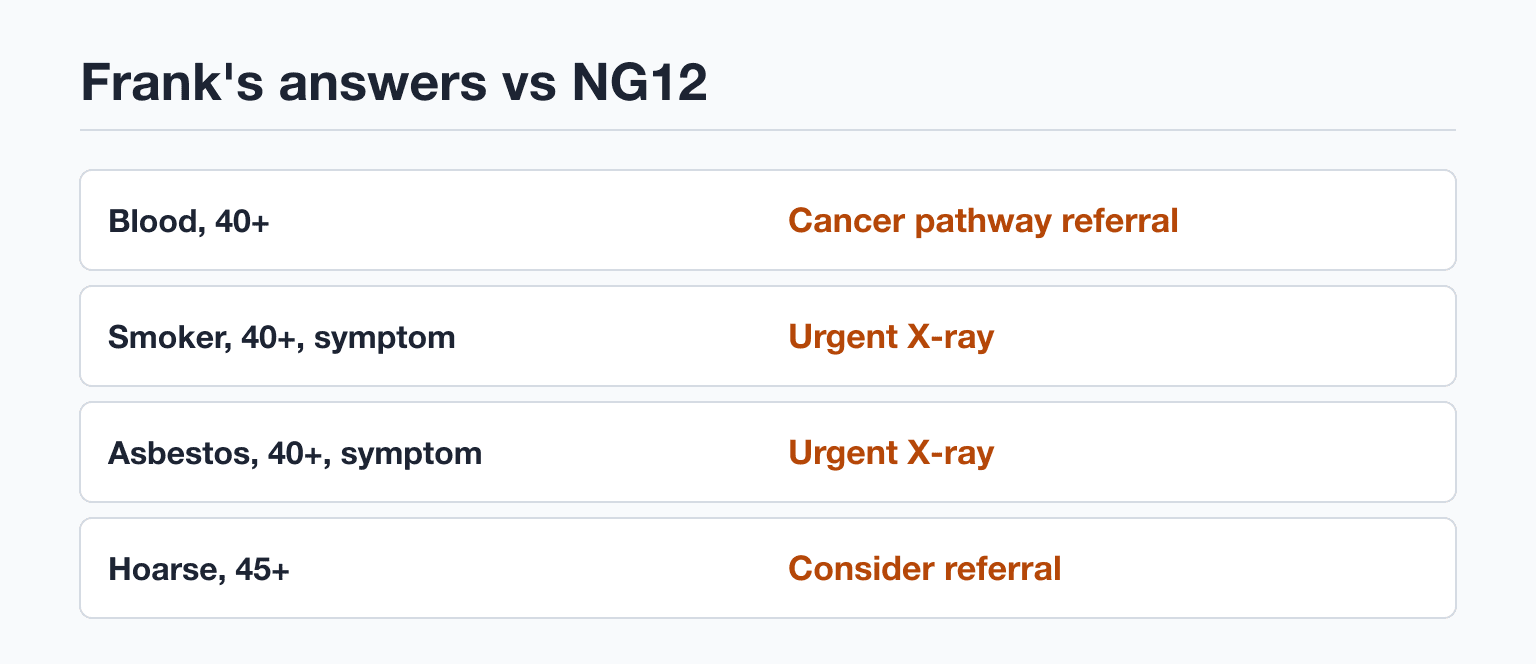
Criteria from NICE NG12; answers from one simulated case
Frank Doyle is 67 and reports blood in his phlegm. He has smoked, with cough, weight loss and chest ache. Asbestos exposure also appears in the mesothelioma recommendation, and in this age group persistent hoarseness is its own consider-referral criterion for the larynx. On the other side, the NHS cough page says most coughs clear within 3 to 4 weeks.
Watch out. NG12 guides referral decisions; your trust's local pathway applies. As a student, find these answers and tell your senior promptly, not decide the referral yourself.
What to take away for your next cough station
For cough history taking, anchor on time and change, then pull on risks and red flags with NG12 age cut-offs in mind:
- Ask duration and whether symptoms are changing, before moving to differentials.
- Ask smoking, work and voice specifically, because Frank didn’t volunteer them.
- Know the NICE NG12 age cut-offs: 40 haemoptysis, 45 hoarseness.
Breathlessness has its own station, see the breathlessness OSCE station, and the same open-then-specific habit works for a dizziness history.
Then try another case from a library of over 130 cases across 18 specialties, free to start, no card needed.