Medical school assistantship tips for UK final year

Your UK final-year assistantship is a rehearsal for day one F1 work. Medical school assistantship tips start with being on the team rota with a defined role, alongside a designated doctor in training, preferably an F1.
Key takeaways
- Before you start, rate yourself on the 10 outcomes used in the Imperial study.
- Check rules on writing actual prescriptions for a registered doctor to check and sign.
- Draft notes and dummy prescriptions for a doctor to check.
What is a medical student assistantship in the UK?
The UK student assistantship is a final-year placement where you join a clinical team and do supervised tasks like an incoming FY1. Typical supervised tasks include clerking, managing acutely unwell patients, and practical procedures, always under supervision. It's defined by what you do and learn, not by length or specialty.
This page is about UK medical students, not US medical assistant training. The GMC doesn't define assistantship by length, so timing varies by school, per the GMC's assistantship guidance.
Four example documents to read, applying to those places only:
Where | Length | Setting |
|---|---|---|
3 weeks | Eight affiliated hospitals | |
6 weeks | Partner trusts, last six months of final year | |
6 weeks | General practice, always with supervision | |
8 weeks | Largely on the ward, no timetabled clinics or theatre |
The Imperial authors note assistantships were traditionally longer, often up to 15 weeks.
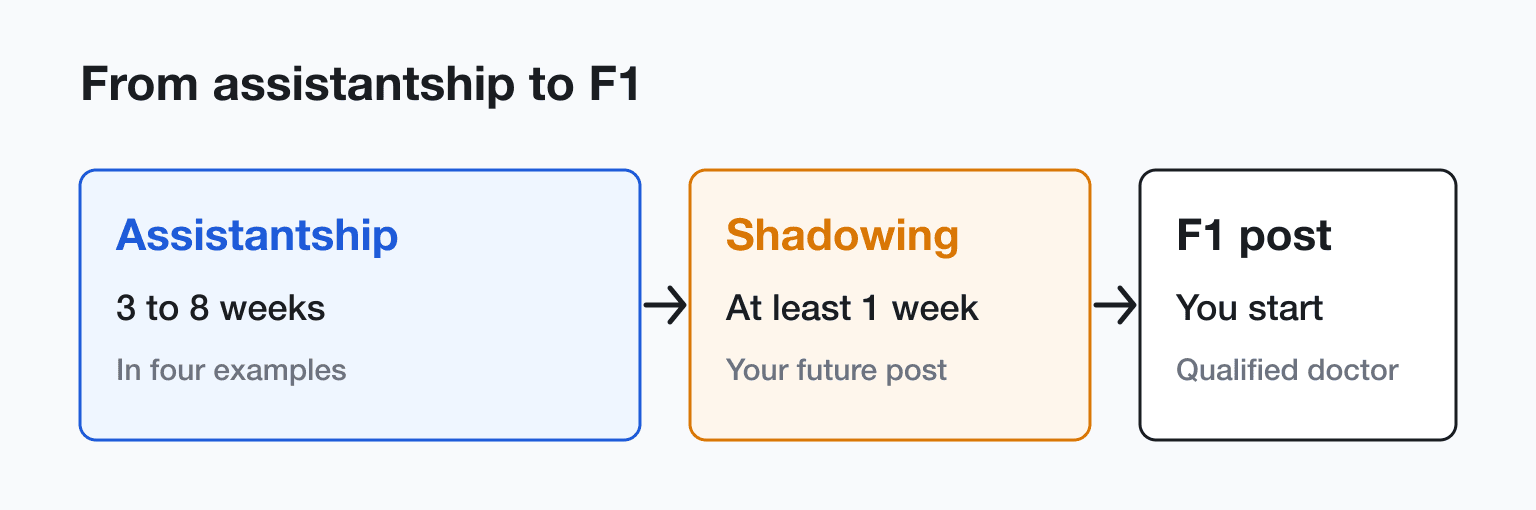
Sequence from assistantship to post-specific F1 shadowing, at least one week, per GMC guidance.
After the assistantship, the GMC says you should work with the F1 in the post you'll take up, normally for at least one week, as close to starting as possible. Shadowing focuses on that specific post rather than a general placement.
Before your first ward day, you can clerk one simulated patient as a quick rehearsal with an AI patient.
Do this first: rate yourself before day one
The assistantship is your rehearsal for FY1: before you start, rate your confidence now across the core outcomes. That lets you target the right tasks on day one and ask for chances that close your gaps.
In the Imperial evaluation, a 3-week assistantship across 8 hospitals, 208 completed both questionnaires. Of these, 169 (81%) reported higher confidence in at least one objective, in one school's cohort. The authors say pre-placement rating helped students target gaps. That's self-rated confidence after 3 weeks, not measured performance, and we can't say the rating alone caused it.
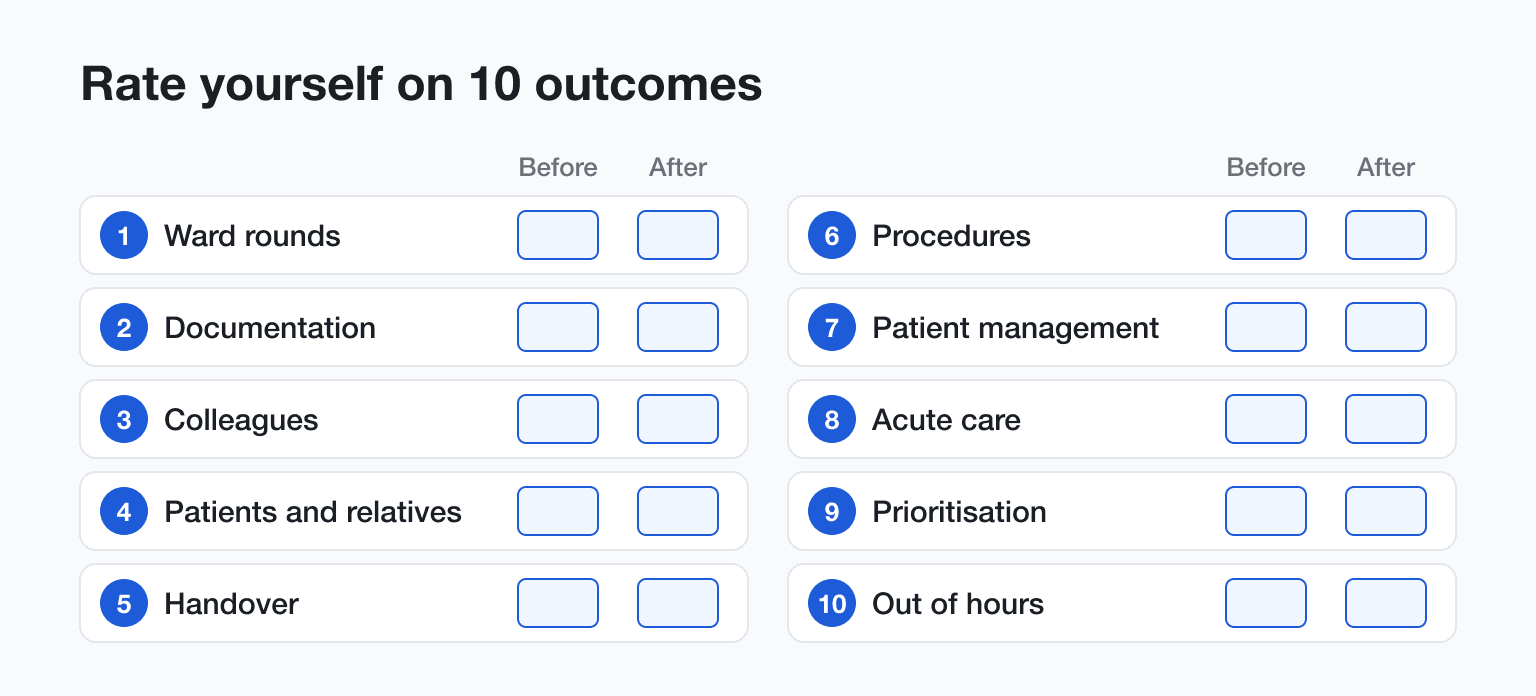
The 10 outcomes come from the Imperial study; the before and after grid layout is ours.
The ten outcomes are organising ward rounds, documentation, communication with colleagues, communication with patients and relatives, patient handover, practical procedures, patient management, acute care, prioritisation and out-of-hours clinical work.
Seven ways to work like the F1's right hand
The assistantship is a supervised run-up to F1. The GMC describes it as real tasks under supervision, so these seven steps favour doing over watching:
- Ask for clarity. Secure a defined role, a rota place and a designated doctor in training so you see what F1 asks of you.
- Learn the ward. Find the emergency trolley, emergency call, bleep, key staff and protocols, per NHS Tayside's supervisor guide.
- Run the list. Keep and prioritise jobs, as Tayside expects; see running a jobs list.
- Clerk then present. Clerk under supervision, then present clearly using structuring a clerking and presenting to your F1.
- Draft and file. Write notes and discharge summaries for a doctor to check and co-sign, as Tayside asks.
- Practise prescribing. Write duplicate dummy prescriptions and ask a registered doctor or pharmacist for feedback.
- Ask for feedback. Invite your F1 to give feedback on your work, since the GMC says F1s should be empowered to give it.
Watch out. Whether you can write actual prescriptions depends on local governance, per the GMC, with a registered doctor checking and signing, so ask your school.
Handover practice with handover in SBAR format belongs on your list too since Tayside expects students to give and receive handover.
Worked case: clerk Alan Griffiths as if your F1 asked you to
Alan Griffiths is a fictional 68-year-old AI patient from Diagnosica. He is a good clerking exercise because most of his history doesn't come out unless asked. He says: "I've been getting more and more breathless over the last few months."
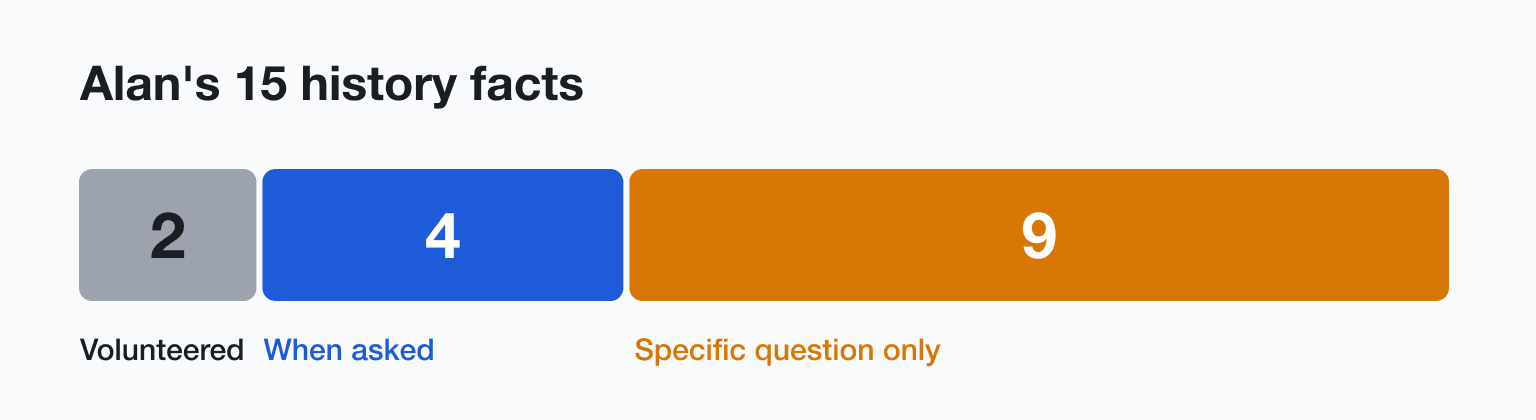
Our count of disclosure tags in this case file: 2 volunteered, 4 on question, 9 specific; simulated patient.
Of 15 history facts, he volunteers 2, gives 4 when asked and 9 only on a specific question. That's why a clerking needs specific questions.
Alan Griffiths, 68 (simulated): what he said, and what you'd have to ask
Chip | Question | Answer | Why it mattered |
|---|---|---|---|
Volunteered | What has been happening with your breathing? | His breathlessness has got gradually worse over several months. | Gradual course separates it from acute events. |
Volunteered | Anything else you've noticed? | He wakes at night gasping and sleeps propped on three pillows. | Points to congestion in the lungs. |
Asked | Any ankle or leg swelling? | His ankles and legs swell up, worse by the evening. | Supports fluid overload. |
Only if asked specifically | Have you ever had a heart attack? | He had a heart attack about five years ago. | Points to an ischaemic cause. |
Only if asked specifically | Has your heart ever raced or fluttered? | On a couple of occasions his heart has raced or fluttered. | A possible driver of his decline to raise with your F1. |
Only if asked specifically | How far on the flat before breathlessness stops you? | It now limits him on the flat. | Documents functional decline. |
The last two are must-elicit in the file, so try presenting all six crisply together.
Simulated patient. Case file hfref-68m. Questions written by us as a model, not a learner session.
How Diagnosica helps with this
You clerk an AI patient by voice or text, then get a scorecard.
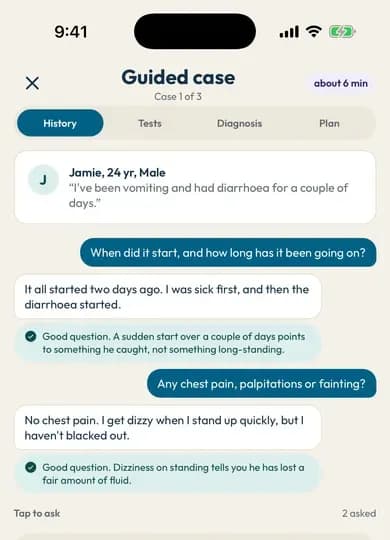
Diagnosica app, guided case history screen, as of October 2026.
- Ask a question, the AI patient answers.
- Good questions get a why.
- Alan's case opens from the button below.
Simulated patient. Screenshot from Diagnosica, October 2026.
Common assistantship mistakes to avoid
From what we can tell, assistantship mistakes come from treating it as observation and assuming every school runs it the same way. This is our reading of the documents, not survey data.
Four traps these documents point to:
Mistake | What the documents say |
|---|---|
Only watching | Rotherham wants most of your time with the F1; consultant, F1 and senior ward nurse provide a 360 evaluation. |
Taking every extra shift | The GMC says you shouldn't be required to work extra shifts due to service pressure. |
Assuming sign-off rules travel | In Tayside, FY1s can't sign four Mini-CEX or four case presentations, so check your school's rules. |
Leaving procedures late | Check what you've done against the GMC's core practical skills list, always under supervision. |
The GMC also says you should get the same rest and commute protection as qualified doctors after out-of-hours shifts. For raising concerns about a placement, see the GMC's placement guide by students.
Practise the clerking before your first ward day
Diagnosica rehearses history and reasoning for your assistantship with an AI patient and a scorecard. It doesn't cover prescribing on a chart, procedures, handover or physical examination, so those stay with your F1 on the ward.
If you're planning ahead, tackle the rest of final year next, then prepare for your first FY1 day.
Now clerk another simulated patient, free to start, no card needed, then present it out loud.