Obstetric history taking: structure, gravidity and parity
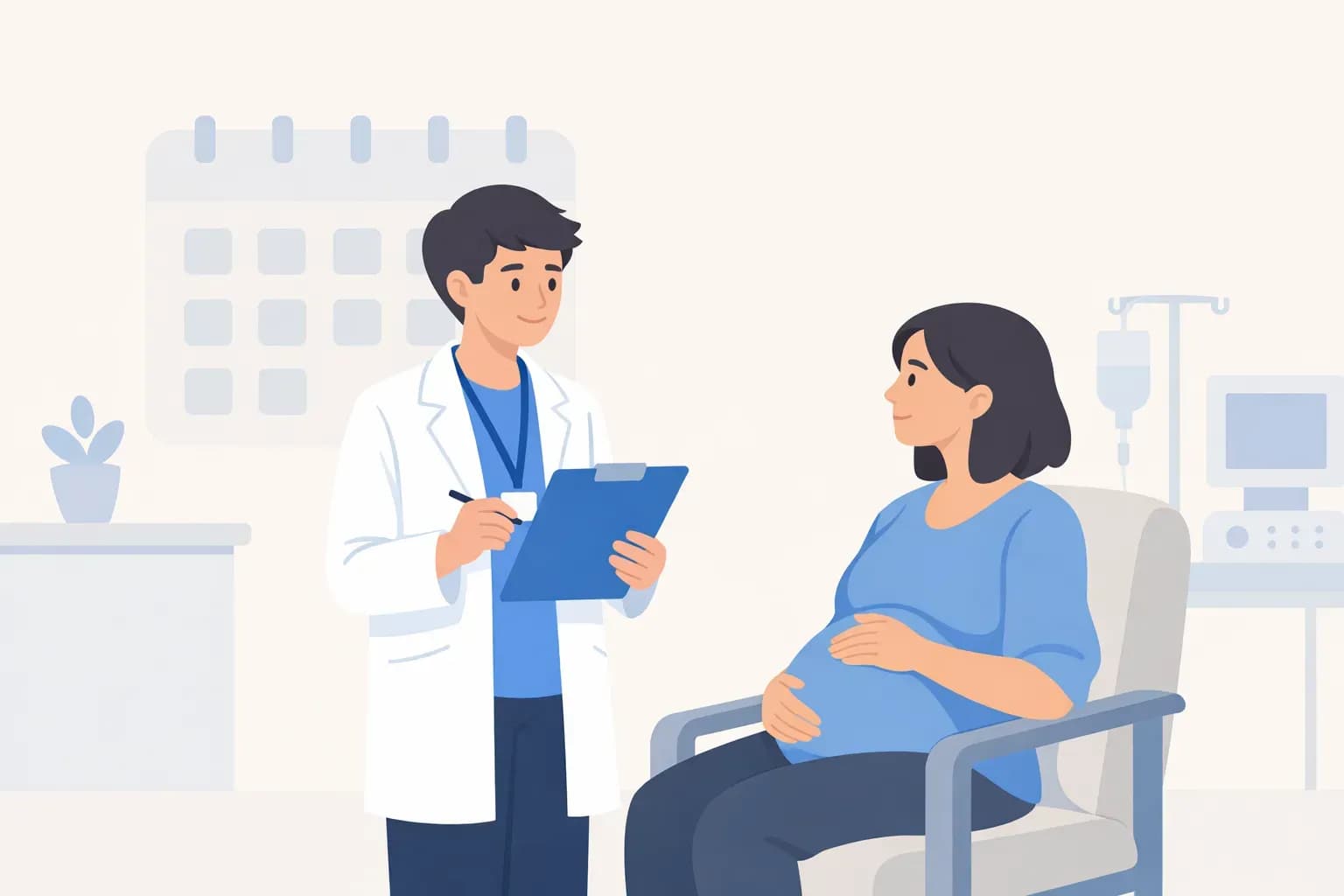
Obstetric history taking adds the current pregnancy, gravidity and parity, and each past pregnancy's outcome to a standard history. You'll record gravida including the current pregnancy, per the NHS Wales Data Dictionary, so ask explicitly about this pregnancy first.
If this is a real person: If someone pregnant has severe pain below the ribs, headache, or vision changes, call their maternity unit straight away. Call 999 if life-threatening. This post is exam practice only.
Key takeaways
- Gravida counts every pregnancy, including the current one, no matter the outcome.
- Parity counts live births at any gestation, plus births at 24 weeks or more.
- Severe rib pain, bad headache, or vision change in pregnancy needs immediate review (NICE NG133).
What does an obstetric history cover?
Obstetric history taking uses the same skeleton as any medical history, with added pregnancy detail. Start with the presenting complaint. Then document the current pregnancy: gestation, booking, scans and checks so far. Record gravidity and parity with outcomes for each pregnancy. Add gynaecological history, including periods and contraception.
Finish with past medical history, drugs, allergies, family and social history, and ICE.
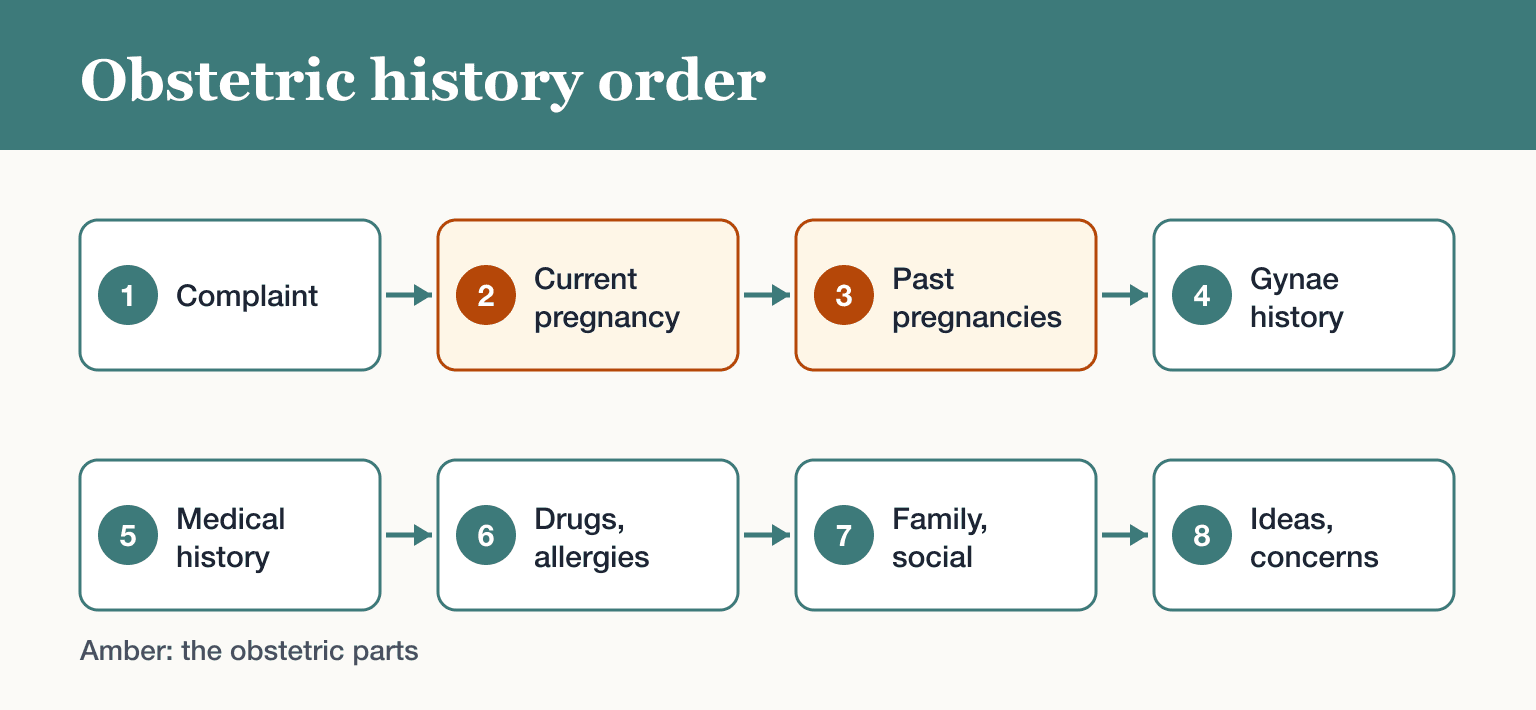
Start with the current pregnancy, then previous pregnancies, gynae, PMH, family and social, and ICE.
Order: introduction and presenting complaint. Current pregnancy. Previous pregnancies with gravidity and parity. Gynaecological history. Past medical history. Drugs and allergies. Family and social history. Then ideas, concerns and expectations. Schools differ on this slightly.
For structure, see the standard history framework. Zoom on the presenting complaint section, and compare the paediatric history version. At booking, the NICE antenatal care guideline lists medical, obstetric and family history, and mental health. It also lists current and recent medicines, including over-the-counter. It also lists supplements and herbal remedies, allergies, occupation, and family and home support.
If you want to take this history from an AI patient, it's a pregnant AI patient you can talk to by voice or text, free to start, no card needed, on phone, tablet or laptop.
How do you work out gravidity and parity?
Gravidity and parity in obstetric history taking are count labels. Gravida is the number of times pregnant, any outcome, with the current pregnancy included. Parity is the number of times she has given birth at 24 weeks or more. It also counts a live birth at any gestation. A stillbirth at 24 weeks or more counts too.
Sources: NHS Wales definition of gravida, NHS Wales definition of parity.
If you feel lost in the arithmetic under pressure, anchor the definitions first. Then count pregnancies and births separately, and check parity rules on gestation and live birth:
Situation | Gravida | Parity | Why |
|---|---|---|---|
First pregnancy, now 34 weeks | G1 | P0 | one pregnancy (this one); no births yet. |
Pregnant now; one live birth at term; one miscarriage at 10 weeks | G3 | P1 | 3 pregnancies; only the birth counts; miscarriage was before 24 weeks. |
Pregnant now; one stillbirth at 30 weeks | G2 | P1 | 2 pregnancies; a birth at 24 weeks or more counts. |
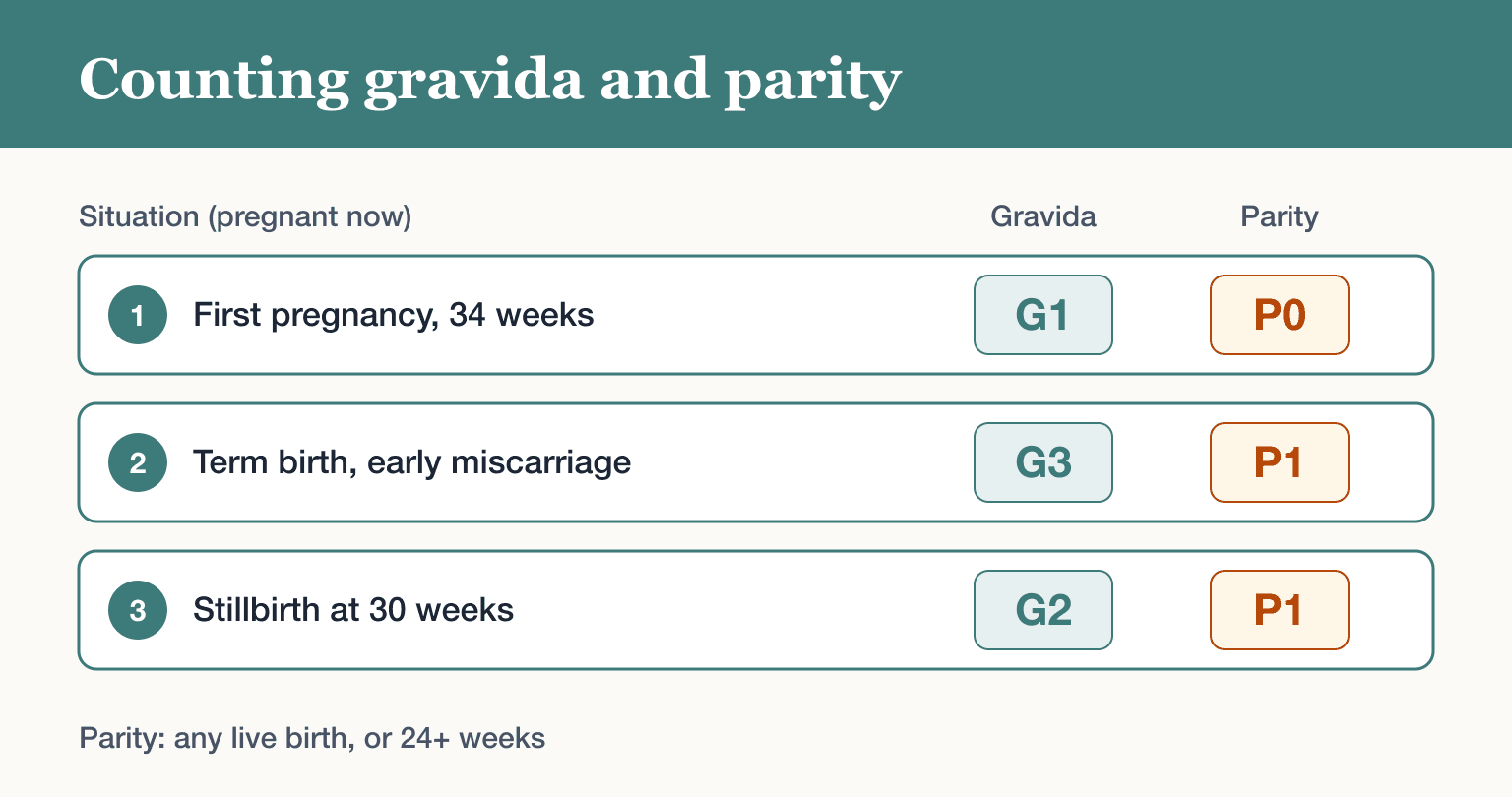
Gravida counts all pregnancies; parity counts births meeting the definition. Examples from NHS Wales Data Dictionary.
From the same NHS Wales page, nulliparous means never previously given birth, primiparous means given birth once only, and multiparous means given birth more than once.
Watch out. The common slip is forgetting the current pregnancy counts in gravida. It does not count in parity until she actually gives birth. So a pregnant woman with no previous births is G1, P0, whatever the gestation today.
Current pregnancy: what to ask, in order
For the current pregnancy, use a set sequence: establish gestation and parity, confirm early booking, then check scan findings, red-flag symptoms, baby's movements, and exposures.
Use this order as the spine of the current pregnancy history:
- Confirm how many weeks pregnant she is and whether this is her first pregnancy.
- Ask when she booked with a midwife, noting NICE recommends booking by 10+0 weeks in the NICE antenatal care guideline.
- If she booked late, ask why, because NICE says it may reveal social, psychological or medical issues.
- Ask what her checks and scans have shown so far, in her words.
- Assess severe headache, problems with vision, severe pain below the ribs, vomiting, sudden swelling of the face, hands or feet.
- Ask about baby's movements.
- Cover medicines including over-the-counter and herbal remedies, allergies, and smoking and alcohol questions.
Local trust guidance and the booking notes set the detail.
How Diagnosica helps with this
Ask by voice or text, the AI patient replies, and scored feedback follows.
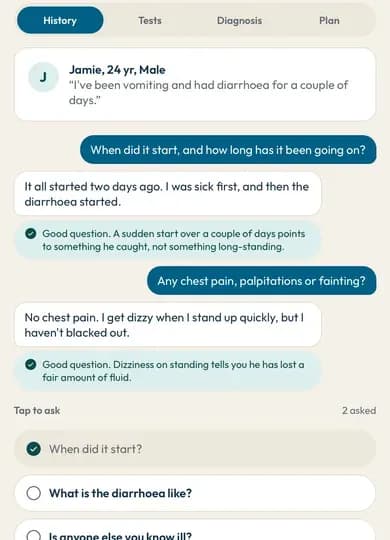
- Your question appears on the right panel.
- The patient's reply appears in plain words.
- A short note explains why that question mattered.
Simulated patient. Screenshot from Diagnosica, November 2026.
Worked case: Rachel, 34 weeks, told it was heartburn
Rachel Okonjo, 31, is a simulated AI patient in Diagnosica and the library's only obstetric case. This worked case shows what she volunteered and what only surfaced when asked, so you can see which questions surface safety-critical details fast.
Rachel, 31 (simulated): what she said, and what had to be asked
Chip | Question | Answer | Why it mattered |
|---|---|---|---|
Volunteered | What's brought you in today? | pain under right ribs and top of tummy, two days | NICE lists severe pain just below the ribs |
Volunteered | What have you been told about the pain? | reflux, antacids made no difference | NHS lists heartburn not settling with heartburn medicines |
Volunteered | Is this your first pregnancy, and how many weeks are you? | 34 weeks, first pregnancy | G1 P0; NICE counts nulliparity as a moderate risk factor |
Only if asked specifically | Any headache or problems with your vision? | forehead headache, flashing lights | both on the NICE symptom list |
Asked | Any swelling in your hands or face? | hands and face over the past week | sudden swelling is on the NICE list |
Only if asked specifically | How have the baby's movements been? | less over the last day | she would not have mentioned it unprompted |
Three of the six facts only came out because a question was asked; her midwife's "not too bad" check is the reassurance to look past. Simulated patient. Case file rachel-okonjo-31f. Questions written by us as a model, not a learner session.
She had her own worries and theory: heartburn or gallstones, and fear for the baby. The negatives that change urgency mattered too, given her story and gestation: no bleeding and no leaking of fluid.
Which symptoms in pregnancy mean escalate now?
NICE NG133 advises pregnant women to seek immediate review for symptoms of pre-eclampsia. These include severe headache, problems with vision, and severe pain below the ribs. Vomiting, and sudden swelling of the face, hands or feet are also included. In an OSCE or on placement, say this and escalate to a senior or the maternity team the same way.
See NICE hypertension in pregnancy guidance.
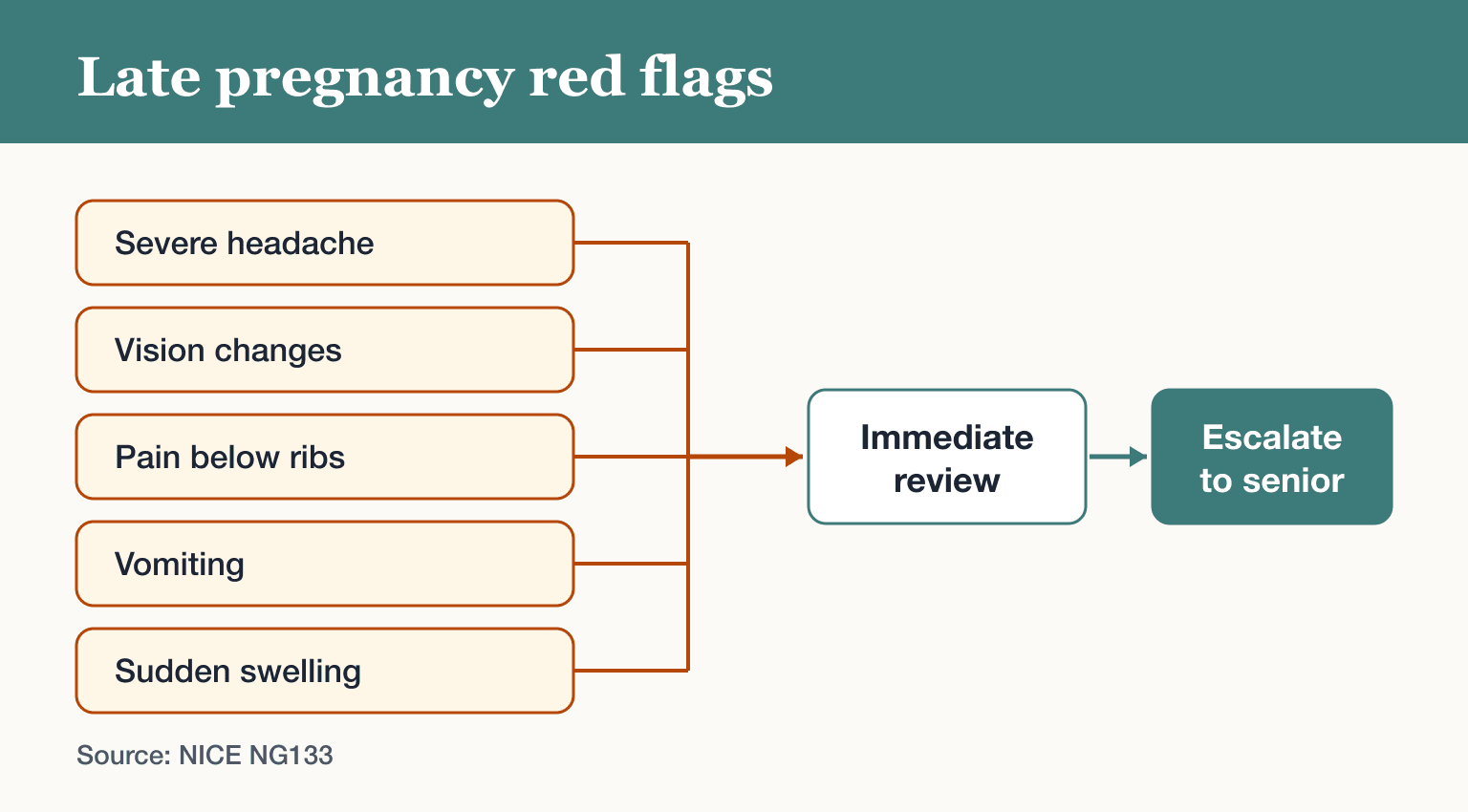
These symptoms warrant immediate review and escalation per NICE NG133.
Any of those symptoms after 20 weeks means stop treating it as routine and get urgent review. NHS says pre-eclampsia is most likely from 20 weeks onwards. It also lists heartburn that does not go away with heartburn medicines, with any of these needing checking immediately (see the NHS pre-eclampsia page).
Say what you found, anchor it in time, and ask for review; see escalating to your senior quickly. Local trust guidance sets who to call. Follow it the same way every time for maternity symptoms raising concern.
Common mistakes in an obstetric history OSCE
Common mistakes are counting errors and missed red flags. Exclude the current pregnancy from parity per the NHS Wales definition of parity. Include it in gravida. Screen for pre-eclampsia symptoms with direct questions about headache, visual disturbance, and swelling.
Keep these four traps front of mind in obstetric history stations:
- Don't count the current pregnancy as parity.
- Don't drop miscarriages before 24 weeks from gravida.
- Don't accept "it's heartburn" when antacids haven't helped.
- Ask directly about headache, visual disturbance and swelling.
Practise the questions out loud so your wording lands under pressure. Then practise another full history with an AI patient, free to start; obstetric history is one case, the other full histories are in other specialties.