History of presenting complaint: what it is and how to take it
The history of presenting complaint (HPC) is the exploration of the symptoms. It comes after the presenting complaint, which is recorded in the patient's own words, and it's documented in chronological order to capture the symptom's timeline.
Practise Terence's history, a 67-year-old with four days of burning pain, simulated and free, then take this history from an AI patient.
Key takeaways
- Start with one open question, then cover the 8 SOCRATES parts for pain only.
- Ask which came first, then sequence events; pain 3 to 4 days before rash.
- Write one time-ordered HPC paragraph, in the patient's words, with clear chronology.
What is the history of presenting complaint?
The history of presenting complaint is the time ordered story of the main symptom from onset to today. The presenting complaint is a short phrase in the patient's own words. The history of presenting complaint builds a chronology with onset, fluctuation, triggers, and associated features to test differentials.
How PC and HPC relate, with one simulated patient example:
Part | What it holds | Example from one patient |
|---|---|---|
Presenting complaint (PC) | Short symptom in patient's words | Terence, 67: "Burning pain round my left side" |
History of presenting complaint (HPC) | Detail, onset, course, associated features | Terence, 67: Four days of burning band pain, then blisters this morning |
US name (chief complaint and history of present illness) | Chief complaint and HPI, chronology | Same jobs, different labels |
On TeachMeSurgery's history-taking page, the PC is in the patient's own words and the HPC explores the symptoms in further detail. In US templates, the HPI should "Convey the acute or chronic nature of the problem and establish a chronology" in a sample US write-up.
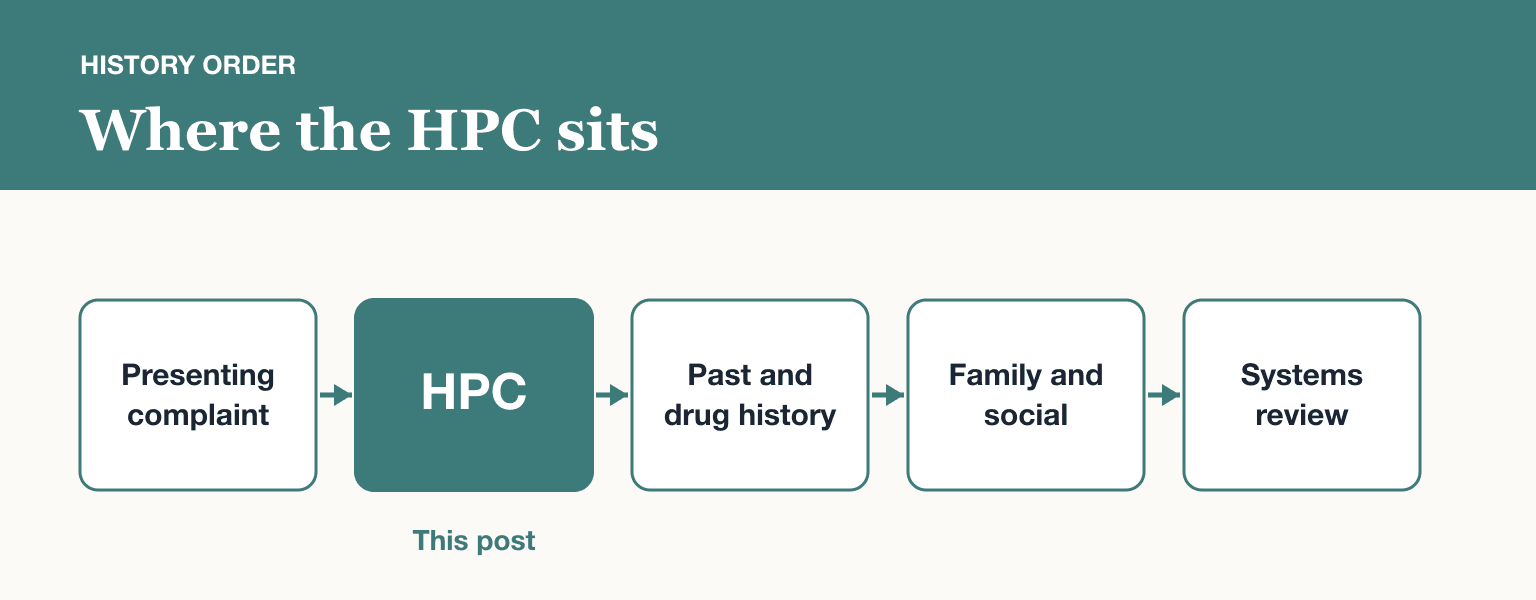
HPC comes straight after the Presenting Complaint, then Past and Drug, Family and Social, and finally a Systems Review.
Presenting complaint first, then the history of the presenting complaint, then past and drug, family and social, then systems review. The HPC comes straight after the presenting complaint and before the background questions.
Start open, then let the story run
The history of presenting complaint starts with an open question, then a pause. Many patients volunteer the order of events unprompted. Only once the free narrative tails off should you use closed questions to clarify gaps.
After the presenting complaint, ask one open prompt like, "Tell me more about that," then stop talking. Silence helps. Patients often lay out what happened and when, in their order, before you need a checklist.
Terence starts with, "I've had a burning pain round my left side for four days." That one line gives duration, character and site. Then switch to open then closed questioning.
The steps inside the HPC, in order
Use six ordered steps. Open with broad listening; fix the timeline; characterise the symptom; add associations; test targeted negatives; then capture impact and actions, and summarise back.
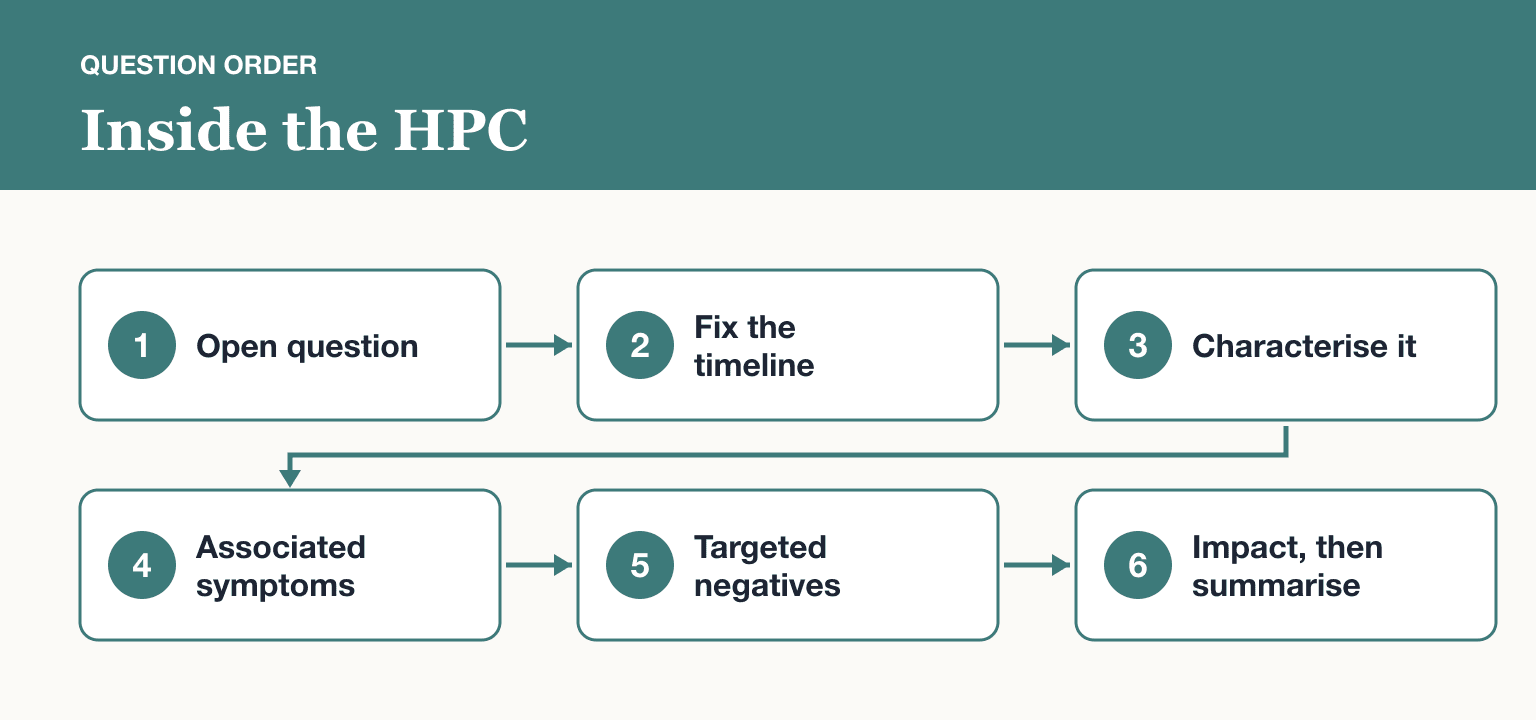
The six HPC steps in order for quick recall.
Open question, build the timeline, character of symptom, associated symptoms, targeted negatives, impact and summary.
Use this HPC sequence after the presenting complaint; Medistudents' step list shows PC then HPC, and the questioning then flows like this:
- Open question. Ask an open question, listen without interrupting, and reflect their key words to guide later detail.
- Fix timeline. Establish onset, what came first, and what's changed since, documenting events in clear chronological order.
- Characterise symptom. Use SOCRATES and its cousins for pain and cover its eight parts succinctly.
- Add associations. Ask associated symptoms that cluster by system, including any red flags logically linked to the presenting complaint.
- Target negatives. Ask the negatives that shape the HPC that would shift likely differentials or urgency for this presentation.
- Impact and actions. Ask what it's stopped them doing and what they've tried, then summarise back for confirmation.
The HPC ends where wider questions begin, which is where the systems review starts.
Worked example: Terence, 67 (simulated)
Terence is a simulated library patient, a retired postman. His history turns on the order of events: days of burning pain, then a one-sided crop of blisters.
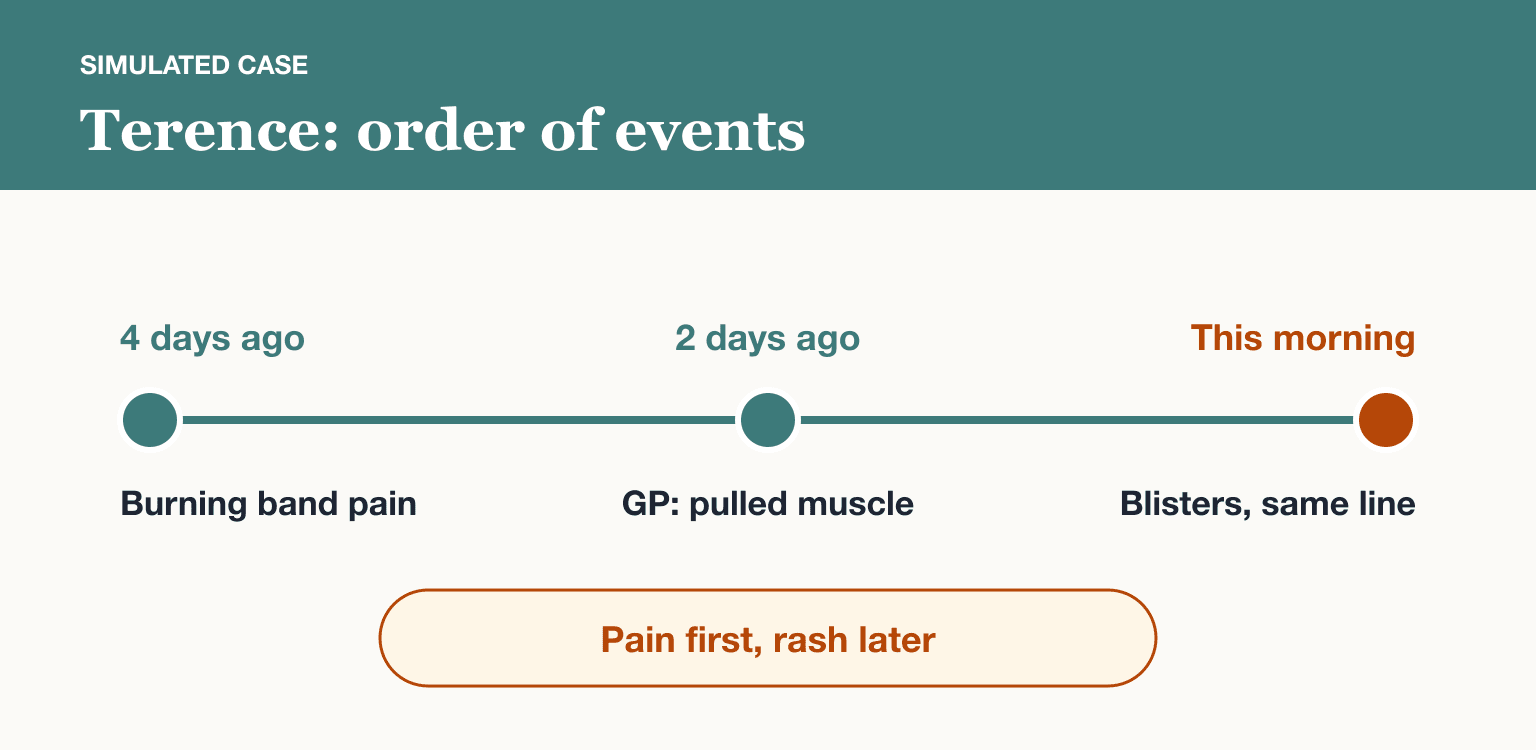
Simulated case timeline for the HPC.
Four days ago, burning band pain began on the left. Two days ago, the GP said pulled muscle. This morning, blisters appeared along the same line, one side only.
Terence, 67 (simulated): what he said, and what had to be asked
Chip | Question | Answer | Why it mattered |
|---|---|---|---|
Volunteered | What brought you in today? | Four days burning left-sided pain; blisters there this morning. | Sets timeline for focused questions. |
Volunteered | Which came first, the pain or the rash? | Pain came first, three to four days before any rash. | Explains nothing was seen earlier. |
Asked | What does the pain feel like? | Burning, stabbing, electric shocks; shirt and bedsheet hurt. | Neuropathic pattern over cardiac. |
Asked | Is it on both sides? | One side only, stops at the midline front and back. | Dermatomal, not central. |
Only if asked specifically | Does walking bring it on, or spread to your arm or jaw? | No; not exertional or central, no arm or jaw spread. | Fewer cardiac red flags. |
Only if asked specifically | Anything on your forehead, eyelids, or nose tip? | Nothing there; vision normal. | Screens for eye risk. |
Four of six facts came only because they were asked; the timeline (pain first, rash days later, one side) is the clue.
Simulated patient. Case file shingles-67m. Questions written by us as a model, not a learner session.
Pain followed by a one-sided rash days later matches the NHS shingles page description of shingles.
Watch out. A real person with sudden chest pain that does not go away, or chest pain with sweating, feeling sick, light-headed or short of breath, should call 999, per NHS chest pain advice. This case is practice.
How to write the HPC paragraph
Write the history of presenting complaint as one paragraph in time order. Start with symptom and onset. Use the patient's words where helpful. Then add pertinent negatives at the end. Keep it tight, specific, chronological, and in clear note style.
Example. Model HPC, Terence (simulated). 67-year-old man, 4/7 burning, stabbing band pain L chest; pain came first, 3-4 days before rash; blisters this morning along same line; unilateral to midline; skin sore to clothes; GP 2 days ago, no findings; painkillers barely helped, not slept two nights; no exertional trigger, central/crushing pain, or arm/jaw radiation; not worse on deep breaths or cough; no breathlessness, fever, chills or malaise; no forehead, eyelid or nose-tip; vision normal.
When speaking, deliver the HPC once, early, as a crisp paragraph, then stop. Place it before other domains. See presenting the history aloud for structure and timing.
How Diagnosica helps with this
You ask, the AI patient answers, and the case is scored against a rubric.
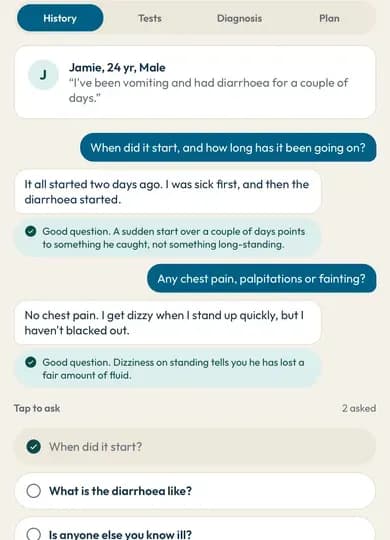
Diagnosica app, guided case history screen, as of November 2026.
- Your question appears at the top.
- The response shows beneath.
- A green note explains why.
Simulated patient. Screenshot from Diagnosica, November 2026.
Mistakes that flatten the story
Four habits flatten an HPC. They are: checklist before story; skipping which event came first; running SOCRATES on non-pain symptoms; and writing out of time order. Each one blurs the timeline and hides the clinical thread.
Avoid these HPC pitfalls:
- Checklist too early. Closed questions before an opener flatten the narrative and hide cues.
- Skip first event. Terence's GP saw nothing two days ago, called it a pulled muscle.
- Misusing SOCRATES. Using it on non-pain symptoms skips the timeline the case needs.
- Out of order. Non-chronological notes confuse events and weaken your reasoning and summary.
Practise it on a patient who talks back
Practising the history of presenting complaint means asking a real-time conversational patient and adjusting on the fly. Reading a model isn't the same as hearing and steering the story under time pressure, with pauses, tangents, and incomplete answers.
Diagnosica's AI patient answers by voice or text and appears as a video avatar. Each case is scored against a rubric.
If you're building reps, move from HPC to the structure for every part of a history, then try a body-system drill with cardiovascular history taking. When you're ready, practise another full history.