Social history taking: what to ask and why it matters
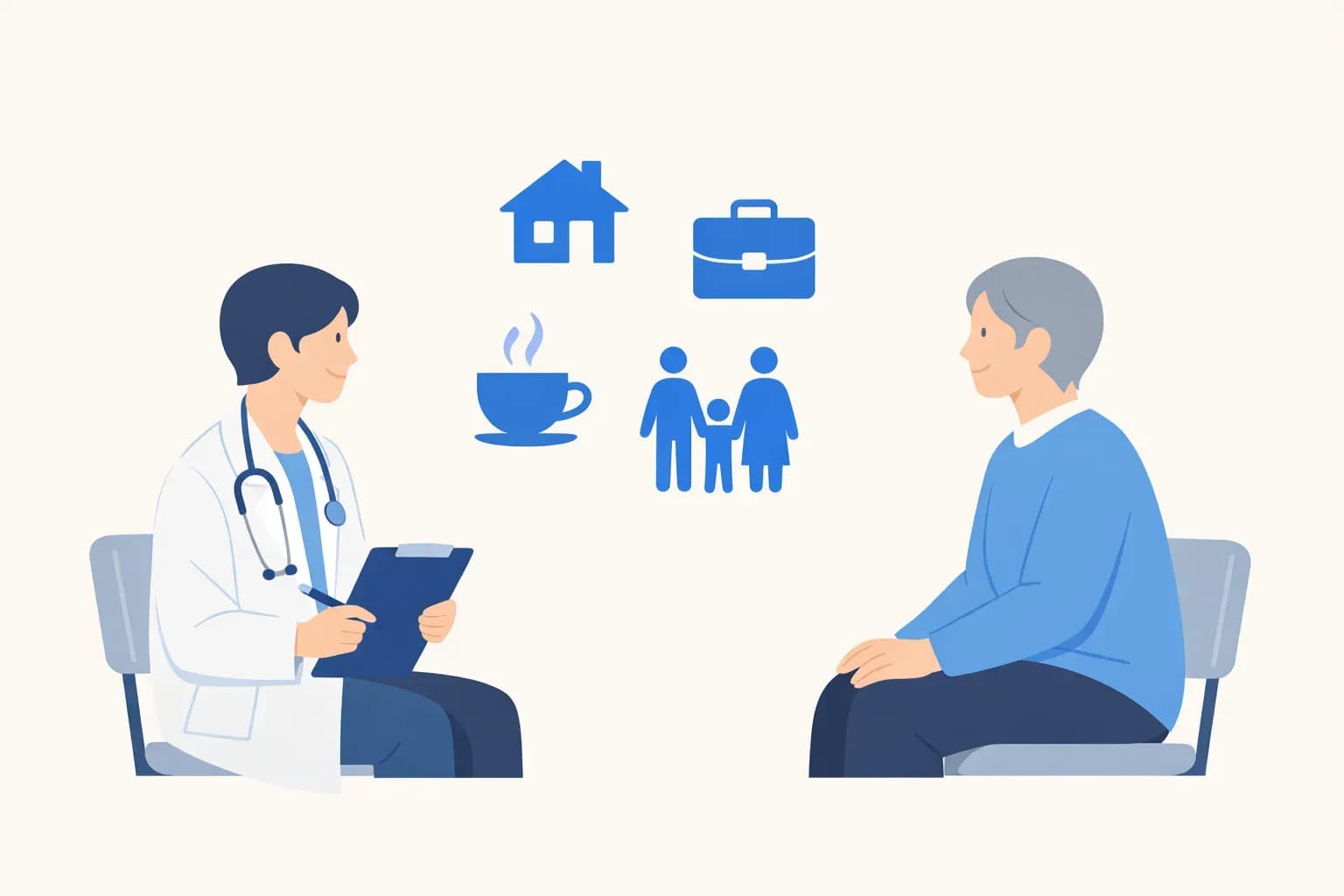
Social history taking covers smoking, alcohol, drugs, work, home and travel, and turns habits into numbers: alcohol in units against the UK's 14-unit weekly guideline, smoking in pack-years. Ask about both plainly and without judgement, and be specific.
Key takeaways
- Ask about alcohol plainly; in our worked case it emerged only on a direct question.
- Units equal strength times millilitres divided by 1,000; compare with 14 weekly.
- Pack-years equal packs per day times years; 20 a day for 31 years equals 31.
Do this first: ask plainly, without judgement
Social history taking works best if you use a flat, routine tone, and say you'd ask everyone, every time. Avoid judgement, and start with open questions before numbers so these topics feel ordinary.
People often understate drinking and smoking. Try, “These are questions I ask everyone. I want a clear picture.” Our worked patient opens up only when asked plainly and without judgement.
TeachMeSurgery's history guide includes occupation and exposures, smoking and alcohol, and home support for older or chronically ill patients. Start with open questions before closed ones, then pin numbers. It sits near the end of the rest of the history. To practise, take a social history from an AI patient, the patient there is an AI.
What does a social history cover?
A social history covers six areas you ask every time: smoking and alcohol, recreational drugs, work, home and support, and travel. You build a consistent picture across visits, not vague notes, and turn smoking and alcohol into numbers you can compare. That way the record is reusable.
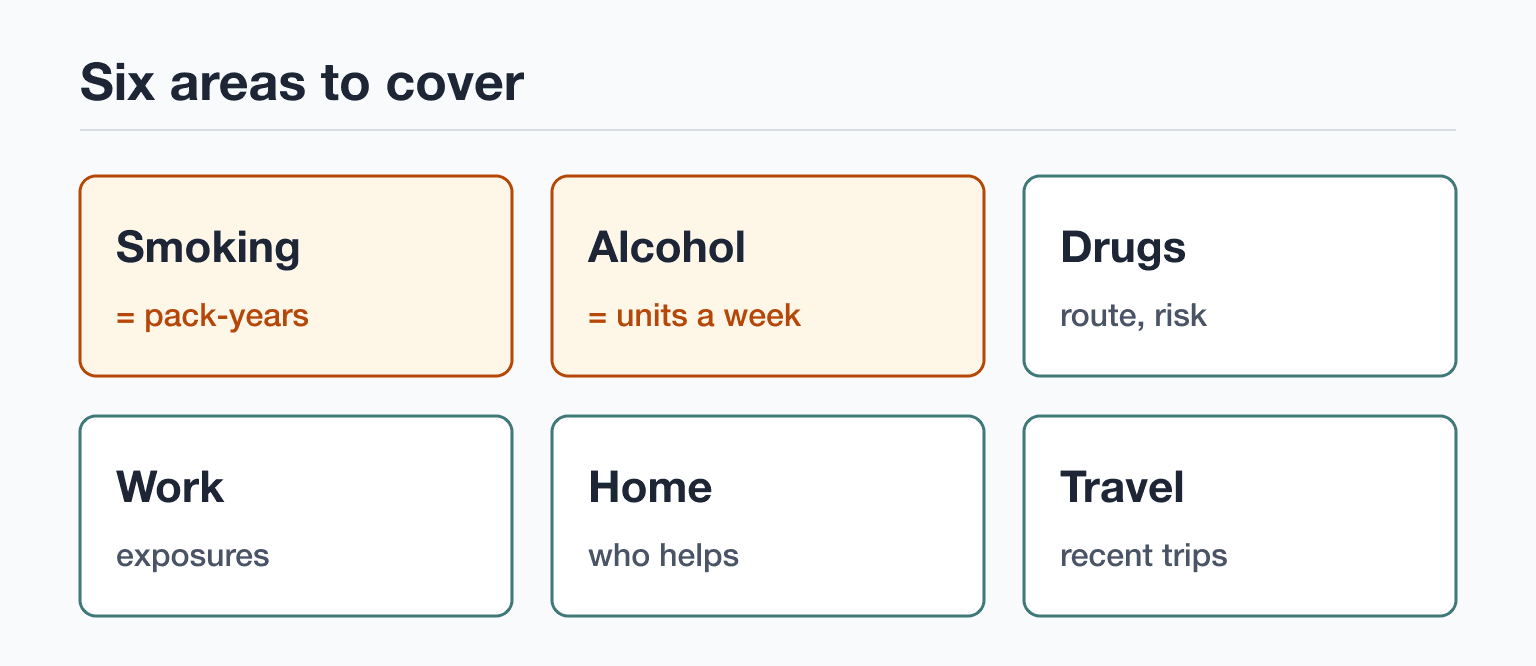
Six areas to ask every time; turn smoking and alcohol into clear numbers.
Use these starter prompts, and note what to convert each answer into:
Area | Ask | Turn it into |
|---|---|---|
Smoking | how many a day, since when, ever stopped | pack-years |
Alcohol | what, how much, how often, any morning drink | units a week |
Recreational drugs | what, how often, ever injected | the route and the risk |
Work | job now and before, exposures | |
Home and support | who lives with them, who helps | whether going home is safe |
Travel | recent trips abroad |
The two linked areas have their own guides, so this post goes deep on the two numbers.
How to count units and pack-years
For clear records every time, ask what, how much and how strong. Then do the standard sums so you record it clearly without guesswork. That makes the numbers reusable across visits.
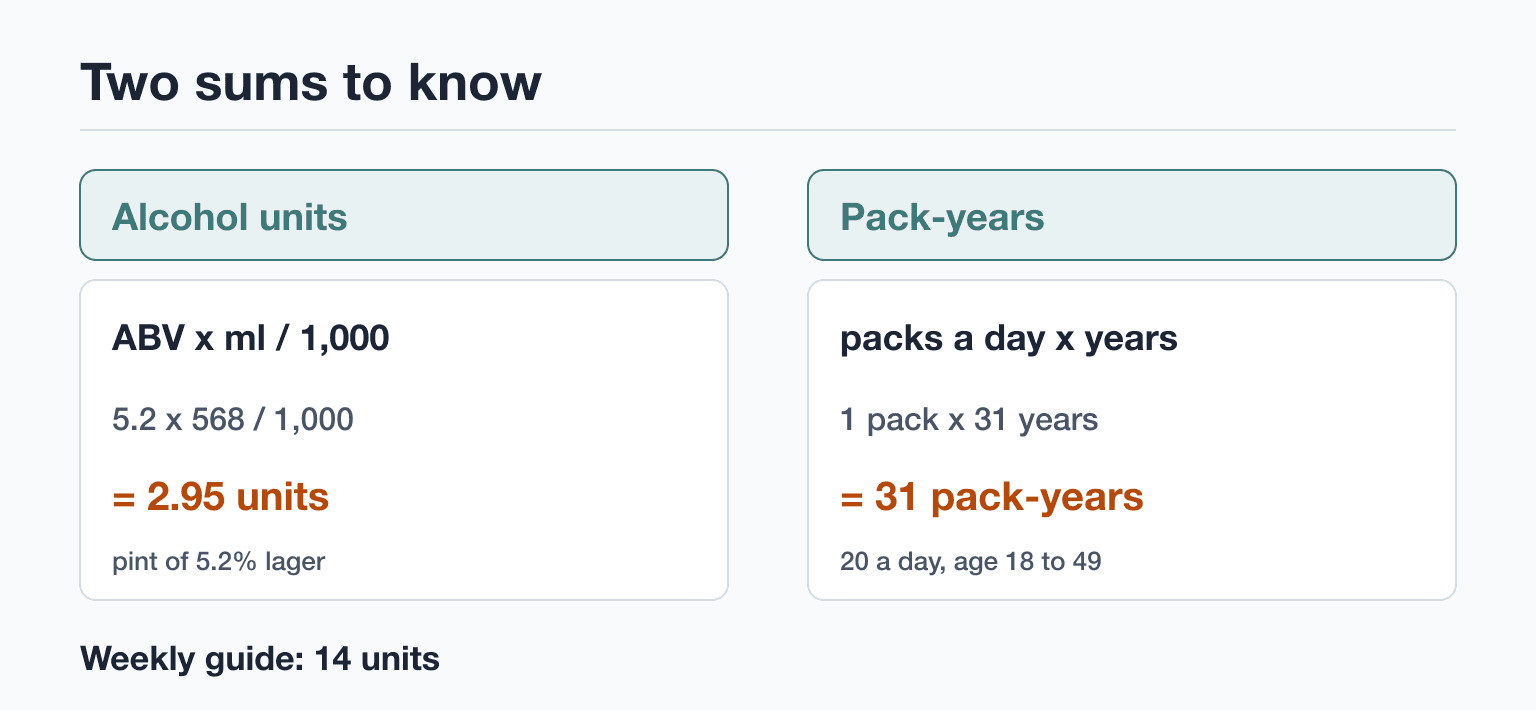
ABV × millilitres ÷ 1,000 gives units. Packs per day × years gives pack-years. Do it the same way every time.
Use this consistent five-step method to calculate and record units and pack-years:
- Ask the drink, the glass or bottle size and its strength (ABV).
- Multiply ABV by millilitres and divide by 1,000, per the NHS units guide; a 568ml pint at 5.2% is 2.95 units.
- Add up a typical week and compare with 14 units.
- Turn cigarettes into packs, counting 20 as one pack, as pack-year calculators do.
- Multiply packs a day by years smoked, the NCI pack-year definition.
The 14-unit figure comes from the UK chief medical officers' low-risk guideline by the 4 UK chief medical officers, published in 2016, for men and women, spread over 3 or more days. Fourteen units is about 6 pints of average-strength beer.
Watch out. “A fair bit” is not an amount. Ask what they drink, how big, how strong and how many days a week, then do the sum.
Worked case: Isaac, 49, who has gone yellow
From our library, Isaac Ashby, 49 (simulated patient) says, “I've gone yellow over the last few weeks and I'm sore under my ribs.” You'll get key social history only if you ask specific questions.
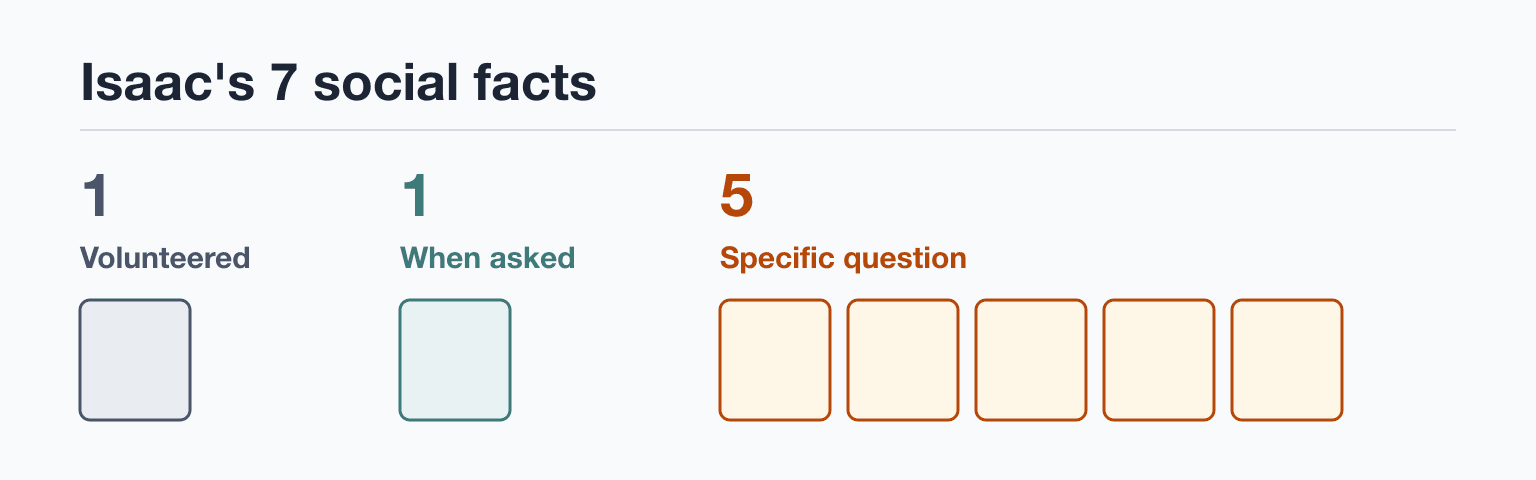
Our count of the case file
His case file holds 19 history facts; 7 are social history, and 5 of those come out only on a specific question.
Isaac, 49 (simulated): what he offered, and what we had to ask
Chip | Question | Isaac's answer | Why it mattered |
|---|---|---|---|
Volunteered | (he raises it himself) | Dry for ten days; he says that proves it can't be the drink. | Steers you away from alcohol early |
Asked | Do you smoke? | Twenty a day, since he was about eighteen. | About 31 pack-years, by our count |
Asked | Who's at home? | Lives alone since splitting from his partner. His brother checks on him. | Who would notice decline |
Only if asked specifically | How much do you drink? | Half a bottle of vodka and two litres of strong cider a day, for twenty years. | Ten dry days versus twenty heavy years |
Only if asked specifically | Do you ever drink first thing? | He drinks first thing to stop the shakes, and feels guilty about it. | Matches NHS signs: drink on waking |
Only if asked specifically | What happens when you stop? | Sweats, shakes, seeing insects; a fit three years ago after stopping suddenly. | Past withdrawal fit needs senior review |
His own theory is a gallstone, because an urgent care doctor said so and he's been dry for ten days. He fears people will decide he did it to himself, see his own theory and fear.
Simulated patient. Case file from our library. Questions written by us as a model, not a learner session.
How Diagnosica helps with this
Question a video AI patient by voice or typing, then get a scorecard.
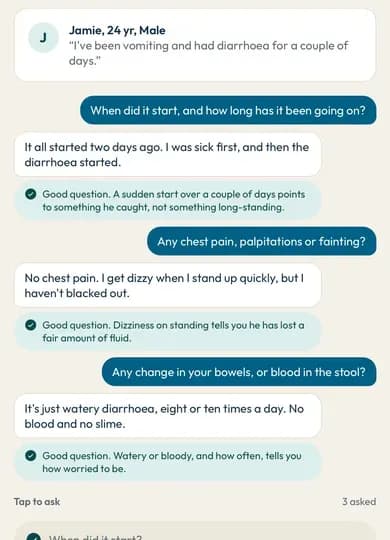
Diagnosica app, guided case history screen, a different case, as of November 2026.
- Ask by voice or typing in a full case.
- Isaac withholds drinking until you ask directly.
- It's history practice, not examination practice.
Simulated patient. Screenshot from Diagnosica, November 2026.
What his answers change
The working diagnosis changes fast once you hear the drinking history. Without the drinking history you'd chase his gallstone label. With it, the case file's answer is alcohol-related liver disease, specifically alcoholic hepatitis. Your questions also surface risks your senior cares about.
The NHS page on alcohol-related liver disease lists yellow skin and a swollen tummy as disease worsens. It names Stage 2 as alcohol-related hepatitis, and says a doctor will ask about your drinking to diagnose it. For structure, see a jaundice history station.
In the case file, ten dry days are part of the story, not against it. That pattern fits alcoholic hepatitis after stopping.
A past fit after stopping goes straight to your senior. The NHS page on alcohol use says withdrawal is a sign your body is dependent. It can be very dangerous to stop drinking suddenly if dependent.
Common mistakes in a social history
Common mistakes in a social history include accepting vague answers, focusing only on today, and signalling judgement. Each one hides risk, damages rapport, and misses basic safety-net details like who is at home.
Four pitfalls you can catch and fix tomorrow:
- Accepting “a fair bit”: He says, 'Fair bit, yeah,' which is not numerical.
- Asking only about now: Ten dry days hid twenty years of heavy daily drinking.
- Judging out loud: Judgement shuts him down and blocks trust and disclosure.
- Skipping who's at home: He lives alone, so ask who would notice deterioration.
Practise it out loud
This gets less awkward when you practise the exact words out loud in a calm way. Repetition makes the questions sound routine rather than accusatory during real ward conversations.
The same plain, unembarrassed tone matters in the psychiatric history, and talking to patients without judging frames it wider for everyday ward conversations.
On Diagnosica, the AI patient appears as a video avatar, and you speak or type. You get over 130 cases across 18 specialties, a scorecard after every case, and a free tier, no card needed. It's history practice with no physical examination practice. Practise another full history.