Psychiatric history taking: the structure, with one case

Psychiatric history taking usually runs through ten sections, from presenting complaint to social history. Every psychiatric history also needs a risk assessment: risk to self, to others and from others.
If you or someone you're with is at immediate risk, call 999 or go to the emergency department. For urgent help, call NHS 111 and choose the mental health option (NHS urgent mental health help) or call Samaritans free on 116 123, any time. In the US, call or text 988 Lifeline. This post is exam and ward practice.
Key takeaways
- Ask about risk in every psychiatric history, whatever the mood looks like.
- In our worked case, 11 of 20 facts appear only on a specific question.
- Ask whether they've felt like this before, to find a past episode.
Do this first: privacy, consent and confidentiality
Psychiatric history taking starts with privacy you can guarantee and ground rules. Find a private room, introduce yourself with name and role, explain confidentiality and its limit, then start with open questions.
Seek a setting where the person can "speak in confidence without being overheard", which NICE's self-harm guideline asks for. Introduce your name and role, warn some questions may be difficult, and explain confidentiality and its limit, per the Geeky Medics psychiatric guide. Start open; use closed questions later for symptoms and risk.
To rehearse your opening, take a history from an AI patient, who appears as a video avatar; you speak or type.
The sections of a psychiatric history, in order
Psychiatric history taking uses Mind The Bleep's ten sections from presenting complaint to social history. The risk assessment sits inside the history of presenting complaint.
It follows the general history framework and adds forensic history and premorbid personality.
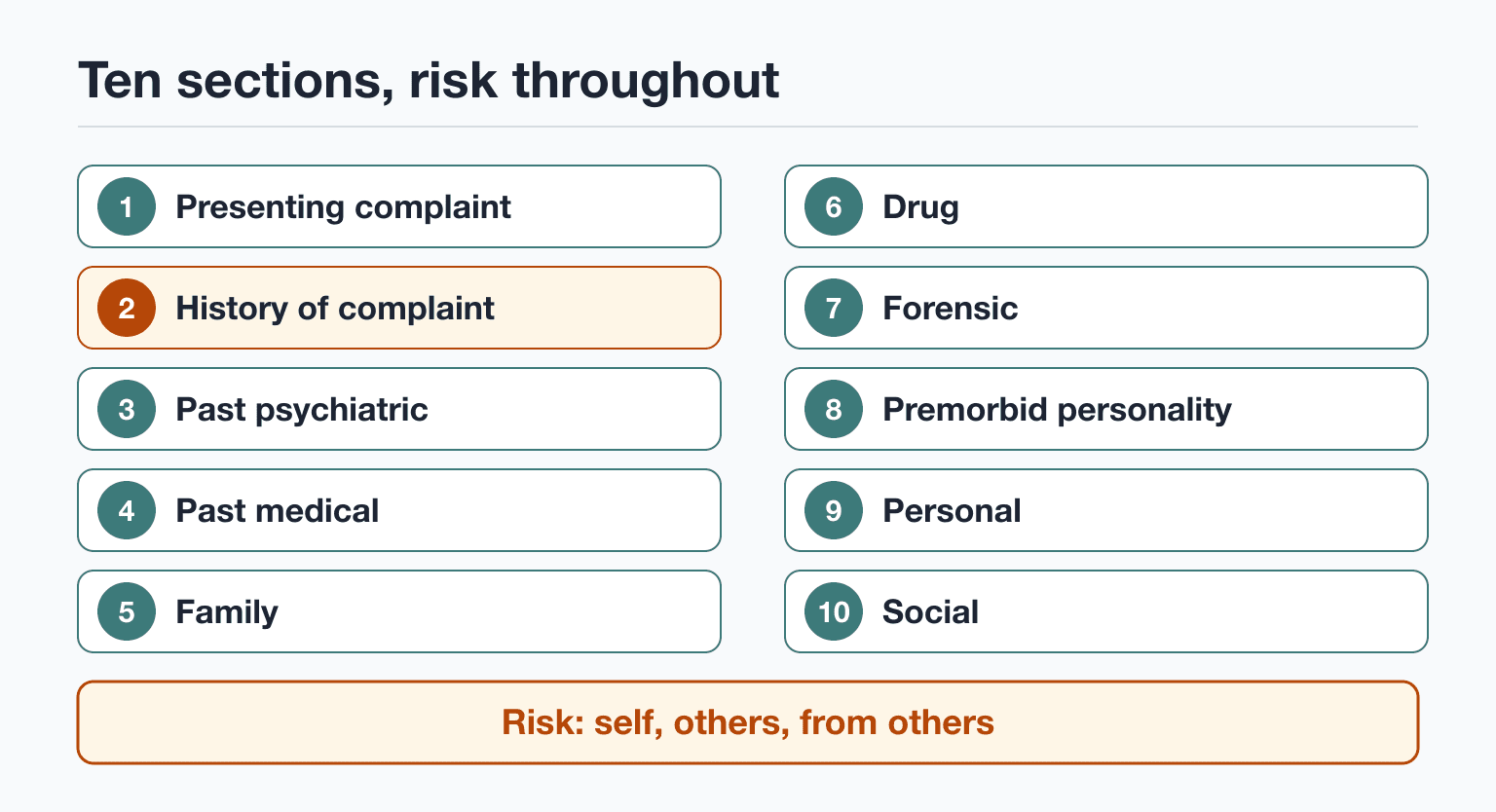
Ten sections for psychiatric history, with risk inside history of presenting complaint. Order from Mind The Bleep
For tomorrow, one prompt per section to keep you moving:
Sections | One question to try |
|---|---|
Presenting complaint and its history | Open question first, then detail symptoms and ask risk within the history of presenting complaint. |
Past psychiatric history (and past medical history) | "Have you ever experienced symptoms like this before?" |
Family history and drug history | Mental illness in family, particularly history of admissions or suicides. |
Forensic history and premorbid personality | "How would your family or friends describe you when you were well?" |
Personal and social history | Childhood, education, work, relationships, housing; see taking a social history |
How do you ask about risk in a psychiatric history?
A psychiatric history should always include a brief, direct risk screen. Ask about risk to self, risk to others, and risk from others in every history. Normalise before asking about suicidal thoughts. NICE asks clinicians to use consultations to ask about thoughts of self-harm or suicide and about actual self-harm, per NICE's guidance on self-harm.
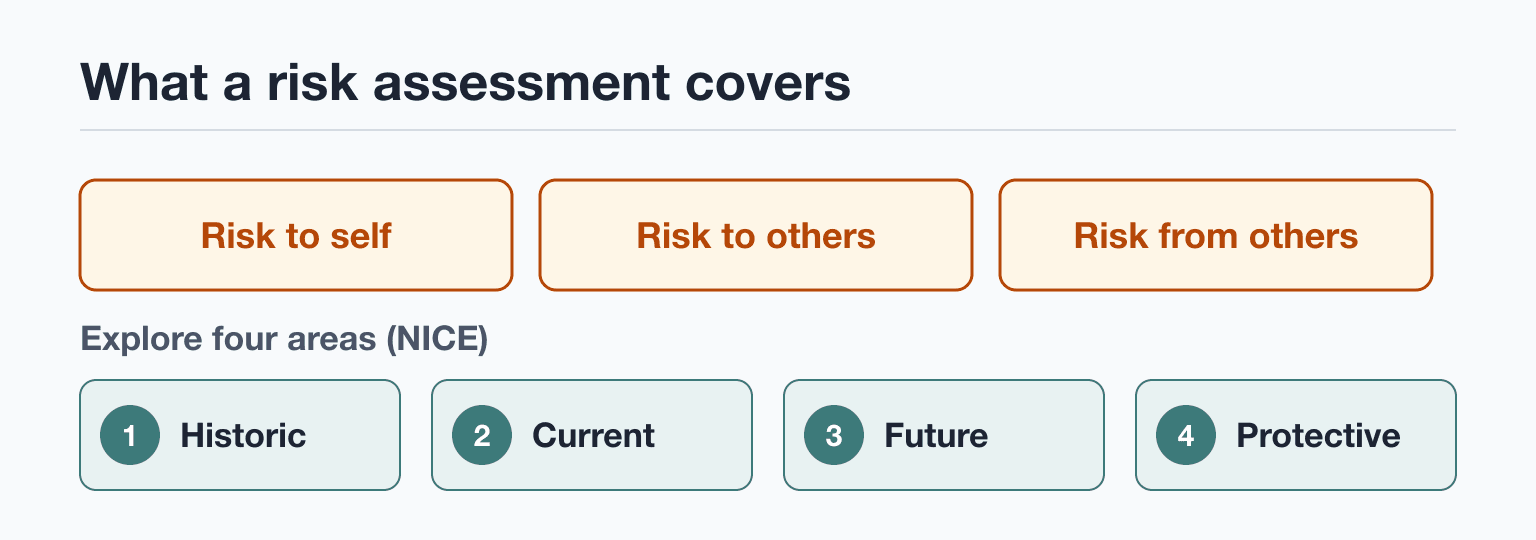
Three directions of risk plus four areas to explore. From Geeky Medics and NICE NG225
Across risk to self, risk to others and risk from others, cover four NICE areas during screening:
- Historic factors
- Changeable and current factors
- Future factors, such as upcoming events
- Protective or mitigating factors
Watch out. NICE says don't use risk tools, scales or global low, medium or high labels to predict suicide. Specialists write a risk formulation instead; as a student, state the facts clearly and tell your senior what you heard.
For phrasing, see interviewing a depressed patient. For next steps with a worrying answer, see telling a senior promptly.
Worked case: Kieran, 28, and the low spell he left out
Kieran Garrick, 28, is a simulated AI patient in our library; his family brought him in because he has barely slept for ten days. He opens with "it's my brother who's got the problem".
Kieran, 28 (simulated): what he said, and what we had to ask
Chip | Question | Answer | Why it mattered |
|---|---|---|---|
Volunteered | How have you been sleeping? | Two or three hours a night for about ten days, and he isn't tired. | Geeky Medics asks about sleep when screening for mania. |
Volunteered | What's been on your mind? | His thoughts are racing and he talks fast. | Racing thoughts are worth following up with a direct question. |
Volunteered | Any big decisions lately? | A car deposit he can't afford and his savings moved into a business idea. | Geeky Medics lists reckless spending among things to ask about in mania. |
Asked | How do you feel when people question your plans? | Irritable within seconds, voice raised. | Geeky Medics asks about irritability when screening for mania. |
Only if asked specifically | Have you ever felt very low, for weeks? | Two years ago, about two months barely out of bed; he calls it a rough patch. | A past low spell changes the diagnosis you're weighing. |
In this case file, 11 of 20 history facts surfaced only after a specific question.
Simulated patient. Case file from our library. Questions written by us as a model, not a learner session.
What Kieran's answers point to
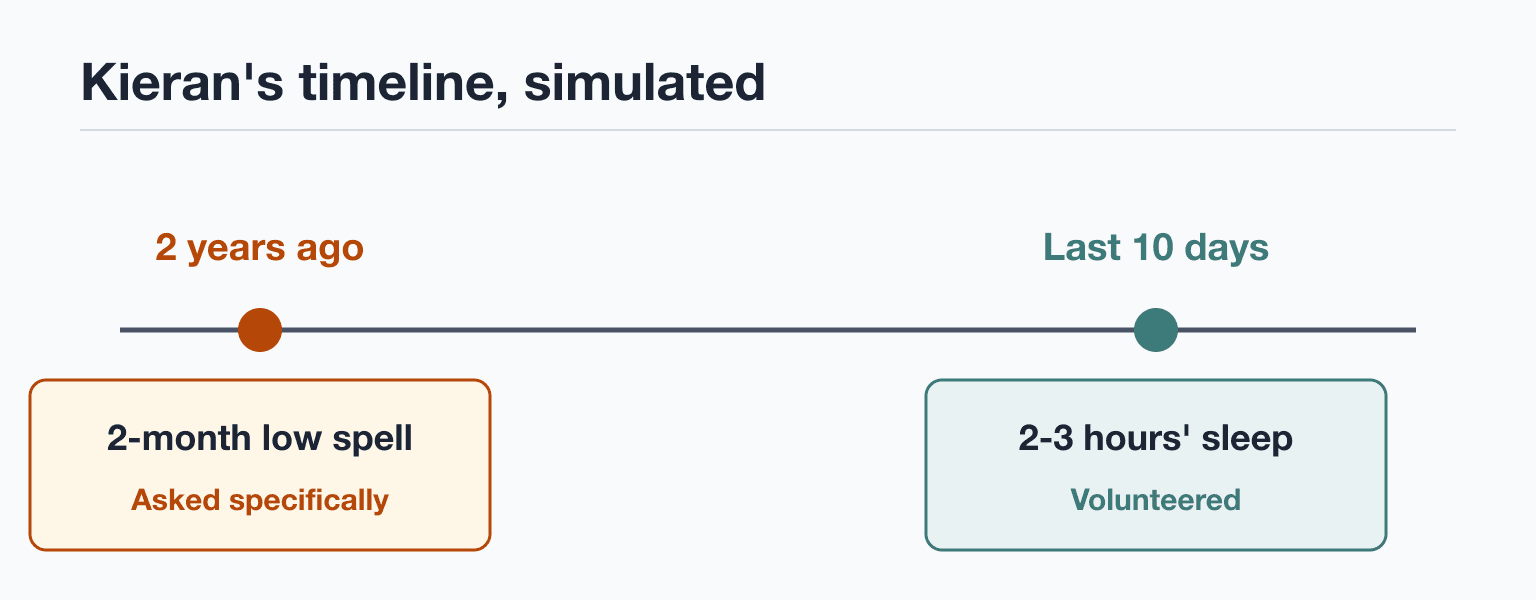
Specific prompts revealed the past episode and shifted thinking, from one simulated case file
Past mood episodes can shift diagnosis, as the Geeky Medics guide notes. In this case file the diagnosis is bipolar I disorder, with hypomania a distractor. A broad past question missed it, while specific closed questions revealed it.
His mother remembers the low spell clearly. Geeky Medics also says a collateral history is extremely useful in mania or hypomania. Ask for a family member's account.
How Diagnosica helps with this
Speak or type to an AI video patient, then view a scorecard.
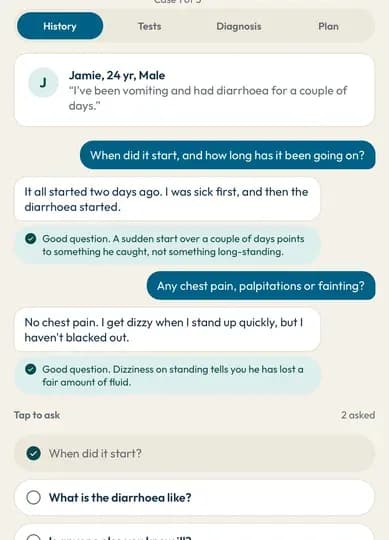
Diagnosica app, guided case history screen, a different adult case, as of November 2026.
- Ask your questions in full cases, speaking or typing.
- Patient withholds facts until you ask.
- History only, no mental state exam here.
Simulated patient. Screenshot from Diagnosica, November 2026.
Common mistakes in a psychiatric history
Common mistakes are mostly about structure and pace. Ask about risk every time, keep history and the mental state examination separate, and slow hypomanic or manic interviews. When details are guarded, a targeted prompt often works better than a broad one.
These come from the Geeky Medics psychiatric history guide and a Diagnosica AI patient case, Kieran:
- Skipping risk: Ask about risk to self, from others, and to others, every time.
- Stopping at the story: In Kieran's case, most facts needed a specific question.
- Mixing with mental state examination: Some history areas also feature in the mental state examination.
- Forcing full history: In mania, return later to complete parts of the history.
Practise it before your psychiatry block
It's a talking skill, so say your opening and risk questions out loud and listen back; build fluency before lists. You'll hear real phrasing on your psychiatry placement, so match that cadence and get comfortable asking direct, closed questions when needed.
The AI patient appears as a video avatar and you speak or type. The library has 136 cases across 18 specialties, psychiatry included; it's history only, so the mental state examination stays on the wards. Finish with practise another history, free to start, no card needed.