What are clinical rotations?

Clinical rotations, also called clerkships, are required blocks of hands-on patient care in different specialties, usually in the third year of US medical school. Core rotations run 6 to 12 weeks each, per the AAFP, checked 18 November 2026.
Key takeaways
- Core rotations: 6 to 12 weeks each, per the AAFP, checked 18 November 2026.
- Many schools require an NBME shelf exam; confirm if it counts toward your rotation grade.
- Outside the US: UK clinical placements, Canada clerkship, Australia clinical placements.
Before rounds feel real, clerk one practice patient tonight, an AI patient that answers by voice or text.
What are clinical rotations?
Clinical rotations, also called clerkships, are the required third-year phase at US medical schools when classroom learning shifts to clinical experience. A core rotation focuses on one specialty at a time for 6 to 12 weeks. At many schools, it ends with a shelf exam, as of 18 November 2026.
See the AAFP's guide to rotations and electives for the third-year requirement and electives 2 to 4 weeks, as of 18 November 2026.
Years one and two are classroom heavy. Then clerkships apply that knowledge with patients.
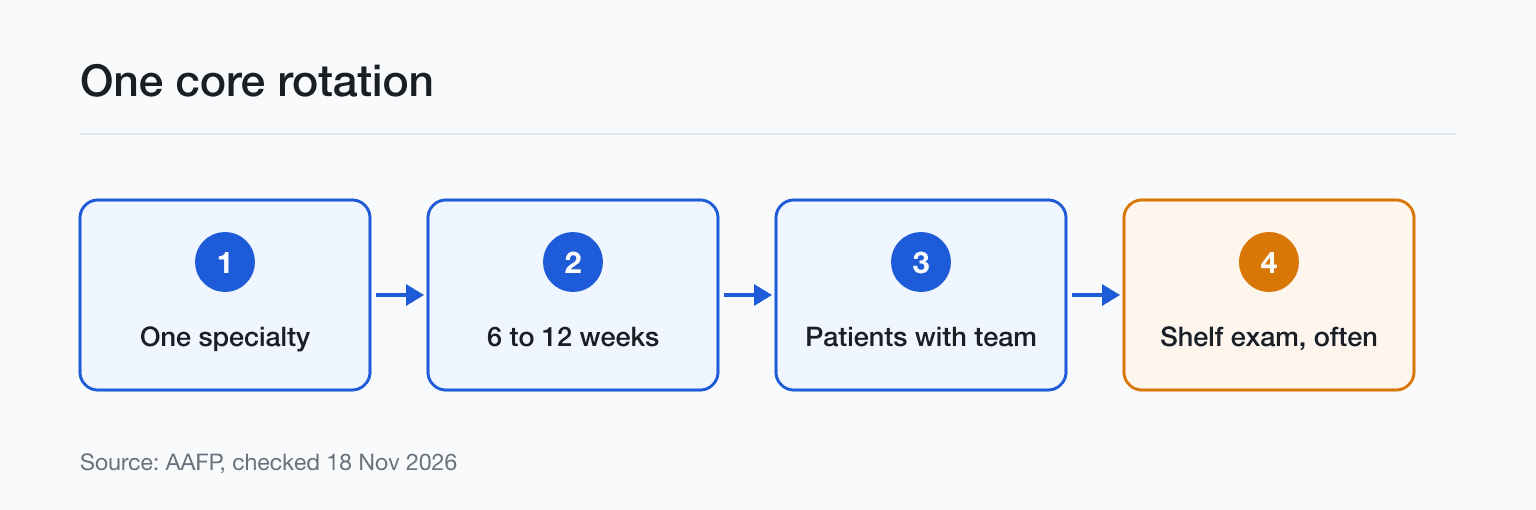
Core rotation flow: one specialty, 6 to 12 weeks, patients with the team, shelf exam often. Source: AAFP, checked 18 November 2026.
Core rotations last 6 to 12 weeks in one specialty, and many end with a shelf exam, checked 18 November 2026.
The core rotations at a glance
The AAFP lists the required clerkships at most US medical schools, checked 18 November 2026: internal medicine, obstetrics and gynecology, general surgery, pediatrics, psychiatry, and family medicine and/or neurology. It also notes that not every school requires family medicine.
Here's the quick view to keep handy while you plan your clinical year:
Rotation | NBME subject exam listed | Read more |
|---|---|---|
Internal medicine | Medicine | Your school's clerkship page |
Obstetrics and gynecology | Obstetrics and Gynecology | Your school's clerkship page |
General surgery | Surgery | |
Pediatrics | Pediatrics | |
Psychiatry | Psychiatry | |
Family medicine and/or neurology | Family Medicine Modular; Clinical Neurology | Your school's clerkship page |
Per the NBME's Clinical Science Subject Exams, the NBME lists a subject exam for each of these areas (checked 18 November 2026).
How clinical rotations work, step by step
Clinical rotations move you through blocks across specialties. You join a team to care for patients and learn workflows. Many schools end each core block with an NBME shelf exam, and it can count toward your grade.
In practice, a single block runs like this:
- Start in one specialty and meet the team you’ll work with.
- See patients with the team, hands-on patient care per the AAFP guide (checked 18 November 2026).
- Study the specialty alongside clinical work, targeted to the cases you’re seeing.
- Sit the NBME subject exam at the end, if your school requires one (checked 18 November 2026).
- Move to the next specialty and repeat the cycle.
For grade mechanics and day-to-day tactics, see how clerkship grades work and surviving MS3 day to day.
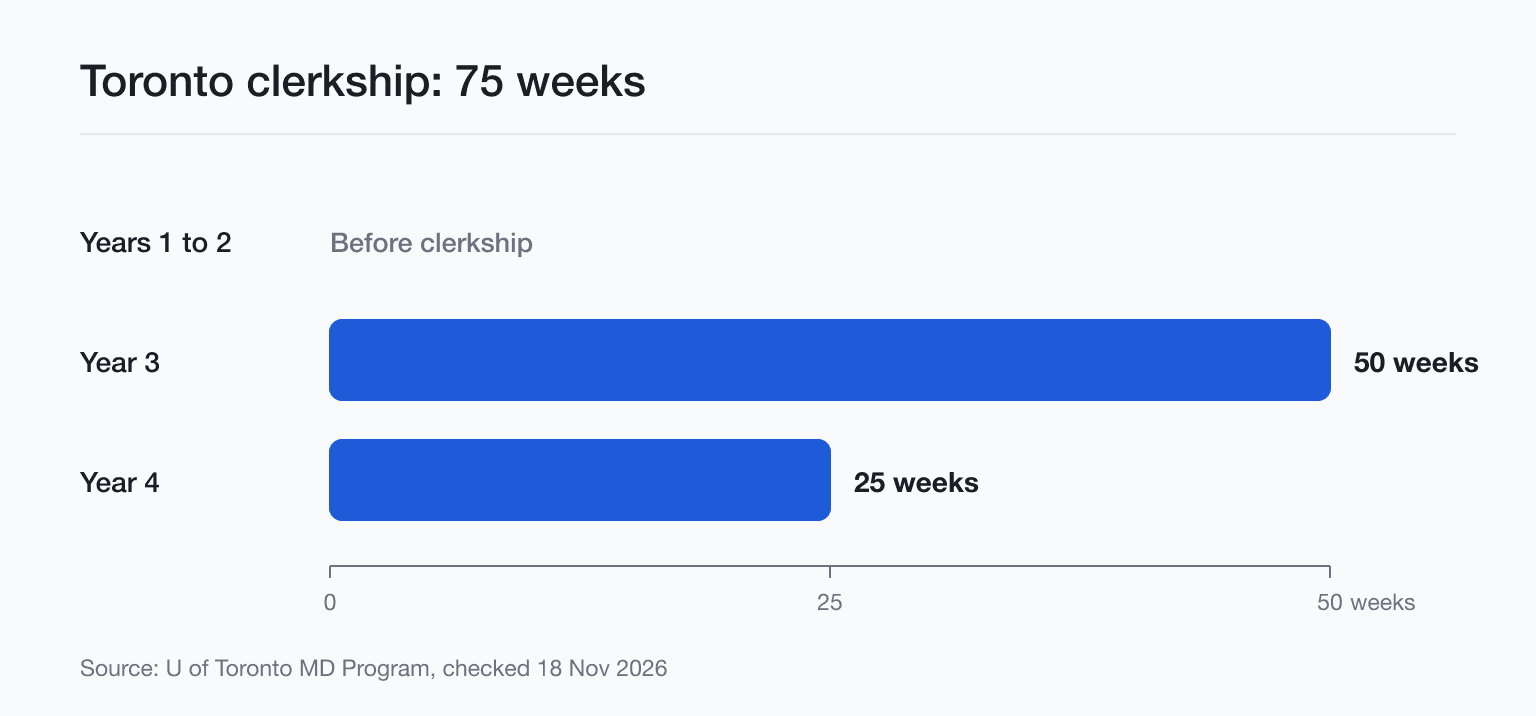
Structure of Toronto’s MD Program clerkship timeline. Source: University of Toronto MD Program, checked 18 November 2026.
At the University of Toronto, clerkship spans the final two years: 75 weeks, 50 in third year and 25 in fourth (checked 18 November 2026).
How Diagnosica helps with this
Practice before rotations: take AI patient history by voice or text, then commit a diagnosis
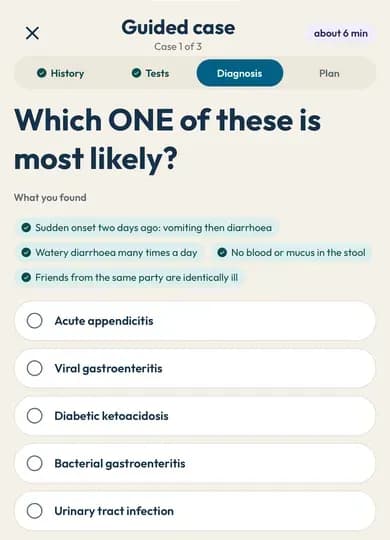
Diagnosica app, guided case diagnosis screen, as of November 2026.
- What you found in the history appears on screen first
- Then you pick the single most likely diagnosis
- History and diagnostic reasoning only, no physical examination practice
Simulated patient. Screenshot from Diagnosica, November 2026.
What are clinical rotations called in the UK, Canada and Australia?
Clinical rotations go by different names: the UK uses clinical placements, Canadian schools call it clerkship and the students clerks, and Australian schools also say clinical placements. The core idea is the same, supervised patient care with a team, but the calendar and structure vary by country and by school.
Names and one timing example by country, with sources:
Country | What it is called | When (one example) | Source |
|---|---|---|---|
United States | Core rotations or clerkships | Third year | AAFP |
United Kingdom | Clinical placements | Planned blocks across the degree | |
Canada | Clerkship (students are clerks) | Last two years at Toronto and Manitoba | |
Australia | Clinical placements | Years five and six at UNSW, after hospital placements in year three |
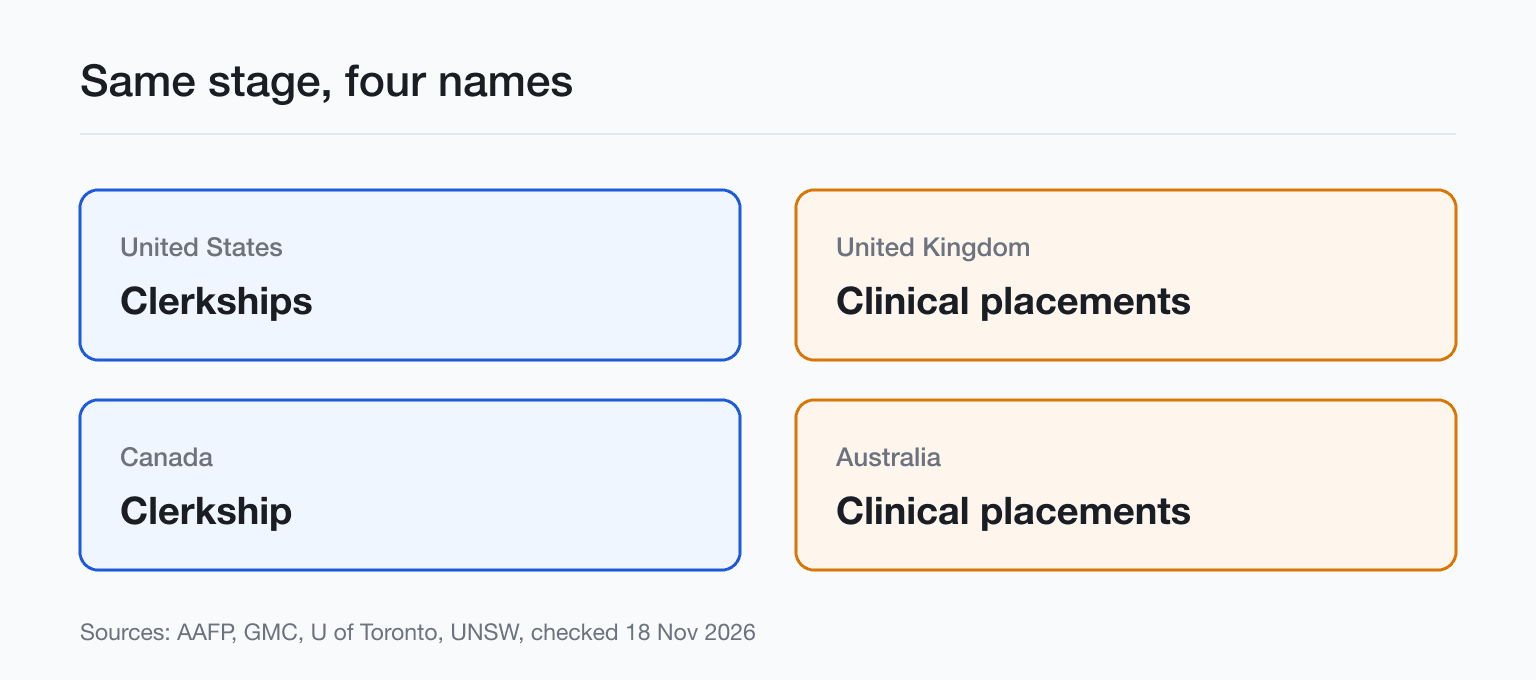
Terminology for clinical training years by country or regulator. Sources: AAFP, GMC, University of Toronto, UNSW, checked 18 November 2026.
US: core rotations or clerkships; UK: clinical placements; Canada: clerkship and students are clerks; Australia: clinical placements.
Example. In Toronto, a third-year student is a clinical clerk with 50 weeks of clerkship, as of 18 November 2026. At UNSW in Sydney, third year means clinical placements three days a week in hospitals, as of 18 November 2026. In the US, third year is the core rotation year. Checked 18 November 2026. Note schools differ.
Manitoba's program description calls the first two years Pre-Clerkship.
Mistakes and myths beginners make
Beginners get tripped by four beliefs: every school has the same list, every rotation lasts the same, only wards count, and UK means hospitals only. A quick source check usually resolves each, since schools and regulators publish their structures.
Quick corrections, with the source named in-line:
Myth | What the source says |
|---|---|
Same list myth | Not every school requires family medicine, per the AAFP. |
Same length myth | Core rotations 6 to 12 weeks, electives 2 to 4, per AAFP (checked 18 November 2026). |
Only wards count | Many schools add a shelf exam that may feed the grade (AAFP). |
UK means hospitals only | The GMC lists primary, community and other care settings too. |
Watch out. Check your own school's clerkship handbook before trusting any general list, including this one; names, lengths, sites and exams vary by school and country, and policies change without warning.
Where to go next
Start with preparation, then focus on navigating the clerkship year, and finally plan for OSCEs, using your next steps as a simple path from prep to assessment.
If you're pre-clinical, start with getting ready before day one. It frames mindset and admin so day one feels intentional. For assessments, skim a list of OSCE stations to see what examiners actually ask. Use it to map rotations to skills.
If you're curious what comes after clerkships in the UK or training there, read the first doctor year. It lays out transitions, teams, and how learning continues post-graduation.
Before the ward, run a case before your first rotation. The AI patient answers by voice or text, and it’s history and reasoning practice, not physical examination.